


6 Best Markets for Day Trading in 2026 Compared


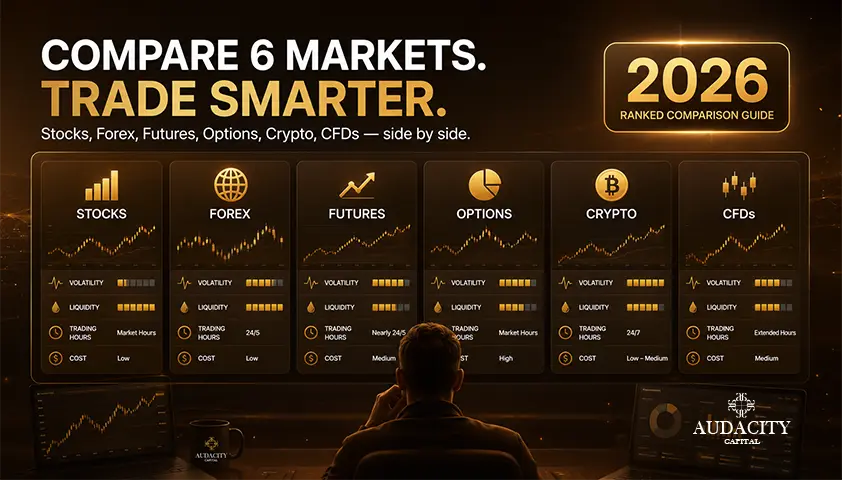
Most traders searching for the best markets for day trading want a single answer.
There is not one.
Forex, index futures, stocks, indices, commodities, and crypto are all viable, and none has a sustained advantage over the others.
The real question is which market fits your capital, the hours you can actually trade, and your temperament.
This guide gives you a four-part framework to decide, walks through each market honestly, and corrects a capital rule that changed in 2026 that most guides still get wrong.
What Makes a Market Good for Day Trading?
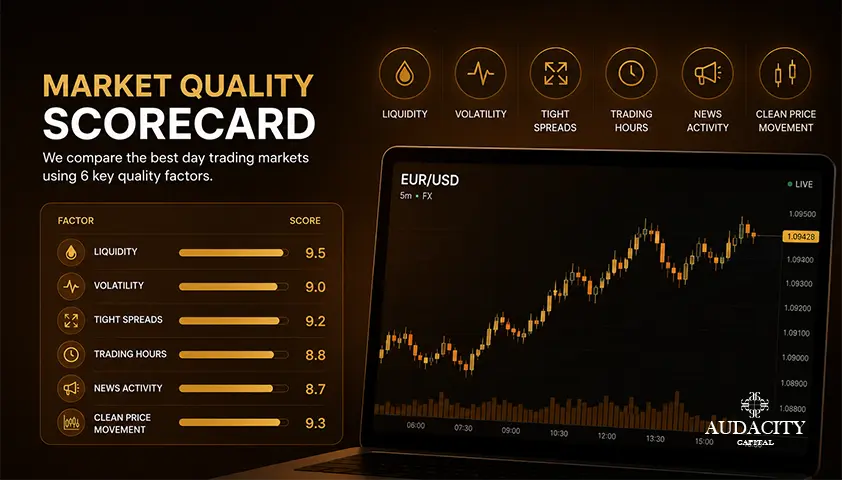
Before comparing markets, you need a way to judge them. Four criteria decide whether a market suits intraday trading, plus two practical filters.
1. Liquidity:
Liquidity is the ability to get in and out of a position at a predictable price. You judge it through bid-ask spreads (the gap between buying and selling prices), traded volume, and depth of book or level 2 data.
High liquidity lowers your transaction costs and reduces slippage, which is the difference between the price you expect and the price you actually get.
This is why traders gravitate toward major currency pairs, large-cap equities, popular index futures, and high-volume ETFs.
2. Volatility:
Volatility is how much a market moves. You need movement to profit intraday, so a market that barely budges gives you nothing to work with.
The tradeoff is that more volatility also means more risk per position, not more guaranteed profit.
3. Cost:
Cost decides whether a small intraday edge survives. Spreads and commissions eat into every trade, and day trading multiplies that cost through sheer frequency. A strategy that looks profitable on paper can lose money once real costs are applied.
4. Hours and session overlap:
They matter because liquidity is not constant through the day. Every market has peak hours when volume is heaviest and spreads are tightest. Trading thin premarket or late-session windows means wider spreads and worse fills, unless you knowingly accept that cost.
Two more filters apply.
Capital is the amount a market realistically requires to trade with sensible position sizing.
Regulation and product structure vary by market and region, and shape what you can trade and how.
The Best Markets for Day Trading - Compared
Here are the main day trading markets, each covered the same way: what it is, what it is good at, what it demands, who it suits, and who it does not. All specifications below are illustrative and vary by broker, product, and region, so verify before trading.
Market | Liquidity | Typical volatility | Capital needed | Main hours | Leverage | Best for |
Forex | Very high (majors) | Lower | Lowest | 24h, weekdays | High | Part-time, small accounts, macro thinkers |
Index futures | Very high | Moderate to high | Middle | US session | Moderate | Price action, order flow |
Stocks | High (large caps) | Varies widely | Highest for size | US session | Lower | Research, company catalysts |
Index CFDs | High | Moderate | Middle | Session-dependent | Moderate | Time-zone-aligned index exposure |
Commodities | Moderate to high | High | Middle | Product-specific | Moderate | Trend and news traders |
Crypto | Varies (thin outside majors) | Very high | Flexible | 24/7 | Varies | Experienced, strict risk rules |
1. Forex, the most accessible market
Forex is the largest financial market in the world, trading 24 hours a day, five days a week. The major pairs carry the tightest spreads available and the lowest capital barrier of any market. Some sources describe starting with as little as around $100 as feasible.
What it is good at: accessibility, flexible hours that suit any time zone, and low entry cost.
What it demands: an honest understanding of leverage, which is the ability to control a large position with a small deposit.
Forex leverage is high precisely because currency majors tend to move less than futures or stocks. The leverage compensates for smaller price movement, and in doing so it magnifies risk just as much as opportunity.
Suits: part-time traders, small accounts, and anyone drawn to macro trends, interest rates, and central-bank policy.
Not for: traders who want large intraday ranges without leaning on leverage.
2. Index futures, the cleanest intraday market
Index futures, notably the E-mini S&P 500 (ES) and the Nasdaq contracts (NQ), are deeply liquid, well regulated, and easy to trade in either direction. They require a smaller account than an equivalent stock position of the same exposure.
Many traders call futures the cleanest market because trading the E-mini S&P means trading the aggregate sentiment of the entire US stock market, rather than the company-specific risk of a single stock.
What it is good at: clean charts, consistent intraday movement, and order-flow analysis.
What it demands: understanding contract specifications and margin, and being available during US market hours.
Suits: price action, market structure, and order-flow traders.
Not for: traders who cannot trade US hours or who want very small position sizes.
3. Stocks, the most familiar with the widest choice
Stock day trading is the most intuitive starting point for many people. The universe of instruments is enormous, but that variety is also the work. You have to scan and select the movers each day rather than trading one instrument you know well.
What it is good at: familiarity, variety, and company-specific catalysts like earnings and news.
What it demands: daily scanning and selection, higher capital for meaningful position size, and close attention to costs.
Note that the capital picture for US stocks changed materially in 2026, covered in its own section below, so any older guidance quoting a $25,000 minimum is out of date.
Suits: traders who enjoy research and following company news.
Not for: traders who want a single instrument to master.
4. Indices via CFDs, session-driven index exposure
Trading index CFDs, such as the DAX, FTSE 100, US indices, HK50, and AUS200, lets you take index exposure without the mechanics of futures contracts. The genuinely useful point here is session behavior.
European indices like the DAX are most active in the London session, US indices lead in the New York session (where the Nasdaq, Dow, and S&P dominate), and HK50 and AUS200 are most active in the Asian session.
Note: Global indices have become increasingly correlated, and smaller indices often take their cue from the US market. Because of this market correlation, trading several indices at once is frequently less diversification than it appears.
Suits: traders who want index exposure aligned to their own time zone.
Demands: awareness of CFD costs, overnight financing charges, and regional session behavior.
5. Commodities and crypto, higher volatility and higher demands
Commodities, notably gold and oil, offer strong trends and clear news sensitivity. The tradeoffs are wider spreads and contract-specific quirks that take time to learn.
Crypto trades around the clock with high volatility, which is genuinely attractive for intraday movement. Be honest about the tradeoffs.
Liquidity thins quickly outside the largest coins, spreads widen fast, and risk sits higher than in mature markets. Crypto suits experienced traders with strict risk rules, not beginners chasing movement.
Suits: traders who want volatility and can manage it.
Not for: undercapitalized beginners.
Which Market Suits your Capital?
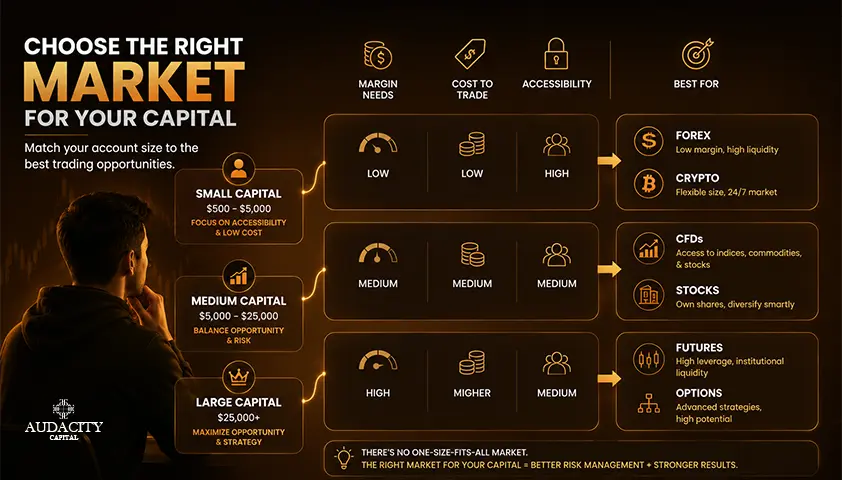
Capital is where a lot of advice goes wrong, so here is the honest, updated picture.
Forex has the lowest barrier. Leverage and micro lots make small accounts workable, and some sources describe starting from around $100 as feasible.
Futures sit in the middle. You need enough to cover the margin required per contract, plus headroom to absorb drawdown without being forced out.
Stocks remain the most capital-hungry when you want meaningful position size.
But be clear about one thing: the widely repeated claim that US stock day trading requires a $25,000 minimum is no longer true. That rule was eliminated in June 2026, covered fully in the next section. Any guide still printing it is out of date.
Now the warning that matters more than any number.
A low barrier to entry is not a low barrier to loss. Leverage is exactly what makes small-account trading possible in forex and futures, and leverage magnifies losses as fast as it magnifies gains. The market with the lowest minimum deposit is not the safest place to learn.
Size your positions from your risk rules, not from what your account minimum technically allows. The question is never how much can I put on. It is how much can I lose on this trade without breaking my plan.
Which Market Suits your Time Zone?
Time zone often decides your market more than anything else.
Here is the rough map:
- Forex runs 24 hours a day on weekdays, so any time zone can find a workable window. The London and New York overlap is the deepest and most liquid part of the day.
- US index futures and US stocks are tied to US market hours. For a reader in India, that means evening and night. For a UK reader, afternoon and evening.
- European indices like the DAX suit the London session.
- Asian indices like HK50 and AUS200 suit the Asian morning.
The rule that makes this section valuable is simple. Trade the market whose peak hours you can actually be awake and alert for.
Trading a market during its thin session just to fit your schedule is a hidden cost, paid in wider spreads, worse fills, and weaker moves. Trading sessions and market hours shift with daylight saving too, so confirm the exact windows for your region.
For example, a trader in India with an evening day job is often better served by forex, or by the US session if they can genuinely trade at night, rather than forcing an illiquid local window.
How to Choose your Market?

Now turn the framework into a decision.
Step one: Score the four criteria against your own constraints.
- How much capital do you have?
- Which hours can you genuinely trade?
- How much volatility can you tolerate without abandoning your plan?
- And, honestly, what do you actually find interesting?
Step two: Be honest about temperament, because it drives consistency.
Macro and central-bank thinking points toward forex. Pure price action and order flow points toward futures. Company news and research points toward stocks. This is not a small point. Trading a market that bores you is a recipe for distraction, and distracted traders make careless mistakes and lose money.
Step three: pick one market and learn it properly.
Each market has its own rhythm, cost structure, and behavior. Spreading yourself across several early on slows your progress in all of them. Master one first.
This is not a permanent decision. Many experienced traders eventually operate across several markets once they have a proven process. But that comes after competence, not instead of it.
The honest conclusion holds throughout.
Since no market has a sustained advantage in returns, and none is genuinely easier than the others, choosing the best market to day trade is about fit, not superiority. The right answer is the market that matches your capital, your hours, and your wiring, and that you can trade with discipline.
Related Article
Frequently Asked Questions
None is genuinely easier, but forex is usually the most accessible. It trades around the clock on weekdays and carries the lowest capital barrier of any market. Keep in mind that its higher leverage also makes it unforgiving, so accessibility does not mean safety.
It depends on the market. Forex can be started with a very small account because of leverage and micro lots, futures need enough to cover the margin per contract plus drawdown room, and stocks need the most for meaningful position size. The old US $25,000 stock minimum was removed in June 2026.
Yes, but the market has to match your available hours. Forex runs 24 hours on weekdays and suits most schedules, while US stocks and index futures require you to be available during US market hours, which may fall late in the evening or overnight depending on your region.
Neither is better overall. Forex offers round-the-clock access and a lower capital barrier, while futures offer deeper intraday movement and cleaner single-instrument charts. The right choice depends on your capital, your hours, and your trading style.
Crypto and some commodities typically move the most, followed by index futures, with forex majors generally moving least. Remember that more volatility means more risk per position, not more guaranteed profit.
Not at first. Each market has its own rhythm, costs, and behavior, so most traders develop faster by learning one market properly before expanding into others.
No. That requirement was eliminated effective June 4, 2026 and replaced with risk-based intraday margin rules. Brokers are phasing the change in through 2027, so check how your specific broker has implemented it before you trade.
Forex and locally-timed index products are usually the most practical, because you can trade them during your waking hours. US stocks and futures require trading during US sessions, which may not suit your time zone or schedule.

Pronto para aplicar risco disciplinado em cripto? Explore os novos instrumentos de cripto da Audacity Capital e traga sua estratégia de trading.
Saiba MaisNewsletter
Junte-se ao nosso boletim para ficar atualizado.
Junte-se à Nossa Comunidade Social

Comece Sua Jornada Hoje Com Nosso Teste Gratuito
Mostre com orgulho suas habilidades e conquistas através de certificados e obtenha reconhecimento pelo seu trabalho árduo e dedicação de potenciais investidores e colegas.
Teste GratuitoArtigos Relacionados
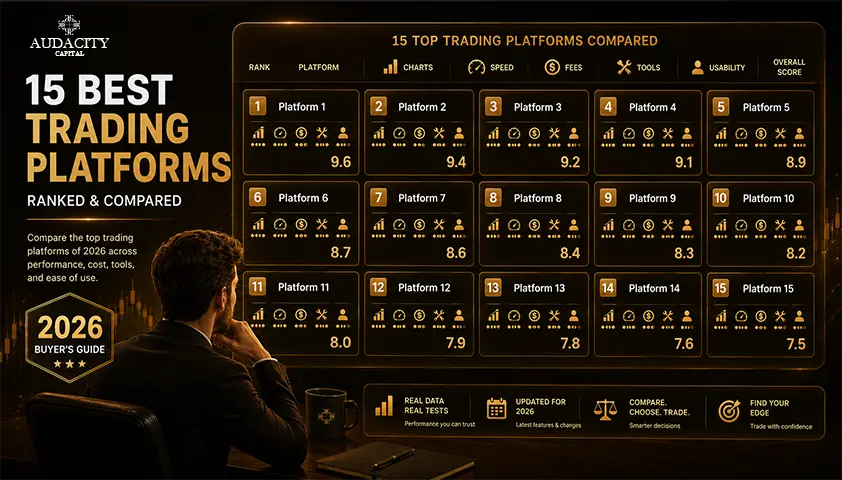
15 Best Day Trading Platforms in 2026
The best day trading platforms in 2026, grouped by what they actually do. Compare brokers, charting layers and funded accounts.


Day Trading Crypto vs Stocks: Which Is Better?
Compare crypto and stock day trading by hours, volatility, fees, liquidity, rules and risk to find which market fits your trading style.
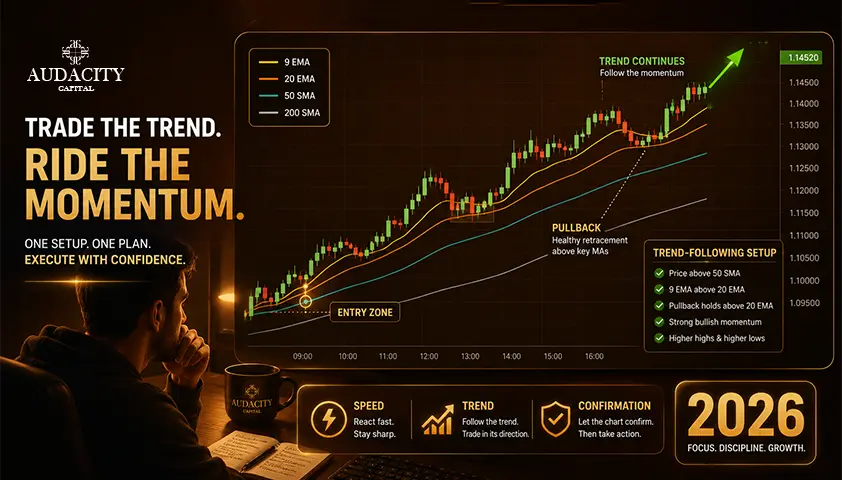
Best Moving Average for Day Trading in 2026
Compare the 9, 20, 50 and 200 moving averages for day trading, when each works best, and how to avoid lag, noise and false signals.
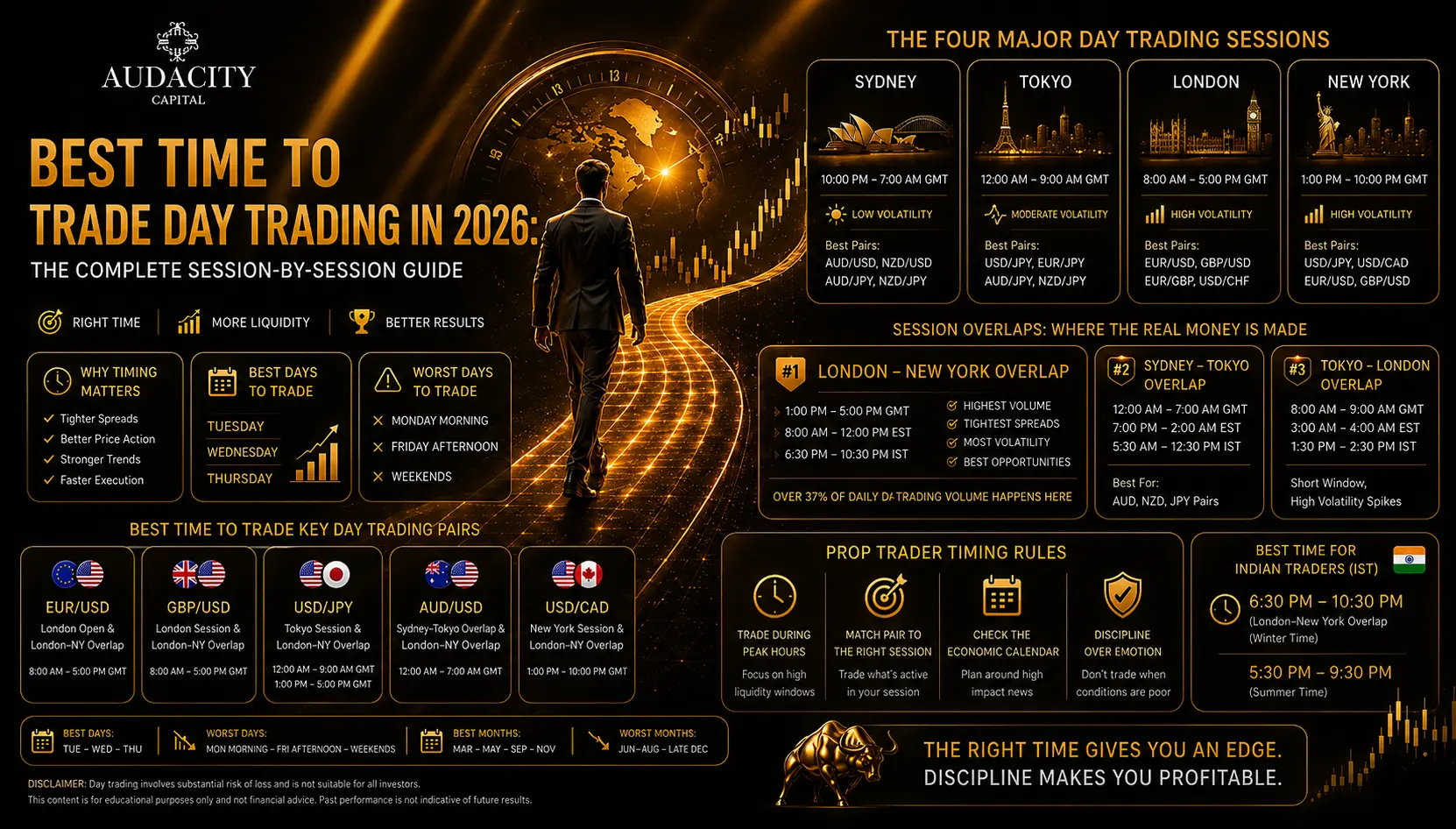
Best Time Frame for Day Trading (2026): 5-Minute vs 15-Minute vs 1-Hour Charts
Discover the best time frame for day tradingin 2026. Compare 5-minute, 15-minute, and 1-hour charts, learn multi-timeframe analysis, and find the right chart for your trading style.