


Cross Trading — What Is Cross Trading?



People rarely discuss ‘Cross Trading’, yet it shapes how large blocks of shares move without ever touching the open exchange. Some traders confuse it with a golden cross, a chart pattern built on moving averages instead of order matching. Before untangling what is the golden cross in trading, here is the real story behind cross trading and why prop firms rely on it.
Key Takeaways
- Cross trading matches a buy and sell order for the same security internally, so the trade never touches the public exchange.
- Two types of cross trading exist: agency cross, where a broker pairs two separate clients, and principal cross, where the firm trades against its own client.
- It is legal only with independent NBBO midpoint pricing, written disclosure, and client consent under SEC Rule 17a-7 and Section 206(3).
- Institutions use it to cut costs, capture price improvement, and move large blocks without moving the market.
- Inside prop trading, cross trading usually means illegal cross-account hedging, and firms track it through IP data, timestamps, and lot sizes.
- A golden cross shares the name but nothing else. It is a moving-average chart pattern, not an order-matching mechanism.
- Wash trading, internalization, and copy trading all get confused with cross trading, yet each follows its own separate set of rules.
What Is Cross Trading?
Cross trading happens when a broker or fund manager matches a buy order against a sell order for the same security internally, without ever sending either side to the open exchange. Large institutional desks use this method to move sizable blocks of shares between client accounts at the same price, executing everything within seconds and away from the public order book. Regulators such as the SEC and FINRA monitor this practice closely because it bypasses normal price discovery. Legitimate cross trades must execute at a fair market price, usually the midpoint of the prevailing bid and ask, to protect both parties involved.
Types of Cross Trading
Cross trading doesn’t look the same every time, and the difference usually comes down to whose money sits on both sides of the deal. Most trading desks and regulatory guides split cross trading into two core categories with separate rules around disclosure and fair pricing.
- Agency Cross: A single broker represents both the buyer and the seller in the same transaction, usually because two clients happen to want opposite sides of the same trade at once. The broker collects a commission from both parties, so regulators require clear disclosure to rule out any hint of favoritism toward one side.
- Principal Cross: The brokerage or trading firm steps in with its own capital to fill one side of the trade, becoming the counterparty to its client instead of simply matching two outside orders. This version draws heavier scrutiny because the firm now has a direct financial stake in exactly how the trade prices out.
What Is the Golden Cross in Trading?
A golden cross forms when a short-term moving average, usually the 50-day, crosses above a long-term moving average, typically the 200-day. Chart analysts treat this crossover as a bullish signal, often marking the start of a sustained uptrend. Unlike cross trading, a golden cross involves no order matching, only price momentum on a chart.
The confusion between cross and golden cross trading is sorted out here.
How Does Cross Trading Work?
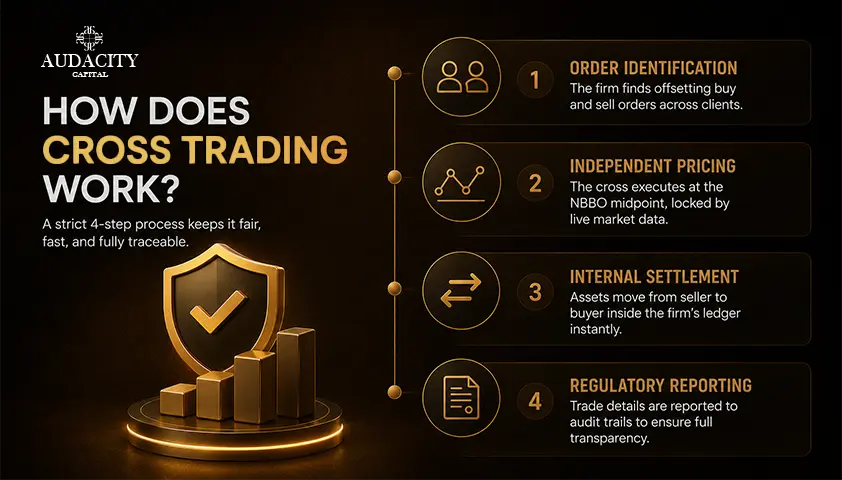
The definition behind what cross trading only tells half the story. The real mechanics unfold through a strict four-step sequence built to protect price integrity while keeping the transaction off the public order book.
- Order Identification and Aggregation: A broker-dealer or investment manager scans internal accounts for offsetting orders, for example, one client looking to sell a large equity position while another client wants to build the exact same position elsewhere in the portfolio lineup.
- Independent Reference Pricing: The internal matching engine blocks manual price entry entirely and instead pulls live data from the National Best Bid and Offer, the consolidated public quote feed, then locks the cross trade at the exact midpoint between the active bid and ask to keep the price objective.
- Internal Ledger Settlement: The firm's clearing infrastructure transfers asset ownership straight from the seller's ledger to the buyer's ledger after the midpoint price locks in. It completes the transaction instantly and without the order ever touching a public exchange matching engine or order queue.
- Post-Trade Regulatory Reporting: While execution skips the exchange floor, regulators still demand full transparency after the fact.
Therefore, the executing firm transmits execution time, lot size, and price to audit trails like FINRA's Trade Reporting and Compliance Engine or the Automated Confirmation Transaction Service. This keeps the trade accountable despite happening off-exchange.
While the public order book never sees a single share of cross-trading change hands, the four-step sequence above keeps it fast, priced fairly, and fully traceable.
Let’s Understand it with a Cross Trading Example
Suppose there's an asset management firm running two separate institutional funds:
- Fund A, a pension fund rebalancing its portfolio, needs to sell 50,000 shares of Microsoft (MSFT).
- Fund B, an endowment fund building its tech exposure, needs to buy the same 50,000 shares.
Now, if a trader sends both orders straight to the open market, it would force:
Fund A to sell into the public bid of $400.00 and Fund B to buy at the public ask of $400.20, a $0.20 spread that costs both funds a combined $10,000, plus exchange fees and slippage risk from algorithmic traders reacting to the block.
But the firm chooses to execute an internal agency cross. It checks the live NBBO, $400.00 bid against $400.20 ask, and matches all 50,000 shares at the exact midpoint of $400.10:
- Fund A picks up an extra $5,000 compared with selling at the bid.
- Fund B saves $5,000 compared with buying at the ask.
- Neither order ever touches the public tape.
Why Do Brokers and Traders Use Cross Trading? (The Benefits)
Many institutional desks depend on cross trading for real financial and operational payoffs.
- It reduces transaction costs as matching orders internally cuts out public exchange clearing fees, routing charges, and extra broker commissions on both sides of the trade.
- It removes Bid-Ask spread friction by pricing the cross at the NBBO midpoint, letting both the buying and selling account capture real price improvement.
- It minimizes the market impact by routing a large block through the open exchange tips off high-frequency algorithms. Plus, it invites adverse price moves, while internal matching absorbs that volume quietly.
- It enables rapid execution and settlement certainty through internal crossing engines that settle trades almost instantly. This avoids the delays associated with routing orders across multiple public venues.
These advantages combine to make cross trading a preferred tool for any desk managing size.
Disadvantages and Market Impacts of Cross Trading
Cross trading carries real costs too, and some fall hardest on traders who never see the transaction happen.
- It reduces pre-trade transparency because off-exchange trades keep order depth hidden from public view. This limits the liquidity information available to market participants for price discovery.
- It creates potential conflicts of interest when managers oversee multiple portfolios and set crossing prices. This can disadvantage smaller clients if higher-fee or performance-incentivized accounts receive preferential treatment.
- It lacks standard exchange-managed risk controls, such as public stop-loss and take-profit triggers. This can leave cross trades exposed to pricing errors that a traditional exchange order might prevent.
- It creates opportunities for price manipulation when off-exchange crossing facilities operate without strong regulatory oversight. Bad actors can use these venues to trade assets at non-competitive prices and distort the information seen on the public tape.
Retail traders often distrust the practice, since they never see these crosses coming and can end up trading at prices institutions already adjusted for.
Cross Trading vs. Regular Market Trading
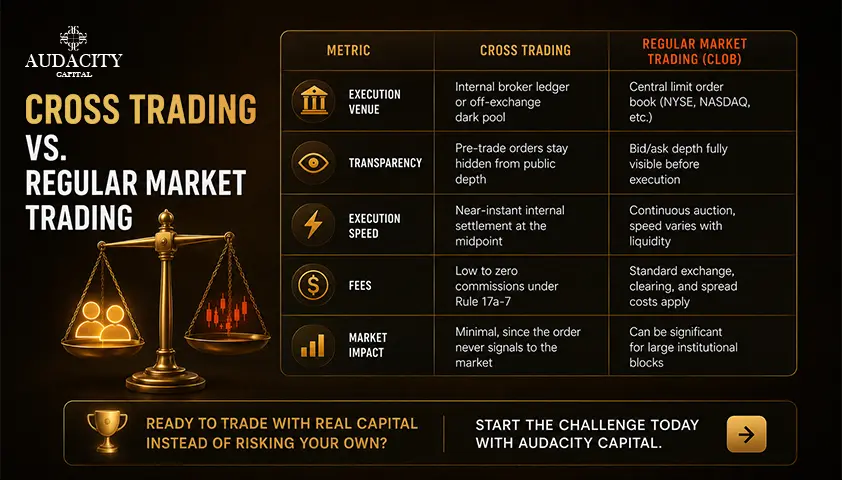
Cross trading and regular market trading solve the same problem, moving shares from one owner to another, through completely different mechanics.
Regular market trading routes every order through a public, centralized venue where price-time priority decides who gets filled first. Cross trading skips that queue and settles internally, as the comparison below shows.
Metric | Cross Trading | Regular Market Trading (CLOB) |
Execution Venue | Internal broker ledger or off-exchange dark pool | Central limit order book (NYSE, NASDAQ, etc.) |
Transparency | Pre-trade orders stay hidden from public depth | Bid/ask depth fully visible before execution |
Execution Speed | Near-instant internal settlement at the midpoint | Continuous auction, speed varies with available liquidity |
Fees | Low to zero commissions under Rule 17a-7 | Standard exchange, clearing, and spread costs apply |
Market Impact | Minimal, since the order never signals to the market's central limit order book (NYSE, NASDAQ, etc.) | Can be significant for large institutional blocks |
For a prop desk moving serious size, that difference in market impact alone often decides which route makes more sense for a given trade.
Cross Trading vs. Wash Trading vs. Internalization
Prop firms operating close to the compliance line need to know exactly where legal cross trading ends and manipulation begins. Cross trading, wash trading, and internalization all move shares without a public exchange in the middle, but only one of the three breaks the law.
Cross trading matches two separate, distinct accounts representing different beneficial owners. Real economic risk shifts from seller to buyer at an independently verified fair price, which keeps the practice fully legal under rules like SEC Rule 17a-7.
Wash trading crosses a hard legal line. A single trader, or a collusive group, buys and sells the same instrument simultaneously while acting as both sides of the trade, so beneficial ownership never actually changes. Federal securities law bans this outright because it manufactures fake volume and misleads investors watching the tape.
Internalization sits somewhere in between operationally, though it stays legal. A retail broker fills a customer's order straight from its own inventory or against opposing retail flow, capturing the bid-ask spread as a market maker rather than matching two outside institutional accounts the way cross trading does. Confusing the three, especially treating cross trading like wash trading, remains one of the fastest ways for a desk to attract unwanted regulatory attention.
Cross Trading vs. Copy Trading
Retail traders new to the space often lump cross trading and copy trading together simply because both involve two accounts and a broker or platform in the middle. The similarities end there. One matches opposing institutional orders internally, while the other automatically mirrors a single trader's positions across many separate accounts.
Metric | Cross Trading | Copy Trading |
Core Mechanism | Internal broker matching of opposing order flow | Software automatically replicates a master trader's trades |
Order Direction | Opposing: one party buys while the other sells | Parallel: the follower account mirrors the master trade |
Target Participants | Institutional fund managers and broker-dealers | Retail traders on social or signal-following platforms |
Regulatory Scope | High, governed by SEC Section 206(3) and Rule 17a-7 | Moderate, mostly platform terms and licensing rules |
Risk Profile | Neutralizes internal liquidity imbalances | Multiplies directional risk across every follower account |
Where cross trading neutralizes existing risk sitting inside a firm's books, copy trading actively multiplies one trader's exposure across every account that follows the same signal.
Is Cross Trading Legal?
Legality in cross trading comes down to three things:
- Independent pricing.
- Proper disclosure.
- Documented consent.
If you miss any one of them, a routine internal match will become a federal securities problem fast. None of these tests care about intent behind the trade. They measure whether the price, paperwork, and permissions line up exactly as required.
- SEC Rule 206(3), Advisers Act: Requires written disclosure and affirmative client consent before an adviser crosses a client against its own book or another client's account.
- Rule 17a-7, Company Act: Sets the pricing bar for fund-to-fund crosses, mandating readily quoted securities, NBBO midpoint execution, zero commissions, and consistency with both funds' investment guidelines.
- Rule 206(3)-2, Blanket Consent: Streamlines compliance by letting advisers pre-clear agency crosses with clients once a year instead of requesting sign-off before every single trade.
The moment a firm skips independent pricing, favors one account's outcome over another's, or forgets a required disclosure, the trade stops qualifying for safe harbor protection.
Retail and prop traders should note that none of these rules touch cross-account hedging on funded challenges, which regulators do not classify as cross trading at all; prop firms police that separately, and far more aggressively. SEC enforcement in this area rarely looks at motive at all, since the statutes measure specific, verifiable facts: a price, a signature, a filed disclosure, things examiners can check without ever asking why the trade happened. That objectivity is exactly what keeps cross trading defensible in court.
Cross Trading in Forex and Prop Trading
Cross trading takes on a very different meaning once it moves from institutional desks into the Forex and prop trading world. Decentralized, over-the-counter currency markets run on broker-managed liquidity, and therefore brokers lean on two core execution models to handle client flow internally:
- B-Book Execution: The broker matches opposing client orders internally and absorbs the trade onto its own book instead of routing it externally.
- A-Book Execution: The broker passes net client exposure straight through to outside liquidity providers, shifting the market risk away from itself.
Both models are standard, fully legal risk management tools used across the retail Forex brokerage industry.
Inside a prop trading firm, cross trading carries a far riskier definition: cross-account hedging, sometimes called reverse trading.
A trader opens opposite, heavily leveraged positions on the same asset across two or more funded accounts, buying 10 lots of EUR/USD on one account while shorting 10 lots on another. That setup neutralizes market risk across the trader's entire profile. When a sharp directional move hits, one account fails its evaluation while the other books a large profit, letting the trader chase a payout without ever proving real trading skill.
Every major prop firm bans cross-account hedging, reverse trading, and multi-profile cross execution outright in its terms of service.
That single word, cross trading, means an accepted brokerage practice in one context and a bannable offense in the other, so the distinction matters enormously for anyone trading funded accounts.
Risks and Rules of Cross Trading
Cross trading can be risky, and its consequences differ sharply depending on which side of the line a trader or firm sits. Regulators enforce compliance from the outside, while prop firms police it internally, but both sides treat violations as serious business.
On the institutional side:
- Regulatory Enforcement Actions: Falling short of SEC Section 206(3) or Rule 17a-7 consent and pricing rules can cause immediate SEC enforcement, steep civil fines, forced disgorgement of profits, and years of costly litigation.
- Fiduciary Litigation: Asset managers who execute cross trades at non-competitive prices open themselves up to investor lawsuits alleging breach of the duty of loyalty and improper trade allocation.
Inside prop trading firms:
- Immediate Account Liquidation: Firms that catch a trader running cross-account hedging terminate every evaluation and funded account tied to that trader then and there.
- Payout Forfeiture and Blacklisting: Firms claw back all accrued profit splits on flagged accounts. They also share offender data across risk networks, leading to industry-wide blacklisting, often within days of detection.
Whether the firm answers to the SEC or to its own funded traders, cutting corners on cross-trading rules ends with swift enforcement and lasting reputational damage.
How Prop Firms Detect Prohibited Cross Trading?
Modern prop firms run surveillance stacks that would make a hedge fund's compliance team jealous, built specifically to catch cross-account hedging before a payout ever gets approved. Four detection methods do most of the heavy lifting.
- IP Address and Network Geolocation Logging: Surveillance engines record login IPs, ISP subnets, VPN headers, and hardware MAC addresses around the clock. If any two accounts trade opposite positions from the matching network infrastructure, the system will highlight them for manual review immediately.
- Millisecond Timestamp Correlation: Compliance software checks order timestamps down to the millisecond. Therefore, a buy order on one account and a sell order on another that come within milliseconds of each other go to automated cross-account hedging.
- Lot Size and Symbol Fingerprinting: Statistical pattern algorithms flag traders who run identical, oddly specific lot sizes across multiple accounts, like executing 3.47 lots on gold at the exact same moment on two separate profiles.
- EA Signatures and API Comment Analysis: Third-party trade copiers leave fingerprints of their own, fixed execution latencies, specific API comments, and predictable ticket number structures, and surveillance platforms scan execution logs to catch these software signatures before payouts go out.
These systems work together to spot unusual trading activity. Firms compare network data, timing, lot sizes, and software patterns, making it hard to hide attempts to game the system.
How to Avoid Cross-Trading Violations?
Good compliance starts with discipline, and these five habits help traders avoid unnecessary rule violations.
Cut Out Third-Party Trade Copiers: Skip unapproved trade-bridging software across multiple prop firm profiles. Unexpected latency in these tools can mirror opposing orders without a trader ever intending it.
Build Independent Strategies: Run every trading account on its own isolated strategy, with distinct risk metrics, timeframes, and asset allocations, so no two accounts ever move in lockstep by accident.
Avoid Opposing Positions on Correlated Assets: Never hold a long and a short on the same instrument across separate accounts, whether those accounts sit inside one firm or across several prop companies.
Use Dedicated Network Infrastructure: Trade from an isolated internet connection and stay away from shared public Wi-Fi or commercial VPNs whose exit nodes overlap with other retail traders.
Document Reference Pricing: For institutional accounts, keep detailed, contemporaneous audit logs proving every cross trade executed at an independently verified NBBO midpoint, with no hidden fees attached.
Keep these habits in place, and cross trading stays a proper execution tool instead of a shortcut to a payout.
Conclusion
Cross trading remains a legitimate, tightly regulated tool for institutions moving size efficiently, while the same term signals outright fraud inside prop trading accounts. Knowing which definition applies, and following the pricing, disclosure, and account-isolation rules that come with it, keeps traders and firms safely on the right side of compliance.
Ready to trade with real capital instead of risking your own? Start the challenge today with Audacity Capital.
FAQs
No. Cross trading matches orders internally through an intermediary, while insider trading means trading on non-public information in violation of a fiduciary duty.
No. It is an institutional mechanism run by broker-dealers and asset managers, not something available on a personal retail trading platform.
Opposing positions across accounts cancel out market risk, letting a trader bypass evaluation rules and extract payouts without real trading skill.
The firm liquidates every linked account, forfeits accrued profits, and permanently bans the trader from future evaluations.

Pronto para aplicar risco disciplinado em cripto? Explore os novos instrumentos de cripto da Audacity Capital e traga sua estratégia de trading.
Saiba MaisNewsletter
Junte-se ao nosso boletim para ficar atualizado.
Junte-se à Nossa Comunidade Social

Comece Sua Jornada Hoje Com Nosso Teste Gratuito
Mostre com orgulho suas habilidades e conquistas através de certificados e obtenha reconhecimento pelo seu trabalho árduo e dedicação de potenciais investidores e colegas.
Teste GratuitoArtigos Relacionados
Bearish RSI Divergence: How to Spot It, Confirm It and Trade It
Learn how to identify bearish RSI divergence, confirm reversal signals, plan entries and exits, and manage risk with practical forex trading examples.

Sortino Ratio in Trading: How It Measures Downside Risk
Learn what the Sortino Ratio means, how to calculate it using downside deviation, and how traders use it to compare risk-adjusted performance.
Risk of Ruin in Trading: Formula, Examples and How to Reduce It
Learn what risk of ruin in trading means, how the formula works, what affects it, and how position sizing can reduce the chance of account failure.
Bullish RSI Divergence: How to Spot, Confirm and Trade It
Learn how to identify bullish RSI divergence, confirm reversal signals, choose entries, set stop losses, and manage risk effectively.