



Is a Leverage of 1:50 OK in Day Trading?


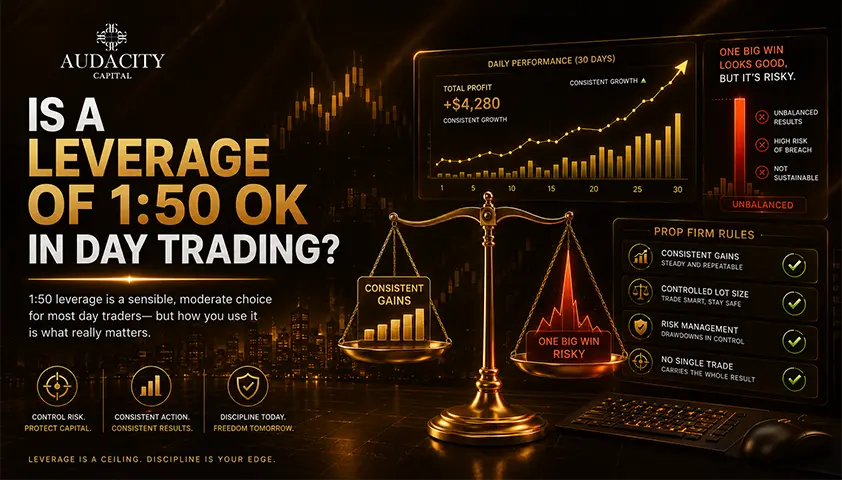
If you have opened a trading account lately, you have seen leverage offered in ratios that range from cautious to eye-watering, and 1:50 sits somewhere in the middle. So the question is fair: is it too much, too little, or about right for a day trader? The short version is that 1:50 leverage is a sensible, moderate choice for most intraday traders, but the ratio itself is not what decides whether you survive. Your position size and your stop-loss do that. Here is how it works and where 1:50 fits.
THE SHORT ANSWER Yes, 1:50 leverage is generally fine for day trading. It is a middle-of-the-road ratio, not a high one, and it happens to be the maximum a US retail trader can use on major currency pairs. It gives you enough buying power to make intraday moves worthwhile without the account-ending speed of 1:100 or 1:500. The catch: leverage available is not leverage used. What you actually risk on any trade is set by how big a position you open and where your stop sits, never by the ratio your broker prints on the account. |
What is leverage in day trading?
Leverage in day trading is borrowed buying power from your broker that lets you control a position larger than your own capital would allow. Put up a small deposit, called margin, and the broker covers the rest so you can trade a bigger size. On a fast intraday move, that larger size turns a small price change into a meaningful gain, which is why leverage and day trading go hand in hand.
The relationship between leverage and margin is fixed and worth memorising. The margin you must post is simply the position size divided by the leverage:
THE MATH THAT NEVER CHANGES Margin required = Position size ÷ Leverage Margin percentage = 1 ÷ Leverage. At 1:50, that is 1 ÷ 50 = 2%, so you post 2% of the position value and the broker covers the other 98%. |
This is the honest part the marketing skips: the same borrowed size that magnifies a winning move magnifies a losing one just as hard. Leverage is a tool for capital efficiency, not a profit button, and it cuts in both directions with equal force.
What does 1:50 leverage actually mean? (and why 50:1 and 50x are the same)

1:50 leverage means you can control $50 in the market for every $1 of your own money. Notation trips people up here, so to be clear: 1:50, 50:1, and 50x all describe the exact same thing. Different platforms and regions just write it differently.
The effect on your account is easy to see:
- Deposit $500 and use 1:50 leverage, and you can open positions worth up to $25,000.
- Deposit $1,000, and that same ratio gives you $50,000 in buying power.
- Whatever your balance, multiply it by 50 to get your maximum position size, and remember you only need 2% of that size as margin.
A quick word on an old myth: 1:50 does not mean you get to open exactly 50 trades, and it does not fix your risk per trade at some tiny percentage. It is purely a ratio between your capital and the size you can control. How many trades you take and how much you risk on each is entirely your decision.
Is 1:50 leverage good for day trading?
For most day traders, yes. To see why, it helps to know where 1:50 lands on the scale that traders and regulators actually use.
Experienced traders usually describe beginner-friendly leverage as around 1:10 to 1:20, a balanced intraday range as roughly 1:20 to 1:50, and aggressive scalping territory as 1:100 and above. On that map, 1:50 leverage sits right at the top of the sensible day-trading band, giving you real headroom without tipping into the ratios that wipe small accounts out in a single bad candle.
There is also a regulatory reason 1:50 is a natural ceiling rather than an arbitrary number. In the United States, the CFTC and NFA cap retail forex leverage at 1:50 on major currency pairs (and 1:20 on minors and exotics). In the EU and UK, regulators cap majors lower still, at 1:30. Offshore brokers may advertise 1:500 or more, but that freedom comes with far higher blow-up risk. So when a US trader asks whether 1:50 is acceptable, the answer is that it is literally the most the regulator will let you use on the majors, and that limit exists precisely because it is considered a reasonable balance of opportunity and protection.
The point that matters most, though, is this: the leverage on your account is a ceiling, not a target. Whether you hold 1:50 or 1:500, your genuine risk on a trade comes from the position size you choose and the distance to your stop-loss, measured against your account balance, not your buying power. Used with discipline, 1:50 is plenty. Used recklessly, even 1:50 will hurt you.
Leverage by trading style: where 1:50 fits
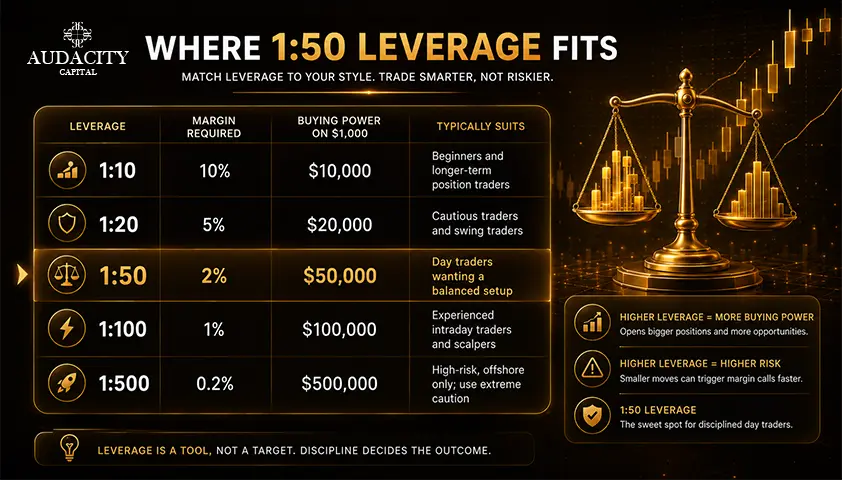
Matching leverage to how you trade is more useful than chasing the highest number. The table below shows the margin each ratio ties up, the buying power it unlocks on a $1,000 account, and the kind of trader it tends to suit. For a fuller breakdown across all ratios, see our guide to the best leverage for forex trading.
Leverage | Margin required | Buying power on $1,000 | Typically suits |
|---|---|---|---|
1:10 | 10% | $10,000 | Beginners and longer-term position traders |
1:20 | 5% | $20,000 | Cautious traders and swing traders |
1:50 | 2% | $50,000 | Day traders wanting a balanced setup |
1:100 | 1% | $100,000 | Experienced intraday traders and scalpers |
1:500 | 0.2% | $500,000 | High-risk, offshore only; use extreme caution |
Read down the table and the trade-off is obvious. Higher leverage frees up more capital and unlocks a bigger position, but it also shrinks the price move needed to trigger a margin call. For someone opening and closing trades inside a single session, 1:50 lands in the comfortable middle.
The advantages of 1:50 leverage
Used sensibly, a 1:50 ratio earns its place for a few concrete reasons:
- Capital efficiency. You tie up only 2% of a position as margin, which frees the rest of your balance for other setups or simply as a buffer against drawdown.
- Access with a smaller account. A trader with a few hundred dollars can still take meaningful positions on major pairs, where an unleveraged account could barely open a micro lot.
- Headroom for intraday moves. Day trading profits come from small price changes captured at size. A moderate ratio like 1:50 makes those small moves worth trading without forcing you to the extremes.
The risks you are actually taking
Every advantage above has a mirror image, and pretending otherwise is how leverage gets a bad name. Two risks deserve your full attention.
Amplified losses. Leverage magnifies a loss exactly as much as it magnifies a gain. Here is a clean example at 1:50. Say you have $1,000 and you deploy the full $50,000 of buying power on one trade. If price moves just 1% against you, that is a $500 loss, half your account gone from a single 1% move. That is not an argument against leverage; it is an argument against using all of it at once.
Margin calls. Because you are trading on borrowed size, the broker holds your margin as collateral. If losses eat into that margin and your account drops below the required level, you get a margin call and positions can be closed automatically to protect the broker. A margin call in the middle of an otherwise good plan is disruptive and expensive, and it is almost always the result of trading too large for the account.
It is worth stating plainly: most retail traders lose money, and over-leverage is one of the most common reasons. Leverage does not change your edge. It only changes how fast your existing edge, or lack of one, shows up in the balance.
How to use 1:50 leverage safely
The traders who use leverage well all do roughly the same handful of things. None of them are complicated.
- Risk a fixed, small percentage per trade. Most disciplined traders cap risk at 1% to 2% of the account on any single position, sized by the stop distance, regardless of how much leverage the account offers.
- **Always trade with a stop-loss.** It defines your exit before the trade goes against you and is what keeps a leveraged loss contained.
- Do not deploy your full buying power. Having $50,000 available does not mean using it. Keeping effective leverage low is how you hold a high account ceiling without taking high account risk.
- Watch your margin level. Keep a healthy buffer above the margin-call threshold so a normal drawdown does not force liquidation.
One market-specific note. If you are applying 1:50 to something far more volatile than major forex, such as crypto, treat the ratio with extra respect. A pair like EUR/USD might move under 1% on a normal day, while a coin like bitcoin can swing 5% to 10% or more, so the same 1:50 leverage produces much larger account swings. On volatile instruments, keep your effective leverage well below the ceiling. For more, see our guide to risk management for day traders.
Leverage on a funded account
There is another way to get serious buying power without gambling your own savings on a high-leverage account: trade with capital from a prop firm. On a funded account with Audacity Capital, you trade the firm's capital on MetaTrader 5 or DXTrade, and the built-in daily loss and drawdown limits enforce exactly the discipline that leverage demands. The guardrails are not a restriction so much as the structure that keeps leveraged trading survivable.
Traders keep up to 90% of the profit they generate, with accounts that can scale toward $2 million as results hold up. To be clear about what that does and does not give you: the capital and the risk framework are the advantage, not a magic multiplier. Your strategy and your discipline still decide the outcome. That is the honest pitch, and it is the only one worth making.
The bottom line
Is 1:50 leverage OK for day trading? For most traders, comfortably so. It is a moderate ratio, it is the US regulatory cap on major forex pairs, and it gives you the buying power to trade intraday moves without the runaway risk of the highest ratios. But the number on your account is only a ceiling. What actually keeps you in the game is sizing each position to a small, fixed percentage of your balance, trading with a stop every time, and leaving most of your buying power unused. Get those habits right and 1:50 is a sharp, useful tool. Get them wrong and no ratio will save you.
Frequently asked questions
You need 2% of the position's value, because margin is one divided by the leverage (1 ÷ 50 = 2%). So a $50,000 position requires $1,000 in margin, and a $10,000 position requires $200. The broker covers the remaining 98% as your leveraged buying power.
It can work, but the danger with a small account is the temptation to use the full buying power. On $100, 1:50 lets you control $5,000, and a 2% move against a full position would wipe the account. Keep positions tiny, risk only 1% to 2% per trade, and treat the ratio as headroom rather than an invitation to trade large.
In some jurisdictions and with some brokers, yes, if a sudden gap blows through your stop. In the EU and UK, retail accounts carry negative balance protection that prevents this, and in practice a margin call usually closes your positions before the balance goes negative. Either way, sound position sizing and a stop-loss are what keep you well clear of that edge.
1:100 doubles your buying power and halves your margin requirement to 1%, but it also doubles how fast a losing move damages your account. It is not better or worse in the abstract; it is simply more leverage. For same-session day trading, many traders find 1:50 the more comfortable balance.
There is no direct fee for the ratio itself. Your real trading costs are the spread and any commission on each trade, plus overnight swap charges if you hold a position past the daily rollover. Since day traders typically close positions the same day, swap is often a non-issue for them.
It varies from firm to firm, and the useful point is that the value of a funded account is the buying power plus enforced risk limits, not a bigger leverage number. Check the specific firm's terms for its exact ratio and its daily loss and drawdown rules before you commit.
Yes. In the US, the CFTC and NFA set 1:50 as the maximum retail leverage on major currency pairs, with 1:20 on minors and exotics. That makes 1:50 the standard ceiling for US retail forex traders on the majors, rather than an unusually high setting.

Pronto para aplicar risco disciplinado em cripto? Explore os novos instrumentos de cripto da Audacity Capital e traga sua estratégia de trading.
Saiba MaisNewsletter
Junte-se ao nosso boletim para ficar atualizado.
Junte-se à Nossa Comunidade Social

Comece Sua Jornada Hoje Com Nosso Teste Gratuito
Mostre com orgulho suas habilidades e conquistas através de certificados e obtenha reconhecimento pelo seu trabalho árduo e dedicação de potenciais investidores e colegas.
Teste GratuitoArtigos Relacionados
Why Every Trader Sees The Chart Differently ?
Unlock the secrets of trader chart interpretation. Understand why different traders see the same chart differently and how it affects trading.


Risk Return Trade Off in Financial Management: A Complete Guide
A complete guide to the risk return trade off in financial management: types of risk, sources of return, and how to strike the right balance.

12 Trading Risk Management Tools Every Trader Needs
Explore 12 trading risk management tools for position sizing, trade planning, drawdown control, journaling, and smarter trading decisions.

What Are The Risks Of Forex Trading For Beginners?
Understand the risks of forex trading for beginners. Learn about the potential pitfalls and challenges involved in the forex market.