


10 Best Prop Trading Strategies for Consistent Profits (2026)



Prop Trading Strategies (Quick Answer)
The best prop trading strategies include:
- Price action trading
- Trend following
- Breakout strategy
- Scalping
- Swing trading
- Mean reversion
These strategies focus on risk control, consistency, and capital preservation.
Prop trading strategies are rule-based methods used by traders to generate consistent profits while staying within strict risk limits.
Prop trading is a unique arena where the goal isn't just to make money, but to keep the firm's capital safe enough to stay in the game. Here is a breakdown of what defines these strategies and why they require a different mindset than standard retail trading.
- What they are: These are systematic approaches specifically engineered to pass "evaluations/challenges" and maintain "funded" status. Common examples include Mean Reversion, Trend Following, and Scalping, all of which must be executed within the strict guardrails of a firm's maximum drawdown and daily loss limits.
- How they differ from retail: Retail trading often focuses on absolute returns and absorbing intraday volatility based on higher-timeframe conviction. Prop trading strategies, however, prioritize capital preservation and low volatility. Because you are trading the firm's money, the strategy must account for "trailing drawdowns," where a single large loss can lead to account termination under strict drawdown rules, regardless of long-term profitability.
- Importance of risk management: In prop trading, risk management is the foundation of every strategy.. Firms don't just look for profit; they look for a high Sharpe Ratio or Profit Factor. Maintaining a strict 1:2 or 1:3 risk-to-reward ratio and capping risk at 0.5% to 1% per trade is usually the only way to survive the tight drawdown limits imposed by the funding model.
Key Takeaways
- Capital Preservation Priority: Unlike retail trading which seeks absolute returns, prop trading strategies prioritize capital protection and low volatility to stay within firm-mandated limits.
- High Risk-to-Reward Focus: To survive tight drawdown limits, strategies like price action are used to achieve high $RR$ ratios (typically 1:2 to 1:4) with very tight stop-losses
- Consistency Over Perfection: Success depends on repeating a proven strategy and maintaining discipline rather than searching for a "perfect trade" or switching methodologies after losses.
- Strict Risk Guardrails: Successful traders must adhere to hard-coded rules, including daily loss caps and maximum trailing drawdowns, where a single breach can lead to account termination.
- Scalability and Liquidity: Strategies must be optimized for high-volume execution in liquid markets to allow for large position sizes without significant slippage.
What Are Prop Trading Strategies?
Prop trading strategies refer to the techniques employed by prop traders when trading stocks, currencies, bonds, and derivatives. Examples of commonly used strategies include market-making, arbitrage, and high-frequency trading (HFT).
Retail trading strategies tend to vary widely because individual traders have the freedom to trade any asset class, timeframe, or risk level without worrying about institutional oversight. Often, these strategies are classified based on how long a trader holds a position and the data they rely on to make decisions.
How Prop Trading Strategies Differ from Retail Trading

When you place a strict emphasis on wanting to understand the differences between these two strategies, it automatically becomes about how a trader balances objective-driven logic (Prop) against total discretionary freedom (Retail).
And this is how these two fare against each other:
Risk Limits
- Prop Trading: Strategies are built around Maximum Adverse Excursion (MAE). This means that a strategy must be discarded or paused if it hits a predefined daily loss limit, regardless of its long-term potential.
- Retail Trading: Strategies are often more flexible, allowing for "breathing room." A trader might choose to hold through high volatility if their personal conviction remains high, as there is no mandated cutoff.
Drawdown Rules
- Prop Trading: The trader needs to deploy techniques that prioritize capital preservation over aggressive growth. And while locking in profits is good, a trailing drawdown follows the "High Water Mark" of equity in many prop firm models. This means if your account goes up by $2,000 and you don't close the trade, your liquidation floor often moves up with that unrealized profit.
- Retail Trading: Its techniques often focus on compounded growth. Because there is no external "hard stop" on a drawdown, a retail strategy might utilize wider stop-losses or "martingale" elements that would be prohibited in a professional prop environment.

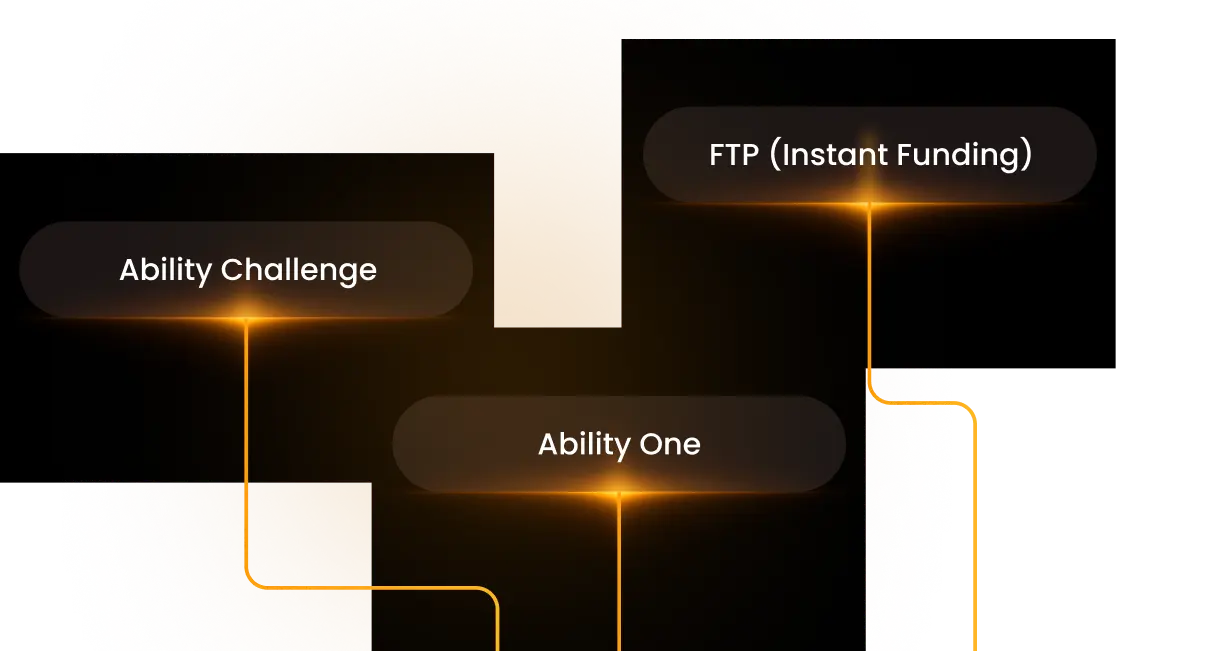
Are You Looking For A Funded Trader Program?
Join the Funded Trader ProgramCapital Structure
- Prop Trading: Its techniques are optimized for scalability. Since the trader is using firm capital, the strategy must be "liquid" enough to handle large position sizes without causing significant slippage, as the goal is to execute large position sizes without impacting market price.
- Retail Trading: Here, the methods used are often niche or liquidity-insensitive. Given that the capital pool is smaller, retail traders can successfully use strategies in low-volume exotic pairs that would be impossible to execute with the large capital of a prop firm.
Psychological Pressure
- Prop Trading: The psychological demand is the ability to trade with systematic discipline and consistency-- executing the edge with robotic precision to avoid "style drift" that could lead to account termination. As a result, the strategy must be rule-adherent.
- Retail Trading: The psychological pressure in retail trading comes from the "pain of loss." A retail strategy often fails not because the math is wrong, but because the trader lacks the emotional detachment to execute it when their own rent money is on the line. And this is why the strategy used tends to be emotionally tethered.
Comparison Table: Prop Trading vs Retail Trading Strategies
The table below shows a direct comparison of the prop trading strategies and the retail trading strategies mentioned above:
Feature | Prop Trading Strategies | Retail Trading Strategies |
Risk Limits | Hard-Coded: Strategies must include mandatory daily loss caps and strict position sizing. Exceeding these limits typically ends the session. | Discretionary: Risk is self-regulated. Traders can adjust exposure based on personal conviction rather than fixed institutional rules. |
Defensive: Optimized for capital preservation. Traders must account for trailing drawdown floors that lock in "liquidation levels" as equity rises. | Aggressive: Focused on long-term recovery. It allows for deeper fluctuations and wider stop-losses since there is no external "hard stop" on the account. | |
Capital Structure | Scalable: Designed for high-volume execution. Strategies must be liquid enough to handle large lot sizes without significant slippage. | Niche-Friendly: Effective in lower-liquidity markets or exotic pairs where smaller capital amounts won't disrupt price action. |
Psychological Pressure | Systematic: Requires "quant-like" discipline. The pressure is on strict rule adherence to avoid termination due to "style drift." | Personal: High emotional stakes. The pressure stems from the direct impact on personal net worth, often leading to emotional execution errors. |
In summary:
Prop Trading Strategy: It’s a systematic, rule-based approach where the primary objective is the mitigation of equity curve volatility to remain within institutional risk parameters.
Retail Trading Strategy: It refers to a discretionary approach focusing on capital appreciation, where the trader accepts higher drawdown in exchange for the freedom to hold through market cycles.
Core Principles Behind Successful Prop Trading Strategies

The most successful prop trading strategies are those that hinge on strict risk management and consistency over profits, among several other factors, as shown below:
- Risk Management: Key risk management principles include capital protection, where you limit each trade to at least 1--2% of total capital. Others are drawdown management and position sizing.
- Consistency Over Profits: Consistency will involve repeating the same strategy over and over again instead of focusing on your search for the “perfect trade.” You may also want to consider daily journaling to help you identify potential patterns.
- Discipline: Becoming a disciplined trader will require you to master emotional control and to learn how to manage your expectations. Mastering control prevents you from engaging in emotional trading when things go wrong.
- Rule-Based Execution: For this, you need to know and understand how technical indicators and analysis works, and the role they play in trading. In the same breadth, you also need to have a good understanding of news and market events to help you adjust your strategy accordingly.
Top 10 Prop Trading Strategies
- Price Action
- Scalping
- Breakout
- Trend Following
- Swing Trading
- Mean Reversion
- News Trading
- Arbitrage
- Momentum Trading
- Algorithmic Trading
Top Prop Trading Strategies That Work
Prop trading includes various strategies that have been tailored for different market environments as well as varied trader preferences. As such, some of the most profitable trading strategies for prop firms include:
Price Action Strategy
Price action trading is a methodology where decisions are based purely on the movement of price on a "naked" chart, largely ignoring lagging indicators like moving averages or RSI. When you look at it in the context of prop firm trading, you’ll find that this strategy focuses on identifying market structure (higher highs/lower lows), support and resistance zones, and specific candlestick patterns that signal market sentiment.
Read more about our Price Action Trading Strategy Guide
Why It Works in Prop Firms
Prop firms are designed to filter for disciplined, systematic traders. Price action is uniquely suited for this environment for several reasons:
- Precision in Risk-to-Reward ($RR$): Prop rules often require a high $RR$ to overcome drawdown limits. Price action setups (like a Pin Bar at a major resistance level) allow for very tight stop-losses compared to the potential profit target. This helps traders achieve the 1:3 or 1:4 $RR$ ratios necessary to pass evaluations, making it one of the best prop trading strategies.
- Adaptability to Market Cycles: Unlike algorithmic or indicator-based strategies that might fail when market volatility changes, price action is a reflection of real-time human psychology. Whether the market is trending or ranging, price levels and "rejection" signals remain relevant, allowing a trader to stay consistent across different market phases.
Scalping Strategy
Scalping is a trading strategy that focuses on making numerous trades within a short period with the sole purpose of capturing small price movements. Its focus on short-term trades demands lightning-fast execution on the part of the trader, making it ideal for highly focused, disciplined traders.
The scalping strategy works best in highly liquid markets that have strict risk limits and tight bid-ask spreads. It’s what makes it one of the best forex prop trading strategies, especially for those who prefer to trade during peak trading hours.
Read more about our Scalping Trading Strategy guide
Swing Trading Strategy
Swing trading seeks to capture the price “swings” that take place over several days to weeks of trading. If you’re a swing trader, you’ll need to use technical analysis to help you identify potential reversal points and hold positions.
The swing trading strategy is best suited for individuals who prefer a market that’s less frantic than day trading, but who still wish to actively participate in market activities. Some of its common attributes include engaging in medium-term trades and trading at a lower frequency than day traders.
Read More about Our Swing Trading Strategy guide
Breakout Strategy
It involves entering a trade when the price moves beyond a defined level of support or resistance with increased momentum. The objective here is to "catch" the volatility that occurs when a market finally escapes a period of consolidation or a technical pattern (like a triangle or a flag), following a major news event.
To avoid "False Breakouts," many successful prop traders use a "Break and Retest" model. Instead of entering the moment the price crosses the line, they wait for the price to return to the breakout level to see if it now acts as new support. This adds an extra layer of confirmation to protect the funded account, making it one of the must-have risk management strategies for prop trading.
Trend Following Strategy
The trend following strategy revolves around riding market momentum. The trader will need to identify and subsequently ride the sustained market trends, which will see them buy when there’s an uptrend, and exit their positions when there’s a downtrend. The trend following strategy is one that is heavily reliant on the use of technical indicators, e.g., momentum oscillators and moving averages.
The strategy is best suited for patient traders who can hold positions for days or weeks as they attempt to ride out short-term volatility. You’ll note that it works well in trending markets that have clear directional momentum.
Risk Management Strategies for Prop Traders
Effective risk management is the bridge between a funded account and a permanent breach. In prop firm trading, all strategies in use by the trader must prioritize capital preservation over aggressive gains.
- Position Sizing: Calculations are based on a fixed percentage of account equity (typically 0.5% to 1%) rather than lot size. To survive a 5% maximum drawdown, a trader should ideally risk 0.25% to 0.5% per trade. This provides a "buffer" of 10–20 trades, which is more sustainable for long-term consistency.
- Risk-Reward Ratio ($RR$): The prop traders target a minimum $RR$ of 1:2 or 1:3. This mathematical edge allows them to remain profitable even with a win rate below 50%, staying well within firm targets.
- Daily Loss Limits: This acts as a "hard stop" for the day. Setting a personal limit below the firm’s mandate (e.g., 2% vs. a firm’s 5%) provides a safety buffer against emotional revenge trading.
- Drawdown Control: These strategies focus on the Maximum Trailing Drawdown. Traders often reduce position sizes by half after a losing streak to protect the liquidation floor.
Common Mistakes in Prop Trading Strategies
The level of success attained in a funded environment is often determined by what a trader avoids doing. You need to understand that subverting the firm’s framework through following errors is the leading cause of account termination.
- Overtrading: It occurs when you enter too many positions or force trades in low-probability environments. This exhausts your buying power and increases the likelihood of hitting the Daily Loss Limit.
- Ignoring Rules: It occurs when you resort to treating prop capital like a personal retail account. The failure to adhere to mandatory stop-losses or trading during restricted news events often leads to immediate, automated disqualification.
- Strategy Hopping (Abandoning a system before reaching its statistical expectancy): It is characterized by a trader switching methodologies after a few losses. This prevents them from realizing the long-term statistical edge of a strategy and often leads to catching only the "drawdown phase" of multiple systems.
- Emotional Trading: Also known as allowing fear or greed to dictate execution. This typically manifests as "revenge trading" to recoup losses, which quickly breaches the Maximum Drawdown parameters.
Best Prop Trading Strategies for Beginners
- Price action
- Swing trading
- Trend following
How to Choose the Right Strategy for You
Choosing the right trading strategy depends on aligning your external constraints with your internal temperament. Given that prop firms are known to impose a "boss" in the form of a risk manager, your strategy must be more disciplined than a standard retail approach.
The following table will help you choose the right strategy for yourself based on:
- Personality
- Time availability
- Risk tolerance
If you value…, | Choose Prop Trading | Choose Retail Trading |
Freedom | Lower (Strict rules) | Higher (Total control) |
Buying Power | Higher (Firm's capital) | Lower (Personal savings) |
Rule Adherence | Mandatory / Automated | Voluntary / Self-policed |
Profit Potential | High (Scalability) | Unlimited (No "hard stops") |
You can use this Funded Trader’s Daily Routine Guide to help you get started on strategy selection:
- Check Economic Calendar: Identify "Red Folder" events where trading might be restricted by the firm.
- Define Daily Loss Limit: Set your platform's "Auto-Liquidate" to 2% to ensure you never hit the firm's 5% limit.
- Confirm Liquidity: Only trade during the New York or London "Overlap" to ensure your scalping/day trading strategy isn't hit by slippage.
- Log MAE/MFE: Record how far a trade went against you before turning profitable to refine your stop-loss placement.
Comparison Table
In order to help maximize clarity and decision-making with regards to the best day trading strategies for prop firms, the following is a table that highlights how the operational environment of a prop firm fundamentally shifts the execution of standard trading strategies compared to a retail setting.
Strategy | Timeframe | Risk Level | Best For |
Prop Scalping | Seconds to Minutes | High (Operational) | Traders with high focus who can navigate tight daily loss limits while hunting small, frequent gains. |
Retail Scalping | Seconds to Minutes | High (Capital) | High-frequency traders who want to keep 100% of profits and aren't restricted by firm-mandated lot sizes. |
Prop Day Trading | Intraday (No Overnights) | Moderate | Disciplined professionals who want to leverage institutional capital without the risk of "gap-down" overnight losses. |
Retail Day Trading | Intraday | High (Personal) | Independent traders who want the flexibility to hold positions past the market close if a setup requires more time. |
Prop Swing Trading | Days to Weeks | Low to Moderate | Patient traders who can manage the trailing drawdown impact on long-term positions and follow weekend holding rules. |
Retail Swing Trading | Days to Months | Low (Personal Time) | Busy professionals who don't want to be bothered by daily performance evaluations. |
Prop News Trading | Seconds (Event-driven) | Extreme | High-precision traders who can handle massive volatility within the strict "hard stop" constraints of a funded account. |
Minutes to Hours | Extreme | Aggressive traders looking for "home run" plays where they can risk significant personal capital for uncapped returns. |
Whether you want to master the markets or scale with institutional capital, we at Audacity Capital have a path for you. Check here to Start Free Trial to hone your skills in our demo environment, then Explore Funded Trder Programs to take your trading to the professional level.
Learn, practice, and apply your trading strategy in Audacity Capital's free monthly trading competition.
FAQs
Always go for a high probability system, such as trend following or price action, that places a lot of emphasis on the risk-to-reward ratio.
They use the same core analysis, but the prop strategies are often modified with “hard stops” and predetermined volume constraints.
Yes, they can, but it’s recommended to practice the strategy in a demo environment before paying for a prop firm evaluation.
Prop traders manage risk by using automated position sizing to ensure no single trade exceeds a small percentage of the account.

Pronto para aplicar risco disciplinado em cripto? Explore os novos instrumentos de cripto da Audacity Capital e traga sua estratégia de trading.
Saiba MaisNewsletter
Junte-se ao nosso boletim para ficar atualizado.
Junte-se à Nossa Comunidade Social

Comece Sua Jornada Hoje Com Nosso Teste Gratuito
Mostre com orgulho suas habilidades e conquistas através de certificados e obtenha reconhecimento pelo seu trabalho árduo e dedicação de potenciais investidores e colegas.
Teste GratuitoArtigos Relacionados

Martingale Strategy in Trading
How the martingale trading strategy works, what the doubling arithmetic actually costs, why position sizing cannot create an edge, and where it is banned.


Momentum Trading Strategy: A Comprehensive Guide
Master the core principles of a momentum trading strategy. Learn how to use key indicators, manage sharp-reversal risks, and master exit timing.
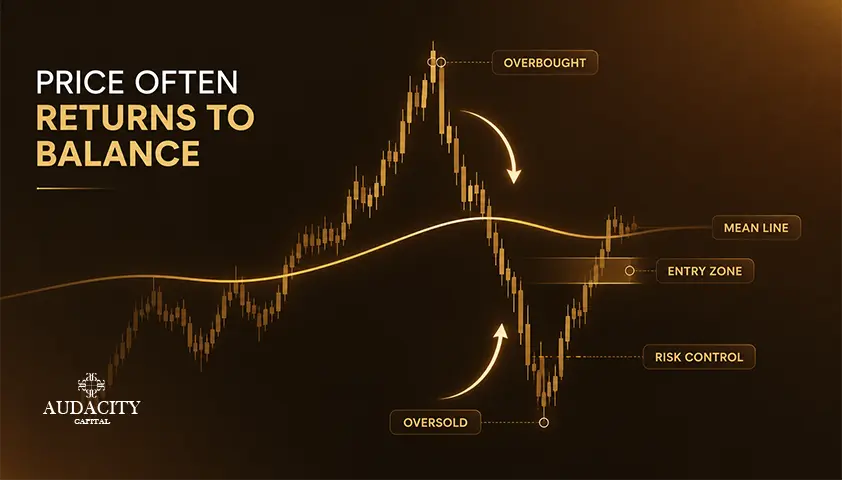
Mean Reversion Trading Strategy Explained (2026)
Prices that stretch too far tend to snap back to an average, but only in the right market. Learn the tools, the setup, and the trend risk.
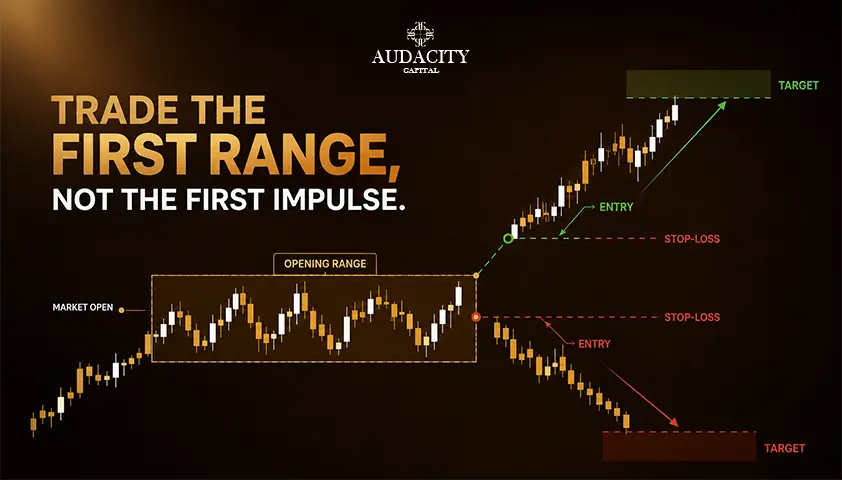
Opening Range Breakout Strategy: Rules, Setups and Examples
Learn how the opening range breakout strategy works, including ORB rules, 5, 15 and 30-minute setups, entry signals, stop losses and risk management.