


9 Best Prop Firms That Allow HFT in 2026


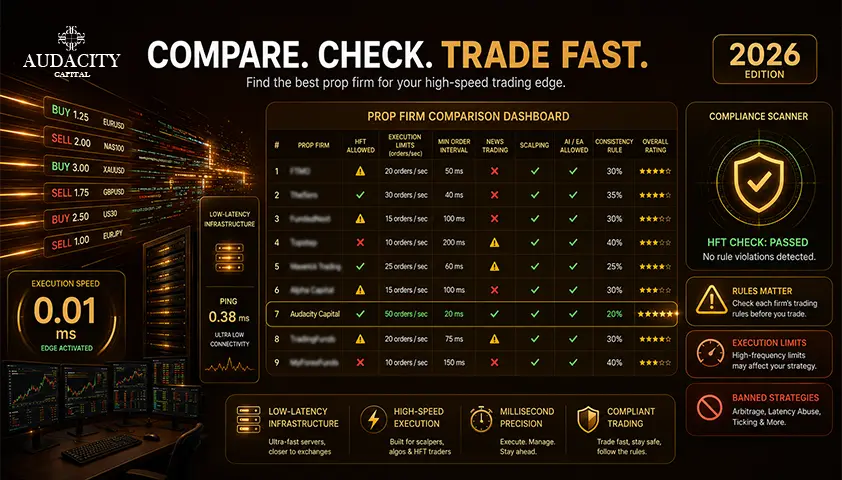
Most prop firms prohibit high-frequency trading. A minority permits it, usually under certain conditions, and even a small minority accepts it as a major headline feature.
The first tension to understand is this: The companies that boast about “fast” automated trading are the youngest companies and the companies that have the longest history of automated trading are the ones that let it happen only within a certain range.
The article provides you with 9 named companies, what each one offers, and the rules governing fast trading systems regardless of permission.
What HFT Actually Means At a Prop Firm
No prop firm offers genuine institutional high frequency trading. The true definition of HFT: colocated servers, direct market access for your trading, proprietary data feeds, and microsecond execution.
There's no retail trader on an evaluation account doing that, and there's no prop firm that's providing it.
What companies call "HFT" in practice is quite brief: Lots of trades, extremely short holding periods, and trades that are executed automatically.
Some companies even employ a stopwatch instead of technology to determine it. There are some prop firms that impose a minimum holding-time that may be 5 seconds or 10 seconds, or even longer, in order to limit ultra-short-term strategies. Another firm has been reported as defining it as trading at under five-second intervals.
This is the practical definition that you need.
It can be useful to distinguish three things that are often put together:
- Ordinary algorithmic trading: an HFT EA / HFT bot running a normal strategy at normal speed. Widely permitted.
- High-frequency automated trading: very high volume and very short holds. Permitted (or limited) at times.
- Feed-exploiting methods: latency arbitrage and tick scalping. Near-universally prohibited.
Typically, strategies such as latency arbitrage and tick scalping are banned due to the possibility of firms interpreting these techniques as price-move exploitation or execution delay, or simulated-feeding instead of a true price move.
Why Most Prop Firms Prohibit High-Frequency Trading?
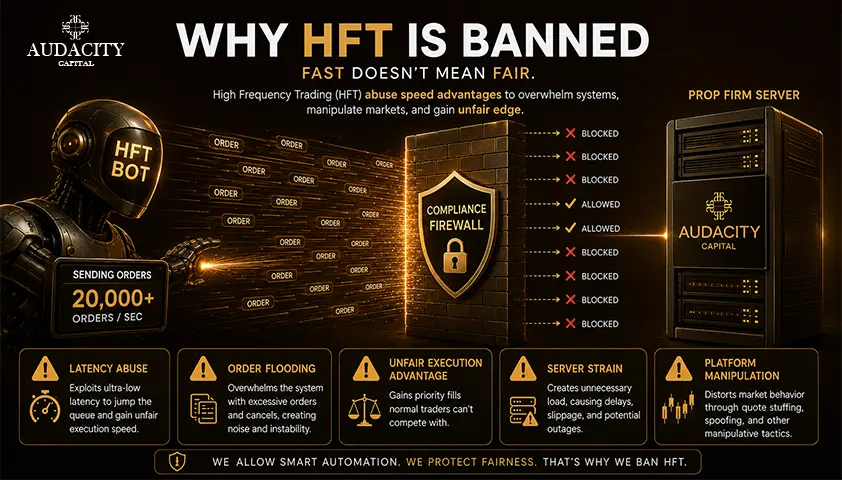
Most of the time, prohibition is related to economics and risk, not fairness. There are four reasons, roughly in this order.
One, infrastructure load.
With thousands of accounts making hundreds of orders, this is a major stress on the servers and execution bridge. It's openly stated by firms.
Two, the evaluation account is simulated.
This is the significant one. In the wider market, any profits arising from a lag or a price gap on a simulated feed are not possible.
If the firm then funds that trader, and pays out, then they're paying real money against gains that were never realizable. It is a solvency problem, not a policy decision, and it's why most of the rules in this article are in place.
Three, risk modeling.
Firms make assumptions regarding trade frequency and holding time when pricing. A system that opens hundreds of positions per day breaks these assumptions.
Four,
Platform and licensing pressure by the technology suppliers the companies rely on.
Knowing point two gives you some idea of something you'll need to deal with many times: permission may be given during the evaluation phase but may be denied later at the "funded account" – just when money enters the picture.
9 Best Prop Firms That Allow HFT in 2026
These companies were chosen according to three criteria:
- the firm takes a stance on automated and high-frequency approaches,
- It is currently in use,
- and its rules are stated not assumed.
Firm | Market | Automation permitted | Stated HFT position |
FTMO | CFD | Yes | Permitted, order/position caps |
Bulenox | Futures | Yes | Welcomed |
FunderPro | CFD | Yes | Permitted |
FTUK | CFD | Yes | Permitted |
Hola Prime | CFD (multi) | Yes | Directory-flagged |
DNA Funded | CFD (multi) | Yes (EA) | Directory-flagged |
Moneta Funded | CFD | Yes (EA) | Directory-flagged |
FXIFY | CFD (multi) | Yes (EA) | Directory-flagged |
FundedX | CFD | Yes (EA) | Directory-flagged |
Group 1: Established firms that allow automated and high volume strategies.
1. FTMO
What it allows: Expert Advisors and algorithmic strategies, the oldest and biggest name in this category.
What limits a fast system: reported limits on simultaneous orders, daily positions, and bans on arbitrage and any technique that takes advantage of a weakness in the platform or feed.
Platforms and infrastructure: two phases of evaluation, with a 10 percent and then 5 percent target; about 5 percent daily and 10 percent maximum loss limits; minimum trading days; and a refundable fee; access restrictions in the platform for US nationals and residents.
Check before you buy: make sure the order and position ceiling, current prohibition language on strategy use and software list (which may vary from third parties).
It's often the order and position ceiling that is the limiting factor for a truly high frequency system, and very few competing lists ever feature it.
2. Bulenox
What it allows: algorithmic and high-frequency strategies, and it's one of the handful of futures firms that are openly accepting these methods, not just tolerating them.
What limits a fast system: trailing drawdown and consistency requirements.
Platforms and infrastructure: a monthly subscription evaluation and an activation fee, and a profit structure that distributes the profits to the trader first.
Check before you buy: make sure to check the existing price levels, trailing drawdowns, consistency criteria and platform listing.
Futures are a very different structure to CFDs. Contracts are negotiated, standardized and not quoted from the firm, which alters the simulated-feed economics outlined above.
3. FunderPro
What it allows: scalping, news trading, high-frequency trading, as stated.
What limits a fast system: execution is done through a partner broker, thus behavior depends on conditions of the partner broker.
Platforms and infrastructure: a challenge-based CFD model, no time limits for evaluation and scaling on funded accounts.
Check before you buy: make sure to verify the existing automation clause, profit split, and if they have permission to the funded phase or just the evaluation.
4. FTUK
What it allows: HFT, scalping, EA trading, according to their rules.
What limits a fast system: the drawdown model varies from route to route, hence the instant path and the evaluation path are different.
Platforms and infrastructure: an instant funding route together with evaluations, profit sharing up to 80 percent and payouts starting around 14 days.
Check before you buy: make sure to verify profit split, pay schedule, and the drawdown model for the instant route.
5. Hola Prime
What it allows: automated and high-frequency approaches, as indicated on major directories.
What limits a fast system: As a relatively young company, published limitations should be examined with caution and not taken for granted:
Platforms and infrastructure: a multi-asset CFD giving you a refundable fee model and 24/7 support.
Check before you buy: directory information is self-reported, so make sure that HFT is listed in the firm's own prohibited-strategies document before assuming it.
Group 2: Newer CFD companies selling permissive automation rules
They're newer companies and a permissive rulebook is easier to come by than a long payout record. This is not an accusation, but a statement about company age, and each of the following is handled in the same neutral manner as Group 1 is handled.
6. DNA Funded
What it allows: Expert Advisors, and it's directory-flagged for high-frequency permission.
What limits a fast system: it runs along with a connected broker, thus execution conditions rely on the relationship with them.
Platforms and infrastructure: multi-asset support in forex, indices, commodities, crypto and stocks.
Check before you buy: verify the automation clause; verify differences between evaluation and funded phases.
7. Moneta Funded
What it allows: EA trading, it's directory-flagged for high-frequency strategies.
What limits a fast system: it works with an affiliated broker, which means the same execution caution.
Platforms and infrastructure: CFD coverage with crypto and bank payout options.
Check before you buy: verify the current rulebook position and drawdown model at source.
8. FXIFY
What it allows: EA trading, and it's directory-flagged for high-frequency strategies.
What limits a fast system: it has been linked to a trailing drawdown system in other coverage, and if that is true it has some direct implications – a tighter trailing limit means bigger account growth.
Platforms and infrastructure: a multi-asset CFD platform with multiple account currencies and a variety of challenge configurations.
Check before you buy: verify if the drawdown model is static or trailing and verify automation clause.
9. FundedX
What it allows: EA trading only, and it's directory-flagged for high-frequency strategies.
What limits a fast system: as a young company, its independent review volume is restricted.
Platforms and infrastructure: Forex and Crypto coverage in USD and AED account currencies.
Check before you buy: verify the rules and payout history before playing.
The HFT Bot Economy, and Why It Deserves Scrutiny
There are open online marketplaces selling automated systems that are specifically designed to pass prop firm evaluations.
They have price ranges from about 15 dollars to several hundred and they promise to pass your evaluation, have 100% success rates, unlimited accounts, and challenges cleared in less than an hour.
Read these listings carefully, as they have the most important information in this whole article.
These products often write in their own product description that they are for evaluation stages at HFT-approved firms only, and that they aren't tested on funded accounts or live broker accounts.
Others explicitly say that they are not suitable for live capital.
Give that some thought, and now the conclusion in a single sentence.
A system that only produces results on a simulated evaluation server, and not on real capital, is not a trading edge. It relies on the conditions of the simulated environment, which makes it not the challenge part, but the payout part that matters.
There were two truths that had been stated clearly.
Firstly, there are conflicting reviews of this product category, including reports of accounts being breached and concerns about grid or martingale strategies being used under the marketing claims.
Second, a guaranteed-pass claim is not a claim that a seller can truthfully make regarding a market outcome since no seller controls the market.
Use the numbers as a guideline before you invest a single penny: challenge fee, cost of bot, trading in VPS hosting, reset fees if you don't reach payout, against the probability of reaching and clearing the payout.
Numbers may differ, so use your own, but add them up before purchasing, not after.
The Rules That Catch Fast Systems Out, Even Where HFT Is Allowed

This is the most useful section here because all of the rules below remain true even after a firm has agreed to automation.
1. Minimum trade duration.
The stopwatch rule is the direct killer of a fast trading system and frequently is concealed in a section that the trader will never read. Both ten seconds and five seconds are in circulation as thresholds. First look for the minimum trade duration rule.
2. Leverage caps.
Prop leverage is often much lower than that of the same strategy at a retail broker. The system designed to work with retail leverage simply doesn't work in a prop account and the cap is what matters, not the strategy.
3. Drawdown model and daily loss limits.
For a high-volume system, static versus trailing can be a huge deal. As the account expands, the trailing limit gets narrower, and a strategy with lots of small trade positions can hit the stop without a single big loss.
4. Order and position ceilings.
Some companies limit the total number of orders placed at any given time and limit daily positions. A genuine high-frequency system can reach an admin limit even before reaching a risk limit.
5. Consistency and lot-size rules.
A system that produces one outsized day can fail a consistency check even while passing every risk rule.
6. Phase asymmetry.
Approval on the evaluation doesn't automatically extend to the funded account. Review them both, one at a time, in writing.
7. Infrastructure and uptime.
If a connection is dropped, then positions are left unmanaged. Companies are clear they won't do the work for anyone else's automation setup, hosting, or troubleshooting.
Wrap everything up with one sentence: permissions are just the beginning and not the end, and the trader who reads "HFT allowed" and stops reading is the trader who gets breached.
How To Choose An HFT-Friendly Prop Firm
Do not start with the firm. Start with your own system.
Step one: profile your system honestly. Average holding time, trades per day, the leverage it was built on, its own historical maximum drawdown, and whether it runs unattended.
Step two: read the automation clause and the prohibited-strategies clause in the firm's own terms. Not a review, not a directory filter, not this article.
Step three: check the minimum trade duration rule specifically. It is the fastest disqualifier and the one most often buried.
Step four: test on a free trial or demo where the firm offers one, and evaluate the system against that firm's drawdown and leverage rather than against retail conditions.
Step five: get anything ambiguous confirmed in writing from support before paying for a challenge. Keep the reply.
Step six: weigh payout evidence at least as heavily as permissive rules. A permissive rulebook at a firm that cannot pay is worth nothing.
Is Audacity Capital Suitable for High-Frequency Traders?
Audacity Capital focuses on disciplined, sustainable trading rather than ultra-short-term, high-frequency strategies. While traders should always review the latest trading rules before joining, the firm's programs are designed for traders who prioritize consistent risk management, capital preservation, and long-term performance over execution-speed-dependent strategies.
If your strategy relies on genuine HFT infrastructure or latency-sensitive execution, a specialized provider may be more appropriate. However, if you're looking for funded trading opportunities with structured risk management and a long-established reputation, Audacity Capital is worth considering.
Conclusion
A small number of firms permit high-frequency automated trading, most do not, and permission is only the first of several gates.
The rules that actually decide whether a fast system survives are the minimum trade duration, the leverage cap, the drawdown model, and whether permission carries from the evaluation into the funded phase.
So the real decision is not "which firm allows HFT." It is whether your system holds up once every one of those rules is applied to it.
Verify each rule in the firm's own current source. Profile your system before you choose the firm. And treat any guaranteed-pass claim for exactly what it is: marketing about a market outcome that no seller controls.
Frequently Asked Questions
No, high-frequency trading is not illegal, but it is often prohibited by the firm's own terms. A prohibition is a contractual rule, not a law, and breaching it usually means a breached or forfeited account rather than any legal consequence. Read the specific firm's terms, because the rule varies from firm to firm.
Sometimes, on a simulated evaluation, but that is not the meaningful test. Many of these bots' own listings state they are untested on funded or live accounts, which means any result on the evaluation server may not survive real capital and payout review. Passing the challenge is rarely where the outcome is actually decided.
It is a rule requiring positions to be held for at least a set time, commonly ten seconds or five seconds. Firms use it to block micro scalping and feed-based techniques on their simulated environments. Trades closed faster than the threshold can be voided or can breach the account, so find this number before you buy.
It depends entirely on the firm, and permission on the evaluation does not guarantee permission on the funded account. This phase asymmetry exists because real capital enters at the funded stage, which changes the firm's risk. Confirm the position for both phases separately and in writing.
Firms state publicly that trading activity is monitored and reviewed, particularly at the payout stage. Reviews typically look at trade frequency, holding times, and whether results appear tied to pricing gaps rather than genuine market moves. The practical takeaway is simple: rules are enforced when a payout is requested, so the rules must be respected from the start.
Sometimes, and futures is a structurally different case. Because futures contracts are exchange-traded and standardized, the firm is not quoting its own prices, which changes the economics that drive many CFD prohibitions. Even so, some futures firms still impose strict minimum holding times, so verify each firm individually.
A trading VPS is commonly used to keep an automated system running with stable uptime, but it is not something the firm provides or supports. A dropped home connection can leave fast positions unmanaged, which is why unattended systems are usually hosted externally. Factor the VPS cost into your total spend before committing to a challenge.
Outcomes vary by firm, but the account is usually forfeited whether the breach was intentional or not. Rulebooks rarely distinguish between a deliberate violation and a misconfigured system. This is exactly why the automation and prohibited-strategies clauses must be read carefully before you purchase, not after a breach.

Готовы применить дисциплинированный риск к криптовалютам? Изучите новые криптоинструменты Audacity Capital и примените свою торговую стратегию.
Узнать большеРассылка
Подпишитесь на нашу рассылку.
Присоединяйтесь к нашему сообществу

Начните свое путешествие сегодня с нашей бесплатной пробной версией
С гордостью демонстрируйте свои навыки и достижения с помощью сертификатов и получайте признание за свой тяжелый труд и преданность делу от потенциальных инвесторов и коллег.
Бесплатная пробная версияПохожие статьи
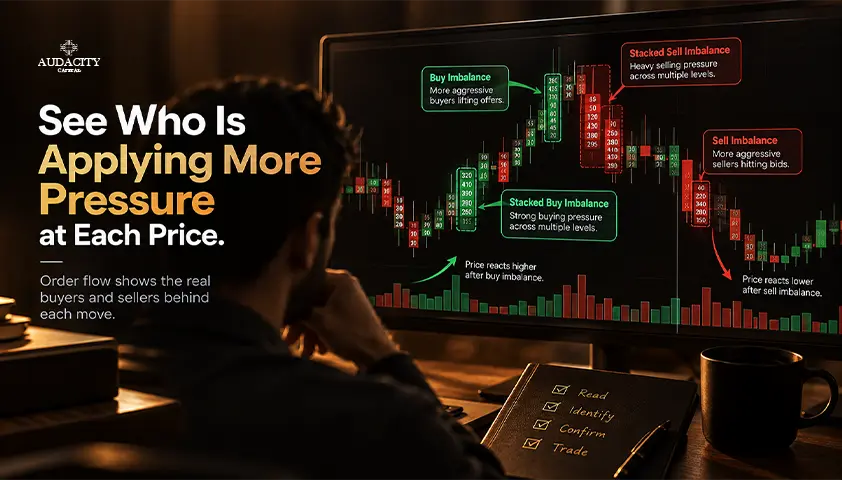
Order Flow Imbalance: How to Read Buy and Sell Pressure
Learn what order flow imbalance means, how footprint and order book readings differ, and how traders assess buy and sell pressure with context.

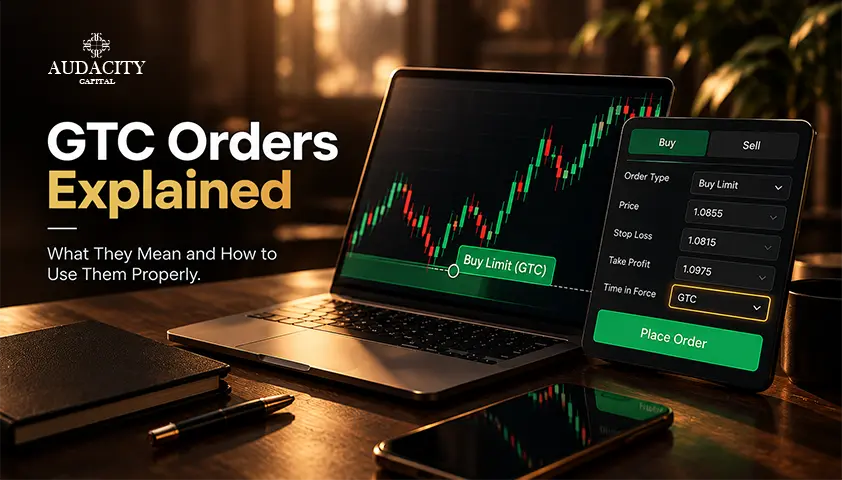
GTC in Trading: What Good Till Cancelled Orders Mean and How to Use Them Properly
Learn what GTC means in trading, how Good Till Cancelled orders work, when to use them, and the risks of leaving pending orders active.

Trade Deficit Explained: Causes, Effects and Markets
What a trade deficit is, what actually causes it, why it can widen in a strong economy, and why the textbook currency rule often fails.
Pin Bar Candlestick: How to Identify and Trade It
What a pin bar candlestick is, how it differs from a hammer, the two entry methods compared, and why location does most of the work.