



Forex Trading Tax Uk


Forex trading is not automatically tax-free in the UK, and the honest answer to “is forex trading tax free in UK” depends entirely on how someone places the trade. Forex trading tax UK rules split sharply by products:
- Spread betting generally sits outside Capital Gains Tax and Stamp Duty, since HMRC treats it as gambling and not investment.
- CFD trading and spot forex profits usually fall under CGT, currently taxed above a £3,000 annual allowance at 18% or 24% depending on income.
- Trade frequency, organisation, and whether trading counts as a main income source can push HMRC to classify the activity as a business, bringing Income Tax into play instead.
- Spread betting generally sits outside Capital Gains Tax and Stamp Duty, since HMRC treats it as gambling and not investment.
- CFD trading and spot forex profits usually fall under CGT, currently taxed above a £3,000 annual allowance at 18% or 24% depending on income.
- Trade frequency, organisation, and whether trading counts as a main income source can push HMRC to classify the activity as a business, bringing Income Tax into play instead.
So, do you pay tax on forex trading UK? Sometimes yes, sometimes no, and the product you choose decides which answer applies.
Do You Pay Tax on Forex Trading in the UK?
Well, it depends. HMRC doesn’t have a single tax category labelled “forex trading”. Three separate questions decide the answer to “is forex trading taxable in the UK”:
What product are you trading? Spread betting, CFDs, and spot forex sit under different parts of UK tax law, and each one starts from a different default position before anything else gets considered.
How is your activity classified? HMRC sees whether any trading classifies as private investment, occasional speculation, or an organised commercial trade. That classification decides whether Capital Gains Tax or Income Tax applies.
What are your taxable gains and allowances? Net gains are measured against the relevant allowance, whether that’s the Capital Gains Tax Annual Exempt Amount or the Personal Allowance for income, alongside the tax band that applies.
A Glance at Forex Trading Tax
Trading method | Potential UK tax treatment | Key consideration |
Spread betting | Generally outside CGT for individuals | Individual circumstances and commercial scale still matter |
CFD forex trading | Potentially subject to Capital Gains Tax | Net gains, allowable losses and the annual exempt allowance |
Spot/other forex products | Depends on the specific instrument | Contract terms decide the treatment, not the word "forex" |
Trading as a business | May trigger Income Tax instead | HMRC weighs overall scale, frequency and organisation |
Tax on forex trading UK does not come down to a single rule but to which row of that table actually applies.
What Type of Forex Trading Are You Doing?
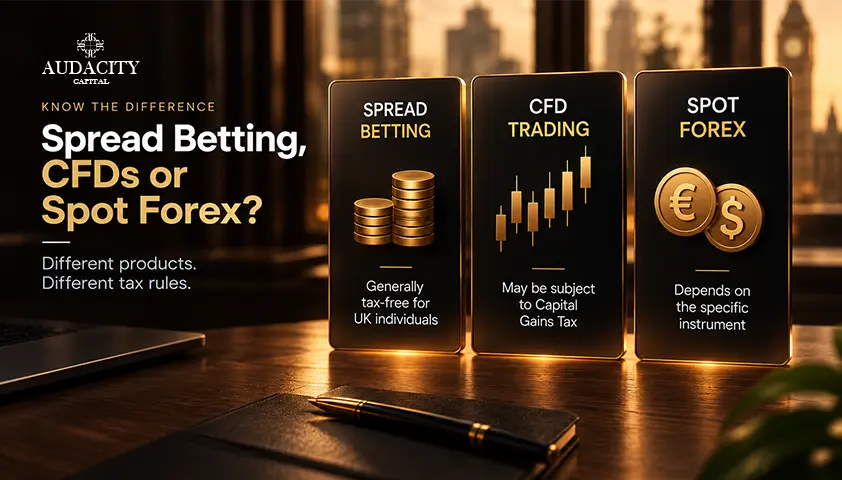
"Forex" is a market, not a single product, so the word by itself says nothing about which tax rules apply.
Forex Spread Betting
This means staking money per point of movement in a currency pair, with no ownership of the underlying currency changing hands. HMRC classifies retail spread betting as gambling.
CFD Forex Trading
A CFD is a contract to exchange the difference in a currency pair’s value between the position’s opening and its close. HMRC groups CFDs with other derivative contracts, financial futures and options among them, a distinct category from spread betting’s gambling treatment.
Spot Forex and Other Forex Products
Spot forex covers direct currency conversion or simply holding foreign currency. Currency is a chargeable asset for CGT purposes on its own, and the exemptions that exist. The currency held for personal expenditure abroad is the main one, don’t extend to active trading for profit.
Funded/Prop Trading Arrangements
Here, a trader operates a firm’s allocated capital and keeps a share of whatever profit results, a setup that looks quite different from trading a personal account.
Forex Trading Tax: Spread Betting vs CFDs
The tax gap between financial spread betting and CFD trading is one of the sharpest divides in UK retail trading. Understanding this is crucial before you choose either product.
Spread Betting
For UK individuals, spread betting is usually tax-free. HMRC’s own Business Income Manual (BIM22015) says that placing a spread bet doesn’t normally amount to carrying on a trade. TCGA 1992s.51 (1) exempts betting winnings from Capital Gains Tax outright. And since no underlying asset ever changes hands, no Stamp Duty applies either.
That exemption has a limit, though. Wherever spread betting operates as part of an existing commercial business, HMRC can treat the profits as taxable trading income instead.
CFD Forex Trading
CFDs sit in a different regime. HMRC’s Capital Gains Manual treats contracts for differences under the same “financial futures” framework it applies to other derivatives under TCGA 1992 s.143. This means CFD gains generally fall within Capital Gains Tax. Net proceeds, after transaction costs and financing charges are measured against the Annual Exempt Amount once that allowance runs out.
The upside: Because CFDs sit inside the CGT regime, losses can offset other chargeable gains, something spread betting doesn’t allow.
Why the Difference Matters?
Because two traders running the same GBP/ USD position, same size, same direction, can owe entirely different amounts of tax. One pays nothing on the profit and gets no relief on a loss; the other tracks every gain and loss for CGT.
Spread Betting | CFD Trading | |
Capital Gains Tax | Generally exempt for individuals | May apply above the annual allowance |
Stamp Duty | Generally exempt | Generally exempt |
Loss treatment | Not usable as CGT losses | Losses may offset eligible gains |
Tax treatment | Depends on circumstances | Depends on circumstances |
Is Forex Trading Tax-Free in the UK?
UK forex trading does not have one universal tax treatment. It depends on the type of product and how you trade. Let’s understand it in both Yes and No scenarios separately.
When Forex Trading May Be Tax-Free?
Spread betting comes closest to a genuine Yes on the question “Is forex trading tax free in UK?”. As discussed earlier, HMRC classifies it as gambling, and TCGA 1992 s.51(1) removes betting winnings from Capital Gains Tax entirely (no Stamp Duty and no underlying asset to transfer).
For the typical retail spread bettor trading currency pairs, that means profit sits outside the tax system altogether. The exemption is narrower than it sounds, though, since it covers genuine private betting and not spread betting carried out as part of an existing business.
When Forex Trading Is Not Tax-Free?
Now you move past spread betting and the answer to “is forex trading taxable in the UK” will suddenly shift. CFD trading remains within the Capital Gains Tax framework, so profits are counted against the Annual Exempt Amount and taxed above it.
Since holding or trading currency directly makes it a chargeable asset outside a handful of narrow personal-use exemptions, spot forex and other financial products follow their own rules too. And no matter which product is used, HMRC can still classify the overall activity as a trade based on frequency, scale and intention, which brings Income Tax into play instead of CGT. Being tax-free is a narrow exception here, so don’t count it as a general feature of forex trading.
How Is Forex Trading Taxed in the UK?
In the UK, forex profits fall under different tax regimes. Which particular regime depends on how you trade and how HMRC classifies the activity. The actual difference is whether your profits are trading income, capital gains, or company profits.
Capital Gains Tax on Forex Trading
So Capital Gains Tax applies when forex trading, particularly CFDs or spot currency held outside narrow exemptions, produces a gain that HMRC treats as investment activity. Each tax year, your overall capital gains are reduced by allowable losses and reliefs before the Annual Exempt Amount (AEA) is applied. For individuals, the AEA is £3,000 for the 2025/26 tax year, meaning CGT is generally due only on gains remaining above that allowance.
Once gains exceed that allowance, the applicable rate depends on total income (18% for gains that fall within the basic rate band, and 24% for gains above it) following the rate changes introduced in the October 2024 Budget.
Losses matter here too. Where CFD losses are allowable, they can offset other chargeable gains in the same year or be carried forward, which lowers the overall CGT bill. These figures change from year to year, so checking the current Annual Exempt Amount and rates before filing matters more than relying on a fixed number.
Income Tax on Forex Trading
Income Tax can apply instead of CGT where an individual's activity amounts to a trade. HMRC assesses this from the facts and circumstances of the activity as a whole. Relevant indicators can include the frequency and repetition of transactions, how the activity is organised, the nature of the transactions, and the intention behind them. HMRC says that a profit-seeking motive can support a finding of trade, but is not conclusive on its own.
Where activity is treated as trading, the resulting profits are generally dealt with under the Income Tax rules. Where the activity is carried on as self-employment, National Insurance obligations may also arise, depending on the circumstances.
The distinction is therefore not simply whether someone trades full-time or part-time. The relevant question is whether the nature and pattern of the activity, considered as a whole, amounts to a trade for tax purposes.
Corporation Tax and Forex Trading
Trading through a limited company changes the tax treatment. Company profits is under Corporation Tax, and the rate depends on the level of taxable profits. For 2025/26, the main rate is 25%, while a 19% small-profits rate applies to profits of £50,000 or less, with Marginal Relief available between £50,000 and £250,000.
When Does HMRC Consider Forex Trading a Business?
HMRC does not apply a single numerical test to decide whether an individual’s trading activity amounts to a trade. It looks at the facts and circumstances, with the established “badges of trade” providing useful indicators, as explained in HMRC’s guidance on the badges of trade.
Factors HMRC May Consider
HMRC does not rely on one factor to determine whether an activity amounts to a trade. Its guidance draws on the established “badges of trade”, developed through case law and summarised in the Business Income Manual. HMRC also stresses that the weight given to each factor depends on the precise circumstances and that the overall picture matters.
For financial instruments, however, HMRC notes that the badges of trade have limitations and that the facts and circumstances should be considered as a whole.
- Frequency: Systematic and repeated transactions can support the conclusion that an activity amounts to trading, although frequency alone is not decisive.
- The nature of the transactions: HMRC considers the character of the activity and whether the transactions have the features of trading. It doesn’t simply assume that frequent transactions are a trade.
- Organisation: The way the activity is organised can be relevant, although HMRC cautions that organisation or sophistication alone does not automatically turn investment activity into a trade.
- Intention: An intention to make a profit can support a trading conclusion, but HMRC says it is only one factor and is not conclusive by itself. The stated intention may also be tested against the surrounding circumstances.
- Scale and pattern of activity: The number and frequency of transactions, together with the wider pattern of activity, can help HMRC assess whether the activity has the character of a trade.
- Overall circumstances: No single badge normally settles the question. HMRC's guidance says the facts should be considered together to form an overall view of whether the activity amounts to a trade.
Is There a Profit or Frequency Threshold?
No. There is no fixed number of trades or profit figure that automatically means someone is carrying on a trade. HMRC says that even an isolated transaction can potentially amount to a trade, while repeated transactions may support a trading conclusion; ultimately, the specific facts and circumstances have to be considered together.
Example: Making hundreds of trades does not, by itself, establish that someone is trading as a business for tax purposes. Likewise, a low number of transactions does not automatically mean the activity is an investment. HMRC's guidance emphasises the character of the activity as a whole.
How Much Tax Do You Pay on Forex Trading in the UK?
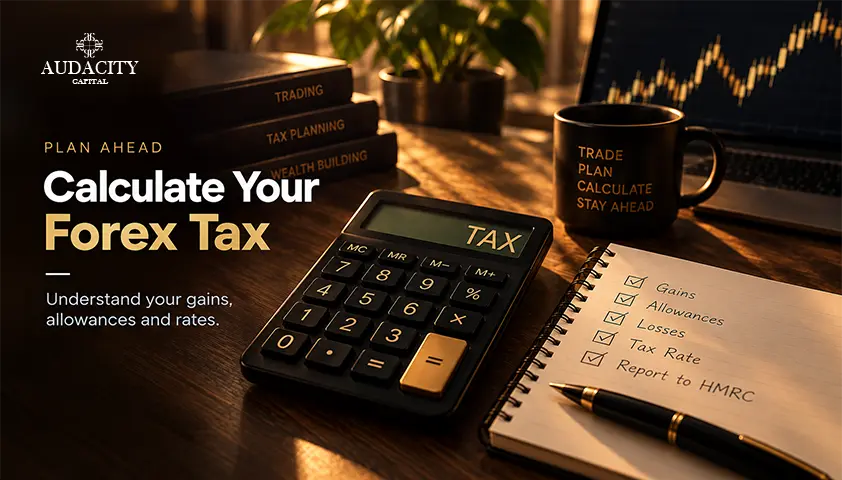
There's no single how much tax do you pay on forex trading UK figures. The actual bill depends on the product traded, the applicable allowance, and also which band the gain or income falls into.
Here’s a Forex Trading Tax Example
Take an individual retail trader operating a CFD forex account who is a higher-rate taxpayer (suppose earning a salary above £50,270):
- Total Realized Capital Gains: £15,000
- Total Realized Allowable Losses: £4,000
- Net Capital Gain: £11,000 (£15,000 − £4,000)
- Annual Exempt Amount (AEA): £3,000
- Net Taxable Gain: £8,000 (£11,000 − £3,000)
Because the trader is a higher-rate taxpayer, the applicable CGT rate on financial assets is 24%.
- Total Tax Liability: £8,000 × 24% = £1,920
[cite: 2, 6]
If the same trader executed identical transactions through a tax-free financial spread betting account, the total tax liability would be £0.
How to Calculate Your Forex Tax?
Calculate your Forex Trade with this five-step process:
Step 1: Identify the product - Find out if the trades ran through spread bets, CFDs, spot FX, or a prop firm agreement. It is a crucial step as it decides everything downstream.
Step 2: Determine the tax treatment - Check whether the product falls under a CGT exemption, standard CGT rules, or Income Tax.
Step 3: Calculate gains or income - Add up every closed position across the tax year, factoring in financing fees, rollover costs, and commissions, and convert any foreign currency to Sterling using the HMRC exchange rate on the transaction date.
Step 4: Apply losses and allowances - Offset allowable losses from this year or earlier ones, then deduct the £3,000 Annual Exempt Amount or the Personal Allowance.
Step 5: Check the reporting requirement - Compare the net gain or turnover against the current Self-Assessment thresholds to confirm whether a return is actually needed.
How to Report Forex Trading Profits to HMRC?
If your forex trading is taxable, you'll need to report it to HMRC through a Self-Assessment tax return. The form depends on whether profits are treated as capital gains or trading income.
How to File a Self-Assessment?
Yes, a return is required where CGT is owed on CFD or spot forex disposals, where total disposal proceeds pass £50,000 in a tax year regardless of the actual gain, or where self-employment trading income clears the £1,000 trading allowance.
Reporting Capital Gains
CGT from CFDs or non-exempt forex activity goes on the SA108 Capital Gains Summary within the main SA100 return, covering total proceeds, allowable costs and the net gain.
Reporting Trading Income
Where HMRC treats the activity as a trade, or where prop firm payouts apply, profits get declared as self-employment income on SA103 instead, with allowable expenses itemised.
UK Tax Year and Deadlines
The tax year runs 6 April to 5 April. Key dates:
- 5 October to register for Self Assessment for the first time.
- 31 October for paper returns.
- 31 January for online returns and payment.
- 31 July for a second payment on account where it applies.
What Records Should Forex Traders Keep?
Keep records for at least 22 months after the tax year ends if not self-employed, or five years from the 31 January filing deadline if self-employed. Either way, that means trade dates, instrument, entry and exit price, position size, profit or loss, fees, full broker statements, and deposit and withdrawal records.
Can You Claim Forex Trading Losses?
Because spread betting sits outside the tax system for retail individuals, losses from it work the same way profits do: they simply don't count. There's no offsetting a spread betting loss against a CFD gain, a stock gain, or any Income Tax liability, since the activity never enters the CGT or Income Tax framework in the first place.
Capital Gains Losses from Applicable Forex Trading
Losses from CFD trading or spot forex work differently. They're recognised as allowable capital losses, set against any chargeable gains realised in the same tax year first. Whatever remains carries forward indefinitely, provided it's formally reported to HMRC within four years of the end of the tax year the loss occurred in. Not every loss qualifies automatically, and losses generally can't be set against ordinary Income Tax unless the trading itself is classified as a self-employed business.
Keep Records of Your Losses
Claiming loss relief means formally reporting the loss on SA108 or notifying HMRC directly, backed by clear broker documentation.
Forex Trading Tax for Day Traders in the UK
Trading frequently doesn't settle the tax question on its own. Placing dozens of trades a day doesn't automatically turn someone into a professional business in HMRC's eyes, and holding a position for minutes instead of months doesn't automatically make the profit taxable or tax-free either. What actually matters is the underlying product and the broader pattern of the activity.
A day trader working a spread betting account can execute constantly and still owe nothing, since the product itself sits outside CGT. A day trader running the same pace through CFDs pays CGT on net profit regardless of how short each trade was held, while keeping the right to claim losses along the way.
Do Funded Forex Traders Pay Tax in the UK?
A prop trading arrangement sits differently from trading a personal account for tax purposes. Since a funded trader never actually owns the brokerage capital or the positions taken with it, the payout received looks more like payment for a service delivered under contract than a gain from disposing of a personal asset. That interpretation leans toward Income Tax and Class 2/4 National Insurance, reported through the SA103 self-employment pages, treating it much like other performance-based contractual income instead of a straightforward capital disposal on SA108.
Nothing here comes from explicit HMRC guidance written specifically for prop trading payouts, since the structure is still relatively new and firm contracts vary. Given how much rides on getting this right, individual professional advice before filing is worth more than relying on a general assumption.

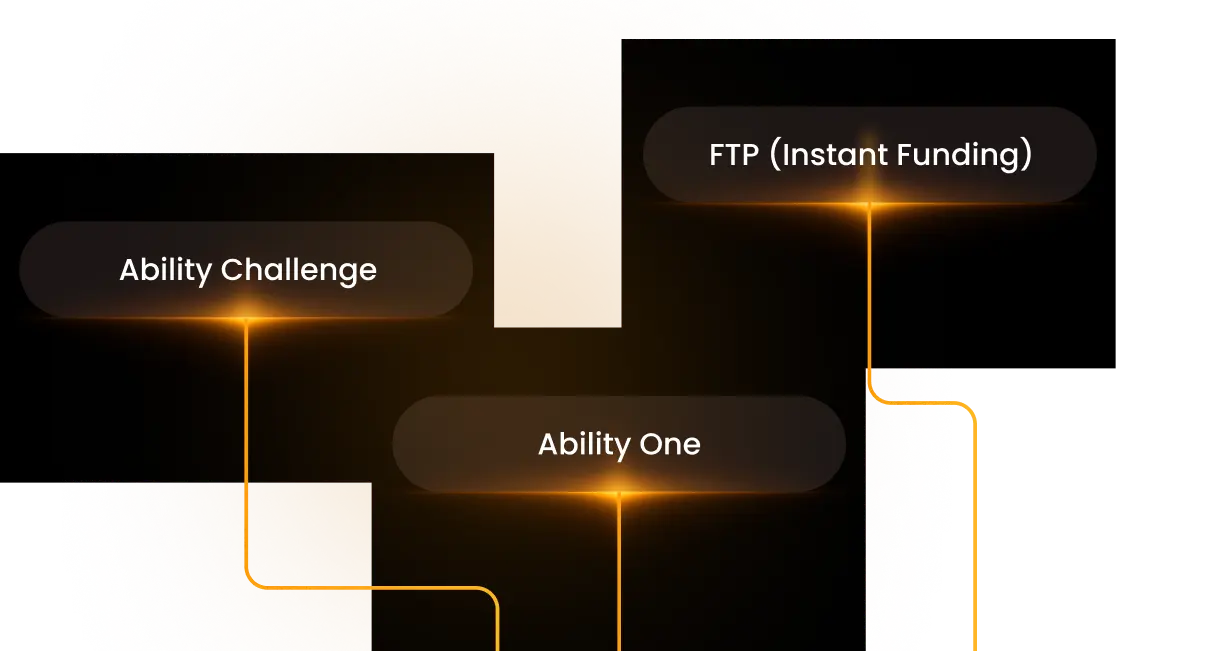
Funded Trader Program
Get Funded NowCommon Forex Tax Mistakes in the UK
A handful of errors show up repeatedly among UK forex traders:
- When traders assume all forex trading is tax-free, but that exemption mainly applies to spread betting.
- Or, when one thinks every profit falls under CGT, missing cases HMRC treats as a trade or prop income.
- Mixing up spread betting and CFDs, treating a taxable position as exempt.
- Using an outdated allowance instead of the current £3,000 exemption.
- Missing the 4-year deadline to claim allowable losses.
- Discarding broker statements needed to prove gains and losses.
- Applying old CGT rates instead of today's 18% and 24%.
- Thinking that trade frequency alone settles tax treatment.
- Thinking that full-time trading automatically means Income Tax applies.
Frequently Asked Questions About Forex Trading Tax UK
No, not automatically. Forex trading tax UK treatment depends on the product used, whether CGT, Income Tax, or the gambling exemption for spread betting applies.
It depends on the product and circumstances. Do you pay tax on forex trading UK has no single yes or no answer.
CGT runs at 18% or 24% above the £3,000 allowance. Trading classed as a business faces Income Tax at 20% to 45% instead.
Generally yes, on CFD or spot forex profits above the £3,000 Annual Exempt Amount, giving rise to capital gains tax on forex profits UK.
Yes, generally. HMRC treats spread betting as gambling, and TCGA 1992 s.51(1) exempts winnings from Capital Gains Tax for individuals.
Yes. HMRC treats CFDs under the financial futures framework in TCGA 1992 s.143, so profits above the allowance attract CGT.
Frequency alone doesn't decide it. Tax depends on the product traded and whether HMRC classifies the overall activity as a business.
CFD losses can offset other chargeable gains and carry forward if reported within four years. Spread betting losses aren't deductible.
Report gains on SA108 or trading income on SA103, both filed as part of a Self Assessment return by 31 January.
Likely, though treatment isn't settled by explicit HMRC guidance. Payouts generally look like self-employment income, so professional advice is worth seeking.
Guides About Forex For Beginners

Готовы применить дисциплинированный риск к криптовалютам? Изучите новые криптоинструменты Audacity Capital и примените свою торговую стратегию.
Узнать большеРассылка
Подпишитесь на нашу рассылку.
Присоединяйтесь к нашему сообществу

Начните свое путешествие сегодня с нашей бесплатной пробной версией
С гордостью демонстрируйте свои навыки и достижения с помощью сертификатов и получайте признание за свой тяжелый труд и преданность делу от потенциальных инвесторов и коллег.
Бесплатная пробная версияПохожие статьи
Why Every Trader Sees The Chart Differently ?
Unlock the secrets of trader chart interpretation. Understand why different traders see the same chart differently and how it affects trading.


What Are The Risks Of Forex Trading For Beginners?
Understand the risks of forex trading for beginners. Learn about the potential pitfalls and challenges involved in the forex market.

Struggling To Face Losses In Forex Trading? Here’s How To Bounce Back
Learn how to recover from losses in forex trading with proven strategies, mindset tips, and a step-by-step plan to rebuild confidence and trade consistently.
How Do Professional Traders Manage Their Risk While Trading?
Discover the importance of risk management in trading. Learn how to mitigate losses and increase your chances of success in the forex market.