



10 Best News Trading Strategies in 2026



Economic releases and breaking headlines move markets faster than almost anything else a trader will encounter. A single interest rate decision or inflation print can send a currency pair hundreds of pips in minutes, and that concentrated volatility is exactly what news traders set out to capture. The catch is that the same volatility that creates opportunity also punishes anyone who turns up without a plan.
This guide breaks down 10 of the most effective news trading strategies professional traders use in 2026. These news trading strategies are designed to help traders prepare for major economic releases, manage volatility, and identify high-probability trading opportunities.
Key Takeaways
- News trading means positioning around scheduled data releases and unexpected events that trigger sharp bursts of volatility and volume.
- There is no single best method. Aggressive strategies such as the straddle and momentum breakouts chase the initial move, while patient strategies such as retracement entries and confirmation trading wait for the dust to settle.
- Spreads widen, liquidity thins, and slippage increases in the seconds around a major release, so execution quality matters as much as direction.
- A reliable economic calendar and an understanding of consensus forecasts are the foundation of every approach on this list.
- Position sizing and predefined exits protect you far more than any entry signal, because the biggest risk in news trading is not being wrong, it is being wrong with too much size.
What Is News Trading?
News trading is the practice of taking positions based on how markets react to information. That information usually falls into two buckets. The first is scheduled data, such as inflation reports, employment figures, central bank rate decisions, and gross domestic product releases, all of which appear on the economic calendar in advance. The second is unscheduled events, such as geopolitical shocks, surprise central bank interventions, or unexpected corporate announcements.
What unites both is a sudden repricing. When new information hits, traders across the world adjust their expectations at the same moment, and that collective adjustment shows up as a rapid move in price. Volume surges, spreads can widen sharply, and a market that was drifting sideways for hours can travel a full day's typical range in a matter of minutes.
The releases that tend to generate the largest reactions include central bank decisions from the Federal Reserve, the European Central Bank, the Bank of England, the Bank of Japan, and the Reserve Bank of Australia, along with inflation data such as the UK Consumer Price Index and eurozone flash estimates, and labour market reports like the US Non-Farm Payrolls and the UK employment figures. Because these releases are timed to specific hours in their home regions, a trader in one time zone may be watching a key print at breakfast while another catches it at midnight, so planning around the calendar in your local time is essential.
With that foundation in place, let's explore the news trading strategies that traders use to prepare for and react to major market-moving events. Each news trading strategy has different strengths depending on volatility, market conditions, and your trading style.
Read Our Complete Guide to News Trading on Prop Firms
How to Choose the Right News Trading Strategy
Not every news trading strategy is suitable for every trader. Beginners often prefer confirmation-based approaches that reduce exposure to the initial volatility, while experienced traders may use breakout or straddle techniques during major economic releases. The right strategy depends on your trading experience, preferred markets, and ability to manage risk under fast-moving conditions.
There is no single news trading strategy that works in every market condition. The most successful traders adapt their approach based on the type of economic release, prevailing market conditions, and their individual risk tolerance.
10 Best News Trading Strategies
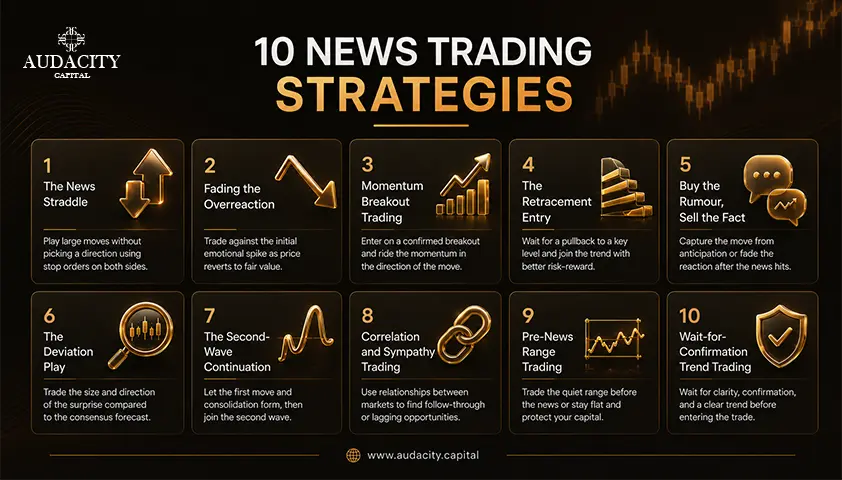
The news trading strategies below vary in complexity, risk, and execution style. Some are designed for experienced traders who are comfortable with fast-moving markets, while others focus on waiting for confirmation before entering a position. Comparing them side by side can help you decide which approach best suits your trading experience and risk tolerance.
News Trading Strategy | Best For | Risk Level | Experience |
|---|---|---|---|
News Straddle | High-impact events | High | Advanced |
Momentum Breakout | Strong trends | Medium | Intermediate |
Retracement Entry | Pullbacks | Medium | Intermediate |
Buy the Rumour, Sell the Fact | Scheduled events | Medium | Intermediate |
Deviation Play | Economic surprises | High | Advanced |
Second-Wave Continuation | Trend continuation | Medium | Intermediate |
Correlation Trading | Multi-market analysis | Medium | Advanced |
Pre-News Range Trading | Low volatility | Low | Beginner |
Wait-for-Confirmation | Conservative trading | Low | Beginner |
1. The News Straddle
The straddle is the classic news trading approach for events where a large move is likely but the direction is genuinely uncertain. Ahead of the release you place a buy stop order a set distance above the current price and a sell stop order the same distance below it, linked as a one-cancels-the-other pair. When the release drops and price breaks out, one order triggers and the other cancels automatically, so you are carried into the move without having to predict which way it will go.
This works best on high-impact, binary events such as interest rate decisions or inflation surprises, where the outcome could reasonably push price either way. The great advantage is that you do not need to forecast the result, only the fact that a strong move is coming.
The risk is whipsaw. In fast, illiquid conditions price can spike through your buy level, trigger the order, then reverse and stop you out before running the other way. Slippage on entry can also be severe, meaning you get filled well beyond your intended level. To manage this, keep your entry brackets sensible rather than too tight, and accept that some releases will produce a false break. The straddle rewards you when a release delivers a clean, sustained move and frustrates you when the market chops.
2. Fading the Overreaction
Markets frequently overreact to the first read of a headline, then retrace once cooler analysis sets in. Fading the overreaction, sometimes called mean reversion trading, does the opposite of the crowd. You wait for the initial emotional spike, then trade against it, back toward the pre-news price or a reference level such as the day's opening range.
This approach suits releases where the surprise is minor, where the figure broadly matches what was already priced in, or where an initial knee-jerk move runs into an obvious level and stalls. Experienced traders look for signs of exhaustion, such as a long wick against the move or volume drying up at the extreme, before stepping in.
The danger is obvious. If the news represents a genuine shift, fading it means standing in front of a real trend, and that can be a fast way to accumulate losses. This is why strict, predefined stops are non-negotiable. Fading is a strategy for traders who can read momentum and exit quickly when they are wrong, not for anyone hoping the market will eventually come back.
3. Momentum Breakout Trading
Where fading bets against the first move, momentum breakout trading rides it. Rather than trying to catch the exact moment of release, you wait for price to close beyond a defined level, a prior high or low, or the edge of the pre-news range, then enter in the direction of that thrust and hold for the follow-through.
Momentum trading comes into its own when a release deviates sharply from consensus, because a genuine surprise tends to produce a directional move that keeps going as more participants react. Entering on a candle close beyond the level, rather than at the first flicker, filters out some of the noise and gives you a clearer signal.
The trade-offs are late entry and fakeouts. By waiting for confirmation you sacrifice the very first part of the move, and in choppy conditions a break can reverse the moment you commit. A sound approach places the stop back inside the range you broke out of, so a failed breakout costs you a controlled amount while a real one lets you run.
4. The Retracement Entry
The retracement entry is the patient trader's answer to chasing. Instead of jumping in on the spike, you let the initial move play out, then wait for price to pull back to a level before entering in the direction of the underlying trend. Common pullback zones include a broken support or resistance level that now acts in reverse, a moving average, or a Fibonacci retracement of the initial thrust.
The appeal here is risk-reward. By entering on the pullback rather than at the extreme of the spike, you can place a tighter stop and aim for a much larger reward relative to your risk. You are effectively letting the impulsive crowd take the first, riskiest part of the move, then joining once a cleaner structure appears.
The limitation is that not every release offers a retracement. Some moves run in a straight line and never give you the pullback you are waiting for, leaving you on the sidelines. That is an acceptable cost. A missed trade is far cheaper than a bad entry, and over time the discipline of only taking clean pullbacks tends to improve consistency.
5. Buy the Rumour, Sell the Fact
One of the oldest sayings in markets describes a very real pattern. In the run-up to a widely anticipated event, traders position in advance, driving price in the expected direction. Then, when the event arrives and simply confirms what everyone already expected, those same traders take profit and unwind, so price reverses against the news even though the outcome was as forecast.
You can trade this in two ways. The first is to ride the anticipation, entering during the build-up and taking profit into the event itself. The second is to fade the reaction, positioning for the reversal that often follows a well-telegraphed result. This pattern shows up regularly around central bank meetings, scheduled policy announcements, and corporate earnings, where expectations are heavily built into price beforehand.
The skill lies in judging how much is already priced in. If the market has fully anticipated an outcome, the confirmation is unlikely to push price much further, and the unwind becomes the trade. If the event delivers a genuine surprise, the rumour-and-fact logic breaks down and momentum takes over instead. Reading market positioning and sentiment ahead of the release is what separates a good expectation trade from a guess.
6. The Deviation Play
The deviation play is a more analytical approach that focuses on the gap between the actual figure and the consensus forecast. The logic is straightforward. Markets price in the expected number ahead of time, so it is the surprise, the deviation from forecast, that drives the move. The larger the gap between actual and expected, the larger the reaction tends to be.
To trade it you need three things: the consensus forecast, the actual release, and a clear understanding of how a given data point maps to direction. A stronger-than-expected inflation or employment figure, for example, typically supports the relevant currency, while a sharp miss tends to weaken it. When the actual print lands far from consensus, you trade in the direction the surprise implies, sizing your conviction to the scale of the deviation.
This strategy demands preparation and speed. You must know in advance what each release means and be ready to act within seconds, because the market processes the surprise almost instantly. Small deviations rarely justify a trade, so the deviation player is selective, waiting for the releases that genuinely diverge from expectations and standing aside when a figure lands close to forecast.
7. The Second-Wave Continuation
Not every opportunity is in the first spike. After the initial burst of volatility, markets often pause and consolidate into a tight range as participants digest the release. Frequently, once that consolidation resolves, price makes a second move in the same direction as the original reaction. The second-wave continuation targets exactly that break.
Rather than fighting the chaos of the initial print, you let the first move and the consolidation form, then enter on the break of that post-news range in the direction of the dominant trend. Because you are trading a cleaner, more defined structure, the entry is often lower risk than the frantic first few seconds, with a stop that sits neatly on the other side of the consolidation.
The catch is that not every release produces a tidy second wave. Sometimes the initial move is the whole story and the consolidation simply fades into range-bound drift. The discipline here is to require a genuine breakout of the consolidation with momentum behind it, rather than anticipating a continuation that may never arrive.
8. Correlation and Sympathy Trading
Markets do not move in isolation, and correlation trading exploits that fact. When a release moves one instrument, it often moves correlated instruments in sympathy, sometimes with a slight lag that creates opportunity. Oil inventory data, for instance, tends to move the Canadian dollar given the currency's link to energy exports. Gold often reacts to shifts in the US dollar and real yields. A major bank's earnings can drag its whole sector along with it.
The strategy involves trading a correlated instrument that has not yet fully caught up to the news-driven move in the lead instrument, or using the strength of a move in one market to add conviction to a trade in another. It rewards traders who understand intermarket relationships and can spot when one asset is lagging the signal coming from another.
The risk is that correlations are not fixed. They strengthen and weaken over time and can break down entirely during periods of stress, when everything moves together on fear rather than fundamentals. Treat correlation as a probability, not a guarantee, and confirm that the relationship is actually holding before you lean on it for a trade.
9. Pre-News Range Trading
Ahead of a major, scheduled release, markets often coil into an unusually tight range as participants hold back and wait. Pre-news range trading works within that quiet window, either by fading the edges of the range in the minutes before the announcement or, just as importantly, by using the period to prepare and then deliberately staying flat through the release itself.
This is as much a risk strategy as an entry strategy. For traders operating under strict drawdown limits, such as those managing funded accounts, the safest response to an unpredictable high-impact event is often no position at all. Sitting out the release, then re-engaging once conditions clarify, removes exposure to slippage and whipsaw at the worst possible moment.
If you do choose to fade the pre-news range, keep positions small and exit well before the release, because holding a range trade into the announcement exposes you to exactly the violent break the range was suppressing. The core discipline of this approach is knowing when the right trade is to protect capital rather than to chase a move.
10. Wait-for-Confirmation Trend Trading
The most conservative strategy on this list is also one of the most reliable for newer traders and for anyone bound by tight risk rules. Instead of trading the release, you wait. You let the initial spike, the whipsaw, and the consolidation all play out, often for fifteen to thirty minutes, and only then, once a clear direction has established itself, do you trade in line with that trend and the broader market context.
By waiting for confirmation you give up the explosive first move, but you also sidestep the phase where most news traders get hurt. Spreads have usually normalised, liquidity has returned, and the market has revealed its genuine reaction rather than its emotional first flinch. Entries taken with the confirmed trend tend to be cleaner and easier to manage.
The obvious cost is opportunity. You will miss trades that resolve quickly and never look back. For traders whose priority is survival and consistency over maximum capture, particularly those working through evaluation programmes with strict daily loss limits, that is a trade worth making. Slow and clean beats fast and reckless when your account depends on staying inside the rules.
Risk Management for News Trading
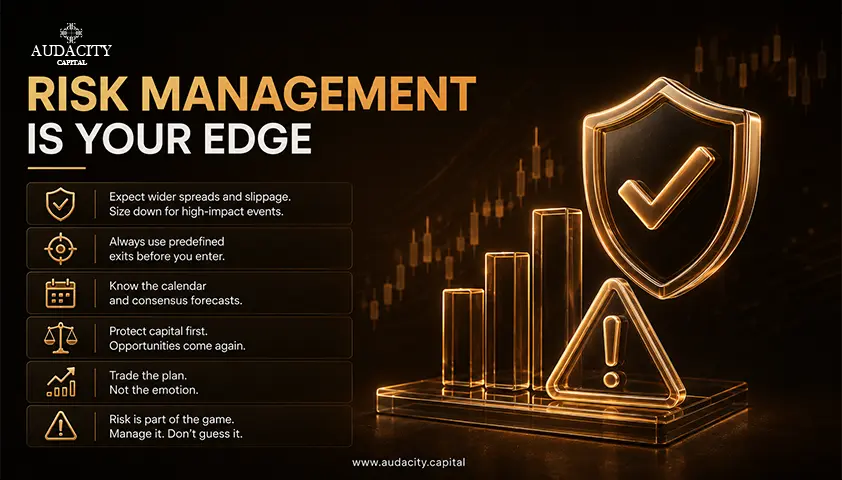
Even the best news trading strategies will fail without proper risk management. Successful traders understand that protecting capital is just as important as finding profitable entries, especially during periods of extreme market volatility.
Spreads widen and slippage increases in the seconds around a major release, so a stop placed at a specific level may be filled some distance away. Account for that when you size a position, and never assume you will exit at your exact stop price during a violent move. Position sizing should reflect the elevated volatility. Reducing your normal size around high-impact events keeps a single bad fill from doing outsized damage.
Build every trade around a predefined exit before you enter, not after. In the heat of a fast move, the decision to cut a loss is far harder to make well, so make it in advance. Keep a reliable economic calendar open and know the consensus forecasts for the releases you intend to trade, because trading news without knowing what was expected is trading blind. Finally, respect the events you do not understand. If you cannot explain how a release maps to price, the disciplined choice is to stay flat and wait for the setups you do understand.
Conclusion
Choosing the right news trading strategy depends on your experience, trading objectives, and tolerance for risk. Some news trading strategies focus on capturing the initial breakout, while others wait for pullbacks or confirmation before entering. By testing different approaches and applying disciplined risk management, you can identify the strategy that best suits your trading style.
Related Articles
How Do Traders Build Live Setups Around Major News Events
Frequently Asked Questions
It can be, but only with the right approach. The aggressive strategies such as straddles and fading demand fast execution and experience reading momentum. Newer traders are usually better served by the wait-for-confirmation method, which avoids the most dangerous moments around a release and lets a clear trend form before committing.
Central bank interest rate decisions tend to produce the largest and most sustained moves, followed by inflation data and major labour market reports. Because these are scheduled to specific hours in their home regions, check the timing in your own time zone so you are not caught off guard by a release that lands overnight.
In the moments around a major release, liquidity providers pull back to avoid being caught on the wrong side of a sudden move. With fewer participants quoting prices, the gap between the buy and sell price widens, and orders can be filled some distance from the intended level. This is a normal feature of news conditions and one you must budget for.
Not necessarily, but avoiding it is a perfectly valid strategy, especially if you are managing an account with strict drawdown limits. Some traders build their entire edge around news volatility, while others deliberately stay flat through releases and trade only the calmer periods. Both are legitimate. The wrong choice is trading news without a plan.
It is central to several of these strategies, particularly the deviation play and the buy-the-rumour approach. Markets price in the expected figure ahead of time, so it is the surprise relative to forecast that drives the reaction. Without knowing what was expected, you cannot judge whether an actual figure is bullish, bearish, or already fully priced in.
Yes, and experienced traders often do. You might, for example, plan to stay flat through the initial release, then look for a retracement entry or a second-wave continuation once a direction is confirmed. The key is to decide your approach before the release rather than improvising in the middle of the volatility.

Готовы применить дисциплинированный риск к криптовалютам? Изучите новые криптоинструменты Audacity Capital и примените свою торговую стратегию.
Узнать большеРассылка
Подпишитесь на нашу рассылку.
Присоединяйтесь к нашему сообществу

Начните свое путешествие сегодня с нашей бесплатной пробной версией
С гордостью демонстрируйте свои навыки и достижения с помощью сертификатов и получайте признание за свой тяжелый труд и преданность делу от потенциальных инвесторов и коллег.
Бесплатная пробная версияПохожие статьи

Prop Firms That Allow News Trading
Compare prop firms that allow news trading. See news restrictions, trading windows, drawdown, payouts, platforms, and weekend holding rules.

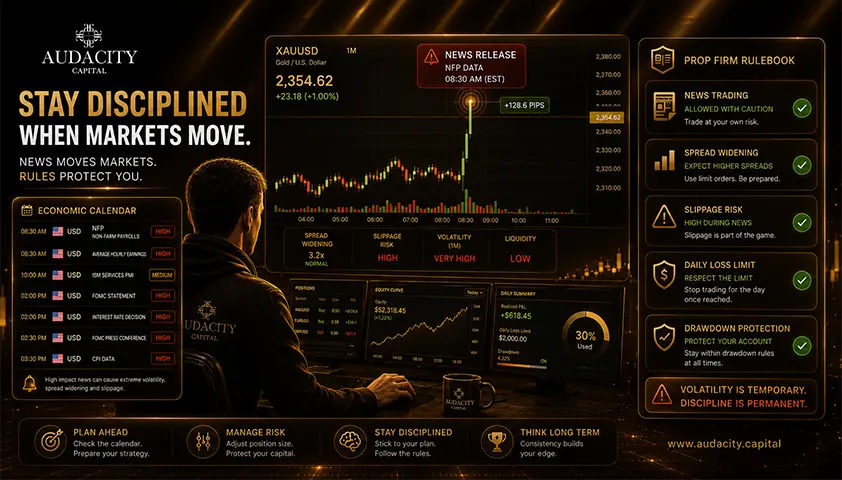
News Trading on Prop Firms: Rules, Risks and Strategy
A clear, honest guide to news trading on a prop firm: the rule models, the real slippage risks, and a responsible strategy. Learn what firms allow and how to trade news without breaching your limits.