


What Is Spread in Trading? Meaning, Calculation and How It Affects Your Trades


Those new to trading often end up with one common query: what is spread in trading? The question sounds simpler than it really is.
Spread in trading is basically the gap/ difference between “the price available to sell” and “the price available to buy”. Traders can see both selling and buying price in their trading platform but it’s only the difference that lies in between effect their trade directly.
Spreads matter most for those traders who either work with small price movements or trade frequently. The gap that looks small on one trade can suddenly become noticeable after multiple trades. This can also change when the market starts moving quickly or when liquidity falls.
So, instead of assuming that spread is just another number on the screen, let’s find out where it came from, how to calculate it, and how it affects your trade.
What Is a Spread in Trading?
The spread is the small gap between the price you can sell at and the price you can buy at. In market terms, these are called the Bid and the Ask.
- The bid shows what buyers are currently prepared to pay.
- The ask shows what sellers are currently asking for the asset.
And the gap between them is the Spread.
In numbers:
- Bid: ₹2,500
- Ask: ₹2,501
- Spread: ₹1
If you buy at ₹2,501 and then decide to sell immediately, you would receive the bid of ₹2,500, assuming those prices are still available. You therefore start with a ₹1 difference to recover before the trade can move into profit, excluding other applicable trading costs.
This is where beginners sometimes misunderstand the spread. Some mistake it for the separate brokerage fee that gets added later.
Also, the spread doesn’t stay at the same level throughout the trading day. There are narrower gaps in more active and liquid markets, whereas spreads get wider during lower liquidity and fast-moving conditions.
Direction alone will mislead you here. If your strategy aims for small moves, the spread can take a meaningful part of that move before you have even considered commission or slippage.
Bid Price vs Ask Price: How Does the Spread Work?
Spread is not just one price, and that’s the best way to understand it. Buyers and sellers quote different prices for the same asset at any given moment.
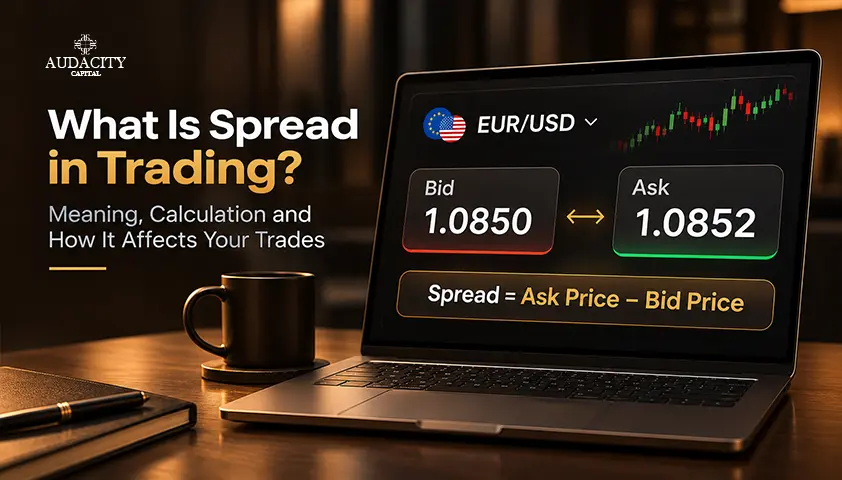
In case, if EUR/USD is quoted as:
- Bid: 1.0850
- Ask: 1.0852
The trader who wants to sell at the available market price is dealing with 1.0850. The trader who wants to buy straight away is dealing with 1.0852. There is a gap between the two, and that gap is the spread.
So why does the price you see on a chart sometimes look different?
It looks different because charts generally display the last traded price, basically the price at which the latest transaction happened. But that doesn’t mean the buyer or seller after you will get that exact price. In an exchange order book, the best bid and best ask can sit on either side of the latest transaction. Many market data feeds separate LTP from the current bid and ask quotes, which is a useful illustration of the difference.
This is worth knowing before using a market order. Suppose the current ask is 1.0852, and now if you see it at 1.0850 as the latest traded price, it doesn’t mean you can buy it at 1.0850.
The same idea applies when you sell. You work with the available bid, not simply the number displayed as the last traded price.
Once you understand that, the spread becomes much easier to follow. It is the space between the two sides of the market, and the size of that space can change as orders and market conditions change.
How Is Spread Calculated?
The calculation itself is straightforward. You take the ask price and subtract the bid price.
Spread = Ask Price − Bid Price
For example, suppose EUR/USD is showing:
- Bid: 1.0850
- Ask: 1.0852
The calculation is:
1.0852 − 1.0850 = 0.0002
For EUR/USD, that difference is 2 pips.
The part that often confuses is what those 2 pips mean in money. A spread is quoted as a price difference, but the actual cost depends on the size of the position you take. A larger position gives the same price difference a larger monetary effect.
You also need to consider what you are trading. A forex pair may use pips, while other markets can quote their spread in points, ticks or the actual currency value of the instrument.
So, when comparing spreads, don't stop at the number shown on the platform. Look at the instrument and the size of the position as well.
For a quick check:
Spread in price = Ask − Bid
Spread in pips = Price difference ÷ pip size
The maths is simple. Working out what that difference means for your actual trade requires a little more attention.
What Does a Spread Cost You?
The spread becomes a cost when you trade because you do not normally enter and leave a position at the same side of the market.
Suppose EUR/USD has a 2-pip spread. You buy at the ask, while the price available to sell is the bid. If nothing else changes, closing the position immediately would leave you on the wrong side of that 2-pip difference.
The market therefore has to move in your favour before the trade covers the spread and any other costs that apply.
When you want to capture small price movements, this becomes even more important. See the difference:
Trading approach | Reason why spread matters for different trading approaches |
A small target can leave little room after the spread is accounted for. | |
Intraday trading | The spread still matters, although the expected move may be larger. |
A larger expected move can make the spread a smaller part of the trade. | |
Fast market conditions can make the available spread change quickly. |
A trader aiming for 3 pips is dealing with a very different cost problem from someone looking for an 80-pip move. The spread has not changed simply because the strategy changed. Its importance to the trade has.
This is also why a low spread should not automatically be treated as the best trading condition. Execution, liquidity, slippage, and commission can affect the final cost as well.
The useful question is not just “How many pips is the spread?” It is “How much of the move I am trying to capture will the trading cost take away?”
What Causes Spreads to Widen or Narrow?
Spreads are not fixed throughout the market. They move with trading conditions, and this is why the spread you see during one part of the day may look quite different later.
- One of the main reasons is liquidity. When there are plenty of buyers and sellers around the current price, there is usually more competition between available quotes. This can keep the spread narrower. When fewer orders are available, the gap between buying and selling prices can become wider.
- Volatility is another factor to watch. When the market moves quickly, prices can change before you get a fresh quote. The people providing those prices have to keep changing them, and that can make the spread wider.
- When you trade also matters. Some times of day are much busier than others. When it is quiet, there is less liquidity.
- News can flip things in seconds. A central bank decision, inflation report, or jobs report can bring a lot of buying and selling at once. But that does not always make spreads tighter. When prices are moving fast, quotes become less stable.
Spreads can also behave differently around:
- Market openings and closures
- Thinly traded periods
- Unexpected economic or political events
- Less liquid currency pairs and instruments
This is why quoting one “normal” spread for an instrument can be misleading. The spread is a reflection of the market conditions at that particular time.
Fixed vs Variable Spreads: What's the Difference?
There are two basic ways a spread can be presented to a trader.
- With a fixed spread, the provider keeps the quoted difference at a set level under its stated trading conditions. The main advantage is predictability. A trader knows roughly what spread to expect rather than watching it change with every shift in market activity.
- A variable spread moves with the market. It narrows when liquidity is strong, and widens when liquidity falls or prices start moving quickly.
A fixed spread looks attractive for a different reason. It is stable, so it is easier to plan around. But do not judge an account by that number alone. It does not tell you whether the overall trading conditions are better. A variable spread can be very competitive in active periods, and a lot less attractive in volatile ones.
Instead of asking which type is best, look at the conditions around it:
- What spread is normally available?
- Does it widen around major news?
- Is commission charged separately?
- How is execution handled?
- How often does slippage occur?
- Are there any trading restrictions?
The better choice is the one that fits the way you actually trade, rather than the one with the more attractive number on the account page.
Spread vs Commission vs Slippage: What's the Difference?
These three terms are often put together because they all affect the cost of trading. They are not, however, the same cost.
- The spread is already present in the buy and sell prices you receive. You do not normally see it as a separate charge on your account because it is part of the quoted price.
- A commission is different. It is a charge applied separately by the broker or trading provider. An account may therefore offer a very small spread and still have a commission attached to each trade.
- Slippage happens at execution. You place an order expecting one price, but the trade is filled at another price because the market has moved or the available liquidity has changed.
Cost | In simple terms | It’s Importance |
Spread | The gap between buying and selling prices | Every time you trade |
Commission | A separate charge applied to the trade | Depends on the account |
Slippage | The difference between the price expected and the price received | More noticeable in fast markets |
This is worth understanding before comparing trading accounts. A provider advertising a very low spread is not necessarily offering the lowest cost overall.
The same applies to execution. A tight spread does not stop an order from being filled at a different price when the market is moving quickly.
For that reason, look at spread as one part of the total cost of trading, not as the whole cost.
Why Do Spreads Matter More for Some Trading Strategies?
A spread that looks small on paper can become a much bigger issue when the trading strategy is built around small price movements.
1. For scalpers, this is particularly important. If a trader is trying to take a few pips from several short-term moves, the spread takes up a larger part of the expected return. Trading costs can build up quickly when the number of trades is also high.
2. An intraday trader has more room for the spread to become a smaller part of the trade. A position targeting a larger move does not face the same proportion of cost as a very short-term trade, although the spread still needs to be included when judging the setup.
3. For swing traders, the expected price movement is normally much larger. The spread may therefore have less influence on the final result, particularly when a position is held for several days.
4. News trading is different again. Around major announcements, prices can move quickly and the available bid and ask prices can change just as fast. A spread that looked acceptable before the release may not remain that way once the market reacts.
Now, forget "Is this spread low?" for a second. The real question is, "Is this spread reasonable for the size and frequency of the moves I am trying to trade?"
How Can Traders Reduce the Impact of Spreads?
You cannot practically be free from the impact of spread whenever trading about bid and ask. What a trader can control is the situation in which they enter and the amount of trading cost they are taking on.
Before opening a position, check:
- The current spread: Is it close to what you normally see for that instrument?
- Market conditions: Has volatility increased or liquidity become thinner?
- Total charges: Is there a commission in addition to the quoted spread?
- Position size: A wider spread has a larger monetary effect when the position is larger.
- Expected move: A small expected move leaves less room for trading costs.
- News timing: Major releases can cause pricing to change quickly.
This does not mean avoiding every period of high volatility. Some strategies are built around those periods. The point is to know what the spread is doing before the order reaches the market.
What Does Spread Mean in Forex Trading?
Forex traders normally talk about spread in pips. It is just a simpler way to measure the difference between bid and ask.
It can change during the session too; it is not locked in. Currency pairs with active trading and strong liquidity can have tighter pricing at some times, while the difference between bid and ask can increase when market conditions become less stable.
The pair itself also matters. A heavily traded major currency pair may have a different spread from a less liquid currency pair, and the same pair can show different pricing conditions at different times.
For forex traders, this makes the spread part of the trade's entry cost. It is one of the numbers worth checking before deciding whether the available price makes sense for the strategy.
Spread in Indian Currency Trading: What Should Traders Know?
For someone trading in India, spread needs context. You are not just trading just one type of product.
NSE lists currency futures and options such as USDINR, EURINR, GBPINR and JPYINR. It also lists cross-currency contracts including EURUSD, GBPUSD and USDJPY.
So the spread you get depends on the instrument and its quoting style.
NSE's contract specifications also show that these products have defined contract sizes and tick sizes. For example, one USDINR futures contract represents USD 1,000, while GBPINR represents GBP 1,000.
So an Indian trader comparing spreads should first identify:
- The exact currency product.
- Its contract size.
- Its tick size.
- The quoted bid and ask.
- The charges applied by the broker.
That gives a more useful picture of trading cost than comparing a spread number on its own.
How Do Indian Traders Check the Spread Before Entering a Trade?
Checking the spread should be part of the order preparation, not something a trader thinks about after the position is open.
For an Indian exchange-traded currency product, the process can be kept simple:
- Look at the current quote.
- Identify the bid and ask.
- Note the difference between them.
- Check the traded volume and open interest for context.
- Look for unusual price movement before entering.
- Add brokerage and other trading costs to the calculation.
NSE's currency derivatives market data displays LTP alongside spread, volume and open interest, so traders can see that the most recent traded price is not the same piece of information as the current spread.
The same habit applies outside currency markets: check the actual trading quotes you can transact against, not just the last price shown on the screen.
Spread Trading vs Spread in Trading: Are They the Same?
“Spread” and “spread trading” are not interchangeable terms.
- Spread in trading means the gap between two quoted prices, usually the bid and ask.
- Spread trading is a trading approach. It involves taking positions in related assets or contracts based on the relationship between their prices.
The first is something you encounter when placing a trade. The second is a strategy built around price differences between instruments.
This distinction also matters for search intent. Someone asking what is spread in trading is usually looking for an explanation of bid and ask pricing. Someone searching for spread trading may be looking for a strategy involving related markets or contracts.
What Is a Good Spread in Trading?
A good spread is one that is reasonable for the market and trading conditions you are dealing with. There is no universal cutoff that works for forex, equities, futures and every other instrument.
Before judging a spread, consider:
- What asset are you trading?
- How liquid is the market?
- What is normal for that instrument?
- How large is your position?
- How far is the trade expected to move?
- Are there commissions or other charges?
The same quoted spread can have very different consequences for two traders. A short-term trader entering and exiting frequently will usually pay more attention to small pricing differences than someone holding a position through a much larger expected move.


Trading With Audacity Capital
Trade TodayConclusion
Every quote has a spread. It looks small, but its effect depends on the market, your trade size, and your trading strategy. When you understand the bid and ask, you can see where the cost comes from and why it shifts during the day.
But for prop traders, spread alone is not enough. You need to look at commissions, execution conditions, drawdown rules, and other restrictions too. Choosing based on the whole trading environment is far more useful than choosing because a programme advertises a low spread.
FAQs
It is the difference between the price available to sell and the price available to buy an asset.
“Spreads” is simply the plural form, referring to the bid-ask differences found across instruments or at different points in the market.
To calculate a spread, use this simple formula:
Ask price − Bid price = Spread
No. The spread is reflected in the quoted prices. Separate costs, such as commissions, may also apply depending on the account or provider.
Spreads can change when liquidity falls, volatility rises or important economic information causes rapid changes in market pricing.
No. A low quoted spread can still come with other costs or different execution conditions.
No. Spread trading is a strategy based on the relationship between prices of related instruments. A spread in trading is a pricing difference.

Ready to apply disciplined risk to crypto? Explore Audacity Capital's new crypto instruments and bring your trading strategy.
Learn MoreNewsletter
Join our newsletter to stay up to date on features and releases.
Join Our Social & Community

Start Your Journey Today With Our Free Trial
Proudly showcase your skills and accomplishments through certificates and get recognition for your hard work and dedication from potential investors and peers.
Free TrialRelated Articles

How To Choose The Right Prop Firm – A Complete Checklist
Learn how to choose the right prop trading company with our expert guide. Compare fees, rules, profit splits, and platforms to trade confidently.


10 Best Futures Prop Firms for Swing Trading In 2026
Compare the best futures prop firms for swing trading in 2026 with overnight holding, flexible rules, fast payouts, and funded accounts.

Introducing Ability One: One Step To Funding With Static Drawdown

The First 30 Days: What New Traders Should Focus On (And Ignore)