


Prop Firms With No Consistency Rule in 2026



Prop firms with no consistency rule let a trader hit a profit target. However, the wins land- one big session or ten small ones- without a formula dictating how that profit gets spread across the days. Other rules still apply, and they differ meaningfully between operators and even between account tiers at the same firm. Reading the specific rulebook before funding a challenge is essential no matter how flexible the marketing sounds.
What Is a Consistency Rule in Prop Trading?
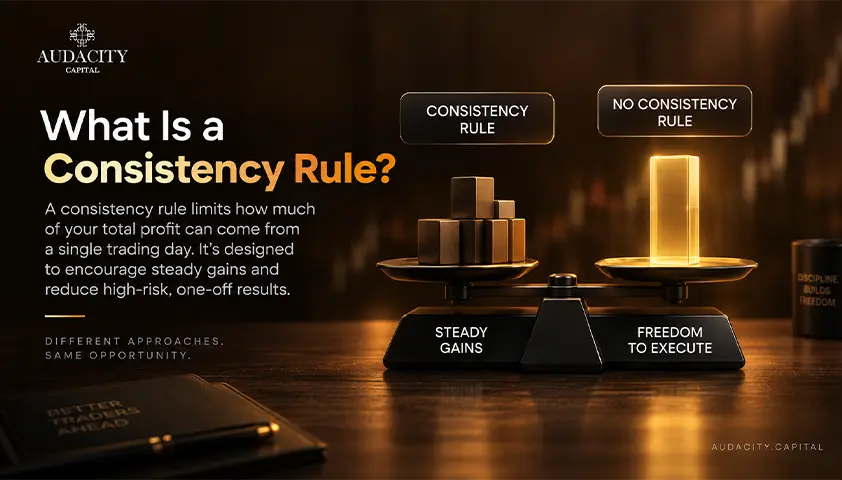
At its simplest, a consistency rule prop firm limits how concentrated a trader's profit can be in any single session. It sits on top of the profit target as a second condition, one about the shape of the gains.
The math behind it is fairly standard across the industry:
Divide the profit from the single best trading day by the total profit earned over the evaluation window, then express that as a percentage. A 30% cap means the biggest day can't make up more than three-tenths of the whole.
The logic behind adding this rule comes down to risk. Traders who reach a target on the back of one oversized session, often by loading up on leverage during a volatile news event, tend to blow through their funded account faster than traders who build profit gradually. The rule exists to weed out the first group before real capital is on the line.
That creates real friction for a certain kind of trader, someone whose strategy depends on a few big, well-timed moves rather than constant small wins. Say a trader nets $2,400 over five sessions, and $1,600 of that came from one outsized Tuesday chasing a rate decision. That single day accounts for roughly two-thirds of the total profit, more than double a typical 30% threshold, even with every trade staying inside the account's drawdown rules.
Comparing that structure against prop firms with no consistency rule only makes sense once this baseline is clear, which is exactly where the difference starts to matter.
What Does "No Consistency Rule" Mean?
Prop firms with no consistency rule simply don't require profit to be split evenly across trading days or sessions. A trader can hit the full profit target in one session or spread it across fifty, and the firm counts the total the same either way.
That said, no consistency rule doesn't mean no rules at all. This distinction matters as much for trust as it does for search rankings. Even prop firms with no consistency requirements lean on a full set of other safeguards to protect their own capital while leaving profit distribution alone. A trader examining funded accounts with no consistency rule should expect some combination of the following:
- Daily drawdown limits, usually a fixed percentage of account balance measured from the server's midnight reset.
- Maximum overall drawdown, tracked either as a static line or a trailing one that follows the account's peak balance.
- Stop-loss requirements, mandating a protective stop on every position within a set window of opening it.
- Prohibited strategy frameworks, ruling out tick scalping, latency arbitrage, or multi-account hedging.
- News-trading restrictions, blocking new positions for a short window around major economic releases.
- Weekend holding rules, requiring all positions to be closed before the Friday close.
- Lot-size and exposure caps, limiting total position size relative to account balance.
- Payout and active-day conditions, often a minimum holding period before funds can be withdrawn.
A no consistency rule prop firm trades one specific constraint for a different set of them. That's exactly why prop firms without consistency rule stipulations still publish full rulebooks covering drawdown, strategy, and payout terms, worth reading in full before funding any account.
Best Prop Firms With No Consistency Rule
A homepage banner saying "no consistency rule" rarely tells the whole story, which is exactly why anyone comparing best prop firms with no consistency rule options needs to look one level deeper.
Prop Firm | Consistency Rule | Max Drawdown | Daily Loss Limit | Profit Share | Funding | Payout Rules |
Audacity Capital | None during Ability One or Ability Challenge evaluation; a Consistency Score, roughly 40% rising to 50%, applies once funded | 15% static (Challenge), 10% static (Live) | 7.5% (Challenge), 5% (Verification/Live) | Up to 90% | Ability One, Ability Challenge (2-Step), Funded Trader Program | Bi-weekly payouts once live; static drawdowns; news trading and weekend holding allowed |
Alpha Futures | None on Zero evaluation; 50% cap on Standard and Advanced evaluation, easing to 40% funded on Standard, dropped entirely funded on Advanced | EOD trailing, plan dependent | 2% to 4%, plan dependent | 70% rising to 90% | One-step evaluation: Zero, Standard, Advanced plans | Payouts tied to minimum winning days; up to $15K cap per request on higher tiers |
Phidias | Reportedly none on Express to Live and Standard lines; a 30% cap is said to apply on cash-funded tiers, unconfirmed directly on Phidias's own site | Static or end-of-day, plan dependent | Plan dependent | Up to 90% | Express to Live, Standard Challenge | Company reports fast processing, often under 30 minutes |
Blue Guardian | Rules and percentages differ by tier and division and have changed more than once in 2026; verify directly before assuming any tier is rule-free | 6% to 10%, plan dependent | 2% to 4%, plan dependent | Up to 90% | Standard, Guardian, Instant (futures); separate forex tiers | Roughly every 14 days |
FundedNext | None on Stellar 2-Step, 1-Step, Lite, or Instant in either phase; Rapid Challenge waives it in evaluation only; Bolt applies 40% in both | Plan dependent | Plan dependent | 70% to 95% depending on account | Stellar and Rapid (CFD); Bolt (futures-style) | 24-hour payout guarantee; wait times from immediate to 21 days by account |
The5ers | None on Hyper Growth or Bootcamp; High Stakes and Pro Growth require a minimum number of profitable days instead of a hard cap | 5% to 6%, plan dependent | 3% to 5%, plan dependent | 50% rising to 100% on top scaling tiers | High Stakes, Hyper Growth, Bootcamp, plus a Futures track | Bi-weekly, after an initial 14-day window |
FTMO | None on 2-Step Challenge and Verification; a Best Day rule applies on the 1-Step Challenge | 10% static (2-Step) | 5% (2-Step), 3% (1-Step) | 80% base, scaling to 90% | 2-Step Challenge, 1-Step Challenge | First payout available 14 days after funding |
Take Audacity Capital as the clearest example of why the fine print matters. Nothing stops a trader from chasing a windfall day during the Ability One or Ability Challenge evaluation, but the moment that account goes live, a Consistency Score kicks in and gets tighter with each payout cycle. Any prop firm without consistency rule claim needs a stage attached to it, and here, the honest version is "no rule in testing, a rule once funded."
Alpha Futures handles it by account tier instead of by stage alone. The Zero plan has no rule anywhere, fast enough that traders sometimes clear it in a single session. Advanced keeps a rule during evaluation but drops it completely once funded, which makes it the closest thing to a true no consistency rule prop firm for anyone who's already through the door.
Phidias claims no rule on its Express to Live and Standard lines, though a 30% cap reportedly shows up on cash-funded accounts specifically. That figure comes from outside reporting rather than Phidias's own published terms, so it's worth a direct check before assuming it applies to a given account.
FundedNext and Blue Guardian sit at opposite ends of how confident we can be. FundedNext's Stellar lineup, both the 1-Step and 2-Step versions, genuinely runs without a consistency rule at any stage, while its Rapid Challenge only waives it during the test. Blue Guardian is murkier. Its published rules have shifted multiple times through 2026, and tiers seem to carry different percentages depending on division, so nothing here gets stated as confirmed fact.
The5ers cuts the rule entirely on Hyper Growth and Bootcamp. High Stakes and Pro Growth don't use a percentage cap, but they do demand a minimum number of profitable days, a softer version of the same idea under a different name.
FTMO's split is simple by comparison. No best-day requirement on the 2-Step path that made the firm famous, but a Best Day rule shows up on the newer 1-Step Challenge, something traders coming from the classic FTMO model don't always expect.
The takeaway holds across the board. Prop firms with no consistency rule should be read as "not right now, for this account," not as a blanket promise that covers every product a firm sells.
Prop Firms Without a Consistency Rule Compared
Dropping the consistency check is only one piece of what separates these firms. Looking at prop trading firms without consistency rule conditions side by side shows the real gap sits in risk mechanics, payout timing, and how fast an account is allowed to grow.
Profit Rules
A firm can skip the daily cap and still hold a trader to an overall target, plus sometimes a minimum trading-day count. Most evaluation targets land somewhere between 6% and 10% of the starting balance. Instant funding routes usually drop the target entirely, but charge more upfront for that shortcut.
Drawdown Rules
Nothing shapes the outcome more than this one. A static drawdown anchors to the starting balance and stays put, so every dollar of profit widens the safety margin. A trailing drawdown climbs with the account's peak balance instead, meaning a strong session can quietly tighten the room to operate afterward.
Payout Conditions
With the profit-distribution check gone, firms find other ways to control cash flow. Some set an "active day" rule, a minimum gain, often around 0.5%, that a session needs to hit before it counts toward a payout. Others require a profit buffer, a balance floor that has to be maintained before a withdrawal is processed. Timelines swing from instant to a fixed 14 or 21 days.
Trading Restrictions
This is where firms diverge the most. Some allow trading straight through high-impact news; others freeze new entries for a window around it. Weekend holding splits the same way, and so does automated trading: some firms welcome an Expert Advisor, others require every trade to be placed by hand.
Account Scaling
Two models dominate. One doubles the account each time a trader clears a growth milestone, often a 10% profit mark, scaling as high as $2 million over time. The other adds a smaller slice, commonly 25%, on a set quarterly schedule instead of waiting for a big jump.
Available Platforms
The platform behind an account shapes execution quality directly. MetaTrader 5 remains the default across most firms, with cTrader, Match-Trader, DXtrade, and TradingView increasingly available as alternatives for traders who want different charting or order-routing options.
Why Traders Look for Prop Firms With No Consistency Rule?

Traders gravitate toward a prop firm no consistency rule setup for a few practical reasons, not because the model is automatically better. It simply fits certain trading styles more naturally.
- More flexibility in trading style. A trader can size up on a strong setup instead of rationing risk to avoid one oversized day.
- Larger profits from individual trades. Markets don't move evenly, and a handful of days often account for most of a year's gains. Removing the cap lets that show up without penalty.
- Less pressure to hit a daily target. Fixed consistency math pushes some traders to force a trade just to keep the ratio balanced. Dropping it removes that specific temptation.
- A better fit for swing traders. Positions held over several days naturally produce lumpy, uneven returns, which a strict consistency rule can penalize unfairly.
- More freedom to size positions. Lot sizes can scale with setup quality instead of being rationed to stay under a daily percentage.
- Less time spent on profit-distribution math. Skipping the ratio check frees up energy for actual risk management and execution.
Who Should Consider a Prop Firm With No Consistency Rule?
Not every trading style benefits from prop firms with no consistency rule, but for a few specific ones, it removes a real obstacle. The rule itself is only part of the picture, though. A firm's drawdown structure and daily loss limit matter just as much for whether any of these styles actually hold up.
Swing Traders
Holding a position across several days means catching a trend on its own timeline, not a calendar's. Trends move in bursts, so one strong swing trade can easily outweigh everything else traded that month. A firm running funded accounts with no consistency rule lets that single result count fully instead of getting stretched thin across quieter days.
Day Traders
Traders built around volatile sessions, central bank decisions, payroll data, and earnings prints tend to book the bulk of their monthly gains in a narrow window. Removing the consistency rule means that window's profit stays intact, and not forcing extra trades into slower sessions just to even out the ratio.
Scalpers
A scalper chasing quick order-flow moves can sometimes hit a full target within one session. With no consistency cap in place, there's no incentive to keep trading afterward. Stepping away once the target is met keeps execution costs and overtrading risk from eating into what was already earned.
Traders With Variable Position Sizes
Sizing up on a high-probability setup and sizing down elsewhere requires real freedom to move. A standard consistency rule works against that instinct, since one large winning day from a bigger position can trip the cap and stall a payout. Prop firms with no consistency requirements take that friction out of the equation.
Traders Using High-Conviction Setups
Some strategies wait for a narrow set of conditions and only trade a handful of times each month. When those conditions show up, the resulting trade often dwarfs everything else in that window. That rhythm fits a no-consistency structure far better than one built around daily distribution math.
No Consistency Rule vs Consistency Rule
Prop firms without consistency rule conditions and firms that keep one are built around two different philosophies for handling risk. The table below lays out where those philosophies actually diverge.
Feature | No Consistency Rule | Consistency Rule |
Profit distribution requirement | None; a single big day counts in full | Usually capped, typically 15% to 50% of total profit |
Handling a large single-day profit | Recognized immediately, payout proceeds once other conditions are met | Held back until later trading dilutes that day's share below the cap |
Trading flexibility | Higher, supports variable sizing and event-driven entries | More structured, rewards steady, evenly spread trading |
Daily profit target | Not required on its own | Indirectly encouraged, since concentrated gains can trigger the cap |
Other risk rules | Daily loss limits, max drawdown, and stop-loss rules still apply | Same risk rules apply, layered on top of the profit cap |
Are Prop Firms With No Consistency Rule Better?
Not necessarily, and anyone claiming otherwise is selling something. A prop firm no consistency rule structure removes one specific constraint, nothing more. It says nothing about whether the drawdown model is fair, whether payouts actually arrive on schedule, or whether the fee structure makes sense for the account size a trader can afford.
Flexibility is a real advantage for the right trading style, the kind covered earlier: swing trades, event-driven day trades, high-conviction setups. But flexibility on one rule doesn't offset a punishing trailing drawdown, a hidden inactivity fee, or a payout cycle that stretches past what a trader can plan around. A firm with no consistency rule and a harsh intraday trailing drawdown can be riskier overall than a firm that keeps a lenient consistency requirement paired with a fair, static drawdown.
The honest answer is that this one rule is a single data point. The full risk framework decides whether a firm is actually worth trading with.
What Other Prop Firm Rules Should You Check?
Reading past the consistency rule is where a lot of traders stop too early. Here's what still deserves a full check before funding any account.
Daily Loss and Overall Drawdown
Maximum daily loss sets the ceiling for how much an account can lose in one server day, and maximum overall drawdown sets the ceiling for the whole account. Check whether either one is calculated from balance or from equity, since equity-based limits count open, unrealized losses too, and that catches traders off guard more than almost any other rule.
Static vs Trailing Drawdown
A static drawdown stays fixed to the starting balance, so profit builds a permanent cushion. A trailing drawdown climbs with the account's peak balance instead, which means a strong week can quietly tighten the room left to operate. When comparing static vs trailing drawdown, this single detail often matters more than the consistency rule itself.
Profit Targets, Minimum Days and Time Limits
Most evaluations still set a profit target, commonly 6% to 10% per phase, and many require a minimum number of active trading days, often 3 to 5, before advancing. Fewer firms enforce a hard time limit these days, but it's worth confirming, since a slow, patient approach doesn't work under a strict deadline.
News Trading, Weekend Holding, EAs, Copy Trading and Hedging
Execution rules vary firm to firm. Some block new trades around high-impact news for a short window; others allow it freely. Weekend holding splits the same way. Expert Advisors and copy trading are permitted at many firms but restricted at others, and hedging rules range from unrestricted to banned outright depending on the platform and account type.
Payout Rules and Scaling Conditions
Payout terms decide how fast profit actually becomes usable money: initial hold periods typically run 14 to 21 days, followed by a recurring cycle and a minimum withdrawal amount. Scaling conditions determine how a consistently profitable account grows over time, sometimes doubling at set milestones, sometimes adding a smaller percentage on a rolling schedule, with profit splits climbing as high as 90% to 100% on the best programs.
None of these rules gets fixed by finding a firm with no consistency requirement. Each one deserves its own line-by-line check, in the current terms, not last year's review.
How to Choose a Prop Firm With No Consistency Rule?
To select an optimal proprietary trading program that works without profit distribution caps, traders should follow this systematic review checklist:
- First, check official terms to verify that single-day profit caps or trade distribution ratios are explicitly waived across evaluation and funded stages.
- Verify stage-by-stage conditions. Make sure that rules waived during the challenge phase do not reactivate once funded.
- Find out whether maximum drawdown is static or trailing, and calculate total usable risk room relative to daily loss limits.
- Check for hidden active-day rules, minimum payout thresholds, profit buffers, or withdrawal frequency caps.
- Check execution guidelines regarding news trading, weekend holding, EA usage, copy trading, and lot-size limits.
- Understand capital growth milestones to confirm how account balances double or scale up to $2M+.
- Check platform availability for trading infrastructure like MT5, cTrader, DXtrade, or TradingView.
- Compare upfront evaluation fees against drawdown allowances and profit splits to evaluate capital efficiency.
- Assess verified payout track records, firm operating history, broker liquidity connections, and customer support quality.
FAQs
A consistency rule is a risk control parameter enforced by proprietary trading firms that limits how much of a trader's total net profit can originate from a single trading day or position.
Several major prop firms offer programs without consistency rules, though coverage depends on the account stage. Audacity Capital waives consistency requirements across all program tiers (Ability One, Ability Challenge, and Funded Trader Program). Other firms waive consistency rules on funded accounts or specific plans.
In proprietary trading, "no consistency rule" means a firm does not restrict profit generation across trading sessions or require profits to be distributed according to a specific formula.
Yes, numerous proprietary trading firms offer funded accounts without profit distribution caps. But they replace consistency controls with alternative risk management parameters, such as daily loss limits, static or trailing drawdowns, and active-day requirements to manage operator risk exposure.
Many standard evaluation programs enforce consistency rules to filter out high-variance traders and encourage steady, repeatable gains. However, prop firms offering no-consistency programs explicitly allow variable return profiles, making them well-suited for swing traders, breakout specialists, and event-driven news traders.
Yes. Under a no-consistency model, a trader can earn 50%, 80%, or even 100% of their target profit in a single trading day and still qualify for challenge completion or payout processing.
Not automatically. While removing profit caps increases execution freedom, operators often balance this risk by introducing tighter trailing drawdowns or lower daily loss thresholds. A program's quality depends on how well its combined risk rules, drawdown structures, payout schedules, and account costs fit a trader's personal edge.
Yes. All legitimate proprietary trading firms maintain strict risk boundaries, including maximum daily loss limits and overall total drawdown ceilings (static or trailing), to protect firm capital from severe drawdowns.

Готовы применить дисциплинированный риск к криптовалютам? Изучите новые криптоинструменты Audacity Capital и примените свою торговую стратегию.
Узнать большеРассылка
Подпишитесь на нашу рассылку.
Присоединяйтесь к нашему сообществу

Начните свое путешествие сегодня с нашей бесплатной пробной версией
С гордостью демонстрируйте свои навыки и достижения с помощью сертификатов и получайте признание за свой тяжелый труд и преданность делу от потенциальных инвесторов и коллег.
Бесплатная пробная версияПохожие статьи

Trailing Stop Loss: How to Use It
How a trailing stop loss works, three ways to set the distance, the MetaTrader setting most traders get wrong, and what the trail costs you in return.


Trading Burnout: Signs and Recovery
How to tell trading burnout from a losing streak, the signs worth taking seriously, what recovery actually involves, and when to speak to someone qualified.

What Is BOS in Trading? A Complete Guide to Break of Structure (2026)
Learn what BOS in trading means, how Break of Structure works, how to identify bullish and bearish BOS, and how traders use it in market analysis.
Equity vs Balance in Trading: Which Number Matters
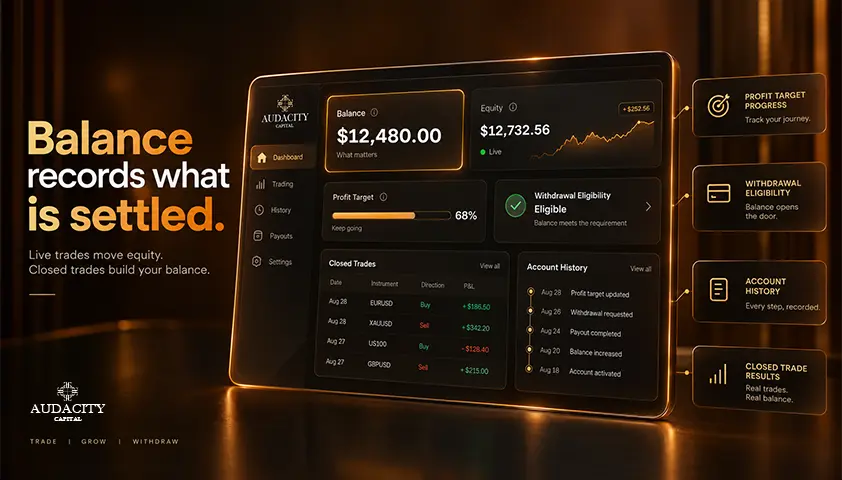
Equity vs balance explained: what each number includes, why margin calls and prop firm rules run on equity, and where your balance still decides things.