


Psychology of Greed in Trading


Introduction
Psychology of greed in trading is an interesting concept that explains why the desire to make more money can force traders to make irrational decisions. Greed can lead to poor risk management and even turn winning trades into losses. The need to accumulate wealth is normal for any trader, but when it interferes with your trading rules or plan, it becomes a problem.
Greed can affect both novice traders and experienced traders. Beginner traders want to buy assets without thoroughly analyzing them because they grew exponentially. On the other hand, experienced ones increase their positions without calculating the risks after a successful trade.
Such behaviors are often associated with overtrading, heavy leveraging, random entries, and losses that could have been avoided if the trader followed their initial plan. A strategy that seems to be working well can be easily thrown out of the window due to uncontrolled emotions.
It is critical to understand what causes the problem and how it can be solved. This article will discuss what greed is, the warning signs, and the effect it has on the trader. We will also go over the methods of coping with the psychology of greed in trading and explain how it can damage a trader’s account.
What Is Greed in Trading?
Greed in trading is the desire to make a bigger profit through a trade. It may cause traders to take profits that are not planned for, to raise the stop-loss level, and to take a higher risk than one can’t afford to lose. While it does not always result in financial gain, greed and the feeling of financial hunger are closely related.
What Separates Ambition from Greed?
Healthy ambition is the ability to define realistic goals regarding the profits from one’s trading or investments, have a trading plan, and be prepared for losing some of the money. Thus, an ambitious trader who is not greedy sets realistic profit goals, adheres to the trading plan, and is aware that now and then, he or she might lose some money.
However, the line between healthy ambition and greed is blurred. A trader who begins to think that he will make a profit in every trade or a bigger profit than expected is already in the process of becoming greedy. The main difference between healthy ambition and greed is the trader’s approach to his trading plan and willingness to cut losses.
How Greed Appears in Different Markets
Depending on the type of market, traders can exhibit different symptoms of greed. Forex traders, for example, may be tempted to use greater leverage to amplify gains, increasing the risk of trades going against them.
In stocks, traders may pursue stocks that have rapidly appreciated while ignoring possible risks or the fair value of the shares. Cryptocurrency traders may engage in a compulsive buying spree due to the sudden price increases and online pressure, which may cause them to be blinded by fear of missing out. In futures, traders may take a more significant number of contracts or increase leverage to capture higher yields, lowering standards for margin requirements.
These manifestations of greed can be a problem for any trader regardless of their experience level or account size. Understanding how to avoid these pitfalls will improve one’s risk management and lead to better trade planning.
The Psychology Behind Greed: Why Traders Want More
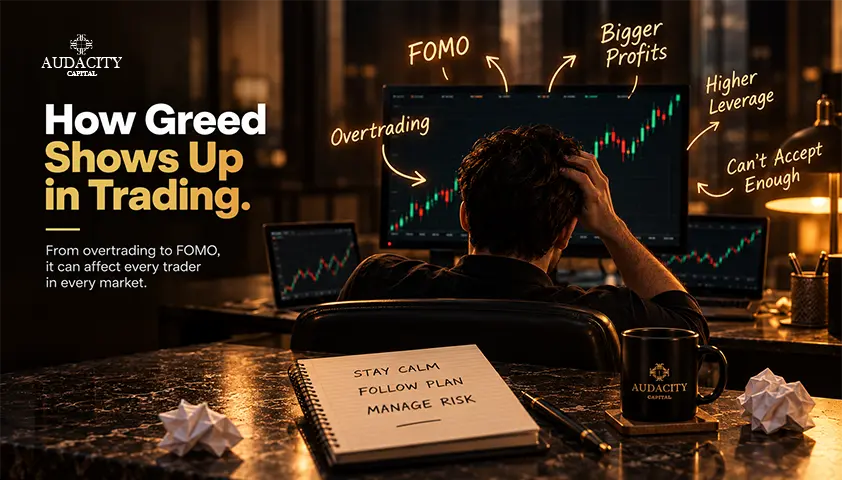
Greed in trading is usually the result of a number of psychological factors, including the reward circuit, decision-making process, and the very desire for success. Therefore, it is useful for a trader to try to recognize these factors in their personal psychological setting in order to determine the right measures on how to control emotions that lead to greed.
The Reward Cycle and the Desire for Bigger Profits
A successful trade is a happy trade, so one can be expected to feel good about a closing position, especially if it brought substantial gains. However, a trader who already made a successful trade might still feel the need to engage in the same behavior, which leads them to the reward. Such psychology often results in extra trades, which most of the time end in losses.
Overconfidence After Winning Trades
A succession of winning trades may lead to overconfidence, which may make a trader feel that they have greater control over the outcomes of their future operations than they should. As a result, a person may raise their position sizes, increase the risks per trade, and become more confident in their ability to predict the outcome of any given trade. But one should always remember that even the most well-established trading plans cannot predict future performance.
Fear of Missing Out (FOMO)
FOMO is a fear of missing out on some significant opportunities that may generate extraordinary profits. It is a common problem that may trigger rash buying and selling decisions with little regard for potential risks and drawbacks. For example, a trader can see a stock or cryptocurrency chart that is continuously rising and decide to join the rally at the peak of its growth. By entering late, the trader may purchase near a temporary price peak and face a reversal shortly afterward.
Social Comparison and Unrealistic Expectations
Social media may be a breeding ground for greed due to the possibility of having screenshots of large swings, exaggerated profits, and short-term success stories. As such, traders may experience unhealthy competition and set unreasonably high expectations for their own trades. Such posts do not always include crucial information about the situation, the struggles, losses, and costs of transactions.
The Difficulty of Accepting “Enough”
It may be hard to exit a winning trade early enough because one may believe that it can generate more gains. A trader may keep thinking that the trade will continue to make a profit, thus increasing the stop-loss point. However, one should always remember the initial plan and not let the desire for more money dominate.
Common Signs of Greed in Trading
Greed rarely comes in the form of a single manifestation. It normally affects the trader’s activity gradually and slowly changes their behavioral patterns. However, the signs of underlying greed can be identified to prevent them from evolving into a severe problem.
Holding Winning Trades for Too Long
The first warning sign of greed is the trader’s inability to close the trade in profit. A person continues holding the position after it has reached the designated profit target instead of securing the gain. The individual remains in denial of the possibility of losing the profits, and, as a result, some or all of the unrealized gains are wiped out during the next market move.
Increasing Position Sizes After a Winning Streak
Even if there has been a string of successful trades, it does not mean that the trader has discovered a foolproof strategy. Increasing the position size just because the winning streak has started can be very detrimental to the account. It creates a feeling of invincibility that can lead to catastrophic losses when the inevitable losing trade occurs.
Overtrading and Taking Low-Quality Setups
Being greedy can make one believe that they have to take every trade that comes their way. Not having the patience to wait for the best setups makes one take any opportunity to get involved in the market. The more one trades, the more they are bound to make errors and lose money.
Ignoring Stop-Loss Orders or Moving Profit Targets
One may take off their stop-loss order because they do not want to admit that they are wrong and that a trade is going against them. Another trader may move their profit target in an effort to make more money than they anticipated.
Chasing Market Moves
After a stock, pair of currencies, or cryptocurrency has just shot up, traders may open positions to try and capitalize on the move. However, entering after a strong move without assessing the situation may result in buying near a temporary peak.
Quick Self-Assessment: It is important to ask yourself these questions after a trading session:
- Have I changed my trading rules because I wanted to make more money?
- Did I increase my position size without a planned reason?
- Did I hold a winning trade longer than my original exit plan?
- Did I take trades that did not meet my usual criteria?
- Did I move or ignore my stop-loss or take-profit levels?
Answering “yes” to one or more of these questions may indicate that greed influenced your decisions more than your trading strategy.
How Greed Destroys Traders and Leads to Account Blowouts
Greed may adversely impact the performance of a trader because it may tempt him into making unwise decisions that place his account at risk. A single greedy act does not necessarily result in losses for the trader, but when done repeatedly, it can jeopardize an account.
Turning Profits into Losses
Traders often fail to take profits because they hope to add to their profits, hoping price will favor them. Many traders are happy to have an unrealized gain of $300. Instead of securing the profit, they decide to hold the position longer to earn more. If the market reverses, that profit could shrink to $50 or even turn into a loss. The problem is not aiming for a larger return; it is abandoning a planned exit without a sound reason.
Overleveraging and Oversized Positions
Using excessive leverage or trading positions that are too large can magnify the financial impact of price movements. This, in turn, may wipe out your account, leaving you with no capital to open the next good setups. Traders should understand these risks before increasing their exposure.
Revenge Trading After a Loss
After experiencing a loss, a trader who is desperate to recover the money may take impulsive actions. More often than not, the frustration associated with underperformance leads to revenge trading, which is characterized by increased position sizes, greed-induced entries, and ignoring the previously used trading strategy. Instead of closing the trade at a break-even point, such a trader leaves it open, hoping that the market will eventually move in their favor.
Breaking a Trading Strategy
When a trader randomly changes the size of positions, entry-exit rules, and profit targets, it becomes impossible to determine whether the initial strategy is profitable or not. As a result, one cannot tell if the success is due to the right strategy or luck.
Emotional Exhaustion and Financial Pressures
Excessive impulsive behavior can derail self-confidence, increase one’s frustrations, leading to a spiral of faulty decision-making. A trader’s finances can be adversely affected by such activities, which in turn fuel further impulsive behavior.
Realistic Trading Scenarios: Greed in Action.
Greed can certainly impact a trader’s performance in different ways and in different markets based on their experience. Below are a few examples of how the need for bigger profits can make one take unreasonable risks and lead to disastrous consequences.
Scenario 1: The Stock That Kept Going Up.
A trader buys shares of a company, which has recently shown a significant increase. They believe that it will continue to go up, so they purchase more, and eventually, they reach the profit target. However, the trader feels that they can still make more money and hold the position, which eventually starts losing value. The trader did not follow the plan and became greedy, leading to significant losses.
The lesson: Set realistic exit criteria and avoid changing them impulsively just because a trade is profitable.
Scenario 2: The Forex Trader That Increases Leverage.
As a consequence of a few successful trades, the forex trader becomes very confident that he knows how the market works. He/she decides to increase his/her position size to maximize profits from the favorable trades. However, since the trader lacks the skill to predict the turning point in the market, the larger position resulted in a larger loss than his/her previous trades.
The lesson: Previous wins do not guarantee future success. Position sizes should reflect predefined risk limits, not excitement or overconfidence.
Scenario 3: The Cryptocurrency FOMO Trade
As a trader, you see a coin that you haven’t invested in going up after reading social media posts and hearing people talk about how much they are making. You feel left out and panic as you believe you will miss out on the next big trade. As such, you jump in without determining your entry strategy, stop-loss, and take-profit. Then the market takes a dive, leaving you with a loss.
The lesson: Avoid chasing market movements without evaluating the risks and whether the trade fits your strategy.
Practical Strategies on How to Control Greed in Trading
The psychology of greed in trading is not only about knowing what causes greed, but also implementing measures to control greed in order to become profitable. There are several ways to control the feeling of greed in trading. These techniques will allow you to be rational and calm while making trades and managing your risks and profits.
Create a Trading Plan Before Taking a Position
Develop a trading plan that will help you trade without being clouded by emotions. Come up with criteria for entering and exiting a trade, setting stop-loss orders, targets, and acceptable risk for every trade. Moreover, it is vital to remember that once you have entered into a position, you should not change any of the criteria just because you want to make more money on the trade.
Establish Position-Sizing and Risk Limits
The size of the position should be based on the risk that you are willing to accept. By calculating position size based on acceptable risk, traders can avoid taking unnecessarily large positions simply because they want to earn more. The aim is to protect trading capital rather than chase bigger profits.
Use Stop-Loss and Take-Profit Orders Appropriately
Use stop-loss and take-profit orders to enforce discipline and prevent emotional decisions. Remember that a stop order does not assure execution at a specific price, especially in fast-moving or gap markets. Familiarize yourself with the ins and outs of your trading platform.
Keep a Trading Journal
It is critical to keep a record of every transaction, including the rationale for opening it, the intended exit point, the actual result, and whether you adhered to the strategy. It is also important to analyze the causes of one’s successes and failures while engaging in activities that promote self-reflective behavior.
Set Boundaries Around Trading Activity
If you are feeling stressed about a loss, take a break to allow yourself to return to a calm mindset. You can also set a limit of winning trades per day, as consecutive profitable days can be exhilarating and lead to poor decisions.
Practice with a Demo Account
When trading with a demo account, traders can test and develop their strategy and identify any self-defeating behaviors on paper. However, it is essential to remember that demo accounts are not an accurate representation of real trading.
Ultimately, controlling greed does not mean eliminating the desire to profit. A trader should develop a set of measures aimed at keeping a calm head and a cool heart. In other words, a trader should understand that the need to make a profit may distort his/her judgment or action plan. Therefore, it is wise to follow a trading plan to eliminate impulsive decisions.
Greed vs. Discipline: Building a More Sustainable Trading Mindset
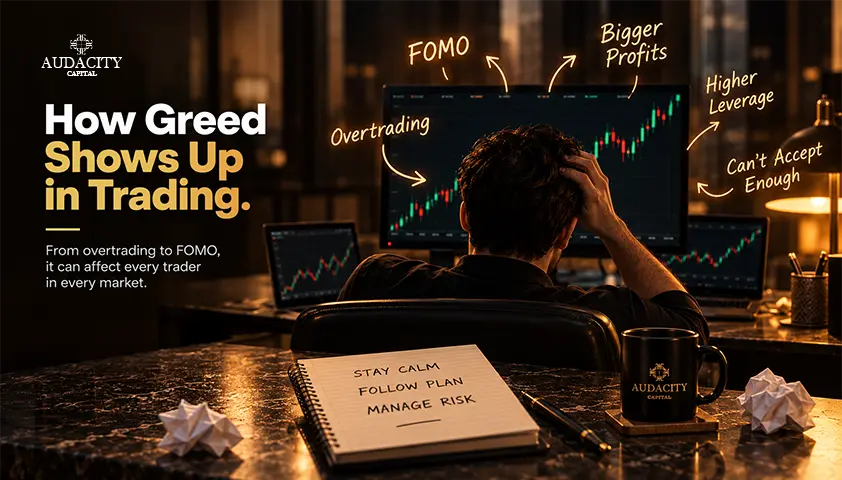
An investor with a solid mindset is not likely to give up on their dreams and close all the profitable trades immediately. A disciplined trader is a market participant who buys and sells with a repeatable process, makes decisions based on the situation in the market, rules, and acceptable risk.
The difference becomes clearer when comparing common trading behaviors.
Greed-Driven Behavior | Disciplined Alternative |
Chasing a rapidly rising asset | Waiting for a setup that meets the trading strategy's criteria. |
Moving profit targets impulsively | Following established exit criteria unless a strategy-based adjustment is justified. |
Increasing risk after winning trades | Keeping position sizes within predefined risk limits. |
Trading to recover losses quickly | Reviewing the loss and reassessing market conditions before entering another trade. |
Measuring success by one large win | Evaluating decisions and results across a series of trades. |
Discipline does not assure that all the trades will be successful. Following your plan might fail to bring you profits immediately because the markets are unpredictable. At the same time, a reckless trade may turn out to be beneficial, but it does not mean that it was reasonable to make it. However, with discipline, you will realize that your trading performance is improving gradually.
Conclusion
The psychology of greed in trading leads to the manifestation of various behaviors in traders since these traders want to make bigger profits. Greed makes traders increase their positions when they should be closing trades, risking more money even after profits have already been gained, chasing every possible move, and staying in the market too long by ignoring crucial exit points.
Understanding what behaviors can be influenced by greed is crucial to avoiding disastrous trades. Following the advice of making a trading plan, determining the size of the position, keeping a trading journal, and setting limits on risk and losses can help a trader stay calm and avoid catastrophic losses.
Ultimately, good trading does not mean closing all profitable trades and maximizing good setups. It is a matter of executing a well-defined system and objectively assessing every trade. Most importantly, one should always be prepared for unpredictable situations, as they are a normal part of the process. For all aspiring traders, it is useful to develop a set of rules that will force you to stop and think about the next step.
FAQs
It is the tendency to prioritize greater profits over rational decisions and risk management.
It can lead to overtrading, excessive risk-taking, and ignoring trading rules.
They hope to earn more and risk losing their existing profits.
By following a trading plan, setting risk limits, and keeping a trading journal.
No. Ambition is normal, but greed becomes harmful when it overrides discipline and risk management.

Готовы применить дисциплинированный риск к криптовалютам? Изучите новые криптоинструменты Audacity Capital и примените свою торговую стратегию.
Узнать большеРассылка
Подпишитесь на нашу рассылку.
Присоединяйтесь к нашему сообществу

Начните свое путешествие сегодня с нашей бесплатной пробной версией
С гордостью демонстрируйте свои навыки и достижения с помощью сертификатов и получайте признание за свой тяжелый труд и преданность делу от потенциальных инвесторов и коллег.
Бесплатная пробная версияПохожие статьи

What Successful Traders Will Look Like In 2026


How Much Money Do You Need to Start Trading Stocks? (2026 Beginner’s Guide)
Learn how much money you need to start trading stocks. Explore capital requirements, risks, and how to trade with funded accounts at Audacity Capital.

The World Is Watching Punch: But Serious Traders Should Be Watching Themselves
Discover how herd mentality and emotional reactions influence trading decisions. Learn why psychological discipline matters in the markets with Audacity Capital.

Trading With Confidence: Structure, Discipline, and the Path to Consistency