


What Is High-Frequency Trading (HFT)?


High-frequency trading (HFT) is a type of algorithmic trading that involves using powerful computers and sophisticated algorithms to analyze market data and make trades at astounding speeds. These computer programs execute thousands of trades per second and are capable of reacting to market developments in a fraction of a second, while an average person cannot take action that fast.
High-frequency trading is essential in the modern market economy and can be applied in various markets, including stocks, futures, currencies, and other electronically traded assets. Such projects use complex algorithms to detect and profit from arbitrage opportunities, add liquidity to the market, and react to the fluctuations in demand and supply. As a rule, high-frequency traders focus on the speed of execution and analysis.
However, speed is not a guarantee of profits. Small price changes, commissions, technical problems, and other market challenges can limit potential profits. Besides, the competition for this type of trading requires robust technology, access to market data, and sophisticated technical knowledge that only institutional traders can provide.
The knowledge of how high-frequency trading works will allow traders to understand its impact on the market, liquidity, and price trends. This article will discuss what lies behind high-frequency trading, its strategies, benefits, and risks, market regulations, and provide some vital information for investors considering algorithmic trading.
Note on High-Frequency Trading Restrictions at Audacity Capital
Audacity Capital prohibits high-frequency trading (HFT) strategies that rely on ultra-fast execution, latency arbitrage, or exploiting delays in price feeds. This includes automated systems designed to identify and profit from pricing discrepancies caused by differences in market data or execution speeds.
However, a trade closing within seconds does not automatically qualify as HFT. The key distinction is whether a trading strategy systematically uses automated, speed-based techniques to exploit timing gaps rather than relying on market analysis or a legitimate trading setup.
Before using an Expert Advisor (EA) or automated trading system, traders should review Audacity Capital’s current trading rules to ensure their strategy complies with the firm’s restrictions.
Read more about 10 Best EAs to Pass Prop Firm Challenges
Check about Prop Firms That Allow EA: The Rules That Actually Matter
What Is High-Frequency Trading?
What is high-frequency trading? High-frequency trading (HFT) refers to the use of computer algorithms, which allow one to automatically identify and execute market opportunities. Unlike manual trading, where a trader looks at a chart and manually places orders, high-frequency trading employs algorithms that make the process autonomous.
One of the main characteristics of high-frequency trading (HFT) is the ability to process a vast number of orders. It includes placing, canceling, and modifying orders. Positions are held for a very short period of time, but may also be held longer depending on the strategy. HFT firms strive to benefit from small price differences, statistical patterns, and spreads. These inconsistencies in the market appear and disappear quickly, so execution speed, data accuracy, and low transaction costs are critical factors for HFT to be effective.
Here is how HFT is different from traditional trading:
Feature | Traditional Manual Trading | High-Frequency Trading |
Decision-making | Primarily human-led | Primarily automated |
Trade Frequency | Varies by strategy | Often very high |
Execution Speed | Depends on the trader and platform. | Often microseconds to milliseconds. |
Main Tools | Charts, platforms, and analysis | Algorithms, market data, and specialized infrastructure. |
Holding Period | Seconds to years | Often very short, depending on strategy. |
HFT is characterized by automation, high volumes of trading, and a particular emphasis on speed of execution. On the other hand, manual traders can hold trades for as long as they can and at a speed they prefer.
How Does High-Frequency Trading Work?
How does high-frequency trading work? It works by using automated systems that help to perform the process of gathering information, analyzing the data, placing orders, and closing positions in a matter of seconds. There are multiple steps involved that are connected and may affect the outcome of trading decisions.
Market Data Arrives
HFT systems process real-time market data provided by data feeds, recent quotes, executed trades, and order-book data. Order books enable algorithms to track the prevailing bids and asks, which in turn allows them to identify potential opportunities. The accuracy and speed of information provided by data feeds can impact the speed at which HFTs can react to the newly discovered opportunities.
Algorithms Analyze Information
Once the information is received, algorithms can perform calculations on it. They may look for temporary price differences, shifts in supply and demand, or statistically significant patterns in related financial products. The algorithm determines if there is trade that will meet the offered risk-reward criteria.
Orders Are Submitted
When the algorithm identifies a buying or selling opportunity, it creates buy and sell orders and directs them to an exchange or a different trading venue. The venues can be selected, and the orders are generally allocated immediately. The systems engaged in high-frequency trading seek to reduce delays as much as possible since prices may fluctuate before the orders arrive at their destination.
Execution and Risk Controls
The trading venue is where the orders are processed, which may be filled completely or partially or not at all. The system tracks the prices at which the orders were executed, open positions, and possible losses. Risk control measures applied can limit the size of the orders, protect against losses, or even suspend trading if there are deviations in the system or technical issues.
High-frequency trading combines rapid data processing, automated order execution, and continuous risk monitoring. Identifying an opportunity is only the beginning; executing both sides efficiently and controlling risk determine whether it can produce a profit.
Key Technologies Behind High-Frequency Trading
High-frequency trading is based on the combination of advanced hardware, software, data, and risk management technologies. While speed is of great importance, companies must also consider other factors and effectively combine different technologies to gain competitive advantages and profit from the market.
Low-Latency Infrastructure and Co-Location
Latency measures the time interval between the occurrence of an event and the response to that event. High-frequency trading (HFT) firms rely on the lowest possible latency to achieve their objectives. A key technique used in the context is co-location, which stands for the placement of a firm’s servers in or near the data center of an exchange.
Direct Market Data Feeds
High-frequency trading systems are usually reliant on specialized market data feeds to supply them with price quotes, order book updates, and trade data. The faster the data arrives, the more likely it will be for an HFT algorithm to benefit from the information. The value of a feed is dependent on coverage, quality, and delivery time.
High-Performance Computing and Programming Languages
Specialized processors, memory management, and networking technologies enable the hardware to perform high-frequency operations. Specific computer languages are widely applied in algorithmic trading due to their ability to provide a deep level of control and optimization. Some programming tools, including Python, can be utilized for research, strategy building, analytics, and surveillance.
Network Optimization
Fast hardware is of no use if the communication between the trading system and the exchange incurs some delays. Companies optimize the network equipment, data transmission, and order routing to avoid extra processing time. Even small delays can matter when competing algorithms respond to the same market information.
Backtesting and Simulation
Before using a given approach, HFT traders confirm its effectiveness by testing it on past data or through an appropriate simulation of the markets. While the results of past performance are helpful in determining whether the given strategy could show a positive outcome, such an assessment cannot ensure that it will produce profitable trades in the future. This is because market conditions and other events at the time of the strategy’s implementation may have been different, leading to varied results.
Monitoring and Fail-Safes
HFT systems must be monitored continuously to detect technical failures, unusual orders, unexpected exposure, or losses. Automated measures may be taken, such as imposing limits on positions, rejecting orders, or halting trading if necessary.
Ultimately, these technologies work together to support fast and reliable execution. However, lower latency alone does not guarantee profits. Strategy quality, market access, transaction costs, competition, and effective risk controls remain essential to long-term performance.
Common High-Frequency Trading Strategies

High-frequency trading firms use a variety of approaches that allow them to benefit from the specific conditions of the market, the data they have, and the tools they employ. Some are designed to generate profits through a large number of small trades, while others attempt to profit from the ability to buy low and sell high or take advantage of short-term fluctuations.
The following are four common approaches, although not every HFT firm uses all of them:
Market Making
Market making refers to the process of placing buy and sell orders with an aim to provide liquidity to other market participants. High-frequency traders (HFTs) are market makers that constantly update their quotes depending on the volume, prices, and liquidity of a security to ensure they get a spread. Although HFTs aim to make a profit through the spread, the strategy could lead to a loss because of the volatile nature of trading. A trader could end up buying a security before its price drops, or sell a security before its price increases, and hence, result in losses. In addition, fees and intense competition in the market could reduce profits.
Statistical Arbitrage
Statistical arbitrage strategies involve using mathematical formulas to determine mispricing or relationships between stocks. For instance, a statistical arbitrageur may design an algorithm that trades two similar stocks that have historically moved together. In this case, the algorithm may determine that stock A is lower than its fair price while stock B is higher than its fair price.
Therefore, the statistical arbitrageur will short sell stock B and buy stock A. The strategy may make profits if the prices of stock A and B converge to their fair price. However, the fair price may change due to emerging trends, and the prices may move away from the fair price, which means the strategy may result in losses.
Cross-Market and Cross-Venue Arbitrage
This trading strategy is based on the idea of profiting from price inefficiencies between related instruments or trading venues. An algorithm may buy the cheaper security and simultaneously sell the more expensive one to benefit from the price difference. However, such a trade is only worthwhile if the potential profit exceeds the costs of execution, including commissions, fees, and spreads.
Momentum and Short-Term Signal Strategies
Some HFT algorithms are designed to react to temporary price increases or drops, changes in the order flow, and buying or selling pressure. If market data indicates that there is pressure on the buy side, for instance, an algorithm could enter a trade, expecting that the price will continue to climb.
HFT algorithms try to make a profit on small price movements in the market before it goes back the other way. Sometimes, the signals they receive can be false, and prices can turn around before the execution of an order or closing of a position. Competitive pressures, slippage, and volatile prices can all contribute to reduced returns.
The Advantages and Disadvantages of High-Frequency Trading
High-frequency trading comes with its advantages, but it certainly has some technological, financial, and operational downsides. Here are some benefits and drawbacks of HFT:
Advantages of High-Frequency Trading
Improves liquidity: Market makers are enabled to place buy and sell orders, resulting in more trading opportunities for other bidders. However, liquidity may decrease suddenly in periods of uncertainty.
Tighter bid-ask spreads: Competition among automated trading firms may cause the prices’ range to shrink.
Faster price discovery: High-frequency trading platforms can analyze and respond to emerging information faster, resulting in a higher pace of adjustment to incorporate new information.
Greater execution efficiency: Automated trading systems can analyze data, send and receive market data, execute instructions, and respond to new information faster than human traders resulting in fewer delays in favorable conditions.
More continuous quoting: Algorithmic market makers can quote prices constantly under normal market conditions.
Disadvantages of High-Frequency Trading
High operational costs: Because of the necessity to use specialized hardware and software, access to exchanges and market data, and employ professional technical personnel. The costs connected with maintaining such systems and providing high-quality services are considerably high.
Technical failures: Software bugs, network outages, or incorrect algorithms can trigger unintended orders and significant losses.
High competition: The struggle for profits results in low costs, which are incompatible with the yields gained through market prices for similar securities.
Lack of liquidity: A sudden withdrawal of high-frequency traders from the market at a time when prices are volatile may lead to a decrease in liquidity.
Potential market disruption: Induced volatility that can arise from interactions between various trading algorithms may cause abrupt price changes, especially when many algorithmic traders act on similar principles.
Is High-Frequency Trading Good or Bad for Markets?
Neither of the conclusions is entirely correct because high-frequency trading could create liquidity and pricing efficiency in some cases, but in others, it could undermine the markets by causing a sudden decrease of liquidity.
For traders, the important point is to understand that faster trading does not automatically create fairer markets or guarantee better execution. Market structure, transparency, regulation, and effective risk controls all influence whether HFT benefits the wider market.
High-Frequency Trading Risks and Regulations
High-frequency trading (HFT) involves high-speed transactions and quick order execution. Firms as well as HFT traders might profit tremendously from the opportunities provided by the given system, but it also brings significant risks that should be mitigated through regulations and constant monitoring.
Key Risks in High-Frequency Trading
Algorithmic Errors: Poor coding or programming errors that result in faulty instructions and unauthorized trades.
Execution risk: The orders can be executed incorrectly or not at all.
Market risk: Prices can often shoot up and down, and a trader can witness a profit turning into a loss.
Operational risk: Failure of the hardware or connection stability results in halted operations or poor execution.
Model risk: A strategy that was working flawlessly during the testing period can fail terribly in real-world situations due to non-optimal assumptions, rounding errors, or transaction costs.
Cybersecurity risk: Deliberate software interference can result in unauthorized data access and usage.
To manage these risks, HFT firms may use pre-trade order limits, position restrictions, real-time exposure monitoring, automated kill switches, and controlled software testing. Audit trails and post-trade reviews also help firms identify errors, investigate unusual activity, and improve their controls.
How Is High-Frequency Trading Regulated?
Regulation depends on the country, financial instrument, trading venue, and participants. For example, in the United States, the Securities and Exchange Commission (SEC) requires that all broker-dealers subject to the Market Access Rule establish policies and procedures to ensure that their systems are designed to avoid excessive risks and errors. The Commodity Futures Trading Commission (CFTC) regulates those markets of derivatives in the U.S., and it forbids spoofing, among other manipulative practices.
In the European Union, the Markets in Financial Instruments Directive II (MiFID II) sets out rules for investment firms that use algorithmic trading. This legislation covers a range of requirements, from necessary risk management rules to system tests and monitoring, as well as recording specific order records. In addition, those organizations that use high-frequency algorithmic trading methods must ensure the maintenance of the required order records.
One crucial thing to note is that spoofing is not simply placing and canceling orders quickly. It involves submitting orders with the intent to mislead other market participants or cancel them before execution as part of a prohibited practice. Legitimate order cancellations can occur for ordinary trading reasons.
Ultimately, effective risk controls and regulatory compliance help protect market integrity, but they cannot eliminate every trading or operational risk.
Can Retail Traders Use High-Frequency Trading?
Retail traders cannot engage in high-frequency trading the way institutional traders do. The latter can afford to spend a lot of money on research, infrastructure, and technology to give themselves an edge over the market. They also have better equipment, data, and sources. As far as HFT goes, it is all about having an extra edge through research and data.
Ordinary traders only have an average internet connection and brokerage. Network latency, broker order routing, spreads, commissions, and execution delays can reduce the effectiveness of strategies that depend on tiny price differences. Even when a retail system places numerous trades quickly, frequent activity does not guarantee profitability. Transaction costs and small losses can accumulate and outweigh potential gains.
It is essential to differentiate between retail bots/expert advisors and institutional HFT systems. Although a robot or an expert advisor may be programmed to make trades automatically, this does not necessarily classify it as high-frequency trading.
What Can Retail Traders Do Instead?
Retail traders can explore algorithmic trading through supported platforms without attempting to compete directly with institutional firms. Starting points include:
Paper trading: Test execution logic without risking real money.
Backtesting: Evaluate strategies against historical market data.
Performance tracking: Measure spreads, commissions, slippage, drawdowns, and net returns.
Rule-based automation: Use simple strategies with clearly defined entry, exit, and risk limits.
Technical learning: Develop programming skills and understand market microstructure before deploying capital.
Traders should be wary of services that boast of being able to guarantee profits or suggest that everyone can replicate institutional HFT results with ease. These promises do not account for the costs of the infrastructure involved or the difficulties of execution.
On the brighter side, traders can indeed benefit from automated trading, enhanced testing, and execution, but an average trader sitting at home trying to replicate the strategies of institutional high-frequency traders is hardly ever going to succeed because a realistic evaluation of costs and risks is required.
Conclusion
High-frequency trading is a method of trading that employs powerful computers to execute buy and sell orders in the market at a high frequency. These algorithms are designed to detect small market inefficiencies and make a profit out of them. Market making, statistical arbitrage, and cross-market arbitrage are examples of such strategies.
Nevertheless, there is no guarantee of profit in high-frequency trading. It is always essential to choose the right strategies and effectively manage the associated risks and costs to ensure profits. Even though HFT is an accurate system, market conditions and order execution can sometimes affect the outcome of the trade.
For retail traders, examining how HFT works from a distance is a way to gain perspective on modern trading. However, it is often more productive to focus on algorithms that one can actually implement and test. Instead of comparing oneself to the fastest traders, it is important to remain grounded and evaluate how a given system impacts one's P&L, costs, and risk.
FAQs
High-frequency trading uses computer algorithms to execute large numbers of trades at extremely high speeds.
They seek profits from small price differences, bid-ask spreads, and short-term market opportunities.
Yes. HFT is legal in many markets, provided firms comply with applicable regulations and avoid prohibited practices.
Retail traders can automate trades, but replicating institutional HFT is difficult due to infrastructure costs and execution limitations.
HFT is a specialized form of algorithmic trading characterized by very high speed and trading activity. Algorithmic trading also includes slower automated strategies.

Готовы применить дисциплинированный риск к криптовалютам? Изучите новые криптоинструменты Audacity Capital и примените свою торговую стратегию.
Узнать большеРассылка
Подпишитесь на нашу рассылку.
Присоединяйтесь к нашему сообществу

Начните свое путешествие сегодня с нашей бесплатной пробной версией
С гордостью демонстрируйте свои навыки и достижения с помощью сертификатов и получайте признание за свой тяжелый труд и преданность делу от потенциальных инвесторов и коллег.
Бесплатная пробная версияПохожие статьи
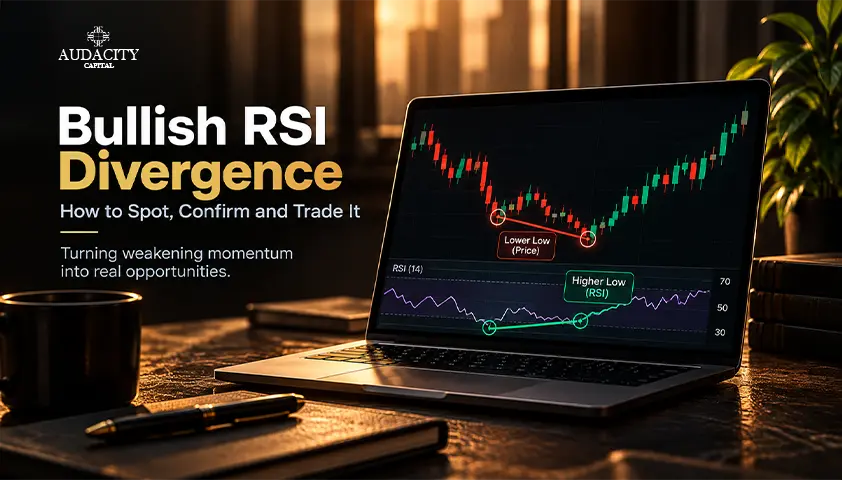
Bullish RSI Divergence: How to Spot, Confirm and Trade It
Learn how to identify bullish RSI divergence, confirm reversal signals, choose entries, set stop losses, and manage risk effectively.

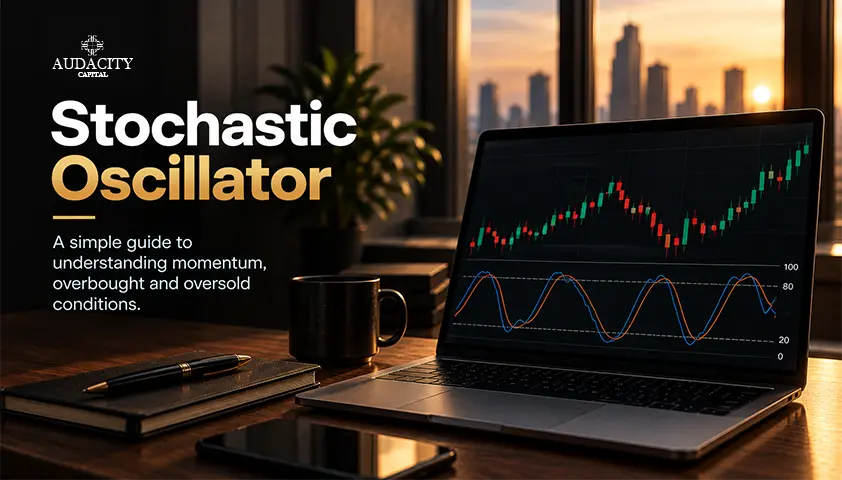
Stochastic Oscillator
Learn how to use the stochastic oscillator in trading, interpret overbought and oversold levels, spot crossovers, and adjust settings.
Maximum Favorable Excursion: How MFE and MAE Read a Trade
Learn how Maximum Favorable Excursion and MAE reveal a trade's best and worst open moves, exit giveback, and possible entry or exit problems.
Swap in Trading: What It Is, How It Is Calculated and How It Affects Your Positions
Learn what a swap in trading is, how overnight fees are calculated, when triple swaps apply, and how swap costs affect forex and CFD positions.