


Backtesting vs Forward Testing: How to Validate a Trading Strategy


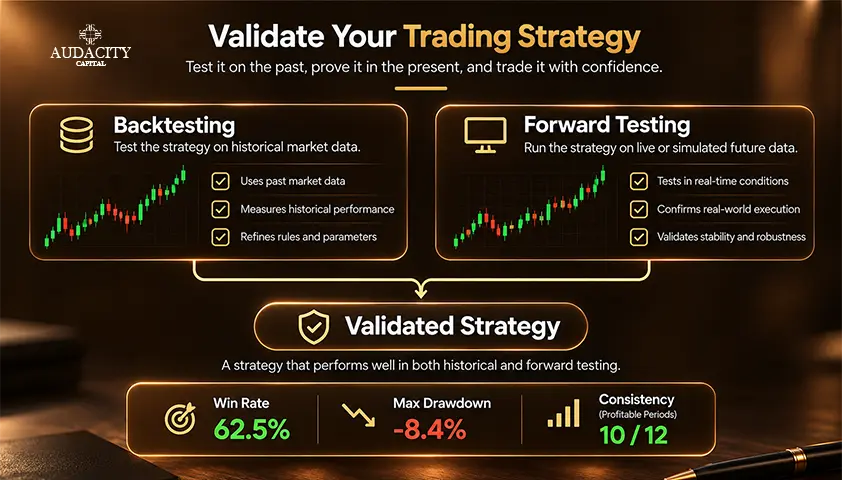
A trading strategy may produce an excellent equity curve in the past and yet be very different when faced with market data that did not exist in the time of its development.
This difference between past and future results can expose weaknesses in a trading strategy.
Backtesting is a strategy's performance on past market data. Forward testing is a strategy's performance on new market data. None of them proves the profitability of a strategy in the future.
In this guide, we will discuss the differences between backtesting and forward testing, the information available at each step, the reasons for the differences, and how traders can use both in the validation of a trading strategy.
Backtesting vs Forward Testing: What Is the Difference?
Backtesting implies applying the defined criteria to historical price data to see how the strategy would have worked out. Forward testing means employing these very criteria without changing anything in response to newly arriving market data.
The first one is for research; the second is a reality check.
Backtesting allows the trader to test years of market behavior in a short period of time. The primary importance of backtesting is research: did this strategy show a historical edge under clearly defined assumptions?
Forward testing is what most people are looking for when they type "what is forward testing in trading". Simply put, it is the process of testing the completed strategy prospectively, often using live or continuously updated data, and documenting the results.
Forward testing checks if the behavior, signals and assumptions about the execution are still similar to those shown by the historical test.
There is one thing that is more important than anything else. Forward testing is not a substitute for backtesting, and backtesting is not a substitute for forward testing. Each answers a different question, so a good process needs both.
Factor | Backtesting | Forward Testing |
Data used | Historical market data | New or live-arriving market data |
Main purpose | Historical strategy evaluation | Prospective strategy validation |
Speed | Fast | Slow |
Sample accumulation | Large samples can be generated quickly | Samples accumulate at market speed |
Execution realism | Based on assumptions | Closer to actual market conditions |
Main risks | Overfitting, bias, unrealistic assumptions | Small samples, regime dependence, simulated execution differences |
Strategy stage | Research and initial validation | Later-stage validation |
Capital required | None | Usually none on demo or paper; implementation varies |
What Backtesting Can and Cannot Tell You
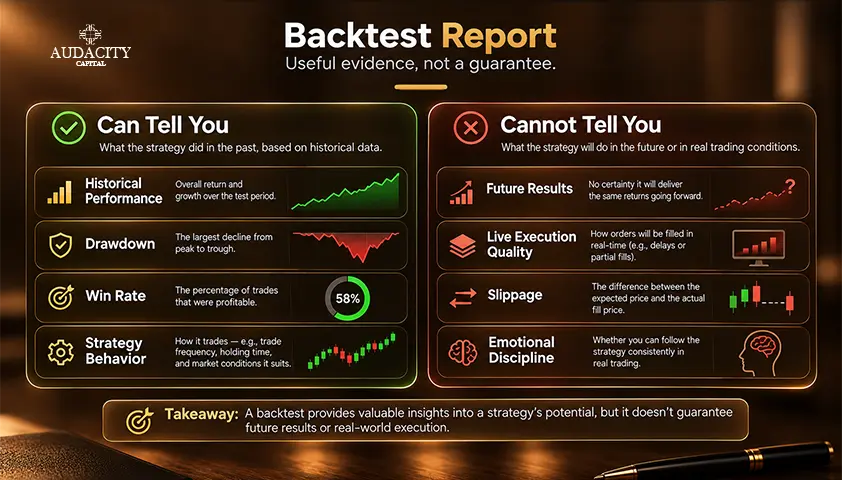
There are many worthwhile questions which a well-designed backtest can answer:
- Did the rules lead to positive or negative expectancy, an overall expected outcome per trade?
- How frequently did the strategy trade?
- What kinds of drawdowns were there during the course of trading?
- Is the performance based only on one period, one type of asset or market situation?
- How were the win rate, average win and loss, profit factor?
- Did the strategy hold up across different historical market regimes?
All these facts prove the usefulness of a backtesting trading strategy workflow. A trader neglecting backtesting is simply guessing. However, a trader completing backtesting at least knows whether further research may be useful.
The drawbacks are no less important. A backtest cannot establish that:
- the same edge will remain for future markets.
- live fills are going to be the same as simulated fills.
- spread, slippage or latency will match the assumption.
- a trader will execute discretionary rules exactly as assumed.
- the trader will follow discretionary rules in live trading exactly as assumed.
Historical results can be misleading for several reasons.
For instance, overfitting describes an approach where rules become too fitted to the historical data.
Look-ahead bias implies that a calculation is done using data that wasn’t available at the time of the decision-making process.
Unrealistic transaction costs, as well as data quality problems, can also affect the results in the wrong way.
When a trader decides to backtest a trading strategy, the main thing they should seek for is evidence not confirmation. A successful result implies that strategy requires some more validation. This doesn't mean, however, that it works.
What Forward Testing Can and Cannot Tell You
The forward testing trading strategy involves fixed rules and parameters. Once the test starts, no changes can take place. The trading strategy is then observed while receiving the new market data.
This enables a trader to determine such factors that a backtest cannot entirely reveal:
- Presence of predicted signals in real time.
- Whether entries and exits have been correctly implemented.
- The difference between assumed and observed spreads and slippage.
- Trade frequency.
- Whether any issue exists with the trading platform, data-feed or automation.
- whether a discretionary trader follows the rules.
- how the strategy behaves in the current market regime.
Forward testing and paper trading
The concepts are frequently confused but are not the same. Forward testing is the validation process. Paper trading is one of the environments in which a forward test can be performed, demo trading on a broker's platform being another.
Performing a few demo trades without any set of rules is not a forward test. A test is considered such only if the rules have been defined first and the results are analyzed against them.
The limitations of forward testing
Forward testing makes the test more realistic but still has its own limitations:
- It takes time to gather enough data.
- A short observation period may reflect only one market regime.
- Demo fills may differ from live fills.
- Paper trading cannot simulate the stress of real money.
- A few trades that win or lose are not much evidence.
Forward testing helps to bring the strategy closer to reality. It still cannot ensure its performance in live trading.
Why a Strategy Can Pass Backtesting but Fail Forward Testing
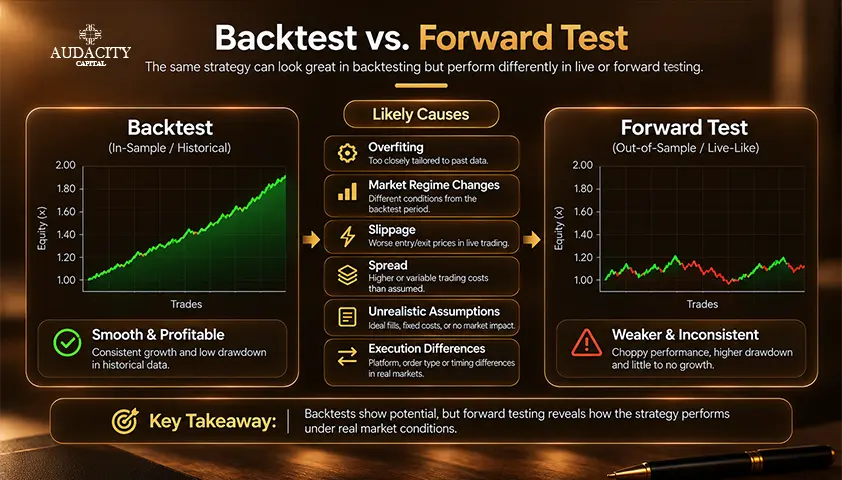
Poor performance during forward testing does not necessarily mean one reason behind it. There are several causes, and it is up to the trader to identify which reasons apply.
1. Overfitting or Curve fitting.
The trading rules or parameters might have captured noise of the development period rather than capturing repeatable market behavior. When the new data comes, the noise disappears.
2. Look ahead bias or Data leakage.
The historical calculations might be based on the data that is not actually available at the time of the decision-making. The backtest was too smart for any trader.
3. Unrealistic execution assumptions.
Spread, commission, slippage, latency, partial or missed fill and order execution timing are some of the factors affecting the results. It is particularly important for short term strategies, where small execution differences can materially change expectancy.
4. Changes in market regimes.
A strategy designed under trending, volatile or highly liquid circumstances might find itself facing a completely different environment in the future. While a bad regime doesn’t automatically nullify a strategy, this fact should be taken into account.
5. Implementation differences.
The rules applied in the forward test may be somewhat different from the rules used in the historical test. This is true for both manual and automated trading strategies.
6. Trading style.
In discretionary trading, indecisiveness, missed opportunities, early exits or quiet modifications of rules cause discrepancies between theory and practice.
7. A small forward-test sample.
A small number of trades can create a substantial short-term difference through normal outcome variation alone.
Cause of Difference | What It Can Affect | What the Trader Should Investigate |
Overfitting | Overall performance | Whether results survived unseen data |
Execution costs | Expectancy and profit factor | Spread, commission, slippage |
Market regime | Trade frequency, win rate, drawdown | Whether conditions differ materially |
Implementation | Signal count, entries, exits | Whether the same rules were executed |
Rule deviation | Results and trade distribution | Whether every valid setup was taken |
Small sample | Nearly every metric | Whether enough observations exist |
This is the reason why backtest vs forward test comparison needs to include diagnosis, not panic. There is no general threshold of an acceptable loss, because the proper expectations depend on the strategy.
How to Use Backtesting and Forward Testing Together
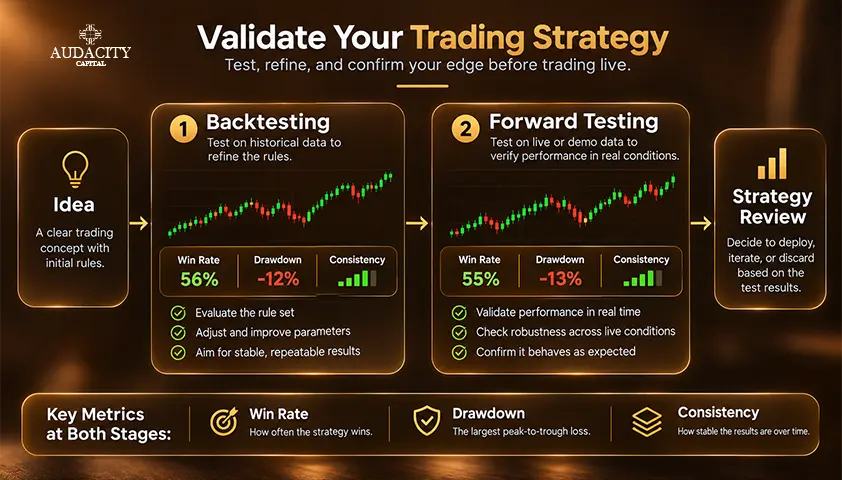
The proper validation process starts with less expensive and less time-consuming evidence and progresses to increasingly realistic evidence. Every step eliminates those strategies that do not deserve the next step.
Step 1: Define and lock the strategy rules
Record the entry rules, exit rules, position size, stop-loss and take-profit rules, list of eligible instruments, trading sessions, filters and any other relevant execution assumptions. The purpose is to prevent the strategy from changing each time it fails.
Step 2: Test the strategy using the historical data
Determine whether the strategy demonstrates sufficient consistency to be worth further testing. Make sure to account for costs and different market conditions.
Step 3: Out-of-sample testing using untouched data for validation
Out-of-sample testing uses untouched historical data that has been kept separate from strategy development. It is still a historical test as the data already exists.
However, it is a question whether the strategy survives the untouched historical data that did not shape its rules.
Step 4: Use walk-forward testing whenever possible
A strategy that has its parameters periodically optimized or recalibrated can undergo a walk-forward testing. It checks whether the recalibration process stays consistent across sequential windows.
Walk-forward testing still operates on historical data and cannot be considered a true prospective forward test.
Step 5: Perform the forward test with the frozen rulebook
Test the given strategy with frozen rules on the new market data. Don’t optimize the parameters after several unsuccessful trades. If the rules change materially, the trader has invented another version of the strategy, and needs fresh validation from the beginning.
Step 6: Compare historical and forward results
Compare equivalent metrics. The important question is not whether both tests were profitable, but how similar the approach was.
Step 7: Diagnose differences before increasing risk
If the test results diverge considerably, determine whether the cause is execution, implementation, market situation, statistics, or original strategy hypothesis.
Validation Stage | Data | Main Question |
Backtest | Historical | Did the strategy show a historical edge? |
Out-of-sample test | Reserved historical | Did it survive data not used to develop it? |
Walk-forward analysis | Sequential historical windows | Does a defined recalibration process remain robust? |
Forward test | New or live-arriving data | Does behaviour persist prospectively? |
Small live deployment | Real market and real capital | Does execution remain viable under actual trading conditions? |
Small live deployment is mentioned above just for clarification only. It’s the last and most realistic phase and, as such, includes real risks, therefore it comes after the earlier evidence is in place.
How Do You Know Whether Forward Testing Confirms the Backtest?
Often traders ask about how many forward tests are enough? There is no single answer in numbers.
A fixed count of 30 trades, a three-month window, a 20% tolerance or a single profit-factor threshold ignores the fact that the right answer depends on trade frequency, holding period, market and the strategy's return distribution.
Better is to define your evaluation criteria prior to forward testing starts. Decide in advance what to measure and what would count as consistent, inconclusive or concerning.
Metrics to compare
Compare the same metrics in both tests to have equal grounds to evaluate trading strategy performance.
Metric | What to Compare |
Trade frequency | Whether the number and timing of setups resemble expectations |
Expectancy | Whether average outcomes remain directionally consistent |
Profit factor | Whether gross wins relative to gross losses deteriorate materially |
Win rate | Evaluate alongside average win and loss, not in isolation |
Average win vs average loss | Whether the payoff structure has changed |
Whether observed losses stay broadly consistent with expected behaviour | |
Trading costs | Whether spreads, commissions and slippage materially reduce the historical edge |
Rule adherence | Whether discretionary execution matches the defined strategy |
Signal consistency | Whether live signals match the strategy implementation |
How long should forward testing continue?
There are two factors to consider here. The first is the number of observations. Strategies generating multiple trades daily will accumulate observations faster compared to those generating just two setups per month.
The second is the diversity of market conditions. Even a very large number of trades conducted in very favourable conditions will only provide you with a partial picture.
The debate in the trader circles usually revolves around whether to consider calendar time, number of trades, or number of regimes, but the right answer would be enough observations in relevant conditions, rather than a fixed number of weeks.
This is also where forward testing vs backtesting differs most in practice: one produces samples quickly, while the other earns them slowly.
If results are worse
There are three reasonable responses:
- Continue monitoring if there is not enough data yet.
- Investigate if execution, implementation or market conditions could explain the difference.
- Re-examine the strategy if the loss continues on sufficient data and cannot be explained by execution or variance.
What is not a proper course of action is changing parameters to make the forward test profitable. This would just create another overfit strategy.
Conclusion
The strategy validation is the process of gathering independent data. Backtesting can demonstrate that a strategy is worth investigating further.
Forward testing checks if that behavior is sustainable when the strategy is unable to benefit from hindsight. Both do not eliminate uncertainty.
A trader preparing for a prop firm evaluation or a funded environment needs to come with rules that have already been tested, researched and implemented consistently.
At Audacity Capital, proper execution and risk management are important, and getting funding does not mean that a strategy works. Testing does not guarantee an edge, but helps traders identify flawed assumptions before risking money.
This article is for informational purposes only and is not investment advice. Trading involves risk, and neither testing method guarantees future results.
Frequently Asked Questions
No. Market Replay will use recorded data by default. It can simulate the experience of watching candles forming without displaying future bars, which makes it useful for practice. All this data will remain historical; you won’t be able to work with the latest information.
Yes, provided that your strategy has enough criteria and rules that will allow you to identify opportunities to execute a trade. As a rule of thumb, the less objective the decision-making process in discretionary trading is, the harder it becomes to compare performance of two tests.
Yes, you can forward test your algorithm using live data on a shadow, paper or demo system, tracking the trades that would have been made. This can reveal potential issues with your signals, timing, and technical implementations without a full live deployment.
Where possible, yes. Matching the intended environment is especially useful for execution-sensitive strategies, because spreads, symbol specifications, data feeds and order handling can differ from one environment to another.

Handa nang maglapat ng disiplinadong panganib sa crypto? Galugarin ang mga bagong instrumento ng crypto ng Audacity Capital at dalhin ang iyong diskarte sa pangangalakal.
Matuto PaNewsletter
Sumali sa aming newsletter.
Sumali sa Aming Social Community

Simulan ang Iyong Paglalakbay Ngayon Gamit ang Aming Libreng Pagsubok
Ipagmalaki ang iyong mga kasanayan at tagumpay sa pamamagitan ng mga sertipiko at makakuha ng pagkilala para sa iyong pagsusumikap at dedikasyon mula sa mga potensyal na mamumuhunan at kasamahan.
Libreng PagsubokMga Kaugnay na Artikulo
Calmar Ratio: Meaning, Formula and Examples
Learn what the Calmar Ratio means, how to calculate it, interpret results, and compare it with Sharpe and Sortino ratios.

Bearish RSI Divergence: How to Spot It, Confirm It and Trade It
Learn how to identify bearish RSI divergence, confirm reversal signals, plan entries and exits, and manage risk with practical forex trading examples.
Stochastic Oscillator vs RSI: How They Differ and How to Use Them
Compare RSI and the Stochastic Oscillator, understand their signals, and choose the right indicator for your trading strategy.
Sortino Ratio in Trading: How It Measures Downside Risk
Learn what the Sortino Ratio means, how to calculate it using downside deviation, and how traders use it to compare risk-adjusted performance.