


Take Profit vs Stop Loss: How These Two Orders Work Together


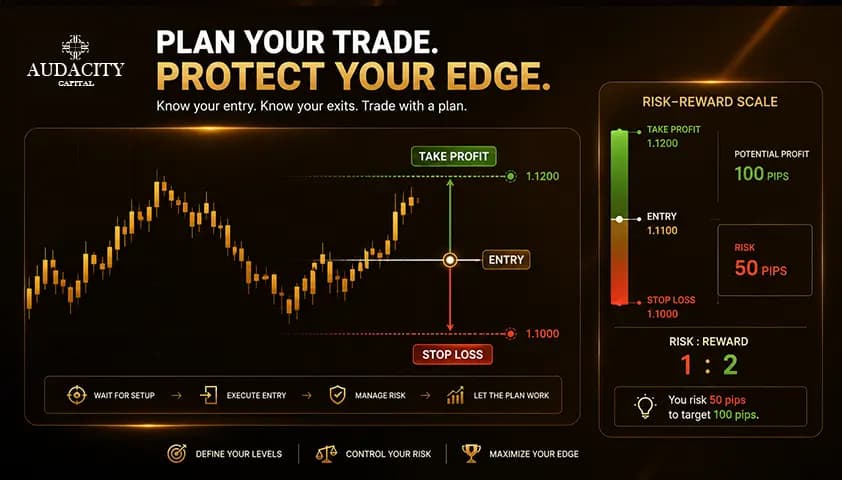
Every trade needs a plan for getting out, not just a plan for getting in.
The two orders that automate that plan are the stop loss, which caps your loss, and the take profit, which locks in your gain.
It is tempting to treat take profit vs stop loss as a choice between two options, but that framing is wrong. These orders are not competitors. They work on the same trade at the same time, one defining your risk and the other defining your reward, so you decide both before you enter and let the trade play out without second-guessing.
Below we will explain what each order is, how they differ, the risk-to-reward ratio, how to set them, common mistakes, and why both matter on a funded account.
What are Stop Loss and Take Profit Orders?
Both a stop loss and a take profit are exit orders.
An entry order opens a position. An exit order does the opposite: it closes an open position automatically when price reaches a level you set in advance.
That automation is the whole point. You define your acceptable loss and your target gain up front, and the platform executes for you, so you do not have to sit and watch every tick.
The difference between the two comes down to three things:
direction, order type, and purpose.
We will cover those in the next section. For now, define each one clearly.
Stop loss: capping your losses
A stop loss is a stop order you place at a price worse than the current market.
Its job is to close your position and limit your loss if price moves against you. For a long trade (you bought expecting the price to rise), the stop loss sits below your entry.
If price drops to that level, the position closes and your loss stops growing.
Here is the mechanic you must understand carefully.
When your stop level is hit, the stop loss becomes a market order, which means it fills at the next available price, not necessarily at your exact level. In fast markets or when price gaps over the weekend or around news, it can fill at a worse price than you set.
This is called slippage, and it means your actual loss can be larger than planned.
There are three main types worth knowing:
- Standard stop loss: the common one described above. It can slip in fast conditions.
- Guaranteed stop loss: guarantees your exit price even through gaps, usually for a fee.
- Trailing stop: a stop that automatically follows price as it moves in your favor, locking in gains while still capping your downside.
The emotional benefit is just as important as the mechanical one. A stop loss stops you from holding a losing trade and hoping it comes back. It turns a decision you would rather avoid into one you already made calmly, in advance.
Take profit: locking in your gains
A take profit is a limit order you place at a price better than the current market. Its job is to close your position and secure your gain when price moves in your favor.
For a long trade, the take profit sits above your entry. When price reaches that level, the position closes and the profit is booked.
The mechanic here is cleaner than a stop loss. A take profit executes only at your chosen price or better, so you do not face the same slippage risk on the exit itself.
The emotional benefit is that it removes greed and hesitation. Without a take profit, it is easy to watch a winning trade, hope for more, and then see the gain evaporate as price reverses.
Set a take profit and the position closes at your target automatically, even if you are away from your screen.
Take Profit vs Stop Loss: The Differences and Why You Need Both
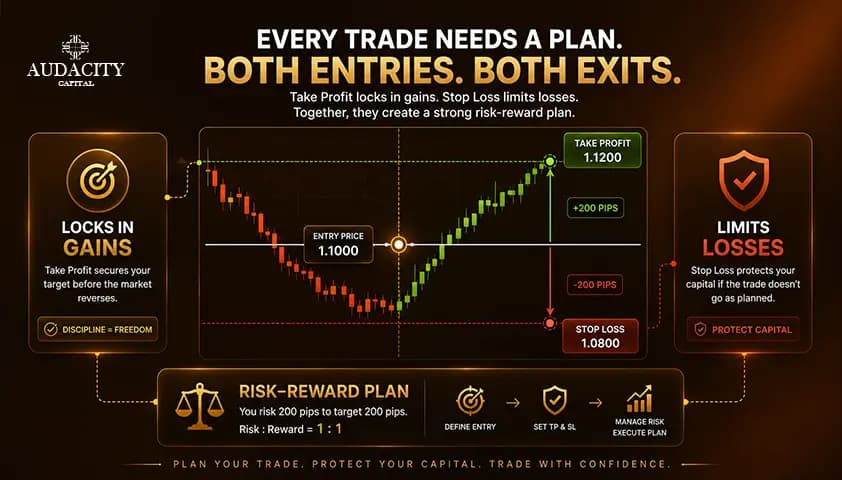
Now that both orders are defined, here is the stop loss vs take profit comparison side by side.
Feature | Stop loss | Take profit |
Direction (long trade) | Below entry, on the loss side | Above entry, on the profit side |
Order type | Stop order that becomes a market order when triggered | Limit order that fills at your price or better |
Purpose | Cap your loss | Lock in your gain |
Emotion it manages | Curbs hope that keeps you in losing trades | Curbs greed that makes you overstay winners |
For a short trade (you sold expecting the price to fall), the sides flip. The take profit sits below your entry, and the stop loss sits above it.
They are complementary, not either/or
The key point is simple. Understanding the take profit and stop loss relationship means seeing that the "vs" is a little misleading.
You do not pick one. You use both on the same trade to define your reward and your risk before you enter, then step back and let the trade resolve without emotional interference.
Why use both?
Because together they automate discipline.
They remove emotion from the exit, they protect your capital, and they mean you do not have to watch every candle.
That is the practical difference between stop loss and take profit in action: one guards the downside, the other captures the upside, and neither leaves the decision to your mood at the moment.
For example:
Say you buy GBP/USD at 1.3260.
- You set a take profit at 1.3300. That is a 40-pip gain if it fills.
- You set a stop loss at 1.3235. That is a 25-pip loss if it triggers.
You are risking 25 pips to make 40 pips. Both orders live in the same position. Whichever price reaches first closes the trade for you.
Now flip it for a short.
If you sell GBP/USD at 1.3260, your take profit goes below entry (for example 1.3220) and your stop loss goes above it (for example 1.3285).
Same logic, opposite sides.
The Risk-to-Reward Ratio: How They Work Together
This is where the two orders combine into something more useful than either alone.
The distance from your entry to your stop loss is your risk. The distance from your entry to your take profit is your reward. Put together, they set the trade's risk-to-reward ratio.
In the example above, you risked 25 pips to target 40 pips. That is roughly a 1:1.6 ratio.
Why does this matter?
Because a higher reward-to-risk changes what your win rate needs to be.
Many traders aim for at least 1:2, meaning they risk one unit to make two. At 1:2, your winners are twice the size of your losers, so you can lose more trades than you win and still come out ahead over a series of trades.
A good ratio does not guarantee anything on a single trade. It simply gives your account a healthier math over time, provided you actually respect your levels.
How to Set Your Stop Loss and Take Profit
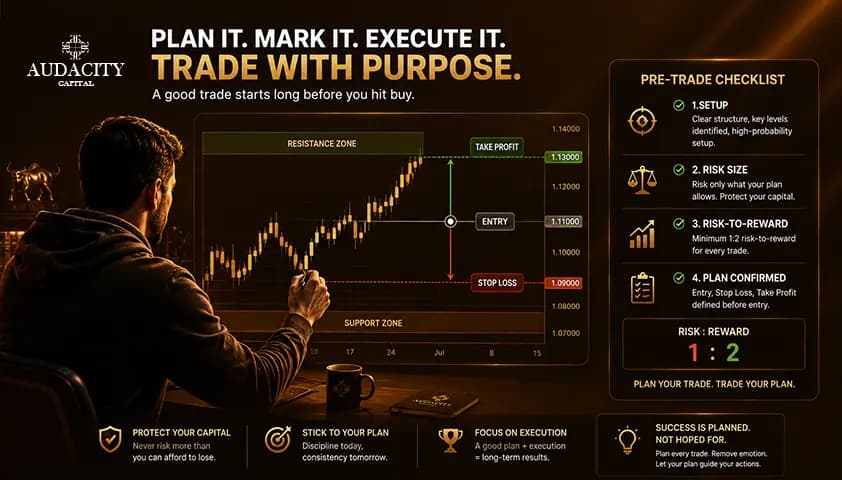
There is no single correct distance. Here are the common, practical methods.
1. By a fixed percentage of capital risked per trade.
Decide the small percentage of your account you are willing to risk on one trade. That risk amount, combined with your position size, sets how far your stop can sit from entry. This keeps every loss inside a limit you chose in advance.
2. By a predefined risk-to-reward ratio.
Place your stop where the trade idea is invalidated, then set your take profit at a multiple of that stop distance. If your stop is 25 pips away and you want 1:2, your take profit goes 50 pips out.
3. By technical levels.
Use the chart. Place a stop just beyond support and resistance or a clear market-structure level. For a long, that often means a stop below a nearby support level, with a target near the next level above. Structure gives your orders a logical reason to sit where they do.
A few nuances that separate careful traders from careless ones:
- In volatile markets, place stops further out (a tool like ATR helps size this) so normal price swings do not stop you out prematurely. The same fixed distance is rarely right for every asset.
- Avoid placing stops and targets at obvious round numbers, where orders cluster and price can be swept through before continuing.
- Account for the spread and possible slippage, especially on the stop side.
- Consider a trailing stop to protect gains as a trade moves your way, letting your winner run while raising your protection behind it.
Common Mistakes with Stop Loss and Take Profit
The orders only help if you set them sensibly and then respect them. Here are the errors that undo that.
Mistake #1. Trading with no stop loss.
Leaving your losses uncapped means one bad move can do outsized damage. Always define your exit before you enter.
Mistake #2: Moving or widening a stop loss to avoid being stopped out.
This turns a small, planned loss into a large, unplanned one. It is one of the most damaging habits in trading. The fix is simple: do not move a stop against yourself once the trade is live.
Mistake #3: Setting stops too tight.
A stop that sits inside normal market noise gets triggered constantly, even when your idea is sound. Give the trade room based on volatility.
Mistake #4: Taking profit too early out of fear.
Cutting winners short ruins your risk-to-reward. A planned take profit level helps you hold to the target instead of exiting on emotion.
Mistake #5: Ignoring the risk-to-reward ratio.
Taking trades where the reward does not justify the risk erodes your account even when you win often.
Mistake #6: Placing stops and targets at obvious round numbers.
These are crowded price points that are easy to sweep. Nudge your levels away from them.
The theme across all six is discipline. The orders are only as good as your commitment to setting them well and leaving them alone.
Conclusion
Take profit and stop loss are not rivals to choose between.
They are partners on the same trade, working at the same time, one capping your risk while the other locks in your reward. Together they automate the discipline that separates consistent traders from the rest.
They remove emotion from the exit, protect your capital, and free you from watching every candle. But the orders are only as good as your commitment to them.
Set both before you enter, size them with logic rather than fear, respect the levels you chose, and let each trade resolve on its own terms.
Related Articles
Stop Loss Orders To Reduce Risk
Stop Loss in Day Trading : How to Use It Effectively?
Frequently Asked Questions
For most traders, yes. A stop loss caps the loss on a trade and protects your capital from a single sharp move against you, while trading without one leaves you exposed to large, uncapped losses. The exact placement still depends on your strategy and the market you are trading.
A standard stop loss becomes a market order when triggered, so in fast markets or price gaps it can fill at a worse price than your level, causing a larger loss than planned. A guaranteed stop loss avoids this by locking your exit price, usually for a fee.
Many traders aim for at least 1:2, risking one unit to make two. A higher reward-to-risk lets you stay profitable even with a win rate below 50%, because your winning trades are larger than your losing ones. It improves your odds over time but does not guarantee any single result.
A common approach is to place it just beyond a level that price would have to break to prove your trade wrong, such as below support for a long or above resistance for a short. In volatile conditions, set it further out so normal market noise does not stop you out early.
Exiting winners too soon is a common, fear-driven mistake that can leave most of a move on the table and hurt your risk-to-reward. Setting a take profit at a planned level in advance helps you avoid emotional early exits and hold to your target.
A take profit is a type of limit order used to close an open position at a better price. A limit order more generally can also be used to open a position at a specified price, so all take profits are limit orders, but not all limit orders are take profits.
Not necessarily. They are usually set by your risk-to-reward plan and the chart, so the take profit is often further from entry than the stop loss, giving you a reward larger than the risk you are taking.
No. They manage risk and automate your exits, but they do not create an edge. You still need a sound strategy, and a stop can be hit by normal volatility, so most traders still lose without genuine discipline and a real edge.

Ready to apply disciplined risk to crypto? Explore Audacity Capital's new crypto instruments and bring your trading strategy.
Learn MoreNewsletter
Join our newsletter to stay up to date on features and releases.
Join Our Social & Community

Start Your Journey Today With Our Free Trial
Proudly showcase your skills and accomplishments through certificates and get recognition for your hard work and dedication from potential investors and peers.
Free TrialRelated Articles
How to Keep a Trading Journal as a Funded Trader
Your trading journal as a funded trader is a survival tool, not a diary. Track your distance to the limits and catch the habits that quietly blow accounts.

Best RSI Settings for the 1-Minute Nasdaq 100 Chart
No single setting prints money on this fast, noisy index. Here's the best RSI for 1-minute chart Nasdaq 100 scalping, the filters it needs, and the real risks.
Best Futures Prop Firms for Scalping (2026 Guide)
Compare the best futures prop firms for scalping in 2026. Review drawdown rules, payout policies, execution speed, fees, and scalper-friendly trading conditions.
Range Trading Strategy: The 10 Best Range Trading Strategies in 2026
Discover the 10 best range trading strategies for forex, stocks, and indices. Learn how to identify ranging markets, manage risk, and trade support and resistance successfully.