



How Do Traders Build Live Setups Around Major News Events?



Introduction
Major economic news events can move financial markets within seconds. A single interest rate decision, inflation report, or employment release can trigger sharp price movements across Forex, indices, commodities, and cryptocurrencies. While many traders focus on reacting after the news is released, experienced traders spend far more time preparing before the event than executing during it.
Building a live trading setup is about preparing for every possible outcome before the announcement arrives. Professional traders don't rely on guesswork or emotion. Instead, they analyse market expectations, identify important price levels, define risk, and create multiple trading scenarios that allow them to respond with discipline rather than panic.
Whether you're preparing for Non-Farm Payrolls (NFP), CPI, GDP, FOMC meetings, or central bank interest rate decisions, having a structured trading plan can help you navigate volatile market conditions with greater confidence.
In this guide, you'll learn how professional traders prepare for major news events, how they build live trading setups, and the risk management techniques they use to protect their capital.
Key Takeaways
- Professional traders prepare their setups before major news is released.
- Economic calendars help traders identify high-impact market events.
- Successful news traders prepare bullish, bearish, and neutral scenarios instead of predicting one outcome.
- Risk management is more important than entering the market quickly.
- The best trade is often the one that's planned before the news—not the one chased afterwards.
What Is a Live Trading Setup?
A live trading setup is a complete trading plan prepared before a major market event occurs. Rather than reacting emotionally once prices begin moving, traders define exactly how they will respond under different market conditions.
A professional live setup typically includes:
- The economic event being traded
- Market expectations and consensus forecasts
- Important support and resistance levels
- Potential entry scenarios
- Stop-loss placement
- Profit targets
- Position sizing
- Conditions that invalidate the trade
The objective isn't to predict the market perfectly. Instead, it's to prepare for multiple possibilities so decisions can be made objectively when volatility increases.
Why Major News Events Matter
Financial markets constantly react to new information. Some news releases have only a minor effect, while others can create significant price movements within minutes.
The events that typically generate the highest levels of volatility include:
Central Bank Decisions
Interest rate announcements from central banks often produce some of the largest market moves.
Examples include:
- Federal Reserve (Fed)
- European Central Bank (ECB)
- Bank of England (BoE)
- Bank of Japan (BoJ)
- Reserve Bank of Australia (RBA)
Markets react not only to interest rate changes but also to policy statements, economic forecasts, and comments made during press conferences.
Inflation Reports
Inflation data directly influences central bank decisions.
Examples include:
- Consumer Price Index (CPI)
- Producer Price Index (PPI)
- Core Inflation
Higher-than-expected inflation often increases expectations of higher interest rates, while weaker inflation data can have the opposite effect.
Employment Reports
Labour market data is another major driver of volatility.
Important releases include:
- US Non-Farm Payrolls (NFP)
- Unemployment Rate
- Average Hourly Earnings
- UK Employment Data
Employment reports often produce sharp movements in currency pairs, especially those involving the US Dollar.
GDP Growth
Gross Domestic Product measures the health of an economy.
Strong GDP growth generally supports a country's currency, while weaker growth can reduce investor confidence.
Geopolitical Events
Unexpected events can move markets even more aggressively than scheduled economic releases.
Examples include:
- Elections
- Trade negotiations
- Military conflicts
- Political instability
- Emergency central bank interventions
Unlike scheduled announcements, geopolitical news arrives without warning, making preparation and disciplined risk management even more important.
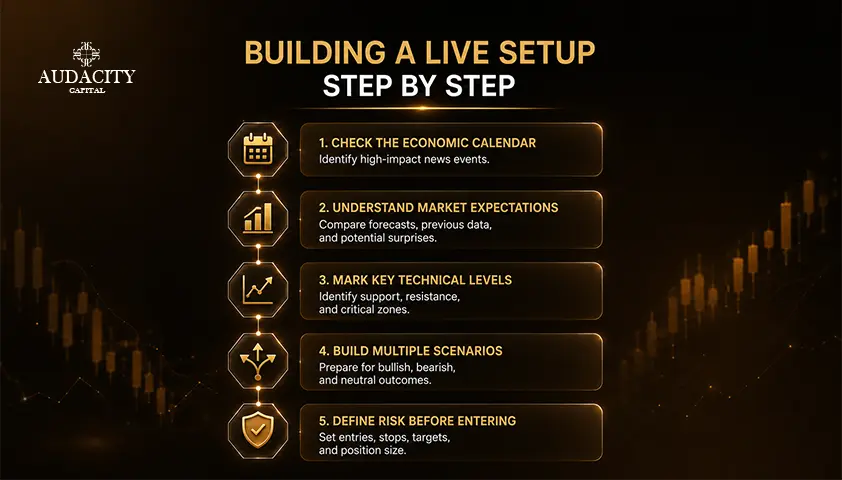
Step 1: Start With the Economic Calendar
Every professional news trader begins with an economic calendar.
The calendar tells traders:
- Which events are scheduled
- When they will be released
- Their expected market impact
- Previous results
- Consensus forecasts
Rather than monitoring every announcement, experienced traders focus on high-impact events that historically generate meaningful price movement.
Examples include:
- Interest Rate Decisions
- CPI
- PPI
- GDP
- Non-Farm Payrolls
- Retail Sales
- Manufacturing PMI
- FOMC Statements
Knowing exactly when these events occur allows traders to prepare their charts, define their trading plans, and avoid being surprised by sudden volatility.
Step 2: Understand Market Expectations
Markets don't simply react to the news itself—they react to the difference between expectations and reality.
Before every major release, analysts publish consensus forecasts based on available economic data.
Professional traders compare:
- Previous result
- Consensus forecast
- Possible surprise outcomes
For example:
If inflation is expected to rise by 3.2%, but the actual figure comes in at 3.8%, the stronger-than-expected reading may create a bullish reaction for the currency.
Understanding these expectations helps traders build realistic scenarios before the announcement instead of making emotional decisions after the news is released.
Step 3: Mark Key Technical Levels
Before the news is released, professional traders identify the price levels that are most likely to influence market behaviour.
These levels help determine where traders may enter, exit, or avoid the market.
Important levels include:
- Previous day's high and low
- Weekly high and low
- Major support and resistance
- Trendlines
- Supply and demand zones
- Round psychological numbers (e.g., 1.1000 on EUR/USD)
- Moving averages
- Fibonacci retracement levels
Rather than drawing dozens of lines, focus on the levels that have recently caused strong reactions.
These areas often become decision points once the news is released.
Step 4: Build Multiple Trading Scenarios
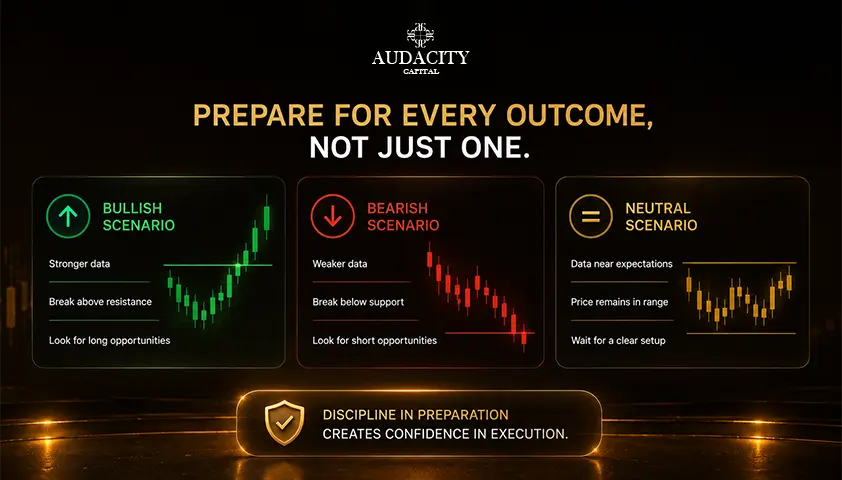
One of the biggest mistakes beginners make is trying to predict exactly what will happen.
Professional traders prepare for multiple outcomes instead.
Instead of saying:
"The market will definitely go up."
They prepare scenarios like:
Scenario 1: Bullish Outcome
If the economic data is stronger than expected:
- Price breaks above resistance
- Volume increases
- Momentum confirms the breakout
- Buy opportunities become valid
Scenario 2: Bearish Outcome
If the economic release disappoints:
- Price breaks below support
- Selling pressure increases
- Market confirms lower highs
- Short opportunities become valid
Scenario 3: Neutral Outcome
If the release is close to expectations:
- Price remains inside its range
- Volatility quickly fades
- No trade is taken until a clearer setup develops
Preparing several scenarios removes emotional decision-making and allows traders to react objectively once the market reveals its direction.
Step 5: Choose Your Entry Strategy
Not every trader enters the market in the same way.
The best entry depends on both the market conditions and your trading style.
Breakout Entry
A breakout strategy involves entering once price breaks through a major support or resistance level following the news.
This approach works well when economic data creates strong momentum.
Best for:
- Interest Rate Decisions
- CPI
- Non-Farm Payrolls
- GDP
Pullback Entry
Instead of chasing the first move, some traders wait for price to retrace before entering.
This provides:
- Better risk-to-reward
- Smaller stop-losses
- More controlled entries
Although some opportunities may be missed, waiting for a pullback often results in higher-quality trades.
Straddle Strategy
Some traders don't predict direction at all.
Instead, they place:
- Buy Stop above resistance
- Sell Stop below support
Once one order is triggered, the opposite order is cancelled.
The straddle strategy is commonly used during high-impact announcements where large price movements are expected but the direction is uncertain.
Confirmation Entry
Many professional traders simply wait.
Rather than trading the first spike, they allow:
- Initial volatility
- Pullback
- Trend confirmation
Only then do they enter.
This conservative approach avoids many false breakouts and is often better suited to traders operating under strict drawdown rules.
Step 6: Define Risk Before Entering
Every trade should have a predefined exit before the position is opened.
Professional traders never calculate risk after entering a trade.
Their trading plan usually includes:
- Entry price
- Stop-loss
- Take-profit
- Position size
- Maximum acceptable loss
- Risk-to-reward ratio
Many traders also reduce their normal position size before major announcements because spreads often widen and slippage becomes more common.
Protecting capital is always more important than capturing every opportunity.
Example: Building a Live Setup for Non-Farm Payrolls (NFP)
Imagine it's the first Friday of the month and the US Non-Farm Payrolls report is due in one hour.
Rather than opening a position immediately, a professional trader follows a structured process.
Before the Release
- Review the economic calendar.
- Check the consensus forecast.
- Read recent Federal Reserve commentary.
- Mark support and resistance on EUR/USD.
- Identify the day's trading range.
Prepare Scenarios
Bullish USD
- Strong employment data
- EUR/USD breaks below support
- Look for short opportunities
Bearish USD
- Weak employment data
- EUR/USD breaks above resistance
- Look for buying opportunities
Neutral Data
- Stay out of the market until a clearer trend develops.
Define Risk
Before the announcement:
- Maximum risk per trade: 1%
- Stop-loss predefined
- Profit target established
- Position size reduced to account for higher volatility
Once the report is released, the trader simply follows the prepared plan instead of making emotional decisions.
Common Mistakes Traders Make During News Events
Even experienced traders can struggle during periods of extreme volatility.
The most common mistakes include:
Trading Without Preparation
Entering the market without reviewing the economic calendar or understanding market expectations.
Chasing the First Candle
Many traders enter immediately after a large price movement, only to get caught in a reversal.
Ignoring Risk Management
Increasing position size because the opportunity appears attractive often leads to larger losses.
Trading Every News Event
Not every announcement creates a tradable opportunity.
Sometimes the best decision is to stay out of the market.
Moving Stop-Losses
Changing your stop-loss because you hope the market will reverse usually increases losses instead of reducing them.
Professional Trader Checklist
Before every major economic announcement, ask yourself:
✅ Have I checked today's economic calendar?
✅ Do I understand market expectations?
✅ Have I identified key support and resistance levels?
✅ Have I prepared both bullish and bearish scenarios?
✅ Is my stop-loss already defined?
✅ Does my position size match today's volatility?
✅ Am I following my trading plan?
If the answer to any of these questions is "No," consider waiting before entering the market.
Final Thoughts
Professional traders don't rely on luck during major news releases.
They prepare well before the announcement, define their risk in advance, and remain flexible enough to adapt to changing market conditions.
Building live trading setups isn't about predicting every move correctly. It's about preparing for multiple outcomes, protecting your capital, and executing your strategy with discipline.
Over time, consistency in preparation often becomes a greater advantage than trying to react faster than everyone else.
Related Articles
10 Best News Trading Strategies in 2026
Read Our Complete Guide to News Trading on Prop Firms
Frequently Asked Questions
A live trading setup is a structured trading plan prepared before a major market event. It includes key price levels, entry criteria, stop-loss placement, profit targets, and risk management rules.
Interest rate decisions, inflation reports (CPI), Non-Farm Payrolls (NFP), GDP releases, central bank speeches, and major geopolitical developments typically produce the highest levels of market volatility.
Beginners should approach high-impact news with caution. Waiting for the market to stabilise before entering often provides a safer and more disciplined trading opportunity.
Preparation allows traders to define multiple scenarios, manage risk effectively, and avoid emotional decisions during periods of high volatility.
Most experienced traders focus on reacting to confirmed market behaviour rather than predicting the outcome of a news release. Building scenarios in advance provides greater flexibility and reduces emotional trading.
Ready to Practice Your News Trading Skills?
Understanding how to build live setups is only the first step. The next challenge is applying that knowledge in real market conditions while maintaining discipline and effective risk management.
Start your Prop Firm Free Trial with Audacity Capital and practise trading major news events in a simulated funded environment before risking real capital.

Handa nang maglapat ng disiplinadong panganib sa crypto? Galugarin ang mga bagong instrumento ng crypto ng Audacity Capital at dalhin ang iyong diskarte sa pangangalakal.
Matuto PaNewsletter
Sumali sa aming newsletter.
Sumali sa Aming Social Community

Simulan ang Iyong Paglalakbay Ngayon Gamit ang Aming Libreng Pagsubok
Ipagmalaki ang iyong mga kasanayan at tagumpay sa pamamagitan ng mga sertipiko at makakuha ng pagkilala para sa iyong pagsusumikap at dedikasyon mula sa mga potensyal na mamumuhunan at kasamahan.
Libreng PagsubokMga Kaugnay na Artikulo

Martingale Strategy in Trading
How the martingale trading strategy works, what the doubling arithmetic actually costs, why position sizing cannot create an edge, and where it is banned.

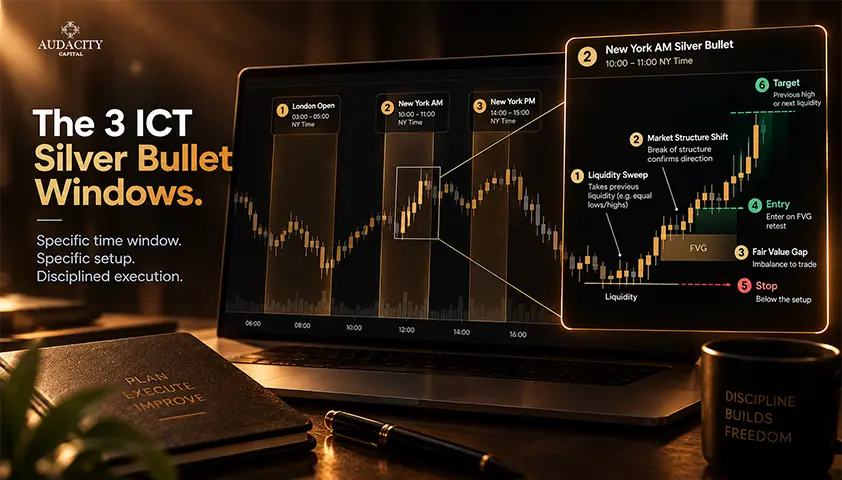
ICT Silver Bullet Strategy: Windows, Setup and Execution Rules
The ICT Silver Bullet windows, the setup step most guides skip, entry and stop rules, and what the published win rates rest on.
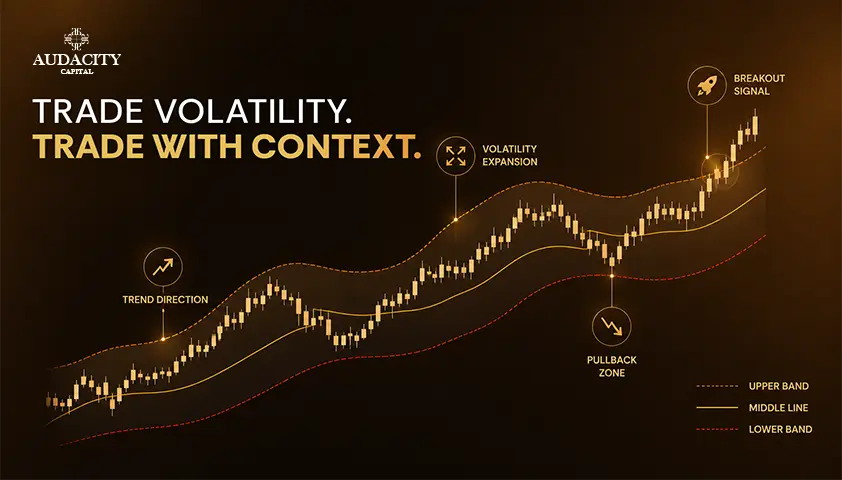
Keltner Channel Trading Strategy: How to Read Volatility With Context
Discover how Keltner Channels measure market volatility, spot trend pullbacks, and confirm breakouts. Includes setup rules, settings, and testing methods.
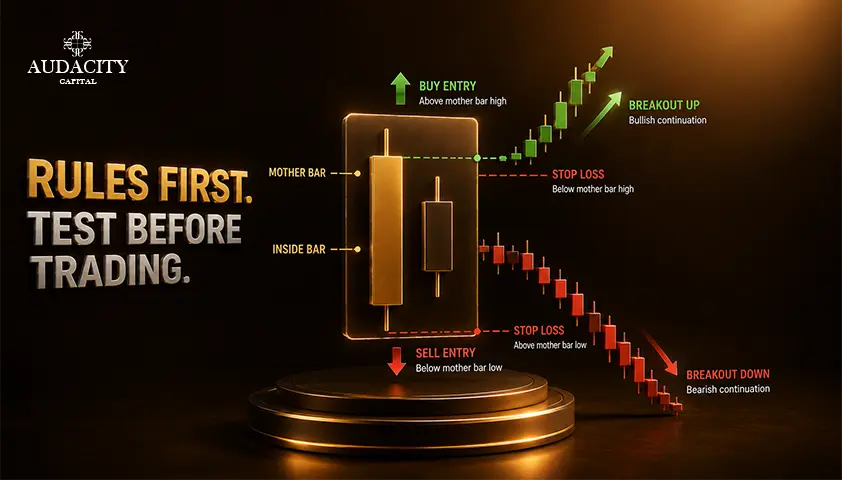
Inside Bar Trading Strategy: Rules, Entries and Backtest Guide
Learn a rule-based inside bar trading strategy. Get the pattern definition, three entry models, stop and target logic, and a backtest framework for your market.