


Martingale Strategy in Trading


Martingale is one of the few strategies that seems like it can never go wrong. Double your position after every loss, and when the first win comes, it will pay off all your previous losses and the initial stake too.
The logic is sound. The calculations are correct. One winning trade does make up for a losing streak.
It still fails, and it fails for reasons that have nothing to do with discipline. This article discusses the reasons, providing an accurate arithmetic calculation which you may verify yourself. This is educational information, not financial advice, and trading with leverage is extremely risky.
What the Martingale Strategy Is ?
The martingale trading strategy is based on one rule. If you lose a trade you double the size of the next trade. If you lose again, you double again.
When a win finally comes, it rewards you with your original stake back in addition to compensating for all prior losses in the sequence. After that, the sequence repeats, and you begin again at your base size.
This is the whole mechanism. This is what people mean when talking about a martingale strategy in trading, and this is why the sales pitch seems so convincing.
The strategy has been in use for years. It was used from eighteenth century gambling, created for bets that have an even-money outcome like flipping a coin.
This has been applied as a gambling strategy for quite some time prior to being ever suggested as a market strategy.
An important note to make here, since it can be rather confusing. A martingale in probability theory is a formal object: a process whose expected next value is equal to its present value. The betting strategy that shares its name is something completely different.
When asked what martingale trading is, traders talk about the betting strategy, and confusing both strategies might have more mathematical backing than there really is.
The Arithmetic Almost Nobody Runs
Every competing website will tell you that the risk rises exponentially. None of them will show you the math behind it. So, here is the math, expressed in units. This way it becomes scale-independent and can be applied to any trading account.
Two numbers matter. After a run of losses, the next position you need is 2 to the power of n. The total already staked in the sequence is one less than that amount.
That's the price of doubling down, and it's increasing at a rate faster than many people think.
Ten consecutive losses means you have already committed 1,023 units in order to be in a position to win 1. In a sufficiently large sample of trades, a series of ten losses is not an unusual occurrence. It is a matter of when, not if.
Then there is the cost that is never counted. Each re-entry pays the spread. You also have to pay a commission on many accounts. The costs double with every doubling of position size.
Your recovery trade should take into account not only losses and trading costs but also your transaction costs. The trade which gives you zero profits is not at all a break-even trade.
The following table is not a plan but rather the cost of the sequence. Read the whole column and try to guess the size of the account it represents.
Consecutive losses | Next position required | Total already staked | To win |
3 | 8 units | 7 units | 1 unit |
5 | 32 units | 31 units | 1 unit |
8 | 256 units | 255 units | 1 unit |
10 | 1,024 units | 1,023 units | 1 unit |
13 | 8,192 units | 8,191 units | 1 unit |
Why Position Sizing Cannot Create an Edge
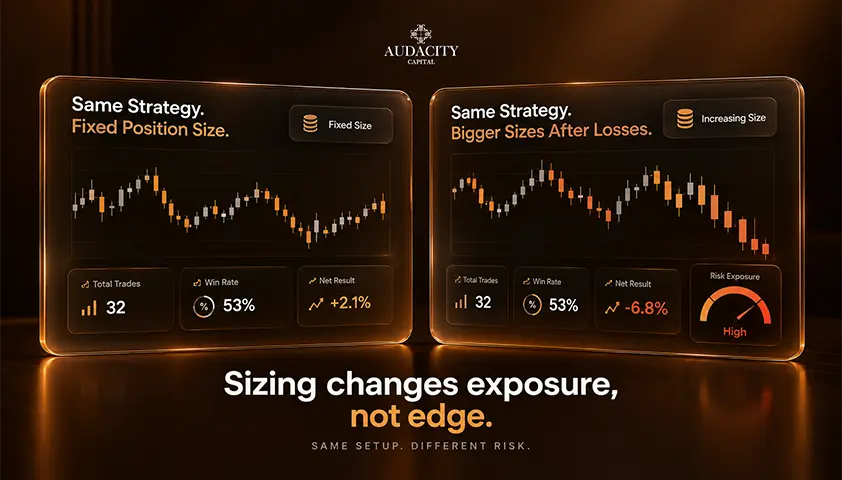
This is the thing that all of the ranking pages never say explicitly. Martingale is a position sizing system. Position sizing systems affect the shape of the outcome distribution. They do not alter the expectation of that distribution.
If a trading system lacks an edge, then the expected value of the outcome is negative after accounting for spread and commission. No matter how much you increase the size of your position, you will not be able to get rid of the negative expectation; you just increase the size of losses.
Doubling does not make a losing technique a winning technique. It transforms numerous small, predictable losses into fewer, but far bigger, losses.
The average outcome is unchanged. The variation is a lot greater.
Work it backward, as that's where the section has its value. If the method truly has an advantage, then it doesn't require martingale. Positive expectancy and expected value compound on their own, without exponential risk.
That's the uncomfortable thing: martingale calls on the traders who are at the least advantage, the ones who don't have an edge, and desire a sizing scheme to stand in for one.
This is the true answer to the question of whether martingale works in trading. Not as a tool for creating an edge, because no position sizing approach can create it.
The Two Conditions Martingale Requires, and Neither Exists
The Martingale argument rests on the assumption of two premises that cannot be sustained by a practical trading account. Name them, and their failure is plain.
Condition one: unlimited capital.
The proof requires you to be capable of doubling forever. An account with limited funds cannot do this. There is a point where the next position would be impossible for you to enter, and when you reach this, it terminates the whole process in an instant, and all previous losses become real.
This is not a gradual descent into bankruptcy. The process wins, wins, wins, and suddenly takes everything. It's the classic gambler's ruin and a finite budget assures that you will eventually reach that point.
Condition two: no limit on position size.
Casinos set a table limit for just this reason. In trading, the limits are structural and not posted. Your margin will increase proportionally to your position size, so the more steps you take in this sequence, the more margin is required, and you have less equity available.
Stop out comes before you can make the recovery trade, so you never get to the winning part of this system. The margin and stop-out requirements are not an edge case here; these are the walls.
There is a market condition that beats this system faster than the previous two. Martingale is a bet on mean reversion. A sustained directional movement of the market is a situation where losses are made consecutively, and not randomly.
The worst-case scenario for the strategy is that one market can produce losses for much longer than a trader would expect.
What the theory assumes | What it needs to be true | What a real account has |
You can always place the next trade | Unlimited capital | A finite balance and a hard floor |
Position size can grow without limit | No cap of any kind | Margin requirements that scale with size |
A win eventually arrives in time | Unlimited time in the position | A stop out that can arrive first |
Each trade is independent | Outcomes uncorrelated | Trends, which cluster losses together |
Winning once restores everything | No cost per trade | Spread and commission on every re-entry |
Why the Equity Curve Looks So Convincing

The seduction is mechanical, and understanding it is what actually stops someone buying the expert advisor.
A martingale account produces a long run of small, regular, almost boringly consistent wins, because most sequences do resolve within a few doubles.
The equity curve that results is smoother and straighter than nearly anything a sound strategy produces. Then one sequence fails to resolve, and the curve does not slope down. It drops to the floor.
That shape is what sells martingale expert advisors. A short track record shows only the smooth part, because the failure is rare by design, not by skill. A curve with no visible drawdown is not evidence that risk has been managed.
It is evidence that risk has been postponed and concentrated into a future event. The tail risk is simply sitting off the edge of the chart.
Consistency and safety are not the same property. Martingale is one of the few methods where a flawless-looking record is a warning rather than a recommendation. Once you see why, you read every suspiciously smooth curve differently.
A Loss Limit Is a Table Limit
Martingale is widely prohibited across evaluation and funded programmes in this industry, commonly alongside grid systems and high frequency approaches. An expert advisor that uses martingale sizing is frequently restricted even where automation is otherwise allowed.
The rule itself is not the interesting part. The interesting part is that a fixed loss limit is functionally identical to a casino table limit, which is the exact mechanism that makes martingale unworkable.
A programme with a daily loss cap and a maximum drawdown has, without intending to, installed the one constraint the strategy cannot survive. A trader running martingale under those rules is not gambling on the market. They are gambling on reaching the recovery trade before the drawdown limit does.
This is common industry practice rather than a universal rule, so verify anything specific. Check your own programme documentation directly. Third-party listings can be out of date.
Anti-Martingale and Grid, Briefly
Two terms you will meet right next to this one. Here they are, defined, not recommended.
Anti-martingale is the inverse. Size increases after wins and decreases after losses, so exposure grows when the account is growing and shrinks during a drawdown. It does not create an edge either.
It fails in a fundamentally less destructive way, because the largest positions are funded by prior gains rather than by an unfilled hole.
Grid means orders placed at fixed intervals around a price. Grid trading is a distinct idea and is not inherently martingale. What tends to be restricted is the combination: a grid whose position sizes escalate on losing levels, which stacks two risk patterns on top of each other.
Conclusion
Martingale is not a bad strategy because it is aggressive. It is not a strategy at all. It is a sizing rule, and sizing rules cannot manufacture an edge the underlying method does not have. What martingale does is hide the absence of one, for a while, behind an unusually convincing equity curve.
The pull toward it is usually strongest right after a painful loss, and the urge to recover losses quickly is a different problem from a strategy choice that no sizing rule will solve.
That is also why the table limit point matters in practice. A fixed drawdown floor is exactly the constraint martingale cannot survive, and Audacity Capital's simulated evaluation accounts operate with a defined loss limit of that kind.
Frequently Asked Questions
Yes, but legal and permitted are two different questions. It is a sizing decision, and there is nothing unlawful about it. A programme or platform can still prohibit it contractually, and a breach ends the account regardless of legality. Always read the rules that apply to your specific account.
Capping the doubles removes the very thing that made martingale appealing. Once the sequence can end unresolved, the guarantee is gone. What you are left with is an ordinary strategy carrying one very large stop loss instead of several small ones. A cap is not a fix, it is an admission that the guarantee was never real.
No, and the difference is both intent and structure. Dollar cost averaging adds to a position on a schedule as part of a long-term accumulation plan with a predetermined total commitment. Averaging down under martingale adds in response to losses, with a size that escalates and has no predetermined ceiling. Same direction of travel, very different risk.
Escalating position size after losing trades is a visible pattern in trade history. Programmes review the trade record itself rather than relying on how a trader describes their method, so the pattern shows regardless of what it is called. Check your own programme's rules rather than assuming a general answer applies to you.
No. Any multiplier above one creates the same basic failure mode. It only changes how many losing trades it takes to reach the limit. There is no "safest" multiplier because none removes the underlying risk. They only move the wall.

Handa nang maglapat ng disiplinadong panganib sa crypto? Galugarin ang mga bagong instrumento ng crypto ng Audacity Capital at dalhin ang iyong diskarte sa pangangalakal.
Matuto PaNewsletter
Sumali sa aming newsletter.
Sumali sa Aming Social Community

Simulan ang Iyong Paglalakbay Ngayon Gamit ang Aming Libreng Pagsubok
Ipagmalaki ang iyong mga kasanayan at tagumpay sa pamamagitan ng mga sertipiko at makakuha ng pagkilala para sa iyong pagsusumikap at dedikasyon mula sa mga potensyal na mamumuhunan at kasamahan.
Libreng PagsubokMga Kaugnay na Artikulo

Momentum Trading Strategy: A Comprehensive Guide
Master the core principles of a momentum trading strategy. Learn how to use key indicators, manage sharp-reversal risks, and master exit timing.

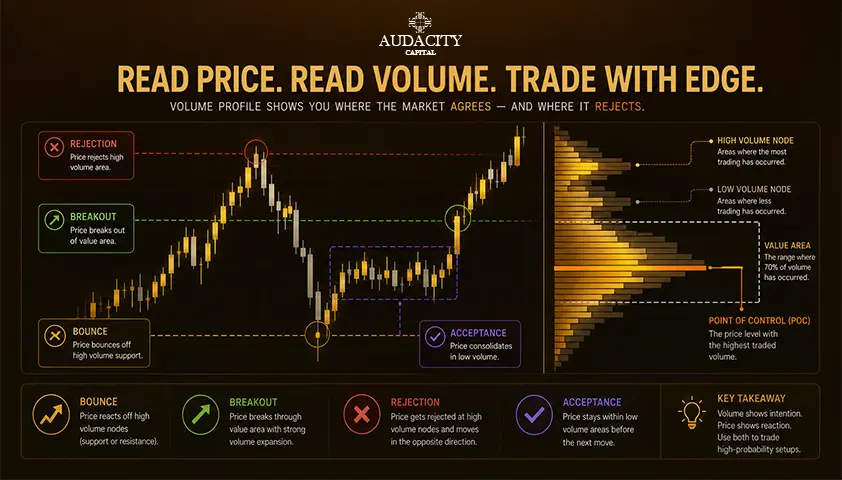
Volume Profile Trading Strategy Guide: Setups & Nodes
A Volume Profile trading strategy shows where the market spent the most volume. Learn POC, value areas, volume nodes, and 4 setups for ES, NQ, and forex.
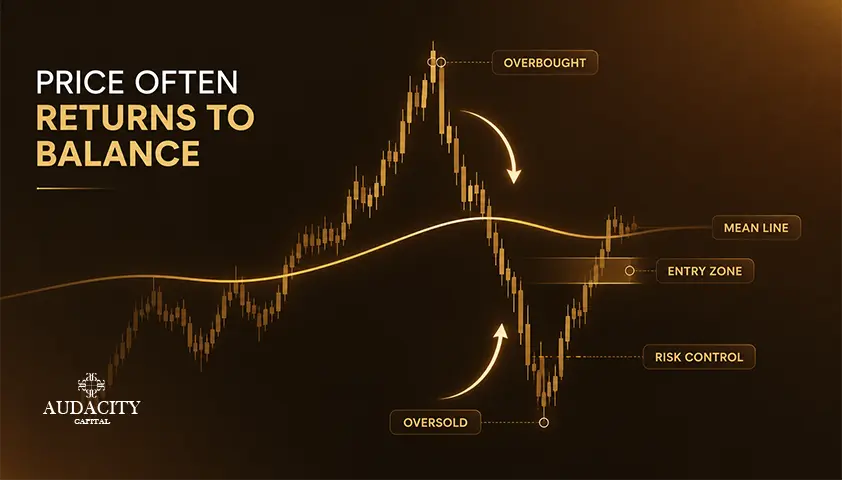
Mean Reversion Trading Strategy Explained (2026)
Prices that stretch too far tend to snap back to an average, but only in the right market. Learn the tools, the setup, and the trend risk.
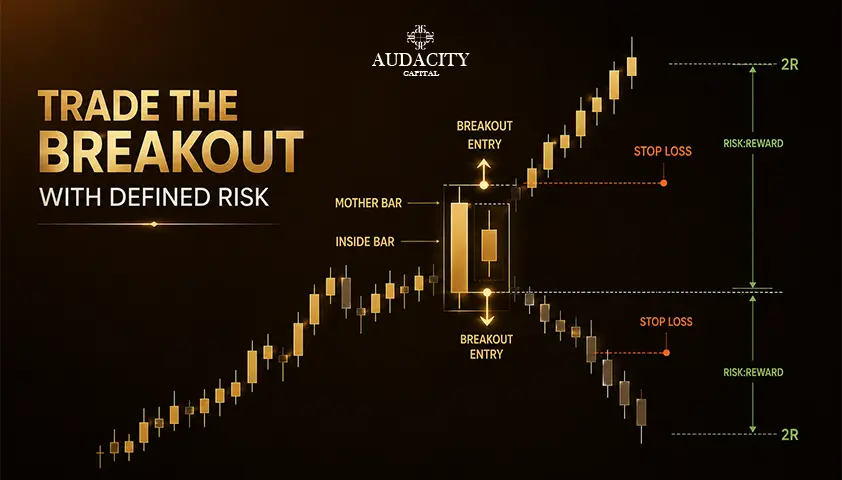
Inside Bar Trading Strategy: Rules, Entries and Risk Guide
Master the inside bar trading strategy with practical rules for pattern identification, entry triggers, stop placement, risk management, and testing.