


How to Create a Day Trading Risk Management Plan?



Search for risk management day trading online, and you'll find plenty of generic advice telling you to "cut your losses" or "protect your capital," but very little of it gives you an actual framework to apply.
Most traders know the theory. Very few of them have ever written a plan down, which is exactly why the same mistakes keep repeating themselves at 9:47 a.m. when a position moves against them, and the account starts bleeding red.
A day trading management plan closes that gap. It's a fixed set of rules, decided before the market opens, that tells you:
- How much to risk per trade
- When to stop for the day
- How to size positions after a losing streak
As a trader, none of these are real-time decisions, because real-time is when judgment is at its weakest.
Now, let’s begin the guide that builds the plan section by section. You'll set a maximum risk per trade, define daily and monthly drawdown limits, build position sizing rules that adjust to recent performance, and put together a checklist to run before, during, and after every session. By the end, you'll have a complete, documented framework instead of a loose set of intentions.
If you are new to risk management day trading, first read our guide on Risk Management for Day Traders.
Why Every Day Trader Needs a Written Day Trading Management Plan?
Trading consistency rarely comes from a better setup or a faster platform; it comes from applying the same rules every single day, most of all on the days when following them feels hardest.
A written plan gives you something to fall back on when a trade goes wrong, because the decision was already made before the pressure started.
Emotional decisions are the biggest reason profitable strategies stop working. A trader with a genuine statistical edge can still lose money over a month by doubling size after two losses or holding a losing position past the stop because "it will come back." Neither choice happens in a vacuum. Both happen because no rule existed to override the emotion in the moment, and that gap is what risk management in day trading is built to close.
Professional trading desks run on documented risk parameters. Prop firms set daily loss limits, maximum position sizes, and drawdown thresholds for every trader on the desk, and a trader who breaches them loses the allocation regardless of how the rest of the month looked. That structure exists because rules that live only in someone's head tend to bend the moment they become inconvenient.
A plan written down, printed out, or pinned to a trading screen doesn't bend. It sits there, waiting to be followed or broken, and the difference between the two usually decides which traders last and which don't.
Set Your Maximum Risk Per Trade
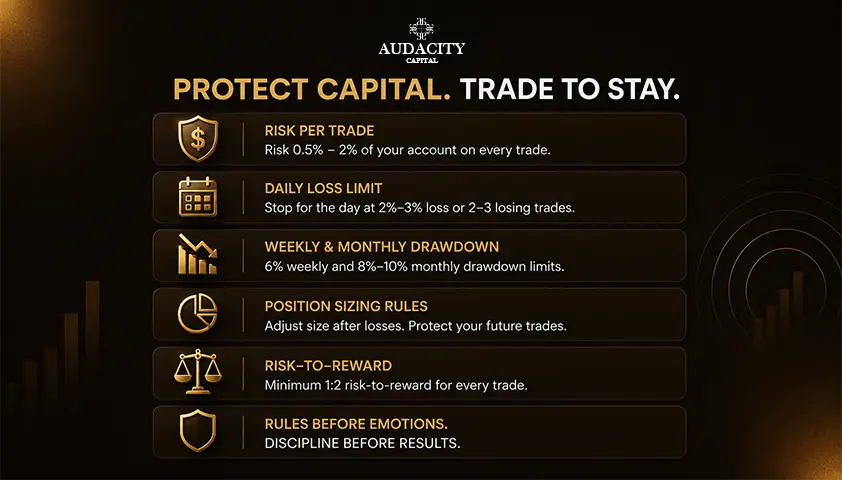
Every risk management in day trading plan starts with one number: how much of the account you're willing to lose on a single trade if the stop gets hit. This number needs to exist before a chart opens, not while a position is already moving the wrong way.
Two approaches dominate this decision:
- Fixed percentage risk: It ties risk to a set share of the account, usually somewhere between 0.5% and 2%. As the balance grows or shrinks, the dollar amount adjusts on its own. This method scales cleanly and stops a losing streak from eating an outsized chunk of a smaller account.
- Fixed dollar risk: It sets a flat amount, say $50 or $150, no matter what the account balance is. Some traders prefer this because it keeps position sizing math simple and removes the temptation to increase size after a strong month, since the figure doesn't move unless it's deliberately changed.
Neither approach wins outright.
- Traders with smaller or more volatile accounts often lean on fixed percentage risk because it self-adjusts.
- Traders who value simplicity, or who are still building consistency, sometimes prefer a flat dollar figure they can memorize and apply without doing math mid-session.
Account Size | Risk% | Example |
$5,000 | 1% | Standard Entry |
$10,000 | 1% | Standard Entry |
$25,000 | 1% | Standard Entry |
$50,000 | 0.5% | Reduced risk on a larger account |
Once you settle on a method, write it into the plan as a single sentence that can't be misinterpreted under pressure. "I risk 1% of my account per trade, calculated before market open and rounded down to the nearest $10" leaves no room to negotiate later. Vague language like "I try to keep risk reasonable" gives emotion an opening, and emotion is exactly what this rule exists to remove.
Define Your Daily Loss Limit
A daily loss limit is the point where you close the platform and step away, no matter how convinced you are that the next trade will work. It exists because losses compound emotionally as well as financially. One loss makes the next trade feel more urgent, and urgency is usually where discipline breaks down.
Most day trading risk management strategies set this limit as a percentage of account size, typically 2% to 3% of total capital. On a $10,000 account, that translates to $200 to $300 for the day, spread across whatever number of trades the plan allows.
Alongside a dollar limit, many traders cap the number of losing trades they'll take before stopping, often two or three. This matters because a string of losses usually signals that something about the current market doesn't suit the strategy, not that the next trade is somehow due to win.
Account Size | Daily Risk Limit | Example Stop Rule |
$5,000 | $100 | Stop after 2 losing trades or $100, whichever comes first |
$10,000 | $200 | Stop after 2 losing trades or $200, whichever comes first |
$25,000 | $500 | Stop after 3 losing trades or $500, whichever comes first |
Set a hard rule for what happens once the limit is hit. Close all charts, log out of the trading platform, and don't reopen it until the next session. The limit only works when it's treated as non-negotiable.
Set Weekly and Monthly Drawdown Limits
Daily loss limits protect a single session. Weekly and monthly drawdown limits protect the account itself, and together they're what separate real day trading management from good intentions. Without them, a trader can follow every daily rule perfectly and still watch a slow bleed turn into a serious dent in capital over several weeks.
A common structure caps weekly drawdown around 5% to 6% of account size and monthly drawdown around 8% to 10%. Once either threshold is reached, trading stops for the rest of that period.
Reset periods matter just as much as the limits themselves. Decide in advance whether the week resets on Monday or Sunday, and whether the month follows the calendar or a personal trading cycle. Write it down so there's no ambiguity when results are being tallied under stress.
Use the pause to review performance instead of simply waiting it out. Pull up the trades from the drawdown period and look for patterns.
Were losses concentrated in one type of setup, one time of day, or one market condition? A drawdown limit that only stops trading, without prompting a review, wastes the one advantage it offers: a forced chance to diagnose what went wrong.
Build Position Sizing Rules
Position sizing determines how much capital moves into each trade, and it should shift with recent performance instead of staying fixed forever. A rigid size that never adjusts ignores useful information a trader's own history is already providing.
Start with a standard trade size calculated directly from the risk per trade and the stop-loss distance. Risking $100 per trade with a stop $2 away from entry gives a standard position size of 50 shares. This is the baseline, the size traded when nothing about recent performance suggests a deviation.
After a losing streak, most experienced traders cut size before they cut anything else. Reducing position size by half after two or three consecutive losses keeps losses smaller while a trader regains footing, without forcing a full stop if the strategy still has merit. Some traders take this further, dropping to a minimum size until they string together two or three winning trades in a row.
Scaling up works in reverse. A trader who's had a strong week, defined by hitting profit targets on multiple days and not one lucky trade, might increase size by 25% to 50% the following week. This should always be capped, and the cap belongs in the written plan rather than in a decision made when confidence happens to be running high.
Maximum exposure across open positions matters too, especially for traders running more than one setup at a time. A common rule caps total risk across all open trades at 2% to 3% of account size, so five small positions can't combine into the same damage as one oversized trade.
All About Acceptable Risk-to-Reward Ratios
A minimum risk-to-reward ratio filters out trades that aren't worth taking, even when the setup looks technically clean. Setting this number in advance stops a trader from talking into a trade because it "feels right" instead of because the math supports it.
Most day trading risk management strategies set a floor around 1:2, meaning the potential reward is at least twice the amount risked. At that ratio, a strategy can stay profitable even with a win rate below 50%, which takes pressure off needing to be right on every single trade.
Risk-to-Reward | Potential Outcome | Plan Decision |
1:1 | Reward matches risk, little margin for error | Usually skip |
1:1.5 | Reward slightly exceeds risk | Take only with a strong win-rate history |
1:2 | Reward doubles the risk | Meets minimum, standard entry |
1:3 or higher | Reward triples the risk or more | Prioritize when the setup supports it |
Skipping a setup because the reward doesn't clear the minimum is one of the hardest disciplines to build, in part because the trade often still looks attractive on the chart. The rule isn't there to judge whether a setup is good. It's there to judge whether taking it fits the math on which the entire strategy depends. A trader who breaks this rule now and then for an "obvious" trade tends to find those exceptions become the norm within a few weeks, at which point the ratio requirement has stopped meaning anything.
Write the minimum ratio into the plan as a hard filter applied before entry, not as a target to hope for. If a trade doesn't meet it, the decision is already made, and no further analysis of the setup is needed.
Create Rules for Different Market Conditions
The same risk parameters don't have to apply to every kind of trading day. Adjusting position size and stop placement to current market conditions is itself part of a solid plan.
Market Condition | Position Size | Stop Approach | Trading Rule |
Trending | Standard | Normal stop distance | Trade qualified setups in the direction of the trend |
Range-bound | Reduced | Placed at range boundaries | Cut size; false breakouts are more common |
High volatility | Smaller | Wider, justified by the move | Reduce exposure even on strong setups |
Major news events | Reduced or none | Avoid new entries into the release | Wait for the initial volatility to settle |
- Trending markets reward standard sizing because momentum carries price further than in choppier conditions, and stops placed at normal distances are less likely to get clipped by noise before the move develops.
- Range-bound markets behave differently. Price oscillates between levels without committing to a direction, so breakouts fail more often than they hold. Cutting size here accounts for the higher rate of false signals without requiring a trader to sit out the session altogether.
- High volatility calls for smaller size paired with wider stops, since tight stops get triggered by normal price swings rather than genuine reversals. Wait, the position gets smaller so the wider stop doesn't push total dollar risk beyond the plan's usual limit.
- Major news events deserve their own category. Spreads widen, slippage increases, and price can move well past a planned stop before an order fills. Avoiding new entries in the minutes around a major release, or cutting size well below normal if a trade is already open, guards against risk that no ordinary stop-loss can fully control.
Build a Daily Trading Checklist
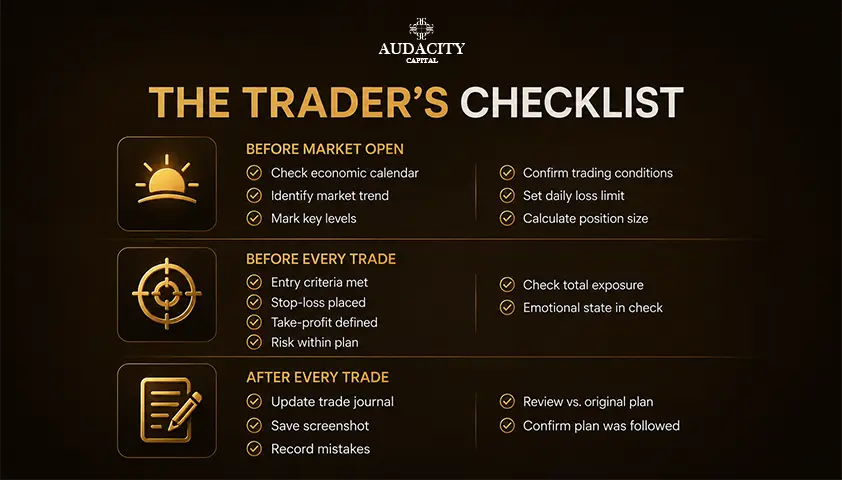
A checklist turns the rules from every earlier section into something a trader runs through every session, not something remembered on good days and skipped on stressful ones. Three checkpoints cover a full session: before the market opens, before each trade, and after each trade closes.
Before Market Open
This stage confirms you're trading with a plan for the day instead of reacting to whatever the market throws at you first.
- Economic calendar checked for scheduled news
- Market trend identified across relevant timeframes
- Key support and resistance levels marked
- Trading conditions confirmed to suit the strategy
- Maximum daily loss confirmed for the session
- Position size calculated from current account balance
- Risk-to-reward minimum reviewed
Before Every Trade
This checkpoint catches trades that don't meet your own criteria, even the ones that look tempting in the moment.
- Entry criteria met according to strategy
- Stop-loss placed before the order goes live
- Take-profit level defined in advance
- Risk confirmed to fall within the plan
- Existing positions checked for overlapping or excessive exposure
- Emotional state checked, most of all after a recent win or loss
After Every Trade
This final stage is where a plan gets refined over time, not just followed and forgotten.
- Trade journal updated with entry, exit, and reasoning
- Screenshot saved for later review
- Mistakes recorded in full, not glossed over
- Trade management reviewed against the original plan
- Confirmation noted on whether the plan was followed, not just intended
Trading Journal: Turning Data into Better Decisions
Good day trading management depends on tracking results, not memory, and a journal is where that tracking happens. Without one, patterns stay invisible, hidden inside a string of trades that feel random even when they're not.
- Track the win rate first, as it indicates how often setups play out as expected.
- Pair it with average risk-to-reward achieved, because the two numbers together reveal whether a strategy is genuinely profitable or only breaking even after costs.
- Maximum drawdown deserves its own line in the journal, tracked separately from daily results. A trader can post a positive month overall and still have survived a drawdown deep enough to threaten the account, and that's worth knowing even when the final number looks fine.
- Mistakes require honest documentation, including those that ultimately worked out anyway. Moving a stop-loss and getting away with it once doesn't make it a good decision, and a journal that only records outcomes, not process, will reinforce the wrong lessons over time.
- Emotional notes and market conditions round out the picture. A trader who logs how they felt going into a trade, along with whether the market was trending, ranging, or choppy, starts to see which conditions and which mental states line up with the best and worst results. Regular review of this data turns a stack of individual trades into a clear map of what to keep doing and what to change.
Sample Risk Management Day Trading Plan
Seeing every rule from this guide applied to one $10,000 account shows how the pieces are meant to work together.
Rule | Example |
Risk Per Trade | 1% of account ($100) |
Daily Loss Limit | 2% of account ($200), or two losing trades, whichever comes first |
Weekly Drawdown | 6% of account ($600) |
Maximum Open Trades | 3 |
Minimum Risk-to-Reward | 1:2 |
Position Sizing After a Loss | Reduced by half after 2 consecutive losses |
News Trading | No new entries during high-impact releases |
Journal | Completed after every session, no exceptions |
The numbers are built to trigger each other. Two $100 losses hit the daily limit before a third trade can compound the damage, and three bad days in a row would use up the entire weekly drawdown, forcing a pause well before the account takes real damage. Position sizing drops by half the moment the second loss lands, so any trade taken near the daily limit is already smaller than the one before it. This is the difference between risk management for day trading on paper and a plan that actually behaves the way it's supposed to once real losses start happening.
Copy the template below and fill in your own numbers before your next trading session.
Risk Management Day Trading Plan
- Trading capital: ___________
- Maximum risk per trade: ___________
- Daily loss limit: ___________
- Maximum losing trades before stopping: ___________
- Weekly drawdown limit: ___________
- Monthly drawdown limit: ___________
- Position size after 2 consecutive losses: ___________
- Minimum risk-to-reward ratio: ___________
- Maximum open trades: ___________
- News trading rule: ___________
- Session stop time: ___________
- Review schedule: ___________
Keep the filled-in version somewhere visible during trading hours, whether that's a printed sheet next to the monitor or a pinned note on the trading platform.
A plan that lives in a folder nobody opens offers the same protection as no plan at all. The value comes from seeing it, not from having written it once and filing it away.
Conclusion
A written plan for risk management in day trading isn't a set of restrictions bolted onto trading. One can find it as the practical core of day trading management, the framework that makes consistency possible in the first place, since every rule inside it removes a decision that shouldn't be made under pressure.
The plan built in this guide covers risk per trade, daily and drawdown limits, position sizing, and risk-to-reward, but it doesn't have to stay fixed forever. Review it as the account grows, as the strategy evolves, and as you learn more about your own behavior under stress. The best plans get refined with experience. They rarely need to be rewritten from scratch.
Built the plan? Now, can it survive real capital?
Audacity Capital gives disciplined traders a shot at funded capital. Start with Audacity Capital's free monthly trading competition and see where it holds.
Related Article
Frequently Asked Questions
Most day trading risk management strategies cap risk per trade between 0.5% and 2% of account size.
A daily loss limit of 2% to 3% of account size works for most traders, though the right number depends on strategy and volatility.
Both work. Percentage-based risk adjusts on its own as an account grows or shrinks, which suits traders focused on scaling. A fixed dollar amount stays simple to calculate and removes the temptation to increase size after a good month.
Yes. Reducing the size by half after two or three consecutive losses is a common adjustment, since it keeps the account intact while a trader regains footing. Some traders drop to a minimum size until they string together a couple of winning trades before returning to standard sizing.

Handa nang maglapat ng disiplinadong panganib sa crypto? Galugarin ang mga bagong instrumento ng crypto ng Audacity Capital at dalhin ang iyong diskarte sa pangangalakal.
Matuto PaNewsletter
Sumali sa aming newsletter.
Sumali sa Aming Social Community

Simulan ang Iyong Paglalakbay Ngayon Gamit ang Aming Libreng Pagsubok
Ipagmalaki ang iyong mga kasanayan at tagumpay sa pamamagitan ng mga sertipiko at makakuha ng pagkilala para sa iyong pagsusumikap at dedikasyon mula sa mga potensyal na mamumuhunan at kasamahan.
Libreng PagsubokMga Kaugnay na Artikulo
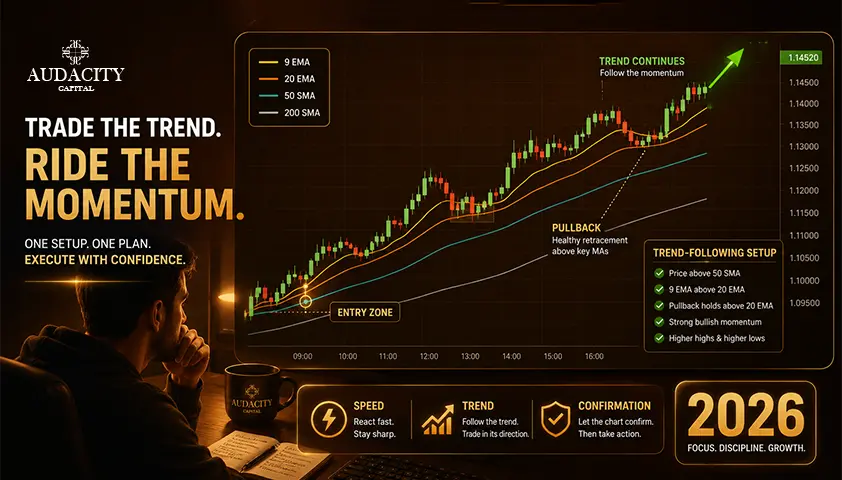
Best Moving Average for Day Trading in 2026
Compare the 9, 20, 50 and 200 moving averages for day trading, when each works best, and how to avoid lag, noise and false signals.

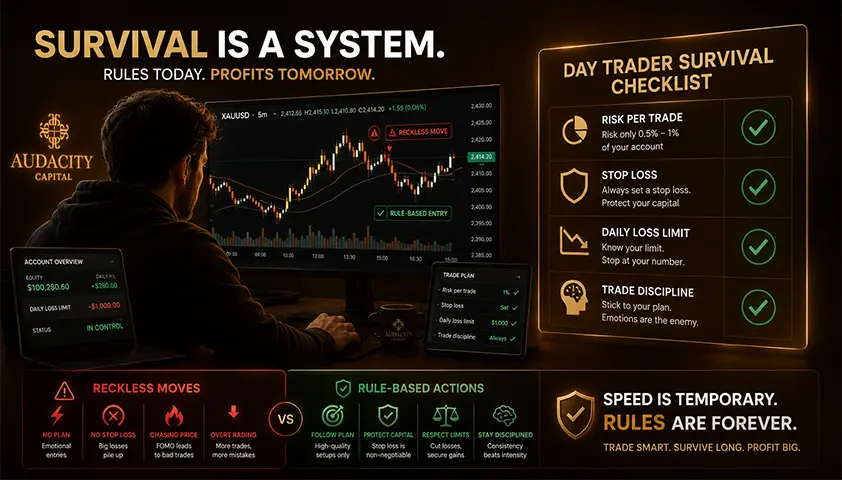
Day Trading Tips: The Rules That Actually Decide Whether You Survive
Practical day trading tips ordered by what actually matters. Risk rules, discipline, execution, and the 2026 pattern day trader change explained honestly.

Day Trading Crypto vs Stocks: Which Is Better?
Compare crypto and stock day trading by hours, volatility, fees, liquidity, rules and risk to find which market fits your trading style.
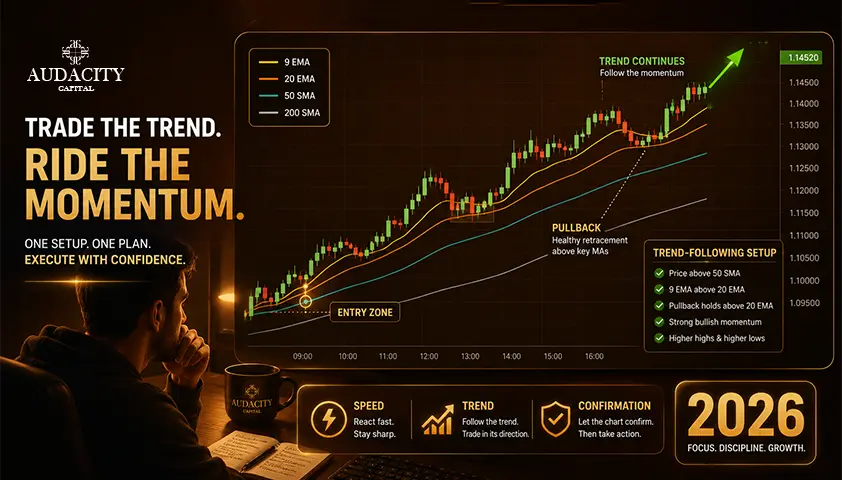
Best Moving Average for Day Trading in 2026
Compare the 9, 20, 50 and 200 moving averages for day trading, when each works best, and how to avoid lag, noise and false signals.