


What Is Take Profit in Trading? A Detailed Guide for Traders


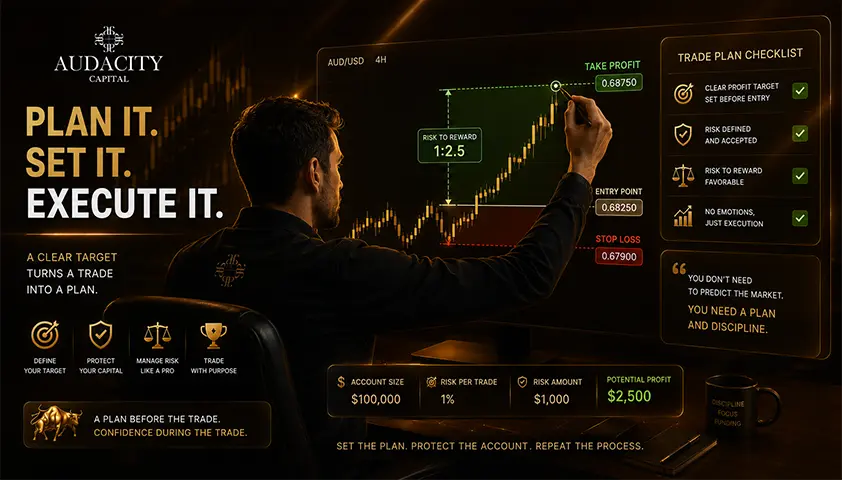
A take profit is a pre-set order that automatically closes your trade at a target price to lock in your gains. That is the short version.
Take profit trading will not make you profitable. It is a discipline tool, not a profit generator, and its entire value depends on placing it where the market actually respects, not on a random round number.
It solves two costly mistakes:
- Holding a winner too long until it reverses (greed), and
- bailing two pips into a move that runs without you (fear).
This guide covers what it is, why to use it, when it works against you, how to place one well, the advanced moves, the common mistakes, and what all of it means on a funded account.
What Is a Take Profit Order?
A take profit (often shortened to TP) is a pending order, a type of limit order, that tells your broker to automatically close your position once price reaches a target better than the current market price.
It locks in the gain without you watching the screen.
Direction matters.
For a long position, you place the take profit above your entry, in forex above the Bid.
For a short position, you place it below your entry, below the Ask.
That spread detail is not pedantic. It affects exactly where your order can realistically fill, especially on shorts.
A take profit order is the counterpart to a stop loss. The take profit secures a gain at a better price. The stop loss caps a loss at a worse price. Together they bracket the trade, so the outcome is defined before emotions get a vote.
This is where the OCO (one-cancels-the-other) idea comes in.
When both orders are set, triggering one automatically cancels the other. Most platforms create them as an OCO pair by default, so you cannot accidentally close at both targets.
You can usually add or modify a take profit after the trade is open, or close manually at any time.
A simple long-trade picture helps anchor it: your entry sits in the middle, the stop loss below to cap risk, and the take profit above to bank the reward.
Why Use a Take Profit (and When It Works Against You)
The benefits are real, but so is the downside. Let us be straight about both.
The Benefits:
1. It removes emotion and greed. The classic trap is holding a winner hoping for more, missing the reversal, then closing far worse, or watching unrealized gains evaporate entirely.
2. It enforces discipline. The exit is pre-planned, not invented mid-trade under pressure.
4. It is set-and-forget. You do not need to stare at the screen, which suits busy traders and fast markets.
5. It defines the reward leg of your risk-reward ratio before you ever enter.
The Trade-Off:
A fixed take profit caps your upside. If price keeps running past your target, the trade has already closed and you miss the bigger move.
This is why fixed targets suit short-term and range strategies more than long-term trend-riding.
There is also a volatility caveat. Around high-impact news, a sharp spike can trigger a too-close take profit prematurely, or the market can gap straight through it.
Re-entering then costs you spread again. None of this is a flaw in the tool. It is a trade-off to manage, and it is exactly why partial profits and trailing stops exist, which we will cover shortly.
How to Set a Take Profit: The Main Methods
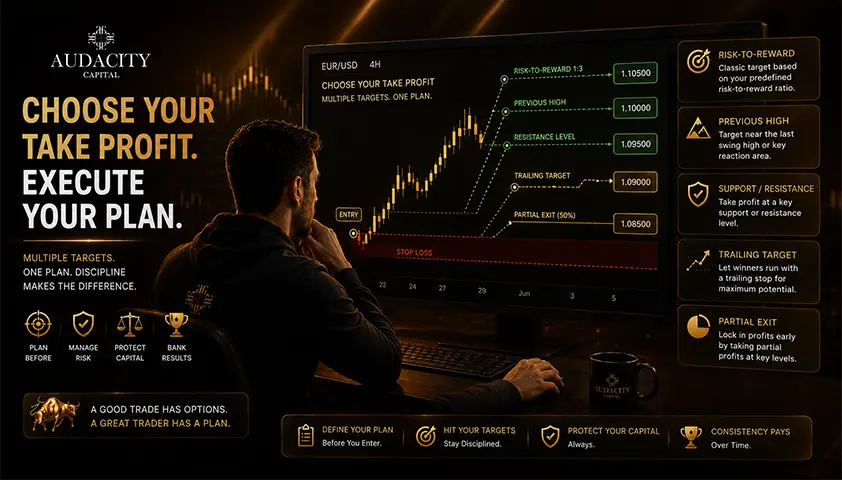
Here is the core principle: a good take profit is placed at a level the market is likely to respect, chosen before you enter, not a round number picked mid-trade.
That single discipline separates traders who keep their gains from traders who give them back.
There are 3 reliable methods for figuring out how to set take profit trading targets.
1. Technical Levels (the most popular)
Place the take profit just before a level where price is likely to stall or reverse.
For a long, that means a few pips below the nearest resistance, so your order fills before the selling pressure arrives.
For a short, place it just above support. You can also use prior swing highs and lows, chart-pattern targets such as measured moves, pennants, and double tops or bottoms, round numbers, and Fibonacci extensions.
Why place it a touch before the level rather than right at it?
Because it raises the probability the target is actually hit. Price often reacts at support and resistance before reaching the exact line.
Levels are also clearer and more reliable when they line up across multiple timeframes.
2. Risk-Reward-Based (a multiple of your stop)
Set the take profit as a multiple of your stop loss distance, so every trade carries a defined payoff.
A commonly cited starting point is 1:3. If your stop is 50 pips, your profit target sits 150 pips away.
Some traders use higher ratios for setups like breakouts, where false-break risk is higher. Treat this as an illustrative example, not a rule.
The ratio only works if the target is also realistic on the chart. A 1:5 target sitting at a price the market never reaches is worthless, no matter how good the math looks.
For the full method, see our guide on the risk-to-reward ratio.
3. Volatility-Based (ATR)
Use the Average True Range (ATR), a measure of recent volatility, to size your target to how much the pair actually moves.
The idea is simple. A target set at a multiple of ATR adapts automatically to calm versus volatile conditions, giving the trade enough buffer so normal noise does not clip it early. ATR multiples here are illustrative, not prescriptions.
How to combine them: The best take profit is usually where two or more methods agree, for example a resistance level that also delivers at least a sound 1:2 reward.
When the methods conflict, tighten the target, cut your size, or skip the trade.
Partial Take Profits and Scaling Out
This is the technique that resolves the constant tension between banking it and letting it run.
A take profit does not have to close your entire position. A common approach is to take partial take profit at a first target (TP1), move the stop loss to breakeven on the remainder so the trade can no longer lose, then let the rest run toward a further target (TP2) or trail it.
Here is a clean example. You close half the position at 1:1. You move your stop to entry, removing all risk on the runner. The other half now aims for 1:3. Whatever happens next, the trade cannot turn into a loss.
Be honest about the cost. Scaling out reduces the size of your biggest winners in exchange for locking in gains, lowering stress, and protecting the account.
It is a trade-off, not free money, and it adds management complexity. For funded traders, that trade-off often makes sense, and we will return to why in a moment.
Take Profit vs Trailing Stop: Which to Use
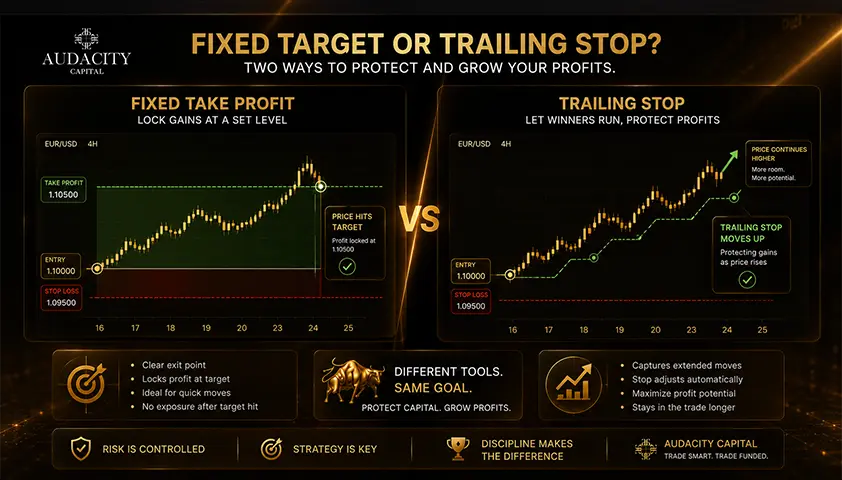
Understanding take profit vs stop loss is step one. The next decision is take profit vs trailing stop, because they solve different problems.
Feature | Fixed Take Profit | Trailing Stop |
Exit type | Set price, chosen in advance | Dynamic, follows price |
Best for | Range markets and defined moves | Strong, sustained trends |
Upside | Capped at your target | Can capture the full run |
Behavior on reversal | Already closed at target | Locks in profit, then exits |
A fixed take profit is best when you expect a defined move, for example a range market where price swings between support and resistance and you want to capture that swing.
A trailing stop is a dynamic exit that follows price as it moves in your favor and stays put when price reverses. It locks in profit while letting a strong trend run, which a fixed target cannot do.
Rule of thumb: fixed take profit for ranges and defined targets, trailing stop (or a partial take profit plus a trailing runner) for strong trends. Some platforms also offer a trailing take profit. Either way, the trend-versus-range judgment is still yours to make.
Common Take Profit Mistakes
Even traders who understand the theory, sabotage themselves at the exit. Here are the mistakes that cost the most, each with the fix.
Mistake | The Fix |
Guessing the level or using a random round number with no technical or risk-reward basis | Place it at a real level, decided before entry |
Moving the take profit further out as price approaches (greed) or closer mid-trade (fear) | Set it at entry and leave it unless your plan says otherwise |
Closing the trade manually before the target is hit | Trust the plan you made when you were calm |
Setting it too close (cut short, clipped by noise) or too far (never hit, then reverses) | Anchor the target to structure and ATR, not hope |
Ignoring the spread, especially on shorts | Account for the bid/ask so the target is actually reachable |
A take profit closer than the stop loss (reward smaller than risk) | Avoid it, since negative reward needs a very high win rate just to break even |
Basing the target on short-term chart noise | Use meaningful structure across timeframes |
One honest reminder runs through all of these. Even a perfectly placed take profit loses if the rest of the strategy is wrong.
The order is a tool, not the edge. Most retail traders still lose money, and a tidy exit does not change a flawed entry or weak risk control.
Take Profit for Funded Traders
On a funded account, exits carry extra weight. A reversal does not just cost you one trade. It erases progress toward your profit target.
Here is how a take profit earns its place in a funded trader's process.
1. It protects target progress.
When a winner reverses and gives back its gains, you lose ground toward the profit target you are working to reach. If you added size on the way up, that reversal can also push you toward your daily loss limit. Banking gains at a planned level protects both sides at once.
2. Partial profits plus breakeven lock in progress.
Closing part of the position at a first target and moving the stop loss to breakeven locks in progress toward the target while removing the risk of the runner turning into a loss. That balance, steady progress with protected capital, is exactly what a funded structure rewards.
3. Set-and-forget supports your trading window.
A pre-placed take profit lets you trade your session and walk away. That reduces the overtrading and screen-watching that drain accounts. The discipline ties directly into trading psychology and knowing when to stop for the day.
4. Placement plus journaling sharpens you over time.
Log where your take profits hit versus where price ran on without you. Over weeks, that record tells you whether your targets are too tight, too greedy, or about right, and you adjust with evidence instead of feeling. A trading journal turns guesswork into a repeatable method.
Used this way, a take profit is a discipline aid toward the target. It does not pass the challenge for you.
The capital and structure of a funded account give you room to work, but the edge is still your skill, your risk control, and your consistency.
Ready to put a disciplined exit plan to work on real capital? Explore Audacity Capital's funded programs and education resources to start building toward your profit target with structure behind you.
FAQ
A take profit closes your trade automatically at a target better than the current price to lock in a gain. A stop loss closes it at a price worse than the current one to cap a loss. Set together, they bracket the trade, and triggering one cancels the other.
At a level the market is likely to respect, chosen before you enter. Common choices are just before a support or resistance level, at a prior swing high or low, or at a sound multiple of your stop distance, rather than at a random round number.
Use a fixed take profit when you expect a defined move, such as a range between support and resistance. Use a trailing stop in a strong trend, because a fixed target caps your gains while a trailing stop lets the trend run while protecting profit already earned.
Usually a take profit is a limit order that fills at your level or better. You still need to account for the spread, especially on shorts, and in fast or gapping markets the exact level is not always guaranteed.
What is a good risk-reward ratio for a take profit? A commonly cited starting point is 1:3, meaning the target is three times the stop distance. The right ratio depends on your strategy and only works if the target is realistic on the chart. Treat it as an example, not a rule.
Should funded traders take partial profits? Many do. Closing part of a position at a first target and moving the stop to breakeven locks in progress toward the profit target while protecting the account from a reversal. The cost is a smaller maximum win, which is often a fair trade on a funded account.
Is it better to take profit early or let it run? Neither extreme works. Bailing early from fear cuts winners short, and holding too long from greed gives them back. The answer is a pre-planned target, sometimes combined with partial profits or a trailing stop, rather than an in-the-moment decision.
Can I move or cancel a take profit after I place it? Yes. You can modify or cancel a take profit at any time while the trade is open. Moving it on impulse mid-trade, further out from greed or closer from fear, is one of the most common ways traders undo their own plan.

Handa nang maglapat ng disiplinadong panganib sa crypto? Galugarin ang mga bagong instrumento ng crypto ng Audacity Capital at dalhin ang iyong diskarte sa pangangalakal.
Matuto PaNewsletter
Sumali sa aming newsletter.
Sumali sa Aming Social Community

Simulan ang Iyong Paglalakbay Ngayon Gamit ang Aming Libreng Pagsubok
Ipagmalaki ang iyong mga kasanayan at tagumpay sa pamamagitan ng mga sertipiko at makakuha ng pagkilala para sa iyong pagsusumikap at dedikasyon mula sa mga potensyal na mamumuhunan at kasamahan.
Libreng PagsubokMga Kaugnay na Artikulo
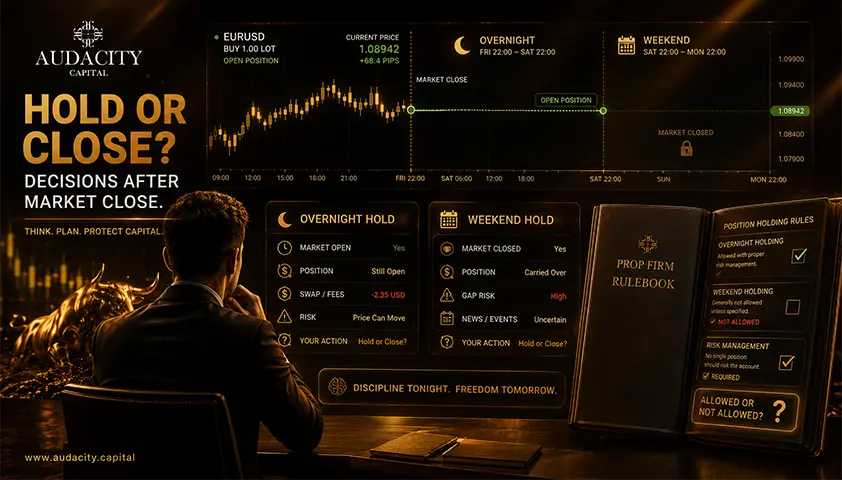
Can You Hold Trades Overnight or Over the Weekend on a Prop Firm?
Can you hold trades overnight or over the weekend on a prop firm? Learn the rules, risks, gap exposure, and which prop firms allow swing trading.


Best Local Payment Methods for Forex Prop Trading
Compare the best local payment methods for forex prop trading by region and learn faster, cheaper prop firm withdrawals with fewer delays.

Are Funded Accounts Legit? An Honest, Balanced Answer
Some funded account firms are real, some are scams. Find out if funded accounts are legit, how to spot a payout-denying firm, and what to check before you pay.

Prop Firm Pass Rate: What Percentage Actually Get Funded?
Learn the real prop firm pass rate, why estimates vary, how many traders get funded, and what the data says about payouts and repeat attempts.