

News Trading on Prop Firms: Rules, Risks and Strategy


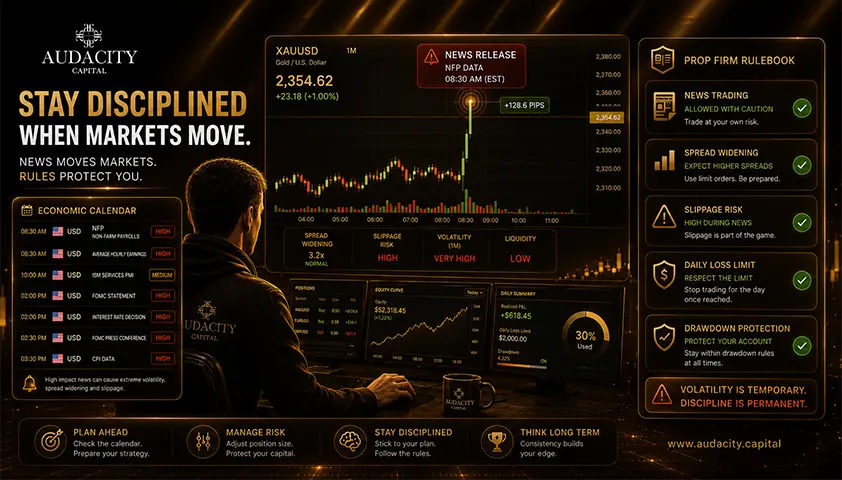
News trading, the practice of trading the violent volatility around high-impact releases, is one of the most heavily restricted activities in prop trading.
Here is the part nobody says out loud: the rules fail more profitable traders than the markets do. People void their profit or lose the account on a news rule they never read.
So the real question is not "can I trade news?"
It is "what is my firm's exact rule, and can I trade news without slippage breaching my limits?"
And even where the answer is yes, allowed does not mean safe, and allowed does not mean gamble. This guide covers the rules, the risks, and a responsible strategy.
What is news trading?
News trading means trading the sharp price movement that follows scheduled high-impact economic releases, along with major unscheduled events.
The headline releases traders track include Non-Farm Payrolls (NFP), inflation data (CPI), interest-rate decisions and statements from the FOMC, GDP prints, and central-bank commentary.
There are a few common styles:
1. Directional: You take a side on or immediately after the number drops.
2. Straddle or breakout: You place pending orders on both sides to catch the move in whichever direction it breaks.
3. Fade the spike: You trade the reversal when the market overreacts to the initial print.
4. Trade the aftermath: You wait for the dust to settle, then trade the established move.
Why do traders gravitate to it? Because the market can travel a huge distance in seconds.
That speed is the appeal, and it is also the danger.
The common news trading rules (the models)
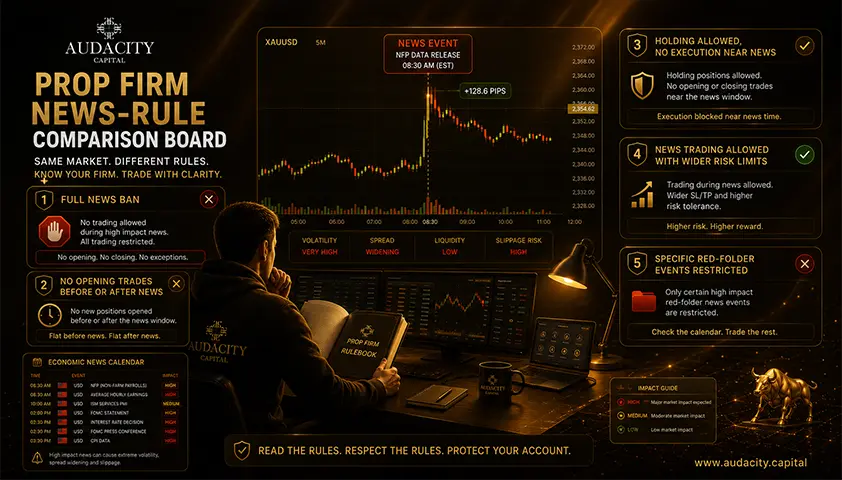
Most firms adopt one of a handful of standard models. Your job is to know exactly which model your firm and your specific account use.
Below are the prop firm news trading rules you will encounter, followed by a verification checklist and one universal rule that applies almost everywhere.
Rule model | What it means | Typical penalty |
Blackout window | No opening (sometimes closing) trades around a release | Soft breach or account fail |
Profit-voiding | You keep the account, but news profit is voided or partial | Lost profit |
Account or phase-specific | News allowed on evaluation but not funded, or by tier | Varies by stage |
Close-only or add-on | Hold but only close during news, or unlock via paid add-on | Varies |
Note: Figures and models are typical and vary by firm and broker, and they change fast. Always verify with your firm.
1. Blackout windows
A blackout window prohibits opening, and sometimes closing, trades within X minutes before and after a high-impact release. Windows vary widely. Many firms use 2 to 5 minutes, while some stretch to 15 minutes. The strictest versions also block you from closing a position inside the window.
2. Profit-voiding (soft breaches)
A soft breach is the kinder model. You keep your account, but any profit from a trade opened or closed inside the window is voided or only partially counted. Some firms count just 40% of that profit. You survive, but you lose the gain the release handed you.
3. Account- and phase-specific rules
Many firms allow news during the evaluation but restrict it on the funded stage. Others tier the rule by account type, or sell news access as a paid add-on. This is why you must check the rule for your exact account and your exact stage, not a general policy line.
4. Close-only windows and add-ons
Some firms let you hold a position into a release but only close during the window, with no new entries allowed. Others offer a swing or news add-on that unlocks news holding, often bundled with weekend holding.
If you trade overnight or into the weekend, our companion guide on overnight and weekend holding covers what to check there.
Verification checklist
Before you place a single news trade, confirm the following:
One detail that catches people out:
A pending order that triggers inside a window can count as opening a trade in prohibited times. This is one of the most common accidental violations, and it is entirely avoidable.
The universal rule
Even where news is fully allowed, deliberately trading at maximum position size into a release is treated as a gambling strategy. It can void profits or close the account at almost any firm. Hence, allowed does not mean gambling.
The risks of news trading (even where it's allowed)
Now the honest risk payload. The danger is not only the rule. It is the execution.
1. Slippage:
Your stop-loss may not fill at your stop price during a violent move. It fills worse. A planned 1% risk can become 3% to 5% or more in an instant. This is the number-one way news blows a prop account.
2. Spread widening:
Spreads can blow out from a pip or two to 20 or more pips instantly, putting you in a deep loss the moment you enter.
3. Stop skipping and gapping:
Prices can jump with no tradeable prices in between. Your stop does not protect you at the level you set.
4. Whipsaw and fakeouts:
The first move is often a trap. Price spikes one way, then violently reverses, stopping you out in both directions.
Here is the point that matters most. Even at a firm with no news rule at all, the daily loss limit and max drawdown still apply.
A single bad fill during a release can breach them in seconds and fail the account. Allowing news does not remove the drawdown guardrails.
The market does not check whether your firm permits news before it slips your stop.
Why do most prop firms restrict news trading?
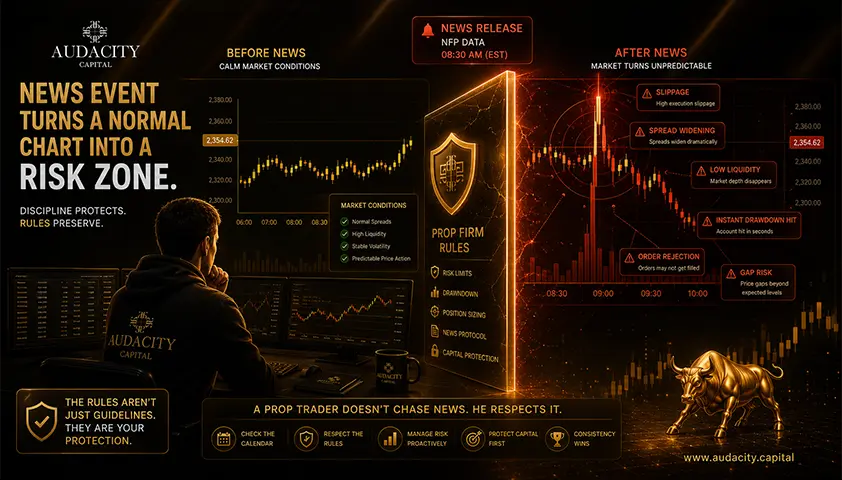
It helps to understand the firm's side honestly, because it is a legitimate risk choice, not firms being difficult.
During a high-impact release, the market becomes hostile to clean execution. Spreads widen, slippage spikes, stops can fail to protect you, and liquidity dries up just when you need it most.
From a firm's perspective, that unpredictability is hard to model and hard to manage.
Restrictions also serve four practical purposes.
- They protect capital.
- They keep risk modelable, since news execution is erratic.
- They help filter gamblers from consistent traders.
- And on a simulated model, they limit the payout liability that comes from lucky spikes.
There is a behavioral reason too. Some traders run news strategies they would never use with their own money on the line.
An evaluation is meant to imitate live trading conditions, so many firms push traders toward disciplined, sustainable behavior.
The result is straightforward: news rules are one of the most common reasons profitable traders still fail. Restricting news is a fair choice, not a sign that a firm is treating you unfairly.
How to trade news responsibly on a prop firm
There is no risk-free way to trade news. There is, however, a disciplined way that respects the rules and your limits.
Here is the responsible playbook.
1. Read your firm's exact news rule first.
Trading news on a firm or account that restricts it is an instant fail or a voided profit. Know the model, the window, the qualifying events, and the penalty before you place a trade.
2. Become a student of the economic calendar.
Use a tool like Forex Factory or similar and check it daily. Never get caught off guard by a release you did not see coming.
3. Control your pending orders.
A pending order triggering inside a blackout window can count as opening a trade in prohibited times. Manage or cancel resting orders around releases.
4. Size down and account for slippage.
Assume your stop fills worse than placed. Reduce position size for news. Never hold a position where one slippage event would breach your daily limit. Keep a personal buffer stricter than the firm's minimum.
5. Trade the aftermath, not the spike.
This is the recommended approach. Instead of gambling the chaotic first minutes, wait 15 to 30 minutes for volatility to settle and a real trend to form, then trade the established direction or a clean retest. Pair this with a sound risk-to-reward ratio so the trades you do take are worth the risk.
6. If you hold through a release, have a clear plan.
Accept gap risk. Calculate the loss if your stop is skipped before you commit a cent.
7. Never trade maximum size into news.
It is reckless and prohibited at almost every firm. No exceptions.
News trading checklist:
If any box is empty, do not trade the release.
The aftermath approach and reduced size are about reducing risk. They are not a way to guarantee a win. Most traders who attempt news trading lose, on the rules or on the execution.
Where Audacity Capital fits
Audacity Capital allows news trading. Many firms restrict it with blackout windows, void the profit around releases, or lock it behind a paid add-on. With Audacity, you can run a news-based edge, including around high-impact releases, without tripping a blackout violation. That freedom is a genuine differentiator for traders who build their approach around the calendar.
Now the candor, because this is how a news trading prop firm should talk to its traders. Allowing news does not remove the risk. Audacity's daily loss limit and max drawdown still apply, so a slippage event can still breach them and fail the account.
Trading maximum size into a release is never smart, and it is never the intended use of a funded account. A funded account is capital and structure. It is not an edge. The edge is your skill and your discipline.
There is a second advantage worth knowing. With no consistency rule, a single big news day will not create the payout-gating problem that some firms have, where one outsized day blocks or delays your withdrawal. To see how that connects to getting paid, read our guide on how prop firm payouts work.
If you want to trade your edge, including news, within clear rules and protective limits, here is how Audacity Capital's programs are structured. Please verify the current news policy on the live site before you build a strategy around it.
Related Articles
10 Best News Trading Strategies in 2026
How Do Traders Build Live Setups Around Major News Events
FAQ
It depends on the firm. Some allow it fully, many restrict it with blackout windows or void the profit, and some allow it only on certain accounts or stages. Always read your firm's exact rules before you trade a release. This is the core question behind every set of news trading rules.
High-impact events like NFP, CPI, and FOMC are the most commonly restricted. Check whether your firm bans them outright, voids profits around them, or allows them. The answer often differs between the evaluation and the funded stage.
It is a short period before and after a high-impact release, often 2 to 5 minutes, when opening and sometimes closing trades is prohibited or will not count toward your results. Window lengths and rules vary by firm.
Many firms apply a soft breach. Trades opened or closed inside the blackout window have their profit voided or only partially counted, even though you keep the account. This is one of the most frustrating ways profitable traders lose a gain.
Yes. Trading inside a prohibited window, or gambling at maximum size into a release, can void profits or close the account at almost any firm. A bad fill that breaches your daily loss limit can also fail the account, even where news is allowed.
Yes, Audacity allows news trading, which many firms restrict. The daily loss limit and max drawdown still apply, so trade it responsibly and never at maximum size. Verify the current policy on the site before you rely on it.
Read the full rules document rather than the marketing copy, track an economic calendar daily, watch your pending orders around releases, and keep a personal buffer stricter than the firm's minimum. Knowing whether you can trade news on a prop firm is only step one, executing within the rule is the rest.
It can be, but slippage and spread widening make it high-risk, and many traders fail on the rules or the execution rather than the direction. The aftermath approach and reduced size are safer than chasing the spike. Among the prop firms that allow news trading, the winning trait is discipline, not aggression.

Kriptoya disiplinli risk uygulamaya hazır mısınız? Audacity Capital'in yeni kripto enstrümanlarını keşfedin ve ticaret stratejinizi getirin.
Daha Fazla BilgiBülten
Yeniliklerden haberdar olmak için bültenimize katılın.
Sosyal Topluluğumuza Katılın

Bugün Yolculuğunuza Başlayın Ücretsiz Denememizle
Becerilerinizi ve başarılarınızı sertifikalar aracılığıyla gururla sergileyin ve potansiyel yatırımcılardan ve akranlarınızdan sıkı çalışmanız ve özveriniz için takdir alın.
Ücretsiz Denemeİlgili Makaleler

Prop Firms That Allow News Trading
Compare prop firms that allow news trading. See news restrictions, trading windows, drawdown, payouts, platforms, and weekend holding rules.


10 Best News Trading Strategies in 2026
Discover 10 proven news trading strategies for Forex and financial markets. Learn how to trade major economic releases with confidence, discipline, and risk management.