


Is AI Trading Profitable in 2026? What Data Shows


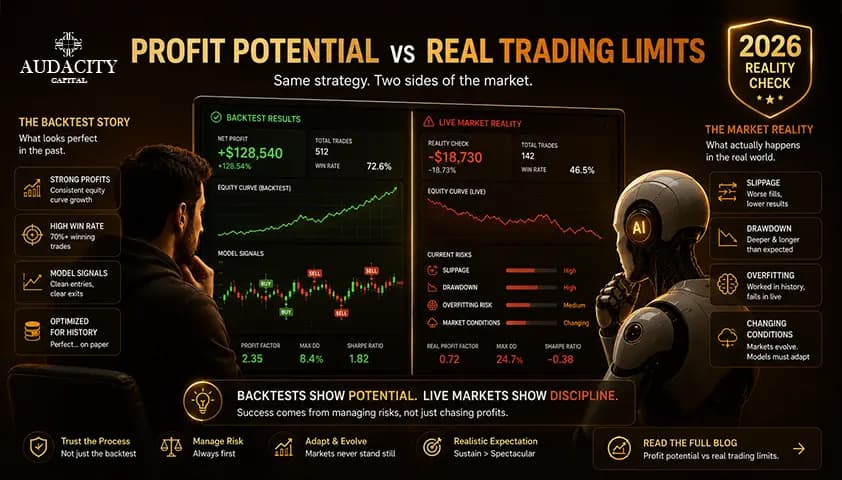
Is AI trading profitable? It can be, but there is no evidence that simply using AI makes a trader profitable.
A profitable system still needs an edge that survives spread, fees, slippage, model error and shifting market conditions.
In 2026 institutions run machine learning inside large research and execution stacks, while retail products range from genuinely useful analysis tools to ordinary rule-based bots relabeled as AI.
Those are not the same product and should not be judged by the same evidence.
What Counts as AI Trading in 2026
Define the system before you judge whether it makes money. The word "AI trading" gets stretched across four very different products, and blurring them is where most confusion starts.
Category one, rule-based automation.
An Expert Advisor (EA), grid bot or script follows fixed instructions with no learning at all. It may be useful, but trading without a human clicking does not make software intelligent.
Category two, machine-learning signal models.
These learn relationships from historical or live data and output forecasts, classifications or trade signals. This is closer to what machine learning trading actually means.
Category three, AI-assisted trading.
Tools summarize news, scan setups, grade charts, analyze journals, write code or flag risk, while the trader keeps the final decision.
Category four, autonomous agents.
An LLM or similar model gathers information, decides, sizes and executes with limited human input. This category carries the highest operational and hallucination risk.
Remember one distinction throughout this article: automation executes a rule, while AI produces or adapts a decision. Neither label proves the underlying rule or decision has an edge.
Is AI Trading Profitable? What the Evidence Actually Shows
The honest answer comes from an evidence ladder, not a collection of screenshots. Different levels of proof deserve different levels of trust.
1. Institutional evidence
Machine learning and automated trading can contribute to profitable systems at scale. But the model sits inside a much larger stack: proprietary data, dedicated research teams, low-latency execution infrastructure, portfolio-level risk controls and continuous monitoring.
This proves the possibility. It does not prove a retail buyer can replicate the result with an off-the-shelf tool.
2. Academic and simulated evidence
Many models beat a chosen baseline inside controlled backtests. The problem is that the result is only as strong as the data split, cost assumptions and out-of-sample design behind it.
Reviews of reinforcement-learning research have repeatedly flagged unrealistic simulated environments and very limited live testing. A model that wins on paper often meets a different market in practice.
3. Live agent evidence
The most timely 2026 data point is the HKU Business School Agentic Trader experiment, released on July 14, 2026. Ten models started from the same $100,000 capital and traded on live data.
After six weeks, outcomes ranged from roughly +9.9 percent to -15.1 percent. More trades and more leverage did not reliably improve returns.
Stating the limit clearly: six weeks in one market environment is a short experiment. It does not establish a long-term ai trading success rate for any model, and it should not be read as one.
4. Retail product evidence
There is no credible universal dataset showing that off-the-shelf bots make the average retail buyer profitable after all costs. Vendor backtests, win rates and equity-curve screenshots are marketing artifacts, not track records.
The verdict is clean. Is AI trading profitable? For some systems, in some conditions, yes.
But "uses AI" is not evidence of profitability. The system, data, execution and risk process are what must be tested.
Why Most AI Trading Systems Lose Their Backtest Edge
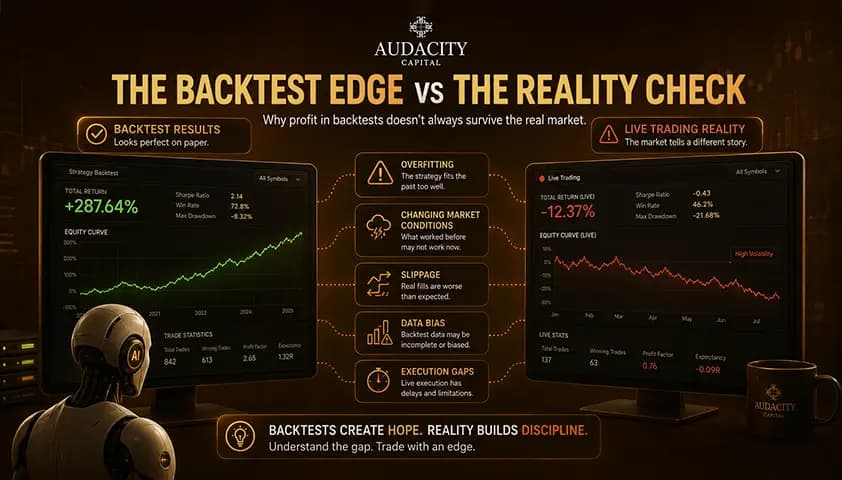
Most systems do not fail because the AI got dumber. They fail because the test overstated the edge, or the operating process failed to preserve it.
Here is the chain, not a vague warning that markets are hard.
No genuine edge: A more complex model can fit noise more convincingly, but complexity does not create predictive information. A smooth curve can be an illusion.
Overfitting and repeated testing: If hundreds of models or parameter sets are tried and only the best one is shown, the apparent edge may simply be the winner of a data-mining contest. Overfitting rewards the luckiest fit, not the truest one.
Data leakage and look-ahead bias: The model quietly receives future information, revised figures or a feature that would not have existed at the moment of the trade. Data leakage inflates results in ways that vanish live.
Costs and execution friction: Spread, commissions, swap, slippage, latency, rejected orders and subscription fees are all paid in live trading, even when the backtest assumed clean fills. Transaction costs turn many "profitable" curves negative.
Regime and model drift: Relationships shift when volatility, policy, liquidity or participant behavior changes. A regime change can quietly break a model's assumptions while it keeps trading, and model drift lets it stay wrong for a long time.
Weak risk controls: A system can be directionally right often and still lose everything through oversized positions, correlated exposure or one tail event.
Connect the six points. The backtest edge disappears because it was never as real, or as durable, as the equity curve suggested.
What AI Can Improve Without Predicting the Market
AI can strengthen a trading process even when it cannot forecast the next candle. The value is in the workflow, not in a crystal ball.
1. Research speed.
Summarize filings, economic releases and market notes quickly, then verify the original source before acting on it.
2. Screening and pattern detection.
Filter a large universe of instruments for pre-defined conditions without claiming the model knows where price is going next.
3. Execution consistency.
Automate an already-tested entry, exit or position-management rule to cut delay and emotional interference from a plan you already trust.
4. Risk monitoring.
Flag unusual exposure, correlated positions, abnormal spread, model drift or a maximum drawdown threshold that should pause the system.
5. Journaling and review.
Classify mistakes, compare planned versus actual behavior, and surface recurring process failures across a trade history.
6. Keep the line clear between process and alpha.
Saving time, enforcing rules and reducing errors can improve your net results. None of that proves the AI predicts the market.
How to Measure Whether an AI Strategy Is Actually Profitable
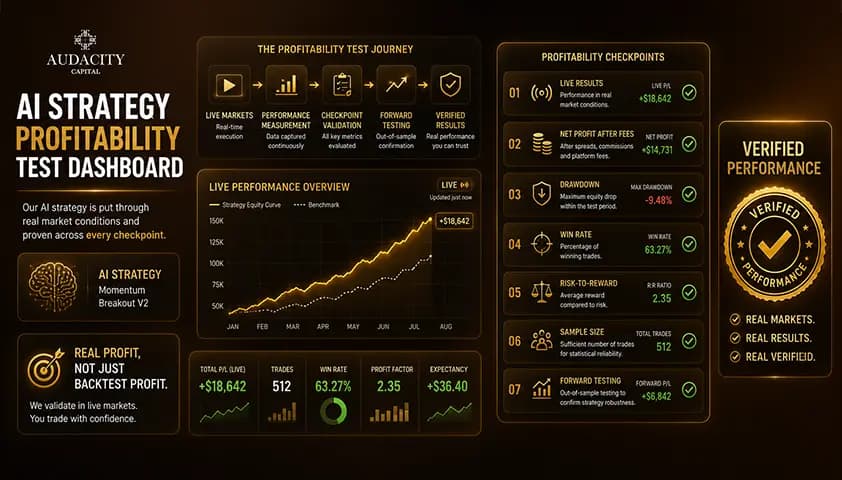
Metrics are only useful as a repeatable audit. Run every AI strategy through the same checks before you call it profitable.
1. Net return: Measure return after spread, commissions, financing, slippage, data fees, platform fees, bot subscriptions and taxes where relevant. Gross return is not the answer.
2. Benchmark return: Compare against a passive benchmark over the same period. A strategy that earns 8 percent while a comparable benchmark earns 12 percent made money, but added no value before you even consider risk.
3. Expectancy and sample size: Calculate average gain times win probability, minus average loss times loss probability. A win rate on its own, without average win, average loss and enough trades, tells you almost nothing.
4. Maximum drawdown and risk-adjusted return: Use the Sharpe ratio carefully, or Sortino, and always pair it with maximum drawdown, recovery time and the worst period.
5. Stability: Break performance down by year, volatility regime, instrument and direction. One profitable window can hide failure everywhere else.
Backtest Profit Is Not Live Profit
A backtest is a filter for bad ideas, not proof that a system will make money. It shows how a fixed method would have behaved under one set of historical assumptions.
Follow a minimum testing sequence:
- Define the hypothesis clearly.
- Separate training data from unseen test data.
- Run out-of-sample testing and walk-forward analysis so the model is judged on data it never learned from.
- Add realistic costs and execution delays.
- Paper trade the frozen rules.
- Run a small live test.
- Scale only if live behavior matches the expected range.
Keep the rule set frozen during the live test. Constantly reworking the model after every loss creates a brand-new, untested system and makes the track record impossible to interpret.
Set failure criteria before you launch: maximum drawdown, deviation from expected slippage, data failure, abnormal trade frequency, model-confidence collapse and any account-rule breach.
Use scientific logic here:
A good test can prove the idea wrong. A process built only to explain every loss after it happens is not validation, it is storytelling.
Can Retail Traders Compete With Institutional AI?
Not on every battlefield, and pretending otherwise helps no one.
Retail traders cannot realistically reproduce data-heavy, latency-sensitive or high-frequency systems that depend on co-location, proprietary feeds and large research teams.
The retail opportunity is narrower and more specific: longer holding periods where milliseconds matter less, small-capacity strategies, specialized market knowledge, process automation and risk tools that remove avoidable mistakes.
Capacity works in your favor here.
A small strategy may operate without moving the market, while a large fund cannot deploy meaningful capital into the same opportunity.
That gap can genuinely help a smaller trader. It does not remove the need for evidence.
One more truth.
A widely available model is rarely a durable edge by itself.
If thousands of traders receive the same signal, competition can erode or even reverse the advantage.
Retail and institutions can use the same class of model while operating with completely different data, execution and risk systems. That difference is the whole story.
Can You Use AI Trading in a Prop Firm Challenge?
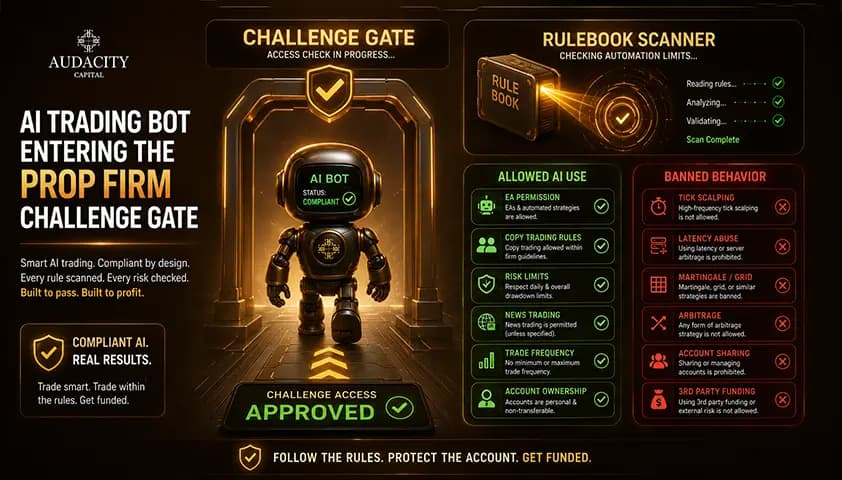
Sometimes yes, but the technology label is not what decides.
The firm's current rules determine whether the exact EA, bot, signal source and execution behavior are allowed.
Separate the common rule categories, because they are treated very differently:
- An internally developed low-frequency EA
- A third-party commercial bot
- Copied external signals
- High-frequency execution
- Latency arbitrage
- Grid or martingale logic
- Coordinated trading
- Third-party account management
There is also a performance problem:
An AI trading bot can be profitable in a broker backtest and still fail an evaluation because a daily loss limit, maximum drawdown ceiling, minimum holding time or prohibited-strategy rule changes how it is allowed to trade.
And there is an operational problem:
The trader stays responsible for API errors, duplicated orders, sudden lot-size jumps, disconnected risk controls and any breach caused by automation. The software does not absorb the accountability.
As a factual example, Audacity Capital is a proprietary trading firm, not a broker, and its funded accounts are simulated.
Its public material distinguishes automation used within policy from prohibited HFT and third-party or exploitative strategies. Before you deploy anything, read the current published rules at source and confirm your exact tool and strategy fit them. Do not rely on an old review.
To be clear on compliance: no AI tool can pass a challenge for you, protect a payout or make a strategy compliant. Rules change, and the responsibility to check the current terms is yours.
How to Evaluate an AI Trading Bot Before Paying
Treat this as due diligence, not shopping.
Run any provider through the checklist below before money moves.
1. Ask what the system actually does.
"AI-powered" is not a strategy. A serious provider will name the market, timeframe, decision type and the conditions where the system is expected to fail.
2. Demand a distinguishable live record.
Insist on results you can tell apart from a backtest or demo. Check the full period, deposits, withdrawals, drawdown, losing months, and whether the record reflects the current model version.
3. Recalculate after every cost.
Subtract subscription, performance fee, spread, slippage, data and financing. A small gross edge can disappear entirely once real costs are applied.
4. Check control and security.
Understand API permissions, withdrawal access, data storage, how model updates roll out, manual override, position limits and whether there is a working kill switch you can trigger.
5. Check the operator.
Verify the company, any registration claims, domain history, support channel and refund terms.
6. Reject the classic red flags.
Guaranteed profit, near-perfect win rate, no losing months, "secret technology" used to excuse zero transparency, pressure to fund fast, and returns shown without drawdown or costs.
Regulators including the CFTC, SEC and FINRA specifically warn about guaranteed returns, risk-free claims and unregistered auto-trading services.
The point is not that every vendor is fraudulent. Instead, the point is to recognize the claim patterns those warnings describe.
When AI Makes Trading Worse
AI does not only fail to help. In the wrong hands, it actively multiplies damage. For example:
It scales a bad process faster: More signals, faster execution and constant optimization all increase harm when the underlying strategy has no edge.
False confidence: Technical language, polished dashboards and model scores can make an uncertain forecast feel objective when it is not.
Hallucination and stale context: An LLM may invent a figure, misread a date, lean on delayed data, or produce different actions from the same instruction on two different runs.
Overtrading: A system rewarded for taking action can churn out unnecessary trades and compound friction. The 2026 HKU experiment reinforced this: more frequent trading did not guarantee better returns.
Automation complacency: When a system is described as autonomous, traders stop watching, and a data error or regime shift is allowed to run far longer than it should.
Model hopping: Swapping systems after every drawdown blocks any honest assessment. It usually means buying the newest backtest instead of maintaining a validated process.
Conclusion
So, can AI trading be profitable? Yes, but say the whole sentence.
The profitable part is a tested edge that survives costs, risk and market change. The AI label alone proves none of those things.
Hold to the evidence standard. Define the system, test it on unseen data, include every cost, compare it against a benchmark, measure the drawdown, and require a meaningful, monitored live period before you trust the result.
Anything less is a backtest wearing a track record's clothes.
And one reminder for funded accounts: even a genuinely profitable bot can be unusable if its behavior breaches a firm's current automation or strategy rules.
Frequently Asked Questions
No. No model, bot or AI tool can guarantee a profit or predict sudden market events. Any provider promising guaranteed returns or a risk-free system is describing a red flag, not a strategy, and both simulated and past performance fail to establish future results.
There is no credible universal percentage. Vendor win rates use different instruments, periods, costs and methodologies, so they are not comparable, and no reliable cross-market figure exists. Are AI trading bots profitable on average? The honest answer is that the data to prove it either way simply is not public.
On its own, no, and treating it as an autonomous trader is where people get hurt. It can help with research, summarizing information and writing or reviewing code, but that is assistance, not a validated strategy. Can AI predict the market through a chatbot prompt? No, and a language model can hallucinate figures or use stale data, so anything it produces must be verified and tested before it touches real risk.
Neither is automatically better. A bot enforces a process without emotion, while a human adapts to context a model may miss, and both still depend on whether the underlying strategy has a real edge. The 2026 HKU live experiment showed models scattered from clear gains to double-digit losses over the same period.
Long enough to see it work on unseen data and across different conditions, which usually means far longer than most traders want to wait. Combine out-of-sample testing, walk-forward analysis, paper trading and a small live test with frozen rules. Does AI trading work over one short window? Six weeks, like the HKU study, is a data point, not a track record.
Only if the exact tool and strategy fit the firm's current rules, and passing is never guaranteed. Automation is judged against daily loss limits, maximum drawdown, holding-time rules and prohibited-strategy lists, not by whether it is labeled AI. Always confirm the live published terms before you deploy.
It removes emotion from execution, not from your decision to trust, tweak or abandon the system. Automated trading follows its rules without fear or greed, but traders still panic, override the bot after a loss, or model-hop chasing a smoother curve. The discipline problem moves, it does not disappear.
There is no fixed figure, and account size does not fix a strategy with no edge. Costs like subscriptions, data feeds, spread and slippage matter as much as capital, since they can erase a small gross gain entirely. Can AI trading be profitable on a tiny account? Only if the tested edge is large enough to survive those costs, which is exactly what your audit should confirm first.

Ready to apply disciplined risk to crypto? Explore Audacity Capital's new crypto instruments and bring your trading strategy.
Learn MoreNewsletter
Join our newsletter to stay up to date on features and releases.
Join Our Social & Community

Start Your Journey Today With Our Free Trial
Proudly showcase your skills and accomplishments through certificates and get recognition for your hard work and dedication from potential investors and peers.
Free Trial