


Intraday Trailing Drawdown: How It Works and How to Trade It


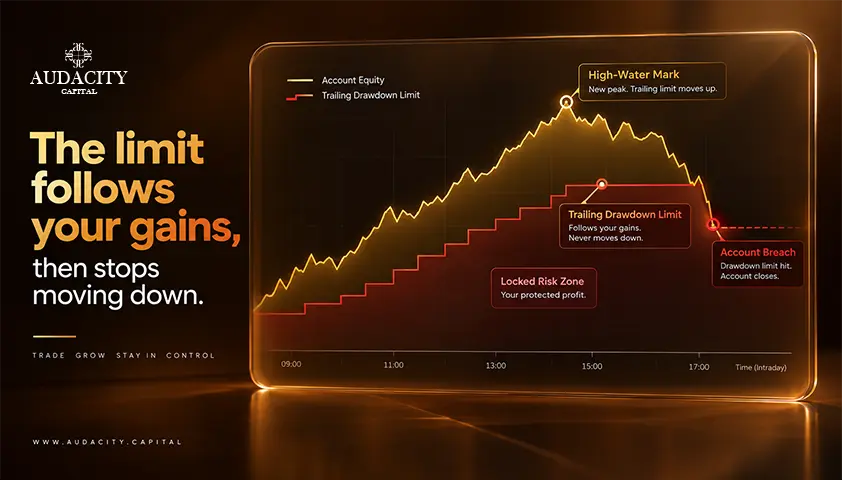
An intraday trailing drawdown is a loss limit that, under this model, recalculates in real time based on your account's highest equity point, including unrealized profit.
Imagine having closed a trading day with a positive result of $200. On the next morning, a regular stop loss on a new trade breaches the trading account. There was no unwise or reckless thing about that stop.
The problem began the day before, when a trade had opened in your favor but lost most of its gains before you took them out. The floor rose while this trade was open, and stayed there even after the gains were gone, leaving almost no room to work with.
This article takes a closer look at the concept in detail. It includes the formula, a step-by-step example on a real account size, and when the floor stops moving. It also tells you how to make trades under it without losing out any gains you never banked.
What Is Intraday Trailing Drawdown?
Intraday trailing drawdown is a maximum loss limit based on the highest equity value of the account, including unrealized gain, recalculated in real-time, and it can only be increased.
As your equity makes a new high during the session, the limit follows it higher. As the equity goes lower, the limit stays where it climbed to.
Three numbers are common to all examples used in this guide.
- Peak equity: Your highest equity value, including open positions.
- Trailing distance: The dollar amount chosen by the firm.
- Floor: The equity level at which the firm's drawdown policy may be violated.
The name defines the behavior. "Intraday" indicates that the limit is updated in real time during the session, and not just at the close. "Trailing" means it follows new highs but never drops back down.
This rule is called by various names by firms. It could be called an intraday trailing threshold or a real-time trailing drawdown, and so you should be able to spot it in a rule book by either name.
Why Open Profit Counts Toward the Floor
Balance and equity are different. The balance is altered when a trade is closed while the equity changes at each tick of the trade being open since it consists of the unrealized P&L. Intraday trailing drawdown monitors the equity and not the balance.
This means that the floor moves upwards with the profit which was not realized. When a trade runs with a strong open gain, the floor follows, even though you close the trade at a much lower level.
The Intraday Trailing Drawdown Formula
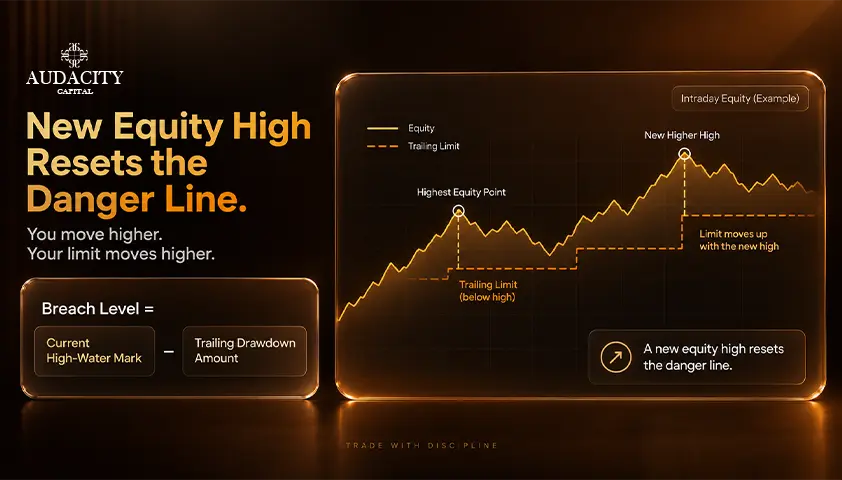
The math is simple. Two formulas capture the whole process:
Drawdown Floor = Peak Equity - Trailing Distance
Headroom = Current Equity - Drawdown Floor
And here's our starting point as we move onto the example:
Metric | Value |
Starting balance | $50,000 |
Trailing distance | $2,000 |
Starting floor | $48,000 |
Starting headroom | $2,000 |
The floor is monitored all the time, not just at market close. In systems where hitting the floor triggers the breach condition, the account gets closed out regardless of what happens right after.
Some companies liquidate open positions automatically at that liquidation threshold.
What counts is not your account balance. It is the headroom, the difference between the current equity level and the floor. The rest of this page revolves around that one number.
Intraday Trailing Drawdown Example: One Trade, Tick by Tick
Let's take a look at the $50,000 account for the above trade with a $2,000 trailing distance. Watch carefully the headroom column.
Stage | Equity | Peak equity | Floor | Headroom |
Session opens, no trades | $50,000 | $50,000 | $48,000 | $2,000 |
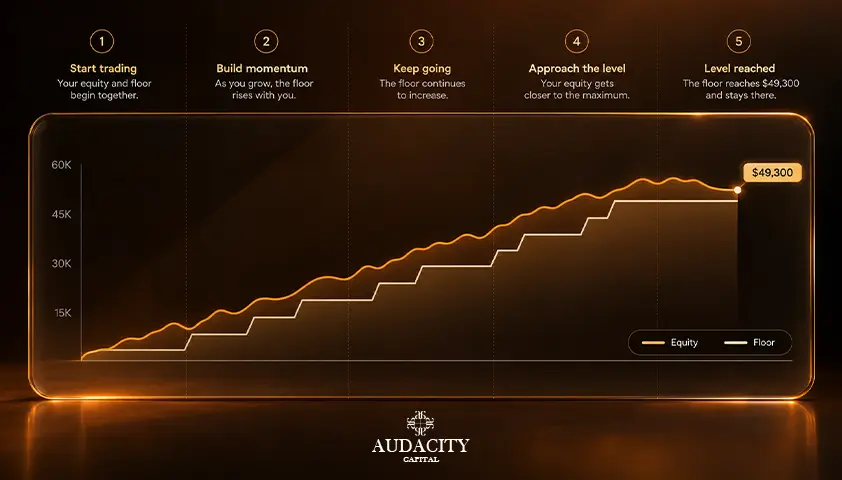
Trade runs to +$1,300 open profit | $51,300 | $51,300 | $49,300 | $2,000 |
Price pulls back to +$200 | $50,200 | $51,300 | $49,300 | $900 |
Trade closed at +$200 | $50,200 | $51,300 | $49,300 | $900 |
Next trade uses a $1,000 stop, stopped out | $49,200 | $51,300 | $49,300 | Breach |
At the beginning of the session all the numbers are at their initial position. When the trade runs to +$1,300 in open profit, peak equity jumps to $51,300 and the floor climbs with it to $49,300. Headroom is still at $2,000 as equity and floor moved in tandem.
The price then retreats to +$200. The current equity is at $50,200, but the floor does not move, since it only runs upward. Headroom collapses from $2,000 to $900. Closing the trade at +$200 does nothing: the floor is fixed at $49,300.
The trade was profitable by $200, but the headroom went down from $2000 to $900. In other words, your $1,100 worth of open profit was given back to you for nothing but a reduced buffer.

Audacity's Trading Program
Check Here For Instant FundingA $1,000 stop, which seemed comfortable at the beginning of the day, now blows up your account by $100. The trader was not doing anything out of the ordinary. A normal stop on a normal trade breached a green account.
In contrast, in an end-of-day scenario, the same day ends at $50,200, thus the floor would rise only to $48,200. Your headroom would remain at $2,000 instead of falling to $900.
The question is not about which model is more strict. The question is about the timing of the floor update.
When Does Intraday Trailing Drawdown Stop Trailing?

The floor will not go up indefinitely. Certain trailing-drawdown systems stop rising the floor after reaching a predetermined lock value. From there, the floor stays fixed for the remainder of the account’s lifetime.
The math is simple. The floor equals the opening balance when the peak equity equals the opening balance plus the trailing distance.
For our sample account, this translates to a point where the floor stops trailing when the peak equity hits $52,000, at which point the floor is locked at $50,000.
There are different types of lock rules depending on the firm. Here are some different variations for the same $50,000 account with a $2,000 trailing distance:
Lock variant | Floor stops at | Peak equity needed |
Locks at starting balance | $50,000 | $52,000 |
Locks at starting balance plus a small buffer | $50,100 | $52,100 |
Locks at a firm-defined profit level | Set by the firm | Varies by plan |
Some firms use the lock independently on both the evaluation and funded account. In such cases, the floor will have to be re-established once you advance to the second stage.
Verify the precise lock rule from your firm's help centre before executing any trades. The behaviour differs enough between firms that assuming the wrong lock level can cost you the account.
What Changes After the Floor Locks
The floor becomes static once it gets locked. This means that it stops tracking new highs. At this stage, any dollar of extra profit becomes additional headroom and not the new floor.
One thing to keep in mind is that a separate daily loss limit may still apply on the same account, so locking the trailing floor does not remove all intraday risk. You have secured one limit, not every limit.

Audacity Capital Empowering Traders Since 2012
Get Funded With A Trusted Prop FirmHow to Trade Under an Intraday Trailing Drawdown
Firm help centres explain the rule. They rarely tell you how to trade it. These five habits keep your buffer intact.
1. Size Every Position by Headroom, Not Account Size
Base your stop distance and position size on the live gap to the floor, not on the number printed at the top of the account. With $900 of headroom, a $1,000 stop is not a valid trade, whatever the account label says.
A useful method is to express risk per trade as a share of headroom rather than a fixed dollar figure. The same risk percentage allows a wider stop when you have $2,000 of headroom. With only $900 of headroom, that same risk percentage requires a smaller position or tighter stop.
2. Decide What Happens to Open Profit Before You Enter
Because unrealized gains lift the floor, plan the exit for a winner before you enter it. Set where you take partial profits and how you tighten the stop as the trade moves, so less open profit can round-trip back to entry.
Look at the example trade. Banking part of the position at +$1,000 could have left more headroom when price fell back to +$200. The exact effect depends on how much of the position was closed and how the firm calculates its trailing floor.
3. Watch the Floor, Not Your Closed P&L
A green day on the statement can hide a shrinking buffer. Before each new trade, note the floor and headroom, either from your firm's dashboard or with a quick running calculation.
Build a simple pre-trade check into your routine: current equity, current floor, current headroom, and whether the planned stop fits inside that headroom. If the stop does not fit, the trade does not go on.
That single check would have stopped the breach in the example above.
4. Treat the Lock Level as a Risk Milestone
Until the floor locks, each new equity high can raise the threshold. Some traders may therefore choose to reduce risk while moving toward the lock level. Once the floor is fixed, the effect of further unrealized gains changes.
On the example account, the floor locks once peak equity reaches $52,000, so the first $2,000 of new highs is the most fragile part of the account's life. Protect that stretch and the rest gets easier.
5. Match the Rule to How You Trade
Short holds with defined targets may fit this rule better than strategies that allow deep pullbacks.
Treat it as a fit question. If your winners regularly give back a large share of their peak profit before you exit, this model can consume your headroom.
A trader taking fixed targets may experience less impact because open profit is banked quickly. A trader who lets winners run through deep retracements may see the floor rise on gains that later disappear.
How Audacity Capital Handles Drawdown
Audacity Capital uses a different drawdown structure. Here is how its current rules describe the maximum and daily drawdown.
Audacity Capital's maximum drawdown is calculated from the initial account balance and does not trail upward with your profits.
A winning trade that runs and then retraces does not tighten your overall limit, because that limit is fixed to where the account started rather than to your peak equity.
The daily drawdown is recalculated at the MT5 server rollover, taken from the higher of balance or equity at that point. For the current daily and maximum drawdown figures on the Ability Challenge and Ability One evaluations, check the live values in the Audacity Capital Knowledge Center before you commit, as program parameters are set there.
If you want to avoid a trailing overall limit, review the current Ability Challenge and Ability One rules in the Knowledge Center and choose the path that matches how you manage open risk.

Prop Trading Challenges
Free Prop Firm Trading CompetitionConclusion
Run one test before you decide whether this rule suits you. Pull up your last 20 winning trades and note how far each one ran in open profit before you closed it.
Note the difference between each trade's peak unrealized profit and its actual exit profit. That difference shows how much open profit was given back.
If that gap is usually small, the rule is workable with the habits in this guide. If it is usually large, weigh that carefully before buying an account built on this model, because it will cost you a buffer on trade after trade.
Whatever you choose, read your firm's exact drawdown rules in full before your first trade, not after your first breach.
FAQs
Usually yes, because the floor is measured against your account value after costs. Heavy trading with commissions can pull equity closer to the floor even on trades that break even at the price level. Check whether your firm calculates drawdown on net or gross P&L before you trade actively.
It depends on the firm. Some apply it on both stages, while others use an end-of-day model on the evaluation and switch to an intraday trail once you are funded. Read the rule for each stage separately rather than assuming one applies across the whole journey.
Most firms close all open positions automatically the moment equity touches the floor, and the account is failed or closed. Some offer paid resets on evaluations. Policies vary, so read your firm's breach terms so you know exactly what happens the instant the floor is touched.
The floor stays at its last level overnight, but a gap at the next open is measured against it immediately. A position that gaps down can breach before you have any chance to react. Overnight and weekend holding rules differ by firm, so confirm both before you carry a trade.
It is most common with futures prop firms. Forex firms more often use a daily loss limit combined with a maximum drawdown that is either static or trailing. Read which model applies to your account rather than assuming it from the market you trade.

هل أنت مستعد لتطبيق مخاطر منضبطة على العملات المشفرة؟ استكشف أدوات التشفير الجديدة من Audacity Capital واجلب استراتيجية التداول الخاصة بك.
اعرف المزيدالنشرة الإخبارية
انضم إلى نشرتنا الإخبارية.
انضم إلى مجتمعنا الاجتماعي

ابدأ رحلتك اليوم مع تجربتنا المجانية
اعرض مهاراتك وإنجازاتك بفخر من خلال الشهادات واحصل على تقدير لعملك الجاد وتفانيك من المستثمرين المحتملين والأقران.
تجربة مجانيةمقالات ذات صلة

What Is a Daily Drawdown in a Prop Trading Firm?
Understand daily drawdown in trading, how it is calculated, and why managing daily losses is crucial for funded traders.


End-of-Day Trailing Drawdown Explained: Formula, Examples & Rules
Learn what end of day trailing drawdown means in funded trading accounts. Audacity Capital explains rules, calculation methods, and risk limits.

What Is Maximum Drawdown? A Trader's Guide to MDD
Learn what max drawdown means in trading, how to calculate it, and the max drawdown formula traders use to measure risk and account performance.

What Is Static Drawdown? How It Works + Examples
Learn what static drawdown means in trading and funded accounts. Audacity Capital explains how static drawdown works and how traders manage risk.