


Prop Firm Hedging Explained: What Is Allowed and What Gets You Banned?


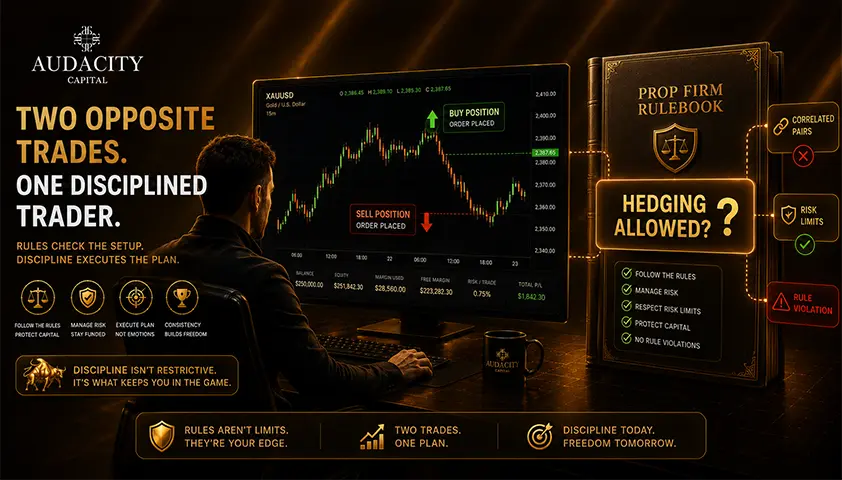
Important: This article explains how different proprietary trading firms approach hedging for educational and industry comparison purposes. Audacity Capital does not permit hedging or any hedging strategies that violate its trading rules. If you are trading with Audacity Capital, always refer to our official Trading Rules before placing any trades. |
|---|
Can you hedge on a prop firm?
The short answer is yes, but it depends on the type of hedging.
Most prop firms allow same-account hedging as a legitimate risk-management technique. However, multi-account hedging, cross-firm hedging, and other forms of hedging designed to game an evaluation are prohibited by almost every prop firm and can result in account termination.
This distinction is where most of the confusion comes from. Traders often use the word "hedging" to describe several completely different practices, but prop firms treat each one differently.
Most traders come to this topic with two questions:
- Can I open a hedge to protect a position during major news events?
- Does the so-called "two-account guaranteed pass" strategy actually work?
In this guide, we'll break down the four main types of prop firm hedging, explain which are allowed and which are banned, show how firms detect rule violations, and clarify how Audacity Capital approaches hedging.
What Is Hedging?
Hedging is a risk-management technique that involves opening a position designed to offset the risk of another trade.
For example, if you are long EUR/USD and open an equally sized short EUR/USD position, your net market exposure becomes close to zero. If one position gains value, the other loses value, helping reduce the impact of market volatility.
The goal of hedging is not to generate additional profit. Instead, it is used to manage risk, protect existing positions, or reduce exposure during uncertain market conditions.
The confusion begins when traders discuss prop firm hedging. The term "hedging" can refer to several completely different practices, and prop firms treat each one differently.
A trader using a hedge within a single account for risk management is in a very different situation from a trader opening opposite trades across multiple accounts to manipulate an evaluation. While one may be permitted, the other is typically prohibited.
Understanding these differences is essential because the rules surrounding hedging vary significantly depending on how the hedge is structured. The next section explains the four main types of prop firm hedging and how firms typically treat each one.
The four types of hedging (and how prop firms treat each)
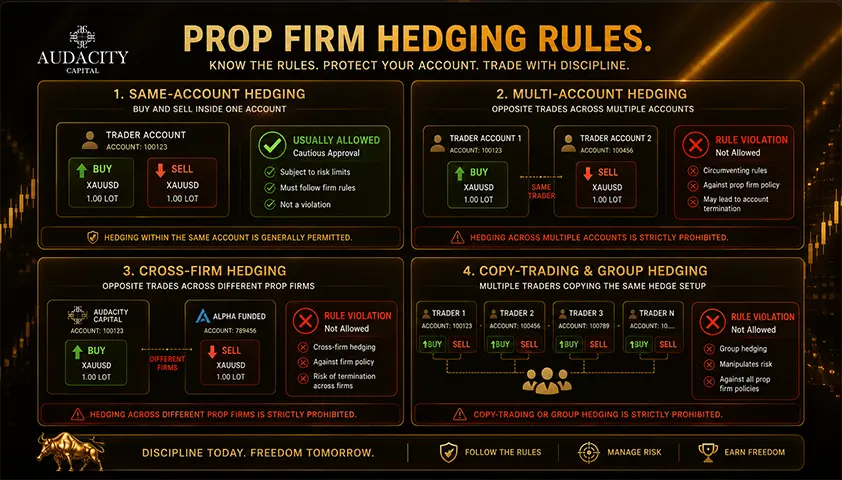
The one most valuable lesson you can take away from this site is that "hedging" is actually four distinct practices, each with four distinct rule outcomes.
Traders end up getting banned by simply lumping them together. Here are the four types, with their allowed/banned status and the reason for their status.
Before we even begin, one line will remove most of the confusion: "multiple accounts allowed" is NOT "opposite trades allowed".
They are two very different things. Many companies offer multiple account options. None of them allow you to swap those accounts between one another.
1. Same-account hedging (usually allowed)
Same-account hedging is taking opposing trades within the SAME account; for example, a long or short position in the same instrument or offsetting a position with a closely related pair.
Most forex companies permit this as it is true risk management. Furthermore, it doesn't game the evaluation as the drawdown still applies to the net result, and you have true execution risk, swap and spread risk on both legs.
It is platform-dependent. If you want to play both sides of a trade on the same instrument, your account must have hedging enabled (this is the default setting for most MT5 forex accounts). In netting mode, opening an opposite position is a mere reduction or closure of the existing position, thus true same account hedging is not possible.
2. Multi-account hedging (banned everywhere)
This is when opposite trades are opened across TWO OR MORE accounts at the same firm, with a EUR/USD long at Account A and an EUR/USD short at Account B. The concept is to leave behind the winning account, let the losing one be destroyed and walk away with a funded account. This is the scheme that is sold as a "guaranteed pass" on the web and it is the most universally banned practice in the industry.
The logic is easy to uncover. The trader pays two evaluation fees, gets rid of one account on purpose and attempts to claim a big funded account without demonstrating any skill. Its multi-account hedging prop firm behavior in its purest form and it's banned at almost every firm around the world. It is a blocked trap and NOT a shortcut, and we will not outline steps to do it because it does NOT work and it will cost you everything.
3. Cross-firm hedging (banned)
The cross-account hedging, which is done across companies, is creating a situation where there are long positions at Firm A and short positions at Firm B, in the hope of a risk-free “split” of the profits from whichever firm succeeds. This is virtually forbidden at prop firm terms. It is more difficult to detect than the single-firm version, but enforcement efforts are increasing rapidly via inter-firm data sharing. When firms catch it, they breach the account and permanently ban the user.
4. Copy-trading and group hedging (banned)
This is pairing up trades that are in opposite directions in different accounts or different traders, usually using copy-trading software. It is banned as a form of multi-account exploit.
The big thing to note is that even an ACCIDENTAL opposition position (one that was created by copy software lag between accounts) may be considered a violation. However, you are responsible for what your tools do for you, so automation doesn't mean you're off the hook.
Why firms ban the exploit (and allow the legitimate kind)
Once you understand the flow of money, it is quite simple. Same-account hedging keeps the risk on YOUR account. The drawdown applies to the net result and you still pay swap and margin on both legs, and you still have to time your exit.
You are not playing anything, and that's why companies permit it.
Multi-account and cross-firm hedging are not comparable, but rather different. They purposely had one account lose money so that another account can gain money. Without a direction, the risk is removed, but so is the purpose of an evaluation.
The scheme is based on a simple asymmetry: one lost evaluation fee for a large funded account "won" with no skill. On the model that most prop firms use, that is a pure loss to the company, and is one of the reasons firms run their programs the way they do (our breakdown of how prop firms make money explains this completely).
It's a fair consideration, which is worth framing. The bans are consistent, industry-standard and legal. They are not firms being difficult.
The main purpose of the evaluation is to identify traders that demonstrate consistency, good decision-making and true risk management. The exploit bends all three; thus, banning it shields all those who do the job properly.
If you're new to the industry, our guide on Prop Trading vs Hedge Funds explains how proprietary trading firms operate and how they differ from traditional investment firms.
How firms detect cross-account hedging
Knowing prop firm hedging rules is just half the story. The other half is enforcement, as the reason the exploit fails is due to it being caught.
Detection methods are multi-layered and improving:
- IP monitoring that identifies multiple accounts trading from the same IP address.
- Hardware-specific device fingerprinting that connects accounts with the same hardware.
- Trade-pattern and correlation analysis to identify mirrored and offsetting trades between accounts.
- Timing analysis to pick up near simultaneous opposite entries.
- Inter-firm data sharing, which is gaining popularity to establish relationships between accounts, instruments and behavior beyond just identifying a single trade.
Penalties escalate quickly. The first detection usually leads to a soft breach, which is a warning, and an automatic closing of open trades irrespective of profit or loss. A repeat is generally a difficult breach, in that the affected accounts are terminated, all profits already paid are forfeited, a ban is placed on the person, and they may be blacklisted across firms sharing data.
Even a short or an accidental overlap of copy software is picked up. Policies differ, with some only allowing overlaps for a brief period, say 10 seconds, and others providing a brief window for the un-hedging.
These details may vary from firm to firm and are updated regularly, so make sure to always refer to the appropriate help center instead of the number you've seen in a forum.
What remains the same is the trader bears the full responsibility of the activity of automated and third party tools.
The bottom line is short and to the point. It can be identified, the consequences are rapid and steep, and the "guaranteed pass" online is pointing at the very same scheme that may take all of your accounts and all of your profits.
How to hedge legitimately on a prop firm
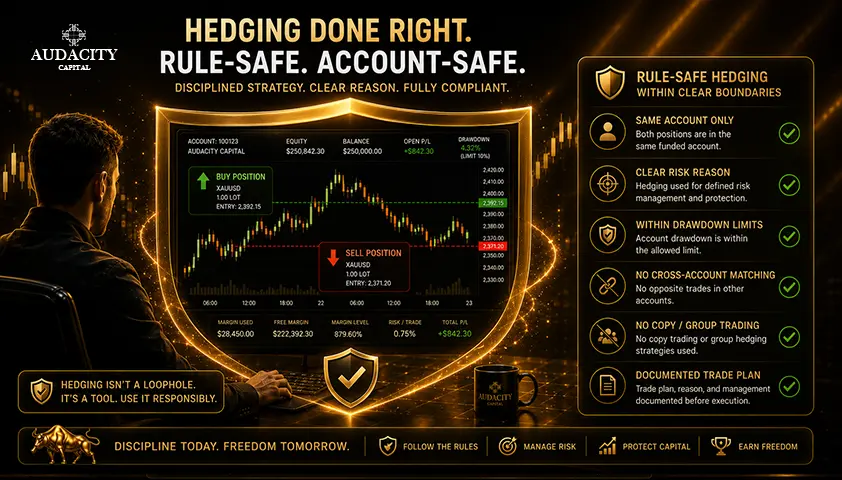
So can you hedge on a prop firm in a way that is allowed? Yes, using same-account hedging in the correct manner. Here are the steps to do that.
Step 1: Before engaging in any activity, always ensure that you understand the rules of the game. Check whether your firm allows same-account hedging and whether your account is hedging or netting.
Forex accounts generally provide MT5 accounts with the hedging mode, whereas futures and CME-like accounts have netting mode, where hedging on a same-account basis is impossible.
Multi-account or cross-firm hedging should be avoided.
Step 2: The purpose of hedge must be clear. With a perfect hedge, you will lock in your profit/loss at zero net balance. This protects you from losses, but does not give you extra money.
You will pay swaps and margins on both sides of the hedge throughout the time period.
Step 3: Use it only for legitimate reasons. These are maintaining an open position around the news event or the weekend, if your broker permits such holding during these windows, locking in profitable positions until finding a better exit, or balancing exposure of correlated pairs based on valid pair-trading logic.
Step 4: Monitor your copy trading program. Cross-account hedges can occur accidentally as a result of automation and delays, and they still constitute violations. If you notice one, close it immediately.
Step 5: Use it sparingly. Use hedging to pick positions rather than as a main strategy. If you rely on hedging all of your bets, the edge is the issue.
Step 6: Never get into the multi-account scheme. It is prohibited everywhere, it is detected, and it cancels all accounts. There are no shortcuts, and no version that's going to work.
Legitimate hedging checklist: same-account only, hedging mode confirmed, firm rules confirmed, a real reason for the hedge, copy-software monitored and used as exception and not default.
The latter is directly related to passing correctly. If you want the disciplined route, our guide on how to pass a prop firm challenge covers the skills the evaluation is actually built to find.
How Audacity Capital Handles Hedging
Audacity Capital prohibits multi-account, cross-firm, and group hedging used to game the evaluation, and breaking that rule will breach your account. Audacity is built for real traders taking real risk, not for exploiters chasing an easy pass that doesn't exist. A funded account is capital and a system to trade from, not an edge in itself.
Same-account hedging is a different question. Whether it is permitted, and how your platform behaves in hedging or netting mode across MT5 and DXTrade, should be confirmed on Audacity's live rules pages before you place a single trade, rather than on a general claim.
If you would rather build a real edge with genuine risk control than gamble on a banned trick, that is exactly who Audacity Capital is built for. Explore the funded program routes and education resources to see how the rules work, with clear risk limits and no consistency rule.
FAQ
Yes, in most forex companies. Having opposing trades in the same account is acceptable risk management; the drawdown still calculates for the net outcome, and it does not cheat the system. However, check your firm’s policy and the mode your platform runs- hedging or netting.
No. Taking opposing trades in two accounts to force one of them into passing is forbidden in almost every company and constitutes the only practice that is banned in the industry. The detection of such an activity leads to closing all the affected accounts and losing the profits earned.
Not generally if your firm permits same-account hedging. Trading Multi-account, cross-firm, or via copy-trading hedging will breach your account, lose the profit, and possibly cause a permanent ban or blacklisting.
No. The multi-account scheme is detectable and banned, so even if one account hits the target, the firm voids it. There is no legitimate shortcut, and the content selling this online is pointing you at a trap.
Hedging mode lets you hold opposing positions on the same instrument at the same time, while netting mode cancels them out into one net position. You can only same-account hedge in hedging mode, which is common on MT5 forex accounts but not on most futures platforms.
If your firm allows same-account hedging and overnight or weekend holding, you can offset an open position to pause risk instead of closing it. Remember that the hedge does not remove cost, since you still pay swap and margin on both legs.
Through IP monitoring, device fingerprinting, trade timing and correlation analysis, and increasingly inter-firm data sharing. A first offense typically triggers a soft-breach warning, while repeats escalate to permanent bans and profit forfeiture.
Like virtually all firms, Audacity prohibits multi-account and cross-firm hedging used to game the evaluation, and breaking that rule will breach the account. For its exact same-account hedging policy and platform mode, confirm the current rules on the Audacity site.

هل أنت مستعد لتطبيق مخاطر منضبطة على العملات المشفرة؟ استكشف أدوات التشفير الجديدة من Audacity Capital واجلب استراتيجية التداول الخاصة بك.
اعرف المزيدالنشرة الإخبارية
انضم إلى نشرتنا الإخبارية.
انضم إلى مجتمعنا الاجتماعي

ابدأ رحلتك اليوم مع تجربتنا المجانية
اعرض مهاراتك وإنجازاتك بفخر من خلال الشهادات واحصل على تقدير لعملك الجاد وتفانيك من المستثمرين المحتملين والأقران.
تجربة مجانيةمقالات ذات صلة

Market Profile Trading: How to Read TPO Charts
Learn Market Profile Trading with TPO charts, value area, POC, initial balance, day types, practical examples, and risk controls.

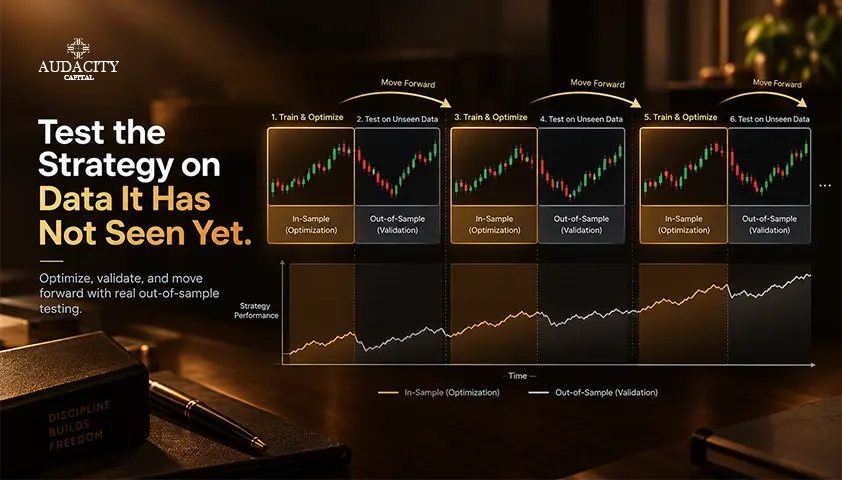
Walk-Forward Analysis in Trading: A Practical Guide
Learn how walk-forward analysis works in trading: in-sample and out-of-sample windows, rolling vs anchored designs, a worked example, and how to read results.
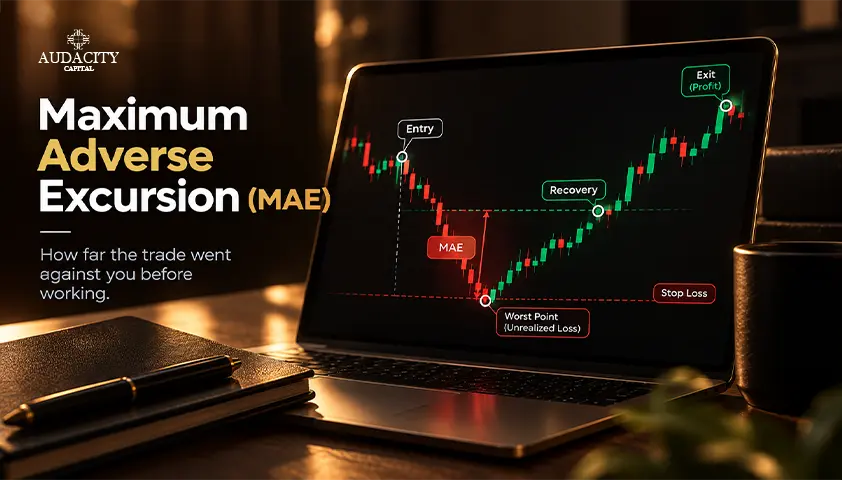
Maximum Adverse Excursion Explained for Traders
Learn how maximum adverse excursion measures a trade's worst open loss, how to calculate MAE, read charts, test stops, and avoid common errors.
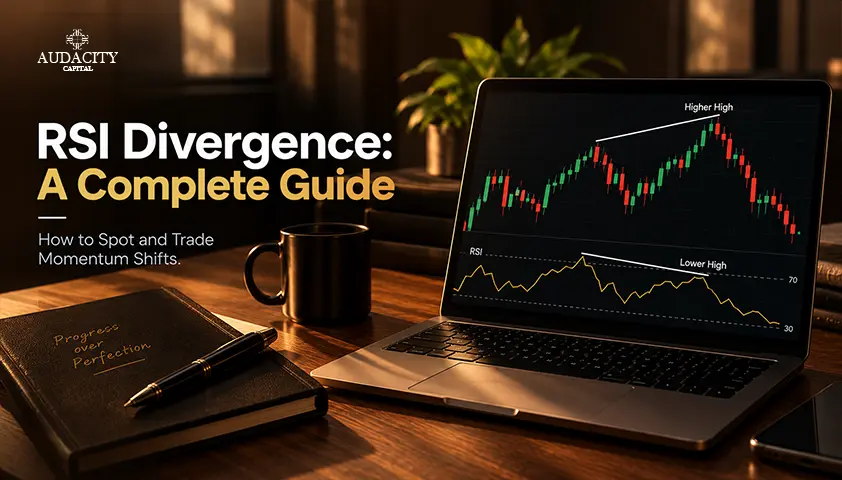
RSI Divergence: A Complete Guide to Spotting and Trading Momentum Shifts
Learn what RSI divergence is, explore bullish, bearish and hidden divergence, and discover how to identify, confirm and trade RSI divergence.