


Prop Trading vs Social Trading Platforms



Key Highlights
Prop trading and social trading platforms emphasize performance under strict rules, but social trading goes a step further to emphasize the need to learn from and follow established traders.
In a nutshell, this is what to expect from these two trading paths:
- Traders at a prop firm use the firm’s capital to open positions in the financial markets, but will first need to pass a paid evaluation challenge. It should be noted that the majority of traders do not pass prop firm evaluations on their first try due to strict drawdown rules.
- Investors using their funds to trade copy the trades being made by experienced traders in social trading platforms. These traders are known as “masters” or “signal providers.”
- The prop firm model ensures that there’s no personal risk of loss and provides for high profit splits for traders who meet their targets and are consistently profitable.
- Social trading revolves around passive investing, thus providing a low barrier to entry. If used correctly, it can prove educational as inexperienced learners can observe the moves being made.
- Prop trading will work best for you if you have a tried and proven strategy and are in need of capital to scale. You should be able to handle strict risk limits.
- Only go with social trading if you’re new to the trading world and have limited time to perform a detailed analysis of the financial markets. It’s worth noting that copy trading is not "set and forget." It requires rigorous "Master Trader" vetting to avoid high-risk strategies (like Martingale).
Prop Trading vs Social Trading Platforms
The distinction between prop firms and online brokerages is merging, as prop firms adopt the user-friendly interfaces of social platforms, while brokers offer 'funded' opportunities. Many prop firms now use regulated brokerage infrastructures as their back-end, though the prop firm itself remains a service provider. What initially started as a wave of funded trader programs has led to a much-needed structural shift in the trading industry.
Prop firms, which once quietly operated in the background, are no longer content with being unseen and have started to make bold moves aimed at securing their place in the trading space. And nothing illustrates this more than the continued adaptation of social trading platforms.
Learn more about latest guide Compare Prop trading to other models
This new trend has marked the beginning of the next phase in the continued evolution of prop firm trading. In this guide, you’ll get a brief description of what each is, before providing you with a comparison of prop trading vs social trading platforms, and a look at the frequently asked questions. Read on to learn more!
What Is Prop Trading?
Prop trading involves specialized prop trading companies or financial institutions making their capital available to traders who trade various assets such as currencies, bonds, commodities, and stocks. The objective is to generate profits to be shared between the firm and the trader.
Prop traders range from developing to experienced traders who have partnered with these prop firms and rely on the use of advanced trading tools to maximize returns on the capital offered by the company.
Please note that while the firm provides capital, the trader's "risk" is typically the evaluation fee, which is lost if the challenge is failed.
Key Features of Modern-Day Prop Firm Trading

The top prop trading firms provide a combination of strong support networks, educational resources, and competitive funding. They’re firms that ensure that prop traders not only get access to substantial amounts of capital, but that they have everything they need to grow their skills.
Below are the top features of reputable prop trading firms:
- Flexible Financing for Volatile Markets: Some firms provide larger capital allocations to traders who specialize in different financial markets. It’s a type of flexibility that enables them to handle rare opportunities that arise during moments of high volatility.
- Access to Top Tier Trading Tools: Prop traders use institutional-grade trading tools such as data analytics and advanced trading software. These are tools and software application packages that individual traders will normally have a hard time accessing.
- One-on-One Learning from Experienced Prop Traders: Financial institutions in the prop trading space often provide one-on-one mentoring sessions for beginner traders from experienced professionals. From this, the newbies get a hands-on learning experience, instead of relying on guesswork.
- Shared Risk, Higher Leverage: The prop trading business model is designed in such a way that the prop trader uses the firm’s capital to trade. Through it, they get to open larger positions without putting their savings at risk, an opportunity that most retail traders can only dream of.
Social Trading Platforms: What Are They?
Social trading has grown rapidly in popularity over the past decade, and its popularity can be traced back to the rising popularity of social networking platforms. In social trading, you get to copy the trading strategies being implemented by experienced traders.
For those of us who have been around in the trading industry for a while, social trading is no different from sitting in a room filled with our fellow trader friends. And I should point out that it makes it easier for you to invest from the comfort of your couch, and without doing much.

So, what does social trading entail?
It’s an online approach to trading that enables traders and investors to duplicate the moves being made by an experienced trader.
Besides replicating trades, traders can also communicate with other traders using the same platform. It, thus, works by leveraging a community of traders who share real-time information and trading strategies.
The goal is to replicate strategies and potentially generate returns.
Beginner traders may find social trading platforms a bit more welcoming, as it’s a trading method that assists in breaking down barriers that may hinder their success in the industry. But while it does have its standout benefits, it also comes with a set of challenges.
One major challenge you’ll note is that social trading significantly increases your potential for losing your investment capital in a volatile market. Even while using sound investment and risk management strategies, you’re still prone to loss-making, thus the need to conduct due diligence on the trader whose lead you intend to follow.
Please be advised that in social trading, followers often get worse entry prices than the "Master" due to execution delays (slippage), which can turn a winning trade for the master into a losing one for the follower.
Prop Trading vs Social Trading Platforms Comparison Table
Understanding the differences between these two trading approaches can help simplify your entry into the trading world. Below is a side-by-side comparison:
Feature | Prop Trading | Social Trading Platforms |
Source of Funding | The prop firm will provide access to a fully funded account once you have passed the evaluation challenge. | You, the trader, are in charge of financing your trading activities. |
Risk Exposure | A prop trading firm will cover the losses provided they’re within the specified limits. | The investor will bear all the risks. |
Profit Split Ratio | Profits are split based on an agreed-upon percentage, e.g., 85/15, with the prop trader getting the higher percentage. | In social trading, if you are a "Master Trader," you don't just keep all profits; you often earn a performance fee (e.g., 10-30%) from your followers. |
Entry Requirements | Strict requirements, as you must pass the evaluation challenge. | Low, and you can start immediately after placing your deposit. |
Trading Style | It’s characterized by strict rules, including daily and maximum drawdowns | Flexible, as the trading activities mainly involve mirroring the strategies of the other traders. |
Account Sizes | While prop accounts can be "six-figure," the buying power is large, but the actual drawdown limit (the money you can actually lose before the account is closed) is usually only 4-10% of that total. | The account size will vary depending on the capital a trader/investor is willing to risk. |
Primary Trading Objective | Capital growth and profit sharing between the prop trading firm and the trader. | Learning and passive income generation. |
Conclusion
The prop trading firm assumes the risk of loss that may come with a bad trade or a volatile market, thus helping the trader avoid losing their own capital. In the case of social trading, the investor will be risking their money and will thus bear all the losses that may be incurred from duplicating their trading strategies. Audacity Capital helps you get started with your journey to becoming a successful prop trader by providing the capital, tools, and resources needed to trade efficiently and profitably. Click here to check out what it takes to pass its Funded Trader Program.
Join Audacity Capital's free prop trading competition, apply the strategies you've learned, and compete for a chance to win a funded trading challenge without risking your own capital.
FAQs
It’s a form of trading that enables beginner and time-barred traders to observe and duplicate the trading moves and strategies deployed by expert traders.
Prop trading provides traders with numerous benefits that include scalable income, professional-grade tools and conditions, and capital access without personal risk.
To excel in social trading, traders need access to a range of tools that include trade copier engines, signal provider marketplaces, and analytics and risk management dashboards.
Blindly following the moves that a so-called “master trader” is making could lead to a major loss of capital. Always make sure you truly understand what it is that you’re doing.
No. But many reputable firms, including Audacity Capital, will provide you with a demo account to use when practicing trading.

هل أنت مستعد لتطبيق مخاطر منضبطة على العملات المشفرة؟ استكشف أدوات التشفير الجديدة من Audacity Capital واجلب استراتيجية التداول الخاصة بك.
اعرف المزيدالنشرة الإخبارية
انضم إلى نشرتنا الإخبارية.
انضم إلى مجتمعنا الاجتماعي

ابدأ رحلتك اليوم مع تجربتنا المجانية
اعرض مهاراتك وإنجازاتك بفخر من خلال الشهادات واحصل على تقدير لعملك الجاد وتفانيك من المستثمرين المحتملين والأقران.
تجربة مجانيةمقالات ذات صلة
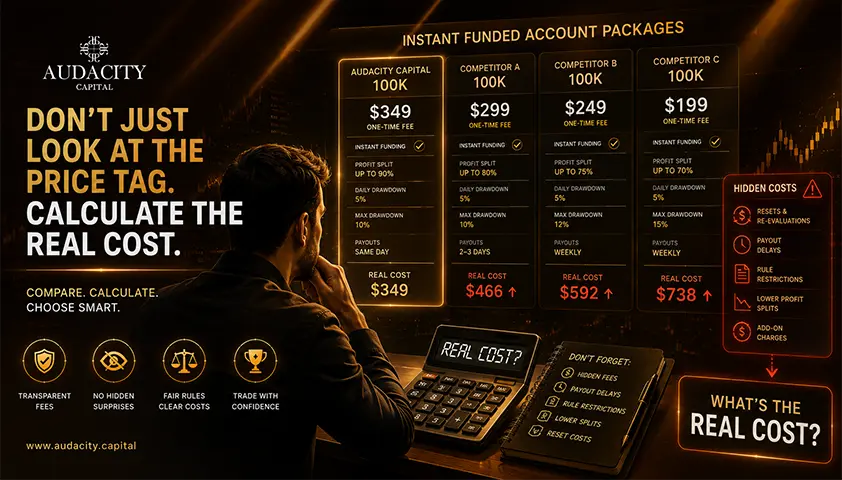
How Much Does an Instant Funded Account Cost?(2026 updated)
Sticker price tells only half the story. See what an instant funded account cost really covers, why it runs 2 to 3x a challenge, and if it's worth it.


Do You Pay Taxes on Prop Firm Payouts? A Funded Trader's Guide
In almost every country, prop firm payouts are taxable income, not capital gains. Learn how they are taxed, what you can deduct, and why records matter.

10 Best Prop Trading Firms in Malaysia in 2026
Compare the 10 best prop trading firms in Malaysia for 2026, ranked on swap-free accounts, payout speed, fees, and payments that work from Malaysia.

Instant Funding vs the Challenge: Which Funded Account Should You Choose?
Two routes to a funded account, one honest comparison. See how instant funding vs challenge differ on cost, drawdown, and profit split, and which route fits you.