


Risk Return Trade Off in Financial Management: A Complete Guide


Would you take a guaranteed 4% every year, or would you rather bet on something that could hand you 20% one year and take back 15% the next? Most people pause right there, and that pause is really the whole topic of “Risk-return trade-off” in miniature.
Every decision involving money (where to park your savings, which stock to buy, whether to lever up a trade) comes down to weighing what you stand to gain against what you could lose. Financial management has a name for this constant balancing act called “the Risk-Return Trade-Off”.
The Risk Return Trade Off in Financial Management sits at the center of almost every money decision. It is there in the first-time saver opening a fixed deposit and even when a portfolio manager is rebalancing a multi-billion-dollar fund.
Let’s break down what the risk return trade off in financial management actually means, why it matters, and how investors and traders put it into practice.
What Is Risk Return Trade Off in Financial Management?
The risk return trade off in financial management describes a simple relationship:
To have a realistic shot at higher returns, an investor generally has to accept more uncertainty about the outcome.
Risk here is the range of possible outcomes around what you originally expected. For example:
- A government bond will usually return close to what its coupon promises.
- A small-cap stock might return far more than that in a strong year, and far less or a loss in a weak one.
There's no such thing as a genuinely risk-free investment, not even cash. A savings account feels safe because the number in your balance won't fall, but inflation quietly chips away at what that number can actually buy. Even short-term government treasury bills, treated as close to risk-free, carry some risk from things like currency devaluation or an unexpected policy shift.
So, when someone asks what the risk return trade off in financial management really comes down to, the honest answer is that it's a spectrum, not a binary choice between "safe" and "risky."
The CFA Institute's work on portfolio risk and return frames this well –
Risk-averse investors aim to maximize return for a given level of risk, or minimize risk for a given level of return, and they rarely escape the trade-off entirely.
Higher expected returns exist, in large part, because investors need to be compensated for taking on uncertainty. If two investments offered identical expected returns but one was riskier, nobody would choose the riskier one, so it has to offer more upside just to attract capital. That extra return is sometimes called a risk premium, and it's the mechanism that keeps the whole trade-off functioning.
Why the Risk Return Trade Off Matters?
Understanding this relationship shapes real decisions at every level of financial management.
When a company weighs funding a new project with debt versus equity, it's weighing risk and return trade off in financial management. When a fund manager decides how much of a portfolio belongs in equities versus bonds, that's the same calculation on a larger scale.
Individual investors run into it every time they choose between a fixed deposit and a mutual fund, and traders face a faster-moving version of it every time they open a position.
When businesses and investors decide where to put their money, they usually have to balance risk and return. Investments with higher potential returns often come with a higher chance of losing money, so they need to be considered carefully.
The same idea applies to building an investment portfolio. Instead of putting all their money into one asset, investors spread it across different investments to reduce risk. Over the long term, taking too little risk may mean not reaching financial goals, while taking too much can lead to big losses at the wrong time.
Understanding Risk in Financial Management
Risk in financial management can take different forms, so it is important to understand what type of risk you are dealing with. In simple terms, investment risk means the possibility that something could happen and lead to a worse financial result than expected. These risks can appear in several common ways:
- Market Risk: This comes from changes in the overall market, rather than from one specific company. A recession, changes in interest rates, or a major global event can cause many investments to lose value.
- Credit Risk: Also known as default risk, this is the chance that a borrower or bond issuer cannot repay the money owed. Stable government bonds usually have lower credit risk, while high-risk corporate bonds tend to carry more.
- Liquidity Risk: This is the risk of not being able to sell an asset quickly without lowering its price. Real estate is a common example because selling a property quickly may require accepting a lower price.
- Inflation Risk: Rising prices can reduce the real value of your money. For example, a savings account or fixed deposit may earn interest but still lose purchasing power if inflation rises faster than the interest rate.
- Interest Rate Risk: Changes in interest rates can affect investment values, especially bonds. When interest rates rise, existing bond prices generally fall. Longer-term bonds are usually more sensitive to these changes than short-term bonds.
- Currency Risk: This affects people who invest in foreign markets. Even if an investment increases in value in its local currency, exchange-rate changes can reduce or even eliminate the gain when converted back into the investor's home currency.
- Operational Risk: Finally, this risk comes from problems within a company's own operations. System failures, human errors, cyberattacks, or supply-chain problems can cause losses even when the wider market is performing well.
Note: Diversification can reduce many risks, but it cannot fully protect against market risk, which can affect most investments simultaneously.
Understanding Return in Financial Management
Return is what an investor earns compared with the amount they originally invested. It can come in several forms.
- Capital appreciation occurs when an asset increases in value, while dividend income comes from companies sharing profits with shareholders.
- Similarly, interest income is earned by lenders and bondholders in return for providing their money.
- For real estate investors, rental income provides regular cash flow from a property.
These different sources come together as total return, which includes both changes in an investment's value and any income it generates. Looking at total return gives investors a clearer picture of how well an investment has performed over a specific period.
The Relationship Between Risk and Return Trade Off in Financial Management
The same basic idea applies across most types of investments: lower-risk investments generally come with lower expected returns, while higher-risk investments usually offer the possibility of higher returns. This is not a fixed rule or something imposed by regulators. It happens because investors expect to be rewarded for taking on more uncertainty and accepting a greater chance of loss.
The word “expected” is important here.
Higher risk does not mean an investment will definitely make more money. Instead, it means the range of possible results is wider. An investment could perform much better than a safer option, but it could also perform much worse.
This is why investments are often placed on a risk-return spectrum, from lower risk to higher risk:
- Cash and savings accounts
- Government bonds and treasury instruments
- Corporate bonds
- Blue-chip and large-cap stocks
- Small-cap and growth stocks
- Emerging-market assets and forex
- Highly speculative assets such as cryptocurrency
The extra expected return an investor receives for moving up this spectrum is often called risk compensation, or a risk premium. Essentially, the reward that has to be on the table before people are willing to accept greater uncertainty.
Some Examples of Risk Return Trade off
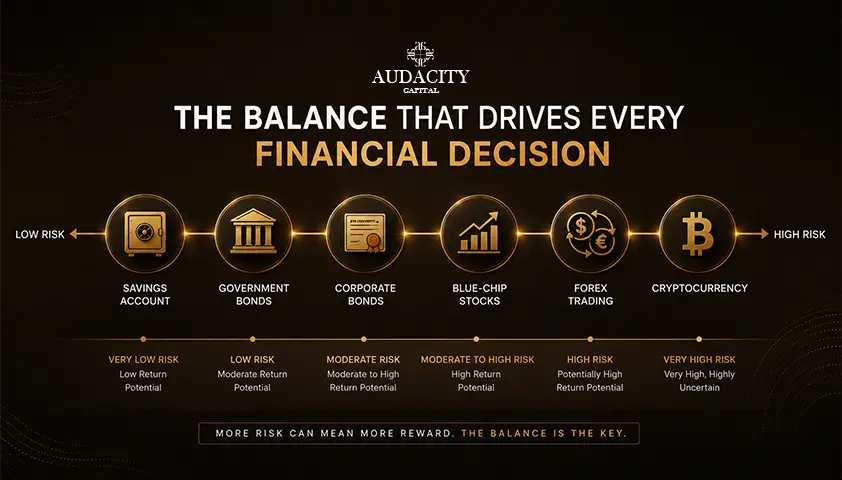
Seeing this trade-off across real asset types makes the concept easier to hold onto than any definition on its own.
Investment Type | Risk Level | Return Potential | Reasoning |
Savings Account | Very low | Low, often below inflation | Principal is protected or insured, but growth is minimal |
Government Bonds | Low to moderate | Moderate | Government-backed, though inflation and rate changes still matter |
Blue-Chip Stocks | Moderate to high | Higher long-term potential | Established companies, but still subject to market swings |
Forex Trading | High | Potentially high, short-term | Leverage and currency moves amplify both gains and losses |
Cryptocurrency | Very high | Very high, highly uncertain | Thin regulation, extreme volatility, no guaranteed floor |
Lined up as a spectrum, the same five options sit like this:
Low Risk → Savings Account → Government Bonds → Blue-Chip Stocks → Forex Trading → Cryptocurrency → High Risk
The pattern worth noticing isn't in any single row of the table above. It's the gap between the columns as you move right. Return potential climbs, but so does the width of the outcome range around it. That's why the left side of this list comes with a long, boring track record, and the right side comes with a much shorter one and far more caveats attached.
Factors That Influence The Risk Return Trade off
Several factors shape how much risk actually makes sense for a given person or portfolio at a given time and thus the trade-off doesn't play out identically for every investor.
- Investment horizon: The longer you have before you need the money, the more short-term ups and downs you can usually handle. Someone investing for retirement decades away has more time to recover from a market decline than someone who needs the money in five years.
- Market conditions: Market trends can change how risky an investment feels. Rising markets may encourage investors to take more risk, while falling markets can lead to larger losses and greater uncertainty.
- Economic cycles: The economy moves through periods of expansion, peak, slowdown, and recovery. Different investments can perform better or worse during each stage, which is why economic conditions matter when assessing risk.
- Inflation: When prices rise, the real value of investment returns falls. This can make investors look for assets that have a better chance of keeping up with inflation over time.
- Diversification: Spreading money across different assets can reduce the impact of a poor-performing investment. A diversified portfolio may therefore achieve a reasonable expected return without relying too heavily on any single holding.
- Risk tolerance: Risk is about money, and it is also about how comfortable an investor is with losses and market swings. Someone who cannot sleep during a major market decline may need a different portfolio from someone who can comfortably stay invested through it.
- Financial goals: The purpose of the money also matters. Saving for a house in two years requires a very different approach from investing for retirement thirty years away. The shorter the time until the money is needed, the less room there usually is for major losses.
- Note: Investment horizon and risk tolerance work together. Having more time can make it easier to handle risk, but only if the investor is comfortable staying invested when markets move sharply.
How Do Investors Balance the Risk and Return Trade Off in Financial Management?
You can’t eliminate risk by managing the risk and return trade off in financial management. That's neither possible nor desirable, since it would also eliminate most of the potential return. The goal is to manage risk carefully and keep it within a level you can accept.
Investors use several common tools to do this:
- Diversification → Spreading money across different investments so that a loss in one does not heavily damage the whole portfolio.
- Asset allocation → Deciding how much money should go into stocks, bonds, cash, and other assets based on financial goals and time horizon.
- Portfolio rebalancing → Adjusting investments back to their target levels when market movements cause the portfolio to become too heavily weighted toward one asset.
- Risk assessment → Regularly checking how much risk the portfolio is actually carrying, rather than focusing only on recent returns.
- Position sizing → Limiting how much money is placed into one investment or trading idea, so a single mistake does not cause a major loss.
- Stop-loss orders → Setting a price level where a losing investment or trade is automatically closed, helping prevent a small loss from becoming much larger.
Together, these tools do not remove risk. Instead, they help investors control how much risk they take and make sure it matches their goals, time horizon, and comfort level.
Risk Return Trade off in Trading
Trading works on the same basic risk-return trade-off in financial management, but everything happens much faster. Because prices can move quickly, traders need clear rules for managing risk.
- Risk-to-reward ratio → Traders compare how much they could lose with how much they could potentially gain. For example, a 1:3 ratio means risking $200 to target a $600 gain.
- Position sizing → Traders usually avoid putting too much money into one trade. Keeping each position small helps limit the damage from a series of losses.
- Capital preservation → Protecting trading capital is important because money that is lost cannot be used for future opportunities.
- Maximum drawdown → Traders can set a limit on how much they are willing to lose before taking a break and reviewing their strategy.
- Consistency → Following the same risk rules on every trade can be more important than getting any single trade right.
Example: If a trader risks $200 to potentially make $600, they have a 1:3 risk-to-reward ratio. This means they do not need to win every trade to potentially make a profit over time.
Common Mistakes
Even investors who understand the theory behind the risk return trade off can fall into these avoidable traps:
- Chasing high returns without weighing the downside that usually comes attached to them
- Ignoring downside risk by focusing on best-case scenarios when evaluating an opportunity
- Lack of diversification, often from overconcentration in one stock, sector, or asset class
- Emotional investing or buying out of excitement near market tops and selling out of fear near bottoms
- Taking excessive leverage, which magnifies both gains and losses and can turn a manageable loss into a devastating one
- Poor risk management, such as skipping stop-losses or ignoring position sizing altogether
Advantages of the Risk Return Trade off in Financial Management
The payoff from understanding this trade-off shows up long after any single trade is closed. A few effects compound alongside the money:
- Better decisions, one at a time: Each opportunity weighs on two axes instead of one, so a tempting return doesn't get evaluated in isolation from what it might cost to chase it.
- A portfolio that ages better: Deliberate risk management is not just great in a bull run and falling apart in the next correction, but smooths out performance across full market cycles.
- Fewer decisions made out of fear: Knowing your risk limits ahead of time takes some of the shock out of a downturn, which is usually when the costliest mistakes get made.
- Capital that survives long enough to compound: Preserving the base matters more than any single winning trade, since compounding needs something left to work with.
- Expectations that match reality: A strategy is much easier to stick with through a bad stretch when the bad stretch was already priced into expectations.
Limitations of the Risk Return Trade off in Financial Management
The framework explains a lot, but it doesn't remove the uncertainty it's describing.
- Short-term markets stay unpredictable: No amount of planning changes that, and pretending otherwise is its own kind of risk.
- Risk buys a chance, not a promise: A higher-risk position has a wider range of outcomes, not a better guaranteed one, and plenty of them land on the losing side.
- Real-world events don't ask permission: Pandemics, policy shifts, and sudden rate changes can undercut even a well-built position, and none of them show up in a model until it's too late.
- There's no universal "correct" amount of risk: What feels balanced to one investor can look reckless, or overly cautious, to someone with a different goal or temperament.
Practical Tips
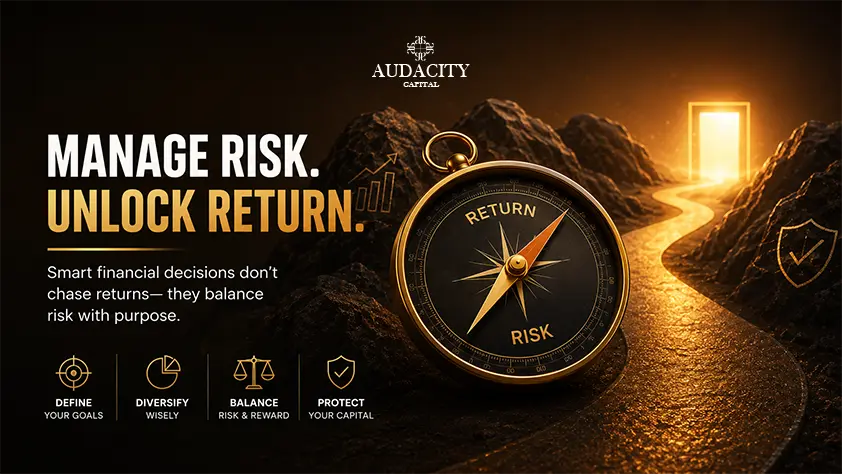
Before you begin to implement any of the learnings from this guide:
- Define your financial goals clearly before putting any money to work.
- Understand your own risk tolerance honestly, not just how you think you're supposed to feel about volatility.
- Diversify across asset classes rather than concentrating in whatever performed best recently.
- Review your portfolio periodically and rebalance when it's drifted from your original targets.
- Focus on long-term consistency rather than chasing whatever is generating headlines this quarter.
Conclusion
At the end of the day, managing money is about making choices between risk and potential reward. No shortcut guarantees strong returns while keeping risk out of the picture. The risk and return trade-off in financial management simply helps investors make that balance more deliberately. The right approach fits the goal, gives the investment enough time to work, and does not expose the investor to more risk than they can comfortably handle.
Want to apply these risk rules in a funded account instead of your own capital? Get funded with Audacity Capital.
FAQs
It's the principle that higher potential returns generally come with higher risk, meaning investors typically must accept greater uncertainty to pursue larger expected gains over time.
It helps investors make informed decisions by weighing potential rewards against possible losses, which guides portfolio construction, asset allocation, and long-term financial planning around realistic expectations.
Not reliably. Some low-risk options exist, like insured savings accounts, but they offer modest growth; meaningfully higher returns almost always require accepting greater uncertainty.
No. It depends on individual risk tolerance, investment horizon, and financial goals, so what feels balanced for one investor may feel too aggressive or too cautious for another.
No. Higher risk only widens the range of possible outcomes. It raises potential reward but also potential loss, with no guarantee that the higher return actually shows up.

هل أنت مستعد لتطبيق مخاطر منضبطة على العملات المشفرة؟ استكشف أدوات التشفير الجديدة من Audacity Capital واجلب استراتيجية التداول الخاصة بك.
اعرف المزيدالنشرة الإخبارية
انضم إلى نشرتنا الإخبارية.
انضم إلى مجتمعنا الاجتماعي

ابدأ رحلتك اليوم مع تجربتنا المجانية
اعرض مهاراتك وإنجازاتك بفخر من خلال الشهادات واحصل على تقدير لعملك الجاد وتفانيك من المستثمرين المحتملين والأقران.
تجربة مجانيةمقالات ذات صلة

Struggling To Face Losses In Forex Trading? Here’s How To Bounce Back
Learn how to recover from losses in forex trading with proven strategies, mindset tips, and a step-by-step plan to rebuild confidence and trade consistently.

How Do Professional Traders Manage Their Risk While Trading?
Discover the importance of risk management in trading. Learn how to mitigate losses and increase your chances of success in the forex market.

12 Trading Risk Management Tools Every Trader Needs
Explore 12 trading risk management tools for position sizing, trade planning, drawdown control, journaling, and smarter trading decisions.

Mastering Money Management With Audacity Capital