


Day Trading Tips: The Rules That Actually Decide Whether You Survive


Most day trading tips lists are interchangeable. They quote the same generic advice in a different sequence, but not telling you which tips actually matter when the money is at stake.
This guide is different. The tips are prioritized based on what's most important for long-term survival: risk management and discipline come first, process and execution second.
The purpose is not to provide you with another list of general trading tips, but to let you know which habits you should focus on first.
Here you will find those rules, grouped and numbered by importance, along with the key traps that can undo even a solid trading plan.
The Honest Reality Before Any Tips
Tips can only be useful to a trader who knows what they are facing, so begin here.
The evidence is clear: Many day traders lose money, and many quit within their first year, and many studies of retail traders have repeatedly demonstrated that only a small percentage are profitable in the long term.
The conclusion that better sources support is worth stating plainly. Day trading isn't a quick and easy way to make money, and anyone who claims a guaranteed profit is selling something. Whenever you encounter a guaranteed-profit claim, consider it a warning.
And here comes the constructive part.
Sustainable gains are achieved through years of practice and strict compliance with all rules, not some lucky trades. The tips below are what the surviving minority actually do differently. They won't guarantee a particular outcome.
They increase your chances of success, but only if you follow them. Only trade with money you can afford to lose, and view the rest of this guide in that light.
Risk Management Tips (The Ones That Decide Survival)

Risk management goes first for a reason. This is the difference between the beginner who survives long enough to become good and the beginner who explodes within a month. If you just take one thing from this article, take these seven day trading tips for beginners.
1. Risk a fixed small percentage per trade
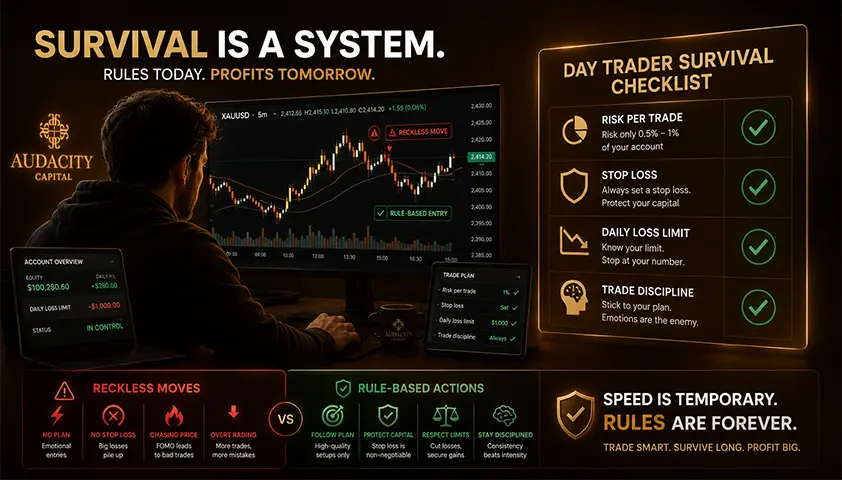
In general, the 1% rule is followed: don't risk more than 1% of the account on any trade, and 1-2% is the standard range.
A common strategy is to size the position so your stop equals 0.5% to 1% of account equity.
For instance, on a $25,000 account, 1% of that means $250 of risk, and once you understand your stop distance, you'll know how big your position will be.
Why it works: even after you lose a few trades you won't get out of the game, giving yourself enough time to learn. Use these percentages as guidelines, not rules.
2. Define your risk before you enter, every time
A stop loss is the price at which you exit a losing trade in order to limit the loss. Put that stop at a price level that will prove the trade wrong, and not a dollar amount you think you can tolerate in the heat of the moment.
Make sure you decide your exit strategy before you make your entry, while you're still objective. To learn about where to place a stop, check our take profit vs stop loss guide.
3. Never widen or move a stop against yourself
This is the most prominent rule and deserves its own place on the list. Beginners do not usually blow up because they chose the incorrect setup. They blow up because they widen their stops.
If you move a stop, then a small planned loss becomes a big unplanned loss and you lose the whole maths of your risk per trade.
The rules are easy: Take a loss without hitting the stop. A stop can be moved to minimize risk, such as moving to breakeven once a trade is working, but cannot be moved to increase risk.
4. Set a daily loss limit and stop when you hit it
Daily loss limit is the maximum amount you are willing to lose a day. There is a common rule of three times the amount at risk per-trade, but it's the discipline that counts more than the number. If you hit it, you're out for the day.
Why it works: this will keep one bad morning from becoming a disaster, and it's the primary line of defense against revenge trading.
5. Never add to a losing trade
If you take an average on a losing day trade, then you are taking a risk at a time when the market is telling you that you are wrong. If your strategy allows scaling, add to winning positions—not losing ones.
6. Respect leverage
Leverage refers to borrowed money which can amplify your position size and risk. Excessive leverage is the worst rookie mistake as it magnifies losses as much as it magnifies wins, and can turn a normal down swing into an account-threatening one.
Always size according to your risk rule, not your margin; and always use the smallest leverage your strategy needs.
7. Only take trades worth more than they risk
Always set a reward that exceeds the risk on each and every setup, which means you don't have to have a high win rate to be profitable. This is the risk-to-reward ratio and it's the unsung power of consistency. To understand the interplay between R:R and overall win rate, check our guide to risk to reward ratio instead of attempting to figure it out mid-trade.
Group:
Show a trader following a structured process board beside the chart: pre-trade checklist, planned entry, stop loss, trade journal, and post-trade review. Add a tempting “revenge trade” button crossed out to show discipline means following the process even when emotions rise.
Discipline and Process Tips

This is the second most important group. Those who survive in day trading are not making better predictions. They are doing things more systematically.
These are the day trading rules which transform a great setup into a repeatable process.
8. Trade a written plan and treat it like a business
If you trade merely to observe what happens without a specific setup and rules then you won’t last very long.
A plan is the answer to when you trade, where the stop and the target are, how much you risk and when you stop for the day. Think of your money as business stock that needs to be safeguarded.
9. Be process-oriented, not outcome-oriented
Do not judge yourself based on a day's loss or gain, but rather by how well you executed, how well you managed risk and how well you adhered to your rules.
A good trade can lose and bad trade can win, so "judging" by profit and loss teaches you the wrong lessons and rewards the wrong habits.
10. Use one strategy and stick to it
Decide on one method, such as a breakout, a trend-following or a range approach and practise it enough time and repetitions to learn it.
Frequent changes will create confusion and each technique requires a meaningful sample before it has any significance. Changing strategies after one losing day is one of the surest ways of never developing an edge.
11. Do not overtrade
Additional trades don’t mean additional profits. In general, the more trades you make, the lower the average profit will be and the additional trades are often made by either fear of missing out or impatience and not due to good setups.
Overtrading is one of the quickest means of giving your edge back to costs.
The quick fix: restrict the number of trades you make each day and ensure that every trade matches the written trade.
12. Maintain a trading journal and review it
Document all of your trades with the setup including your reasons for entering or exiting and how well you adhered to your rules. Without the trading journal, traders lose the best tool they have for learning from their own mistakes.
Check it once a week and see if you have repeated the same mistake, rather than one-time losing trade.
13. Train your mindset
Trading psychology is often the most ignored component of trading but probably also the most crucial. It is your own mind that defeats a day trader rather than the market.
Fear, greed, impatience, and desire for revenge after losses can be expected, so create rules that will turn these negative emotions into an advantage, for example, daily loss limits.
14. Avoid hype and do not trade blindly
When you trade based on social media tips or base your trades on someone else's calls, you have no clue when to exit because you never knew why you were in that trade. Many people make substantial losses from positions that are driven by hype.
Use charts, data, and tested ideas that you are familiar with to make decisions.
Execution and Setup Tips
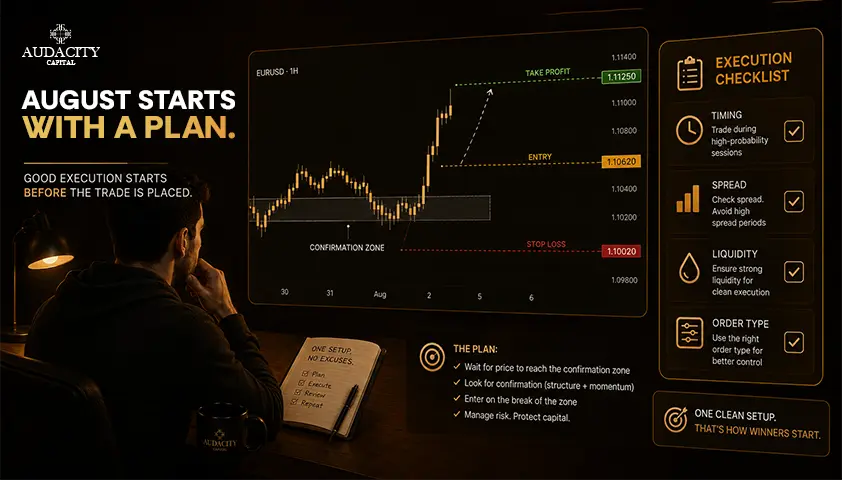
These are the "mechanics" that make the above rules workable. They're fast but they're important.
15. Trade liquid instruments
Liquidity translates to tighter spreads, better fills, and less slippage, all important factors when the advantage is on the small side.
For stocks, it would be the liquid large-caps and the major index ETFs, such as SPY or QQQ.
For forex, it means the major pairs. A very popular beginner configuration is to use an opening-range breakout on a liquid instrument, as it provides a clear and definite risk.
16. Know your hours and check the economic calendar
Volatility and liquidity do not remain equal throughout the day, select the session window that suits your strategy and trade it through it.
Before you start, make sure you check the economic calendar as scheduled releases can cause volatility that can blow through a stop. Plan how you will react to them—whether you will trade around them or not.
17. Have reliable technology
In a game measured in seconds, having a stable and fast internet connection as well as a platform you are familiar with is important. Make sure you can place, adjust and close orders without hesitation and have a back up plan when there’s a failure during the trade; whether it be a phone app or your broker's number saved and ready.
18. Understand your costs
Expenses such as spreads, commissions, and slippage determine whether or not your advantage will be enough. With day trading, the costs can be multiplied by frequency, so work out what the real cost of a single round trip is to you and ensure that your average win pays for it.
19. Use tools as aids, not substitutes
Data work and trade reviews are actually easier with charting, back testing, screeners and AI-assisted analysis. What they can't do is replace discipline.
No tool determines for you which rules to follow—human control is still the determinant. For indicators, read our articles on the best moving average for day trading and the best technical indicators instead of learning them here.
Practise Before You Risk Real Money
This tip is worthy of its own section.
Prior to trading a strategy live, try it out on a simulator or a paper trading account. It allows you to make mistakes without losing any money and you're learning the platform, your setup, and how you react.
Set a realistic standard for yourself. A popular rule of thumb is to log six or more months of profitable simulator results before going live.
Use that as a guideline and not a rule. The better test is if you can stick to your plan and manage your risk over a significant number of trades.
The one thing to note here: paper results typically beat the live results. Simulation can not replicate the “real” stress, it can underestimate costs such as slippage and commissions.
Treat regular paper results as a motivator, but NOT as a guarantee. If you go live, begin with the smallest size that you feel comfortable with.
The Traps That Undo Good Tips
Simply knowing the tips is not the same as actually putting them into practice. These are the behaviours that can override every rule above, with each one directly linked to the rule it breaks.
This is the straight-forward day trading tips most lists don't include.
- Revenge trading after a loss. Breaks your daily loss limit, which exists for exactly this moment.
- Moving or widening a stop mid-trade. Breaks your defined risk and turns a small loss into a large one.
- Over-leveraging after a good run. Breaks your leverage discipline right when confidence is highest.
- Chasing hype or someone else's call. Break your rule to trade only setups you understand.
- Strategy-hopping after a bad day. Breaks your commitment to one method before it had a fair sample.
- Skipping the journal. Breaks your feedback loop, so the same mistake repeats.
- Trading without a plan just to see what happens. Breaks the foundation the other rules are built on.
Conclusion
Stay honest with yourself about the odds. Most day traders lose money. These tips improve your odds, they do not guarantee an outcome, and the skill is not knowing the rules but following them under pressure.
If you want to know how to day trade successfully, the practical takeaway is unglamorous but true: start small, protect your capital, keep the journal, and judge yourself on execution rather than a single day's P&L.
Day trading remains high-risk, so only ever trade with money you can afford to lose.
Frequently Asked Questions
There is no longer a $25,000 minimum for US stock day trading, since that rule was eliminated in June 2026. That said, you still need enough capital that risking around 1% per trade is meaningful after costs, and you should only ever use money you can afford to lose.
It means never risking more than 1% of your account on a single trade. On a $25,000 account, that is a maximum of $250 of risk per trade. Keeping any single loss survivable is exactly why your position size should follow from your stop distance rather than the other way around.
Fewer than most beginners think. Average profitability tends to fall as trade count rises, so many experienced traders cap their daily trades and only take setups that match their written plan. Quality beats frequency almost every time.
Usually because of execution, not analysis. The common culprits are widening stops, over-leveraging, revenge trading after a loss, overtrading, and switching strategies before any of them has had time to work.
No. Moving a stop wider turns a small planned loss into a large unplanned one and breaks the maths of your risk rule. You can move a stop to reduce risk, for example to breakeven, but never to increase it.
Stop for the day once you hit your daily loss limit, then review your journal for the repeated error rather than changing strategy. Most losing streaks come from rule-breaking rather than a genuinely broken strategy.
It can be a legitimate skill to build, but the odds are hard. Most day traders lose money and many quit within a year. It is only worth attempting with money you can afford to lose, strict risk rules, and realistic expectations from the start.
There is no fixed rule. One commonly cited benchmark is several months of consistently profitable simulated results. The better test, though, is whether you can follow your plan and manage risk over a meaningful sample, and you should expect live psychology to feel very different from the simulator.

Bereit, diszipliniertes Risiko auf Krypto anzuwenden? Entdecken Sie die neuen Krypto-Instrumente von Audacity Capital und bringen Sie Ihre Trading-Strategie mit.
Mehr erfahrenNewsletter
Treten Sie unserem Newsletter bei, um auf dem Laufenden zu bleiben.
Treten Sie unserer sozialen Gemeinschaft bei

Beginnen Sie Ihre Reise heute Mit unserer kostenlosen Testversion
Präsentieren Sie stolz Ihre Fähigkeiten und Leistungen durch Zertifikate und erhalten Sie Anerkennung für Ihre harte Arbeit und Ihr Engagement von potenziellen Investoren und Kollegen.
Kostenlose TestversionVerwandte Artikel

6 Best Markets for Day Trading in 2026 Compared
Compare the best markets for day trading in 2026, including forex, futures, stocks, indices, commodities, and crypto, based on capital, hours, and risk.


How to Create a Day Trading Risk Management Plan?
Build day trading risk management strategies with daily loss limits, position sizing rules, drawdown controls, and a practical trading checklist.

15 Best Day Trading Platforms in 2026
The best day trading platforms in 2026, grouped by what they actually do. Compare brokers, charting layers and funded accounts.

Why Is Pattern Day Trading Illegal? (It Is Not, and the Rule Is Gone)
Why is pattern day trading illegal? It never was. Learn what the old PDT rule required, what changed in 2026, and what traders need to know now.