



What Is Day Trading and How Does It Work?


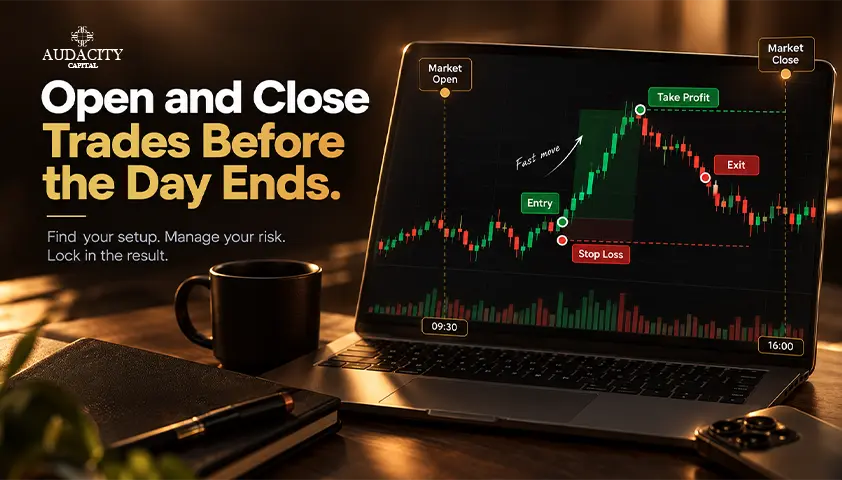
Day trading or Intraday trading is where traders enter and exit their positions within the same trading session. Every trader approaches the market in a different way with a different strategy.
While some prefer to hold their assets for a few weeks, others may prefer to hold for a long-term period. Day trading however takes a shorter approach, seeking to capitalise on quick and sudden price movements.
The article below discusses what day trading is, how trading works, markets involved, risks, tools and profitability.
What Is Day Trading?
Day trading is a form of stock market strategy where the investors buy or sell the financial assets within the same trading day. The purpose of day trading is to profit from small and sudden price fluctuations that happen throughout the day.
The intraday traders do not care about the long-term quality of the stock or or the financial health of a company. Instead, they focus on making quick profits from short-term price movements caused by supply, demand, or market news.
Key Characteristics of Day Trading
- Positions are normally opened and closed during the same trading session, wherein, traders cannot hold stocks or assets overnight or lock capital in active trades when the market shuts down.
- Positions range from a few seconds to minutes or extend up to several hours. Traders can either engage in scalping (seconds to minutes), momentum trading (minutes to hours) or range trading (several hours).
- The trader typically monitors the market (market updates, current stock price, trading activity, bid-ask spread, relevant news, and overall sentiment) actively during the session.
- Liquidity, volatility, volume, bid-ask spreads, and execution quality matter because trades are short-term.
- Short-term technical analysis (price action, chart pattern, technical indicators, support & resistance) and event-driven information (economic releases, company announcement, central bank decisions, etc) are commonly used.
- Day traders generally avoid planned overnight exposure (gap risk), where events like earnings reports, international news or policy updates released after market close, can cause prices to react sharply in the next session.
How Does Day Trading Work?
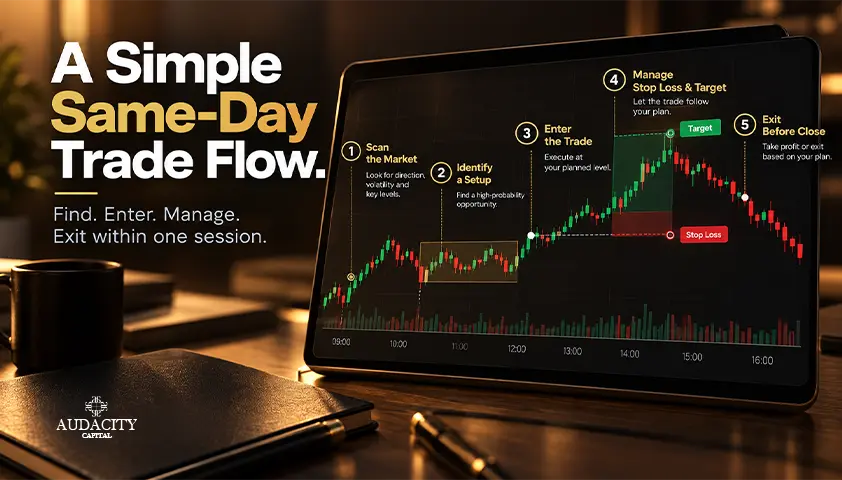
Listed below is the framework that explains how does day trading work:
1. Finding an Intraday Opportunity
The first step in day trading is to look for an asset that offers tradable price movement during
the market hours. For this, the trader must study the broader market, then sectors and then
move to the stocks.
To shortlist the stocks, the traders examine price action (how the price of
stock has moved, the recent lows/ highs, trends, etc.), technical analysis (chart patterns, key
support & resistance, moving averages, momentum indicators), trading volume, scheduled
corporate news or governed financial organisations events, or market structure.
For instance: A trader goes through top-down conditions, analysing markets and sectors. If the technology sector has proven bullish (lets say 2.4% upside), and a stock X ltd. has opened with heavy volume (trading 2.5 x of its daily volume).
The stock’s current market price is $180 and currently it ranges between $178-$180.A breakout above $180 signals a strong interest.
2. Planning the Entry, Risk and Exit
To execute a trader properly, it is imperative to calculate these accordingly:
- Entry: When a specific technical indicator or order-book triggers confirms your idea, it defines the entry point of a trader. Early entry may increase risk while late entry reduces profit.
- Invalidation Point (Stop-Loss): When the price levels of trade goes against your predictions and the idea is proven wrong. In this case, the trade must be exited immediately to prevent further losses.
- Position Sizing & Capital at Risk: The number of shares bought, calculated based on the distance between the entry price and the stop-loss price. A trader determines how much money they are willing to lose (e.g., $100 or $500) and sizes the position accordingly.
- Target (Take-Profit): Target is a pre-determined price level where the trade is exited for a profit.
For instance, the trader plans the entry at $179, targets exit at $185 and places stop-loss at
$176. The trader risks $3 per trade if the set up fails and stands to gain $6 if it succeeds.
The trader, however, is willing to risk a maximum of $300 on the trade, the position size
would be 100 shares ($300 ÷ $3).
The levels are planned before entering the trade.
3. Closing the Position Within the Trading Session
Day traders are required to close every position with 100% cash rather than keeping the position overnight. This phenomenon eliminates the overnight risk. With no overnight positions, after-hours news releases or global market shocks have zero direct impact on their existing portfolio balance.
However,overnight exposure is just one type of risk. Intraday trading is not risk-free or low-risk trading as leverages, margins, volatility, execution quality, and psychological pressure may affect the overall trade.
Now, lets go back to the stock X ltd.
Consider that by 1.45 p.m, the stock reached $185 and the trader made a gross profit of $600. In case, the stock had not hit the desired level, the trader would have been forced to exit the position. Another case is, where the stock hits the $176, and the trader would have incurred a loss of $300 plus transaction costs and others.
4. What Markets Can You Day Trade?
Day trading is suitable for the the following markets:
Stocks
Stock market is trading equity shares of publicly listed companies during market hours. The intraday stock market trades rely on official market hours, highly liquid stocks, tight bid-ask spreads, sudden price spikes, and unpredictable company-specific news.
Forex
Forex, or foreign exchange market is where traders buy and sell currencies. They trade one currency against another through a currency pair such as EUR/USD, GBP/USD, and USD/JPY.
Since forex operates across global financial centres, trading is active through different market sessions rather than being defined by regular hours of a single stock exchange.
Futures
Futures refer to standardized contracts to buy or sell an underlying asset or financial instrument at a specified price under the terms of the contract.
Day traders can use futures to gain short-term exposure to several types of markets such as stock-market indices, commodities, interest rates, currencies, and other financial markets, without directly buying the underlying asset.
A standout characteristic of the future is that traders are not required to pay the full value of the underlying exposure upfront. That is, futures have a built-in leverage, which makes even small movements have a significant impact on a trader's account. While it brings in good opportunities, leverages also increase risk substantially.
Options
Options are contracts whose value is linked to an underlying asset, such as a stock, index, currency, or futures contract. A call option provides the right to buy the unlying asset at a specified price while a put option offers the right to sell the said asset at a specified price.
Options also come with an expiry date, therefore, apart from the movement of underlying asset, the time until expiry and expected price volatility can affect an option's price.
Cryptocurrency
Cryptocurrency markets are for traders who seek to buy and sell digital assets such as Bitcoin, Ether, and other cryptocurrencies. Crypto markets operate 24/7, including weekends and public holidays. These markets are characterized by high price volatility, market quality, trading venue and liquidity.
What Makes a Market Suitable for Day Trading?
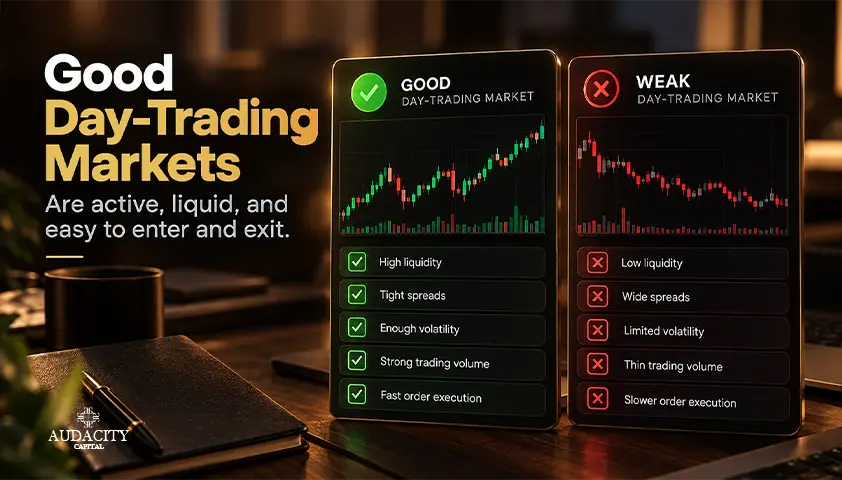
The day trades are tradable only with the following factors:
Liquidity:
How easily an asset can be converted into cash, that is it can be bought or sold to fulfill orders. High liquidity is suitable for day traders as it makes entry and exit closer to the quoted price.
Volatility:
It refers to the degree of price fluctuation. Too little or too much volatility can pose a risk for traders as sudden movements make it harder to execute orders at desired prices while flat movements offer less opportunities or low margins.
Trading volume:
Volume is no. of shares or contracts traded during the given period. High volume confirms that current price trends are backed by strong interest and real supply and demand rather than random, low-liquidity price spikes.
Spreads and costs:
The difference between the highest price the buyer seeks to pay (bid), and the lowest price the seller seeks to sell (ask). A smaller spread means less cost but a wider spread means a higher cost to enter or exit the trade. Besides it also includes brokerage or commission, exchange-related charges, taxes, and etc.
Execution quality:
Execution quality is the difference between the intended price and the fulfilled price. This difference is due to the market speed, liquidity, order type, and the number of buyers and sellers available at a particular price. Poor execution can increase costs through delays, slippage, or getting a less favorable price.
Market hours and session behavior:
Market conditions are not uniform throughout the day. Liquidity and volume may rise or fall depending on the market timing, opening bell, closing bell, or a scheduled event. Therefore planning the timing of the day trade is just as crucial as any other factors.
Important distinction
High volatility alone does not automatically make a market suitable for day trading. Liquidity and execution quality matter as well.
What Does a Day Trader Actually Do During a Trading Session?
The following section discusses how can a trader plan their trading activity during the trading session:
Before the Session
Before the opening bell, it is imperative that a trader must undertake the following activities:
- Review the recent market context such as the previous session's closing prices, recent highs and lows, border market sentiment, and any important overnight market moves.
- Identify important price levels or conditions where the price shows sudden reversal in direction.
- Check scheduled economic releases, earnings, or other major events. It is also important to check the timing as the assets may rise or fall drastically when close to such announcements.
- Shortlist markets or selected instruments based on sufficient trading activity, reasonable spreads, and noteworthy price movement. A stock on the watchlist does not mean a guaranteed trade.
During the Session
During the session, the trader actively tracks and monitors the watchlist of selected instruments and waits for the favorable market conditions to execute the trade.
- Monitor the selected markets and asset conditions (the overall market behavior, sector-analysis, price movement, trading volume, and other relevant metrics).
- Wait for predefined conditions that must occur before a position is opened. In day trading example, a stock may need to move through a particular price level while showing sufficient trading activity. If the condition does not occur, there may be no trade.
- Execute and manage open positions (monitor the stop-loss, the exit levels and check whether the market and asset is undergoing movements as planned, and cross-check execution activity).
- Monitor total exposure and consider their combined potential risks to prevent a series of individually small trades from creating an unexpectedly large overall position.
- Track total risk (total transaction cost, slippage, execution risk, profit/ loss) and avoid uncontrolled trade frequency, that is, to avoid the impulse to buy or sell in quiet markets, or force a trade due to boredom, emotions, or the urge to recover losses.
After Trading
After trading, the trader must pay attention to the following:
- Follow the trading plan and exit all the positions before the closing bell.
- Review executed trades and major decisions (pre-determined entry and exit prices, the size of each position, the risk, the final outcome and the deviations due to execution quality).
- Record useful observations(recurring execution issues, unusual market conditions, or situations in which market behavior deviated from their trading plan) that may help improve future execution.
7. How Do Day Traders Analyze the Market?
Listed below are several metrics that a day trader uses to analyse the market:
Technical Analysis
Technical analysis involves studying price and trading patterns to understand short-term market behaviour. It involves:
- Price action: The movement of an asset’s price over time and assess patterns like higher highs and higher lows, lower highs and lower lows, or moving within a defined range or sideways.
- Market structure: Market structure is the arrangement of important highs and lows that are arranged on an asset’s chart.
- Chart patterns: Traders should study recurring formations or chart patterns such as breakouts and breakdowns, double-top/ double-bottom, head and shoulders, triangles, flags and pennants, wedges, cups and handles along with support & resistance levels to understand day trading markets.
- Volume: A sudden spike in volume can signal a major breakout, incoming news, or a shift in market interest. It is recommended to look out for rising prices and rising volume, rising volume and low price, price move and low volume, or a breakout with strong volume.
- Indicators: Technical indicators such as moving averages, RSI, bollinger bands, V-wap, and etc are day trading tools used to study technical analysis.
Fundamental and Event Analysis
Fundamental analysis involves examining the economic or financial factors that can influence an asset's value. While fundamental analysis is usually undertaken for long-term trades, in day trading, this is often combined with event analysis, which focuses on specific developments that can trigger short-term price movements. This includes:
- Economic releases such as inflation, employment, economic growth, manufacturing activity, etc.
- Earnings announcements like companies' financial reports, revenue, profit, dividends, and other information.
- Interest-rate decisions by central banks.
- Company news including product launches, acquisitions, management changes, regulatory decisions, legal developments, etc.
- Unscheduled events that consist of geopolitical events, emergency policy announcements, natural disasters, or sudden company news.
Market Context
Traders should not take a trade based on individual market signals. Instead, they should also have a look at:
- Broader market direction (relevant stock index, sector and broader market sentiment).
- Volatility conditions
- Liquidity conditions
- Time of day.
Common Day Trading Strategies
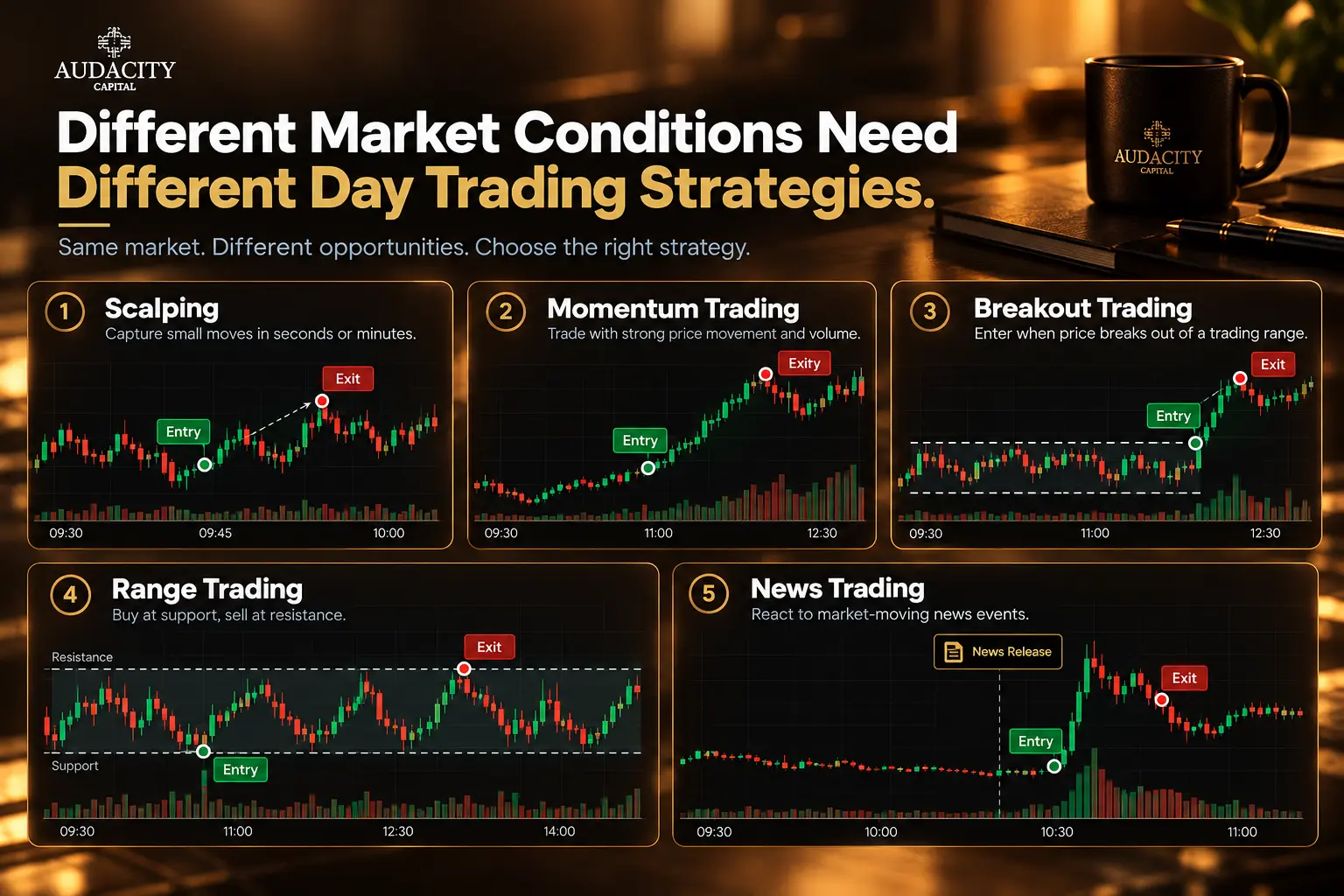
As per the price movements that the traders seek to capture, the day trading strategies can be defined as:
- Scalping: Scalping is a trade undertaken for seconds or minutes, characterised by frequent trades, fast execution and trading costs. It focuses on very small price movements to capture profits.
- Momentum trading: Momentum trading emphasises trading assets that are already showing strong price movement and strong volumes.
- Breakout trading: When price moves beyond a certain trading range, it signals a change in short-term market behaviour and traders engage in breakout trading.
- Range trading: When assets move between defined and predictable upper and lower price areas, traders resort to range trading.
- News trading: Market-moving information such as economic data, company financial announcements, interest-rate decisions or unexpected market events affect the price and volumes. This is called news trading where execution and risk is highly important.
Day Trading vs Swing Trading vs Long-Term Investing
Factor | Day Trading | Swing Trading | Long-Term Investing |
Typical holding period | Same trading session | Days to weeks | Months to years |
Overnight exposure | Normally avoided | Common | Common |
Monitoring requirement | High | Moderate | Lower |
Trading frequency | Higher | Lower | Much lower |
Primary focus | Intraday price movement | Short to medium-term moves | Long-term growth, value, or income |
Common analysis | Short-term technical and event-driven | Technical plus broader context | Fundamental and macroeconomic |
What Tools Do Day Traders Use?
Day trading involves a combination of tools such as:
Trading and Charting Platform:
A trading platform where investors can place buy/sell orders, execute and monitor financial transactions with a broker. Traders also use charting platforms to study price movements with visual graphs, technical indicators, and analytical tools.
Real-Time Market Data:
Day traders need current information such as the current price, bid and ask prices, trading volume, etc to execute real-time orders.
Economic Calendar and News Sources:
Traders must review the list of scheduled economic events, their release timings, and news sources to plan a trade accordingly.
Order Types:
Day traders use different order types such as market, limit or stop-order to communicate how they want a trade to be executed.
Position-Size and Risk Calculators:
A position-size calculator helps traders to decide how much shares or contracts to trade, so when the trade goes wrong, they only lose what was originally planned.
Reliable Internet and Execution Setup:
Day trading is a short-term trading which relies on fast and reliable internet connection to review the market information, place orders without disruptions. Any connection failure can pose a risk to the trades.
What Are the Main Risks of Day Trading?
Day trading risks are as listed below:
1. Fast Market Volatility: With high-volatility, asset prices can surpass the trader’s target or stop-loss within seconds, resulting in losses or unfavorable trades.
2. Leverage and Margin Magnification: Day trading involves margin (borrowing capital from the broker), to facilitate large positions. While this leverage amplifies profits during small spikes, it also magnifies potential losses.
3. Price Slippage: Slippage occurs due to poor execution quality, when a trade executes at a different price than the price requested or expected. During volatile conditions or low-liquidity conditions, slippage can lead to worse order prices and increasing trade losses.
4. Accumulated Spreads and Trading Costs: A high trade frequency means more broker commissions, more regulatory exchange fee, the cost of crossing bid-ask spread on every entry and exit. These accumulated costs have a significant impact on overall performance.
5. Technology and Infrastructure Failures: Power failures, system failures or platform crashes can expose a trader to completely unmanaged during high-volatility events.
6. Unscheduled News and Liquidity Shock: Geopolitical developments, unpredictable regulatory policies, sudden corporate announcements, or other unfavorable and unscheduled news can disrupt the market and hamper the trade.
7. Overtrading: Traders often overtrade out of boredom, passive market trades, or the urge to recover losses. The increase in trade volume while lacking an adequate strategy increases transaction costs, and capital risk.
8. Psychological Stress and Emotional Trading: Fear, anxiety, greed, revenge trading or other emotional impulses add to psychological stress and prompt traders to participate in unplanned trades which can bring adverse results.
Note: Avoiding overnight positions removes planned overnight exposure, but it does not make day trading low-risk.
Day Trading Risk Management
Position Size
Position size can control how much money is exposed to a single trade. It helps traders to choose the number of shares or contracts accordingly.
Stop-Loss and Trade Invalidation
Stop-losses and trade invalidation points help to prevent further losses and overnight exposure, because the trader hopes that the market will reverse.
Risk-to-Reward
The risk-to-reward ratio compares how much a trader is willing to lose with how much they expect to gain from a trade. It supports traders to avoid trades where the potential gain does not justify the amount they are risking
Daily Loss Limits
Daily loss limits restrict the impact of a bad trading day and also reduce the risk of overtrading or emotional trading.
Day Trading Rules and Regulations
Day trading rules and regions are governed by different markets, account types, jurisdiction, brokerage platforms, asset types and more.
U.S. Intraday Margin Rules
In the US, the Financial Industry Regulatory Authority (FINRA) has replaced the previous Pattern Day Trader (PDT) framework with new intraday margin requirements, effective from June 4, 2026. Although brokerage firms have a permitted transition period through October 20, 2027.
- The new framework eliminates the PDT designation (traders executing four or more day trades in five business days) and the $25,000 minimum equity requirement.
- To trade leveraged securities on margin intraday, $2,000 is the minimum equity is required.
- Brokerages monitor accounts for margin shortfalls during the trading session.
- Unresolved intraday margin deficits can lead to account restrictions, though small deficits under 5% of account equity or $1,000 are carved out.
Rules Differ by Market and Country
Central bodies customize rules depending upon the liquidity, leverage risks, and settlement mechanics of their local asset classes.
For example, stocks and options in the U.S. operate under securities-market rules overseen by regulators such as the SEC and FINRA, while future markets are governed by CFTC and NFA.
In India, the Securities and Exchange Board of India (SEBI) imposes stringent peak intraday margin requirements that prevent brokerages from offering custom, high-leverage intraday multipliers.
Whereas, the United Kingdom and the European Union enforce strict caps on retail leverage for Contracts for Difference (CFDs) and forex pairs through the FCA and ESMA.
Publication note: Regulatory information is time-sensitive. Re-check official regulator guidance before the article is published or substantially updated.
Advantages and Disadvantages of Day Trading
Advantages | Disadvantages |
No planned overnight exposure | Requires close attention during the trading session |
Frequent opportunities may appear in active markets | High decision frequency can increase mistakes and stress |
Can be applied across several financial markets | Trading costs can accumulate quickly |
Short holding periods provide fast feedback on execution | Leverage can amplify losses |
Positions are not intended to remain open for long periods | Overtrading and emotional decisions can become serious problems |
Can Day Trading Be Profitable?
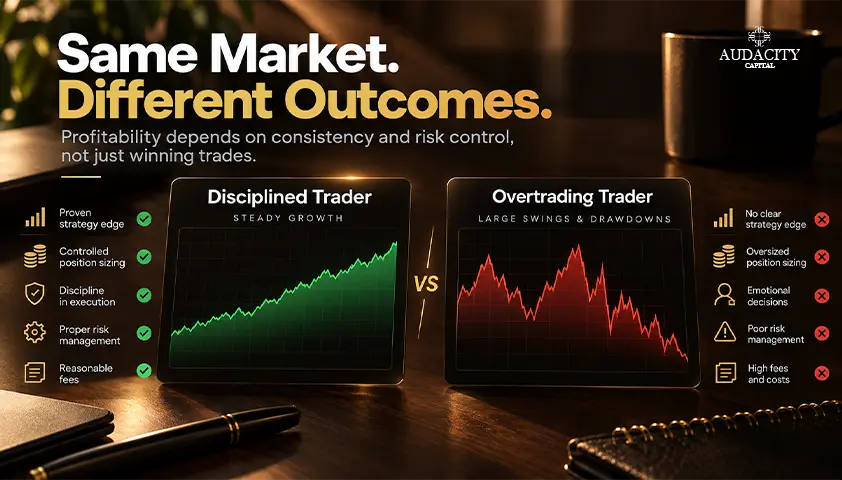
Losses and gains are part of trading. There’s no universal rule which states day trading will always generate a profit.
However, day trading is profitable with a right and disciplined approach. It also depends on factors like win rate, average win, average loss, trading costs, slippage, position sizing, and execution quality.
A strategy that generates profits frequently can still lose money if its losing trades are much larger than its winners. Likewise, a lower win rate can still be viable when the average gains are sufficiently larger than the average losses.
Is Day Trading Right for You?
Day Trading is suitable for you if:
- You can be attentive during your trading hours to watch market movements, trade setups, and execution.
- You can follow a disciplined approach and stick to predefined risk limits after incurring both gains and losses instead of increasing risk based on recent results.
- You can make decisions under pressure and not give into fear, excitement, or short-term market movements and change your plans.
- You can wait for valid setups and be comfortable staying out when your criterias are not met.
- You can handle losing trades without revenge trading
- You can keep essential money out of your trading account and not expose them to risk or losses.
- You are willing to review your decisions, identify mistakes, improve your approach rather than chase quick income.
Final Takeaway
To sum it up, day trading is better understood as a holding-period style where all positions are opened and closed within the same market session.
While day trading can offer opportunities to profit from short-term and sudden price moves, the exact strategy depends on the execution quality, market sentiments,transaction cost and risk management.
There are no guaranteed profits, no universal risk-to-reward ratio, or a talisman strategy that generates profits. Day trading involves substantial risk, so having an adequate strategy, and disciplined approach is essential for intraday traders.
Frequently Asked Questions About Day Trading
No. Day trading differs from investing as the former focuses on short-term price movements where the positions are opened and liquidated within the same session. The latter involves holding assets for a longer time period and benefiting from long–term growth and income. These terminologies also differ from the time horizon, objectives, methods, strategies, risk and end goal.
A day trade can range from a seconds, minutes to few hours. However, all positions must be opened and closed within the same session to characterize the day trades.
Yes. For intraday trading, traders can engage in stocks, forex, futures, options and cryptocurrencies markets. However, the market hours, liquidity, rules, transaction costs and other metrics may vary market to market.
While intraday traders generally rely on technical analysis (price action, chart patterns, indicators, etc), they also study fundamentals, market context and other relevant information to understand the markets and the assets better.
No, a day trader cannot hold positions overnight. All the positions undertaken must be entered and exited on the same day.
There is no dedicated amount to enter intraday trading. The amount depends on the market, asset type, leverage and margin requirements, broker requirement, risk appetite, and other factors.
While day trading involves speculation and high-degree of risk, it does not categorize as gambling. Day trading requires a detailed plan, accurate analysis of markets, assets and related factors, proper risk management and disciplined approach.

Ready to apply disciplined risk to crypto? Explore Audacity Capital's new crypto instruments and bring your trading strategy.
Learn MoreNewsletter
Join our newsletter to stay up to date on features and releases.
Join Our Social & Community

Start Your Journey Today With Our Free Trial
Proudly showcase your skills and accomplishments through certificates and get recognition for your hard work and dedication from potential investors and peers.
Free TrialRelated Articles

From Demo To Live: When Are You Ready To Go Live?


Swing Trading vs Day Trading: Which Is Right for You?
One style costs you your afternoons. The other costs you your sleep. Here is how swing trading vs day trading really compare, and how to pick.
The First 30 Days: What New Traders Should Focus On (And Ignore)

Trading Psychology for Funded Traders: Pressure, Fear and Revenge Trading
Struggling with pressure and tilt? Master trading psychology for funded traders with concrete systems to avoid revenge trading and stay disciplined.