


Minor Forex Pairs (Cross Currency Pairs): The Complete Trader's Guide


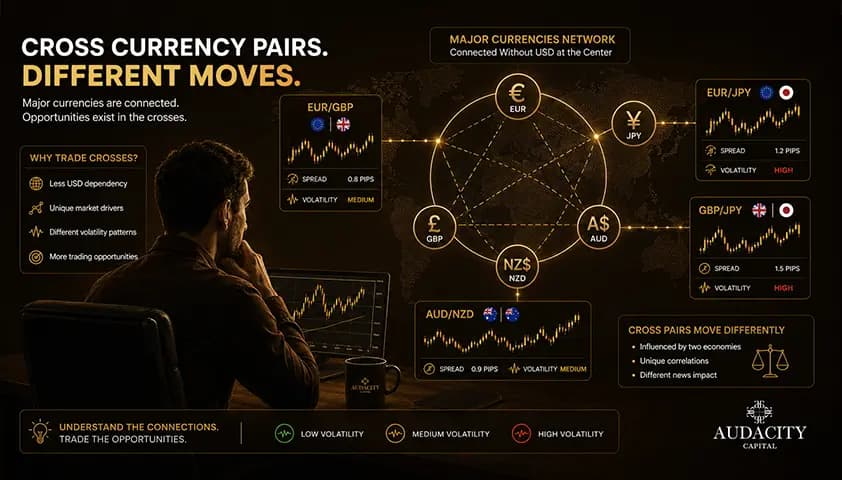
Minor forex pairs, also known as crosses, are pairs of two major currencies without the US dollar and are the natural next step once you have enough experience trading major pairs.
Crosses are not just the majors with higher spreads. They act differently because removing the dollar changes what drives their price.
Today we'll look at the complete list, why crosses exist, how they move, whether they are worth paying for, and which trading styles they belong to. Let’s get started.
What are Minor Forex Pairs?
Minor forex pairs, also known as cross-currency pairs, or crosses, are currency pairs that consist of two major currencies that do not include the US dollar. This is the only difference that confuses most of the beginners, so it is important to be specific.
There are eight main currencies: US dollar, euro, Japanese yen, British pound, Swiss franc, Australian dollar, Canadian dollar and New Zealand dollar.
But there are only seven major pairs, because a pair only counts as a major if it contains the US dollar. All combinations of two of these eight currencies make a minor. So, if you remove the dollar and compare the euro with the pound, or the pound with the yen, then you have a cross.
So what are minor currency pairs in forex in practical terms?
They are the second most traded category after the majors. They are not obscure instruments that you have to hunt for. They are liquid, institutionally traded markets.
Quick reminder on convention. Each pair comes with a base and quote currency.
When you trade EUR/GBP, the euro is the base currency, and the pound is the quote currency, meaning that when you buy EUR/GBP, you are purchasing euros and selling pounds. The same base and quote logic is used for each cross listed below.
Why do Cross Pairs Exist?
The origin story is short and genuinely useful.
Prior to the introduction of cross pairs, any trader or business looking to trade euros for yen would need to follow two steps.
First they converted EUR into USD, then USD into JPY. This required two separate transactions and two separate spreads, adding to the costs and friction at each step.
Cross pairs were developed to allow the exchange of non-dollar currencies directly, without the need for a dollar leg. This is also how the name is derived as the pair trades two currencies without passing through the dollar.
This is not just a historical footnote. That's why crosses provide you with something the majors don't, a direct expression of one economy's strength against another, without the dollar in the middle. That one fact alone dictates the rest of the way these pairs act, and that shall be explored shortly.
The Full List of Minor Forex Pairs
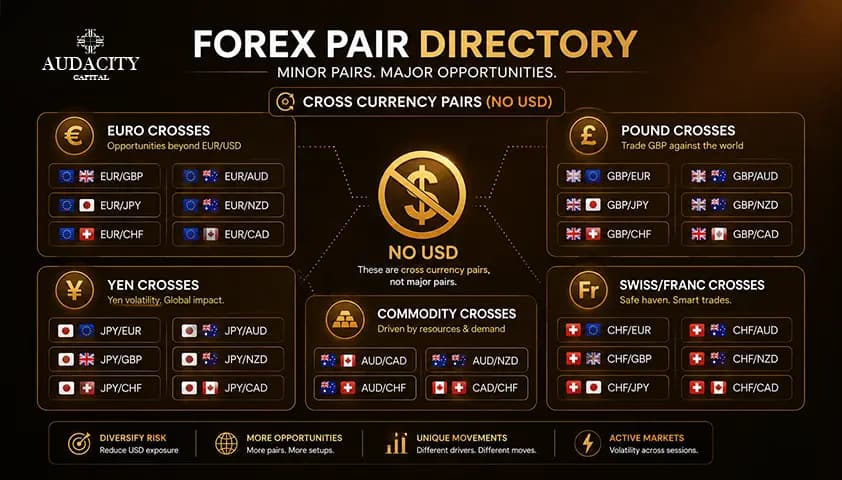
This is the full list of the minor forex pairs, which are organized by groups to make it easy to scan rather than a wall of tickers.
EUR crosses: EUR/GBP, EUR/JPY, EUR/CHF, EUR/AUD, EUR/CAD, EUR/NZD
GBP crosses: GBP/JPY, GBP/CHF, GBP/AUD, GBP/CAD, GBP/NZD
Yen crosses: AUD/JPY, CAD/JPY, CHF/JPY, NZD/JPY
Other crosses (commodity and antipodean currencies): AUD/NZD, AUD/CAD, AUD/CHF, NZD/CAD, NZD/CHF, CAD/CHF
Pair | Two economies | Typical activity level |
EUR/GBP | Eurozone vs UK | High |
EUR/JPY | Eurozone vs Japan | High |
GBP/JPY | UK vs Japan | High |
AUD/JPY | Australia vs Japan | Medium to high |
EUR/CHF | Eurozone vs Switzerland | Medium |
AUD/NZD | Australia vs New Zealand | Medium |
NZD/CHF | New Zealand vs Switzerland | Lower |
CAD/CHF | Canada vs Switzerland | Lower |
The euro, pound or yen are the most commonly traded currency pairs on both sides.
The further down the list you go, the more liquidity will reduce, so a pair such as EUR/GBP will behave completely differently to a pair like NZD/CHF, where the market is thinner and the spread is wider.
Note: availability and pricing vary. Before developing a strategy, determine whether your own broker or platform has access to the crosses that you're interested in and how they're priced.
Minor Pairs vs Majors and Exotics
To understand minors in context, it is useful to have the three categories listed side by side. This part keeps the comparison tight, keeping the reader's attention on the contrast.
Category | Liquidity | Typical spread | Volatility | Main drivers | Who it suits |
Majors | Highest | ~0.1 to 0.5 pips (EUR/USD) | Lower | US data + one other economy | Beginners |
Minors | Second highest | ~1 to 3 pips | Typically higher | Two non-dollar economies | Traders past the majors |
Exotics | Thin | 2 to 3x a major | Highest | Emerging-market and political risk | Advanced only |
The dollar is always included in majors. That's where beginners begin because they have the highest liquidity, the tightest spread and the smoothest price action. The EUR/USD is typically quoted around 0.1 to 0.5 pips.
Minors contain no dollar. They are the second most traded category and they are liquid, although not as much as the majors, so the pips spread is wider, usually around 1 to 3 pips, and the volatility is often higher.
Brokers widen crosses to mitigate against that risk. The concept of minor vs major forex pairs boils down to this trade-off; you get direct exposure to the economy but you lose points due to the higher spread.
Exotic pairs are the ones in which a major currency is paired with an emerging or smaller economy. Spreads are typically double or triple that of a major, liquidity is much thinner and they are far more susceptible to political and geopolitical events.
That's why they're not recommended for beginners and why the spread can consume a meaningful portion of the potential price move.
Each spread above is typical and subject to the dealer. Before putting any pair in your strategy, verify live spread with your broker in your session.
How Minor Pairs Actually Move?
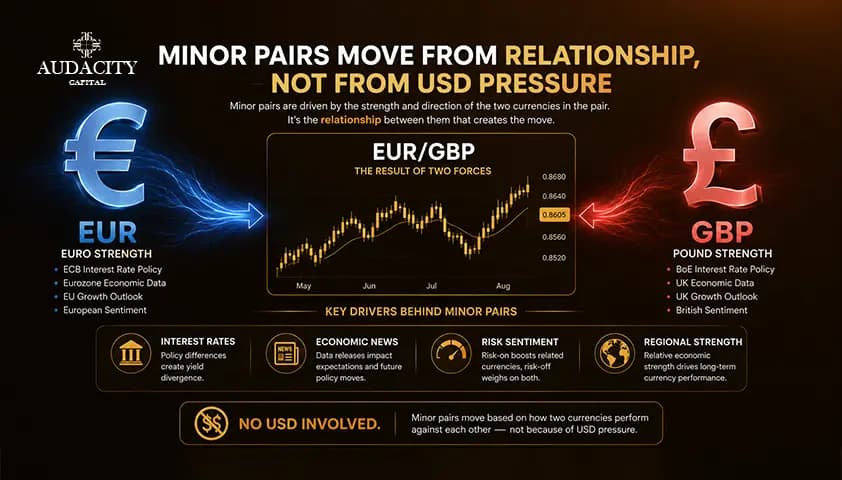
A cross is mathematically related to the two dollar pairs behind it. EUR/GBP is basically EUR/USD divided by GBP/USD. That relationship has two effects which are very significant in practice.
Firstly, the beneficial one.
Since the dollar is on both sides of that relationship, it pretty much cancels out. That's why a cross indicates the relative strength of two economies directly.
EUR/GBP is an indicator that tracks the eurozone as compared to the UK in isolation from any dollar component, meaning that it can be analyzed with only European data.
The take-home benefit is clean trends. If there is regional divergence, for example an ECB decision moving one direction and a Bank of England decision moving the other, a cross can move cleanly on the regional story while dollar pairs are chopping around on US news.
It is the currency correlation between the two legs that brings that clarity, and one of the true reasons that veteran traders reach for crosses.
Second, the caution
If a big dollar move occurs, it pushes both legs at the same time. That means a cross can behave in ways that look strange if you are only watching the cross itself.
When EUR/GBP shows an unexplained move, it will usually be clarified when you glance at EUR/USD and GBP/USD individually. The impact of the dollar on both currencies underlies that pair, and the difference between their reactions may show up through the cross.
The lesson learned is easy and should be incorporated into your practice. Before you take a cross, look at the two majors behind the cross. They let you know if the move is a real relative-strength move or a dollar move that's just passing through.
When Minor Pairs are Worth Trading?
So, the true fit question.
Minors are for traders who already know what the majors are doing and who want one of two things: diversification away from pure dollar exposure; or a way to express a specific economic opinion like eurozone versus UK; or Australia versus New Zealand.
Then there is the spread economics and this is a big deal as it will ultimately determine suitability more than anything else.
Minors tend to have wider spreads and are typically used by swing and medium-term traders who hold trades for days or weeks, rather than scalpers. A 1 to 3 pip spread represents a small portion of a multi-day move, but it's a big portion of a 10 pip intraday target.
The same proportions that make a cross suitable for a good swing trader make it a bad one for a scalper.
The same is true for crosses where regional divergence is the big picture, instead of broad dollar direction, as mentioned above.
Then the session point, which is more important for crosses than majors.
The EUR/GBP cross is most liquid during the London session, and yen crosses are most active through the Asian and London hours.
Trading a cross during a thin session can widen the spread further and worsen your fills.
To summarise: minors are a natural progression from the majors, not an upgrade.
The Risks and Costs of Trading Crosses
Before putting any real money into a cross, be sure to understand the tradeoffs of a cross.
1. Wider spreads consume small targets.
A trading strategy that is successful on EUR/USD may not hold up on a cross, because the spread takes a larger cut of each trade.
2. Lower liquidity means more slippage.
In fast markets and around news, fills will be worse than expected on a major because of thin liquidity.
3. Higher volatility cuts both ways.
Several pound and yen crosses, GBP/JPY especially, have notably large ranges. This makes it appealing to traders but wider ranges need wider stops and wider stops need smaller position sizes to keep the money risked the same. Many traders neglect the second half of that sentence and the second half is what is going to save the account. We've covered the mechanics in detail in our stop-loss placement and risk-to-reward guide.
4. Correlation traps.
This is the one that most traders miss. Holding EUR/USD long and EUR/GBP long is a doubled bet on the euro, not diversification. Be sure to know what exposure you have in your open positions, as currency correlation can take place without your realization.
5. Swap and carry costs.
Swap costs apply to positions held for days, and this is particularly important for crosses which are the perfect fit for longer-term thinking.
6. Drawdown limits.
On a "funded" or "evaluation" account, larger spreads and ranges allow breaches of a daily or maximum drawdown limit to occur more easily. That's why position sizing on crosses is particularly important.
Volatility is one of the qualities to work with, not one to pursue. Larger ranges do not mean larger profits, they mean larger moves in both directions.
How to Start Trading Minor Pairs?
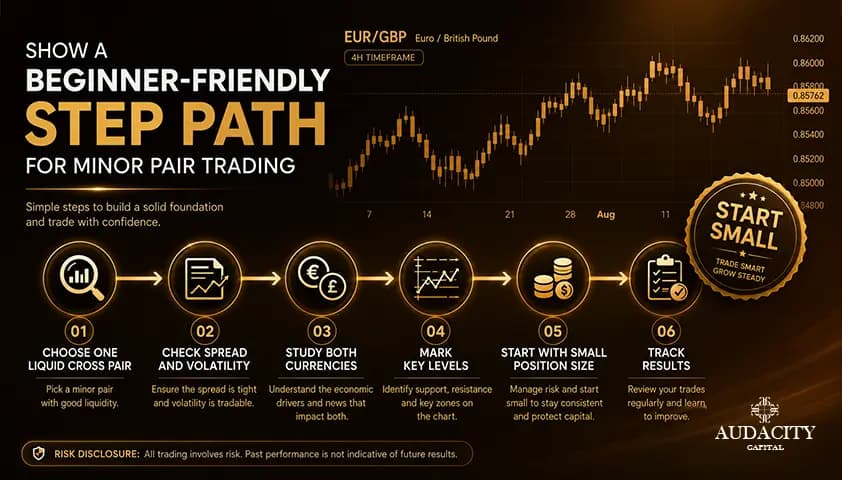
This is a practical checklist to take you from theory to a disciplined approach.
1. Get comfortable on one or two majors first: Crosses reward an existing understanding of how currencies behave, so build that foundation before you branch out.
2. Pick one cross whose two economies you can realistically follow: Do not add six pairs at once. Select one, memorize it, then decide to expand or not.
3. Check the live spread at your broker, in your session: Quoted averages mean little if you trade a thin window. Verify what you will actually pay before assuming a pair suits your strategy.
4. Widen stops to respect the pair's volatility, then reduce position size accordingly: Something like ATR helps size the stop to the pair. The goal is to keep the money at risk constant, whatever the pair's range.
5. Before entering check the two dollar pairs behind the cross: This gives you an indication of whether you are in a relative strength story or a dollar effect passing through.
6. Track high-impact news for both economies: A cross has two calendars, so an event on either side can move your position.
7. Journal crosses separately from majors: This lets you see honestly whether they suit you, or whether they simply feel more exciting.
Conclusion
Minor forex pairs, or crosses, are pairs of two major currencies without the US dollar. They were created so non-dollar currencies could be traded directly, and they are the second most traded category in forex.
What actually matters is this.
Crosses let you trade one economy against another with the dollar taken out, which can produce cleaner trends on regional divergence.
But they carry wider spreads and often larger ranges, so they suit swing and medium-term traders more than scalpers, and they demand wider stops with correspondingly smaller position sizes.
Keep two habits.
Check the two dollar pairs behind any cross before you trade it, and check the live spread in your own session rather than trusting an average.
Minors are a natural progression from the majors, not an upgrade, and no pair is inherently safer or more profitable than another. Forex and CFD trading is high-risk, leverage magnifies losses, and this article is educational content, not financial or investment advice.
Related Articles
Best Forex Currency Pairs To Scalp
Forex Currency Pairs With Lowest Spreads
Most Trending Forex Currency Pairs
FAQ
They are the same thing. Minor pairs are commonly called crosses because they cross two major currencies without the US dollar, so the terms are used interchangeably. You will see both used across charts, brokers, and trading education.
It depends on how strictly you count, but combining the seven non-dollar major currencies produces roughly twenty commonly quoted minor currency pairs. Those involving the euro, pound, or yen are the most actively traded, while others further down the list see much thinner activity.
Not harder in principle, but they carry wider spreads and often larger ranges, so the same strategy can behave differently. They generally reward traders who already understand how the majors move before adding cross currency pairs to the mix.
Usually not. A wider spread is a large fraction of a small intraday target, so cross currency pairs tend to suit swing and medium-term traders whose moves are big enough to absorb the spread.
Largely, which is their appeal, since a cross expresses one economy against another. But a strong dollar move affects both underlying dollar pairs, so it can still show up in the cross even when the dollar is not on either side.
You can, but liquidity for European crosses is thin then, so spreads widen and fills worsen. Yen crosses are generally the more sensible choice during those trading sessions, since they line up better with Asian market activity.
Typically wider than a major, commonly quoted around 1 to 3 pips depending on the pair, your broker, and the session. Always check the live spread at your own broker rather than relying on averages, since real conditions differ from published figures.

Bereit, diszipliniertes Risiko auf Krypto anzuwenden? Entdecken Sie die neuen Krypto-Instrumente von Audacity Capital und bringen Sie Ihre Trading-Strategie mit.
Mehr erfahrenNewsletter
Treten Sie unserem Newsletter bei, um auf dem Laufenden zu bleiben.
Treten Sie unserer sozialen Gemeinschaft bei

Beginnen Sie Ihre Reise heute Mit unserer kostenlosen Testversion
Präsentieren Sie stolz Ihre Fähigkeiten und Leistungen durch Zertifikate und erhalten Sie Anerkennung für Ihre harte Arbeit und Ihr Engagement von potenziellen Investoren und Kollegen.
Kostenlose TestversionVerwandte Artikel
Best RSI Settings for the 1-Minute Nasdaq 100 Chart
No single setting prints money on this fast, noisy index. Here's the best RSI for 1-minute chart Nasdaq 100 scalping, the filters it needs, and the real risks.

Margin Account Requirements in 2026
Learn the margin account requirements for 2026, including minimum equity, initial and maintenance margin, margin calls, and new day-trading rules.
9 Best Prop Firms That Allow HFT in 2026
Compare 9 prop firms and find prop firms that allow HFT in 2026. Review minimum hold times, drawdowns, EAs, trading rules, and funded account limits.
Range Trading Strategy: The 10 Best Range Trading Strategies in 2026
Discover the 10 best range trading strategies for forex, stocks, and indices. Learn how to identify ranging markets, manage risk, and trade support and resistance successfully.