


What Is Overtrading (and How to Stop It)


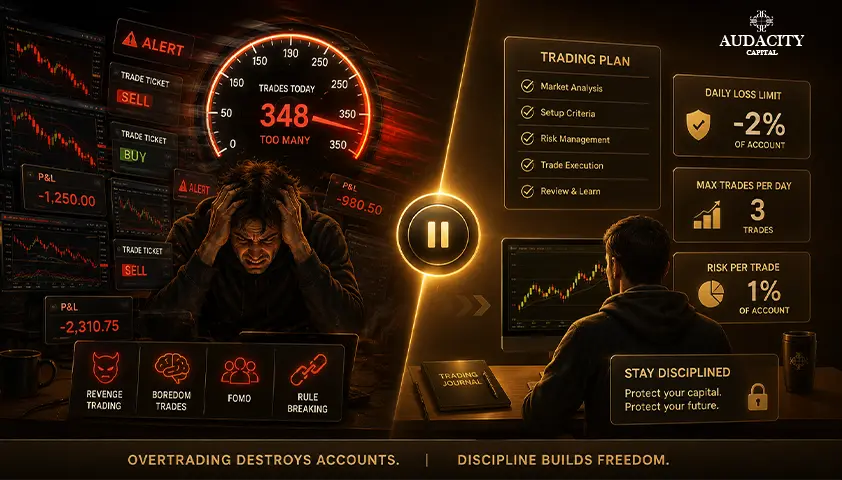
Overtrading means taking trades, size, or risk that your plan and current market conditions do not justify. It is not the same thing as trading frequently.
A scalper running fifteen valid setups in a session is doing their job. A swing trader taking a second trade to make up for a missed move is not.
This article does three things. It helps you spot your personal pattern of overtrading, shows you how to measure what it costs from your own journal, and gives you a set of stopping rules you can install before the next session.
The goal is a system you can observe and enforce, not another reminder to be disciplined.
What Is Overtrading?
Overtrading is trading beyond the limits of a written or tested process. The excess can appear in several ways: too many entries, oversized positions, too much aggregate risk, repeated re-entries after a thesis has failed, or continued trading after decision quality has dropped.
A fixed number cannot define it. As trade frequency depends entirely on strategy.
A market maker, a scalper, and a position trader will produce very different session counts, and all of them can be operating cleanly. The useful test is whether each trade met the same entry, risk, and market-condition rules that would have applied before the session began.
One short contrast makes the point. A scalper who takes twelve rule-valid trades in a session is not necessarily overtrading. A swing trader who takes one revenge trade after a losing morning already is.
Overtrading, Revenge Trading and Active Trading Are Not the Same
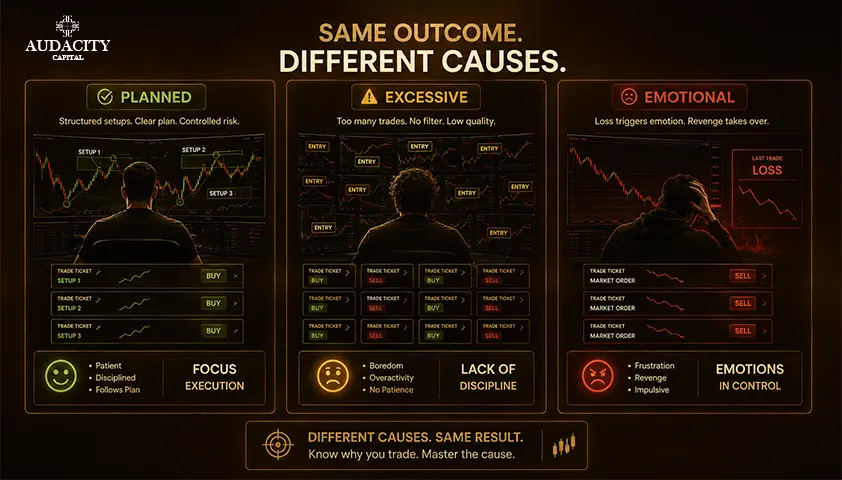
These three terms often get blended, and the blending hides the real problem.
Active trading describes frequency alone.
Revenge trading describes a motive: the desire to recover a loss quickly.
Overtrading describes activity that exceeds a trader's valid process or risk boundaries, regardless of motive.
The overlap is real. Revenge trading usually becomes overtrading, but it is not the only path. Boredom in slow conditions, FOMO trading after a move already ran, and overconfidence following a large winner produce the same off-plan behavior without any prior loss to react to.
Naming the category correctly matters. If you call every extra trade "revenge trading," you will miss the wins that pull you into trading too much.
7 Signs You Are Overtrading
Each sign below is a behavior you can verify from your journal, not a mood you have to guess at.
1. You enter without being able to name the setup and invalidation level.
If you cannot state the trigger and the stop before clicking, the trade is not part of your tested process.
2. Your trade count rises after a loss, a near miss, or a large winner.
Any of these emotional anchors can push activity outside the plan.
3. You repeatedly re-enter the same idea after the original thesis failed.
A stop-out is information. Re-entering without a new signal ignores it.
4. Position size or total exposure increases without a planned reason.
Sizing should follow the rulebook, not the last outcome.
5. Your later trades have lower setup grades than your first trades.
Standards typically drift as sessions run long.
6. Fees, spreads, and slippage consume a growing share of gross profit.
Transaction costs and slippage are the quiet tax on impulsive trading.
7. You stay at the screen because stopping feels like missing an opportunity.
The urge to remain active is not the same as an actual signal.
One sign in a single session is a prompt to review. The same pattern repeating across sessions is evidence that the process needs a hard control, not another mental note.
Why Traders Overtrade?
The causes are easier to work with when you organize them by trigger rather than by generic emotion labels.
Loss trigger: trying to recover the day quickly after a red trade or a bad sequence. Win trigger: believing the next trade deserves more size because momentum is on your side.
Opportunity trigger: FOMO trading after a move has already started and the risk-to-reward has quietly deteriorated.
Environment trigger: boredom in slow conditions, where the screen offers stimulation but the market offers no setup.
Process trigger: no objective definition of a valid setup, which lets any chart pattern qualify at the moment.
Decision fatigue sits underneath all of these. As a session continues, criteria loosen without the trader noticing. This is why prevention has to happen before the urge appears, not while you are staring at a chart with a mouse in your hand.
What Overtrading Can Cost You?
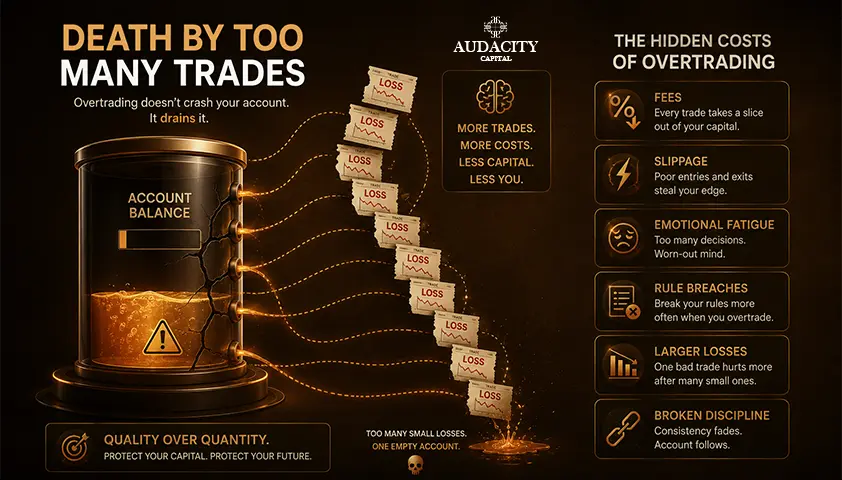
The cost of trading too much shows up in four layers.
The first is direct: transaction costs and slippage. Every extra fill adds spread, commission, and price friction.
The second is execution quality. Impulsive trading tends to produce worse entries and later exits than planned trades.
The third is drawdown risk. Repeated exposure, especially after a loss, compounds losses faster than a single planned trade would.
The fourth is data damage. Off-plan trades contaminate your journal, and the noise can make a workable strategy look broken.
A simple example makes it concrete:
If your planned setups produce a modest positive result over twenty sessions, but six impulsive trades per week add spreads, slippage, and losses, the final P&L can turn negative.
You then conclude the setup does not work, when the setup was fine and the extra activity was the problem.
Academic research supports the general link between high turnover, costs, and weaker net returns. The Barber and Odean work on individual investor turnover, using late-1990s brokerage data, is often cited here.
It is not a pass or fail verdict on day trading, but the direction of the effect, more activity plus more costs equals lower net results, is worth taking seriously.
Use Your Trading Journal to Prove You Are Overtrading
The point of a trading journal review is not to feel guilty about your worst trades. It is to isolate the conditions under which your own decision quality drops. Run this audit on your last twenty sessions.
Tag every trade with three labels: planned, borderline, or off-plan. For each trade, record the trade number within the session, the setup grade, the time of day, the result after fees, the position size, and the trigger that came immediately before entry.
That trigger might be a prior loss, a large winner, a headline, or nothing at all.
Then calculate four practical metrics:
- Off-plan trade rate as a percentage of total trades.
- P&L from planned trades versus off-plan trades, kept separate.
- Average result by trade sequence, so you can see if trade number three or six is where quality falls off.
- Total transaction costs and slippage as a share of gross gains.
The goal is to find the specific conditions, times, and triggers where your process fails you.
How to Stop Overtrading Before It Starts?
Prevention works in three layers. "Have discipline" is not one of them.
1. Before the session.
Write the allowed setups, the maximum daily risk, the maximum number of attempts per setup, and the conditions that mean no trade at all.
This is your trading plan for the day, not a general philosophy document. A daily trade limit should reflect what your tested strategy actually needs, not a round number.
2. During the session.
Use a checklist for every entry. Apply a cooldown rule after any loss, and a mandatory pause after a large winner. Set a hard stop at your daily loss or rule-breach limit, whichever hits first.
Add friction where you know you are weak: hide one-click order entry, type the reason for the trade before sending it, set price alerts instead of watching every tick, and physically leave the desk during a cooldown.
3. After the session.
Review screenshots and label the first trade where the process changed. Focus on the trigger that preceded it, not only the money lost.
The dollar figure is a symptom. The trigger is what you can actually control next time.
These controls will not prevent losses. Valid trades still lose.
What they do is reduce the number of unplanned decisions you carry into a session, which is the only variable you fully own.
A 7-Day Overtrading Reset
If you know the pattern is active right now, work through this reset before returning to normal size.
- Day 1: Stop live trading. Export the last twenty sessions.
- Day 2: Tag every trade as planned, borderline, or off-plan.
- Day 3: Identify your top trigger from the tagged data.
- Day 4: Define one valid setup, in writing, and one no-trade condition.
- Day 5: Practise the rules in simulation only.
- Day 6: Run one limited live session with a strict trade cap.
- Day 7: Review rule compliance, not P&L, before considering normal size.
Keep position sizing decisions with your existing risk plan. The reset is about process, not exposure.
Conclusion
Overtrading is activity that sits outside a justified plan. It is not the same as a busy trading day, and it is not always driven by a loss.
It is the trades you cannot defend against the rules you wrote when you were calm.
The practical sequence is straightforward:
- Measure the pattern from your journal.
- Identify the trigger that shows up most often.
- Set the limit before the session, in writing.
- Then use a circuit breaker that does not depend on willpower in the moment.
Removing off-plan trades will not automatically produce profitability. What it does is reveal the true quality of your underlying strategy, which is the only honest starting point for anything you build next.
For funded traders working through an evaluation, the same logic applies with sharper stakes: unplanned entries eat daily loss limits faster than any single planned trade ever will.
Frequently Asked Questions
No. Overtrading is defined against your tested plan, not a fixed count. A high-frequency scalper and a swing trader will have completely different valid ranges. The right question is whether each trade met the same criteria your process requires.
Yes. Scalpers overtrade when they take entries that do not meet their setup rules, add size without a planned reason, or continue after decision quality has dropped. Frequency is not the issue. Rule compliance is.
No. Revenge trading is a motive, the urge to recover a loss quickly. Overtrading is any activity that exceeds your valid process, whether the trigger was a loss, a win, boredom, or FOMO. Revenge trading often becomes overtrading, but it is only one of several paths there.
Yes. Zero-commission execution removes one cost layer, but spreads, slippage, and the damage to decision quality remain. The strategic cost of trading too much is usually larger than the fee cost anyway.
A win can create a belief that the next setup deserves more size or that current conditions are unusually easy. Both assumptions loosen your criteria. A mandatory pause after a large winner interrupts that drift before it starts.
That depends on what your tested plan says, not a universal rule. Some strategies expect clusters of small losses. Others produce infrequent trades where two losses is meaningful information. Set the stopping rule before the session, based on your own data, and follow it without renegotiating mid-session.
Set a personal daily loss limit tighter than the program's official limit, and stop at yours. Cap the number of attempts per setup, use a cooldown after any loss, and treat rule breaches as the real failure, not the dollar amount. Programs like the Ability Challenge, Ability One, and the Funded Trader Program all reward consistent process more than any single trading day.

Bereit, diszipliniertes Risiko auf Krypto anzuwenden? Entdecken Sie die neuen Krypto-Instrumente von Audacity Capital und bringen Sie Ihre Trading-Strategie mit.
Mehr erfahrenNewsletter
Treten Sie unserem Newsletter bei, um auf dem Laufenden zu bleiben.
Treten Sie unserer sozialen Gemeinschaft bei

Beginnen Sie Ihre Reise heute Mit unserer kostenlosen Testversion
Präsentieren Sie stolz Ihre Fähigkeiten und Leistungen durch Zertifikate und erhalten Sie Anerkennung für Ihre harte Arbeit und Ihr Engagement von potenziellen Investoren und Kollegen.
Kostenlose TestversionVerwandte Artikel
How Many Trading Days in a Year?
How many trading days are there in a year? See the number of U.S. stock market trading days in 2026, monthly totals, holidays and how markets differ.


Spinning Top Candlestick Pattern: Meaning, Formation & How to Trade
Learn what the spinning top candlestick pattern means, how it forms, bullish and bearish setups, confirmation signals, trading strategies, examples, and risks.
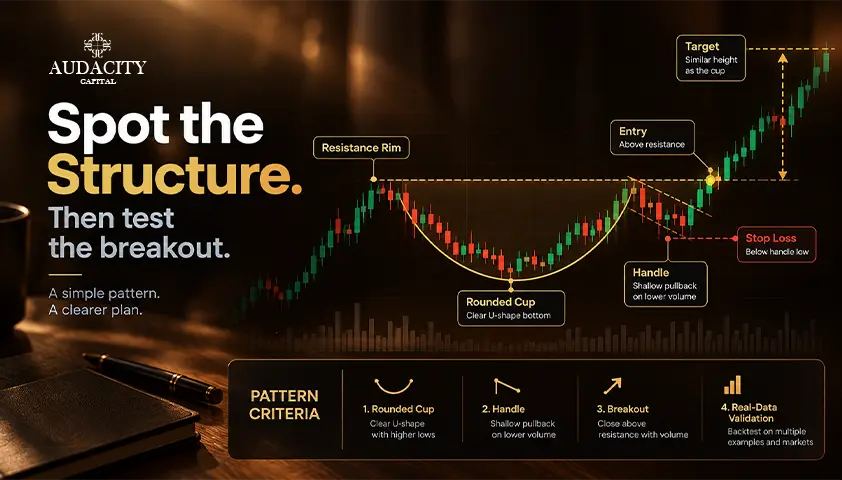
Cup and Handle Pattern: Criteria, Entry and Real Data
The cup and handle pattern explained: the criteria sources disagree on, how to trade it, and what the performance data actually says.
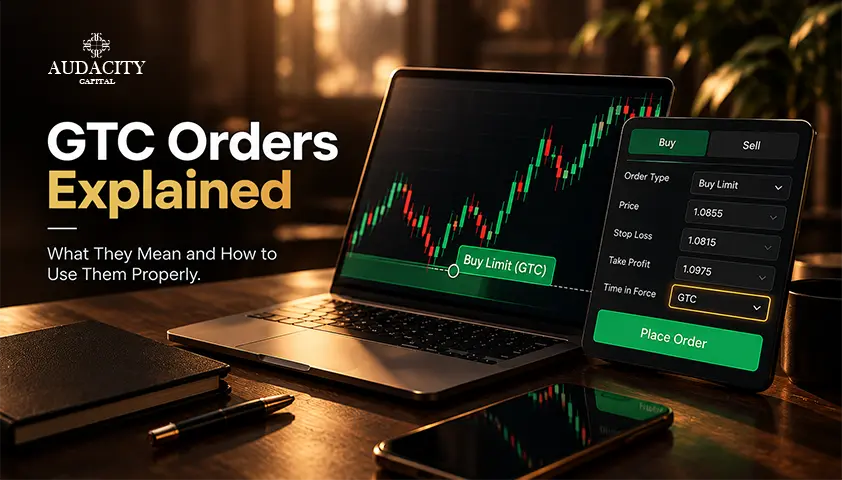
GTC in Trading: What Good Till Cancelled Orders Mean and How to Use Them Properly
Learn what GTC means in trading, how Good Till Cancelled orders work, when to use them, and the risks of leaving pending orders active.