



What Is Lot Size In Forex Trading?



Key Takeaways
- Capital requirements: trading with a standard lot requires a huge capital due to a greater potential of blowing your entire account.
- Risk Management: A smaller lot size minimizes losses. This makes them suitable for traders with low capital and who want to minimize risks as much as possible.
- Mini and micro lots are best for traders who want to manage risk effectively. It is best for intermediate and beginner forex traders.
All forex traders need to understand the concept of lot size to manage their risk exposure effectively. Lot sizes directly impact potential rewards and losses in any given trade. By understanding how they work and how to use them, you will be able to come up with a better risk management plan, ensuring you preserve your capital and flourish in the financial markets.
Most prop trading firms help beginner forex traders choose the best lot size and ensure they understand how it will impact their trades. In this article, we are going to expound on lot sizes, ensuring you understand them before you get your funded account.
What Is A Lot Size In Forex Trading?
In simple terms, a lot size is the number of currency units you buy. It can also be described as a standardized unit of measurement that indicates the quantity of any particular currency pair that you are buying or selling.
Price movements are usually measured in pips, which is normally the fourth decimal place in several currency pairs. These changes are very small, and that is why lot sizes are used to enable traders to trade tiny movements in large batches. In other words, lot sizes allow institutional and retail traders to manage trade volumes and create uniformity across their trades.
Market regulators or an exchange set the lot sizes, ensuring all traders are aware of the amount of assets they are trading when they get into the market. This gives traders control over the amount of exposure they have in the market.
Read More About The Guide About Forex Lot Size And Leverage
How to Calculate Lot Size in Forex Trading
Understanding how to calculate lot size is one of the most important skills in Forex trading. Many traders focus on entries and exits — but professional traders focus on risk management first.
Lot size determines:
- How much you risk per trade
- How much you gain or lose
- Whether your account survives long-term
In simple terms:
Lot size = position size
And position sizing is what separates gamblers from professionals.
Step-by-Step: How to Calculate Lot Size
To calculate lot size properly, you need just 3 things:
- Account Size
- Risk Percentage
- Stop Loss (in pips)
Step 1: Decide Your Risk Per Trade
Most professional traders risk:
1% per trade
Example:
Account Size = $10,000
Risk = 1%
So:
Risk Amount = $10,000 × 1% = $100
This means you should not lose more than $100 on this trade.
Step 2: Define Your Stop Loss
Let’s say your trade setup requires:
Stop Loss = 50 pips
This tells you how far the trade can go against you.
Step 3: Know Pip Value
On most USD pairs:
1 Standard Lot = $10 per pip
Step 4: Use the Lot Size Formula
Here’s the professional formula:
LotSize=RiskAmount/StopLoss×PipValue
Example Calculation
Account = $10,000
Risk = $100
Stop Loss = 50 pips
Pip Value = $10
LotSize=100/50×10
LotSize=100/500
LotSize=0.20Lots
You should trade 0.20 lot size
This keeps your risk within 1%.
Choosing The Right Lot Size
Lots are normally subdivided into four sizes. That is a standard lot, mini lot, micro lot, and Nano lot. Before selecting any of these lot sizes, it is important to understand them in depth in order to manage your risk properly.
Well-calibrated risk management involves knowing your lot size, considering your account capital, and knowing the value of each pip movement. Larger lot sizes can lead to significant gains and losses within a short period. That is why selecting the right lot size matters a lot. Here is a simple explanation of each lot size with examples:
1. Standard Lot Size
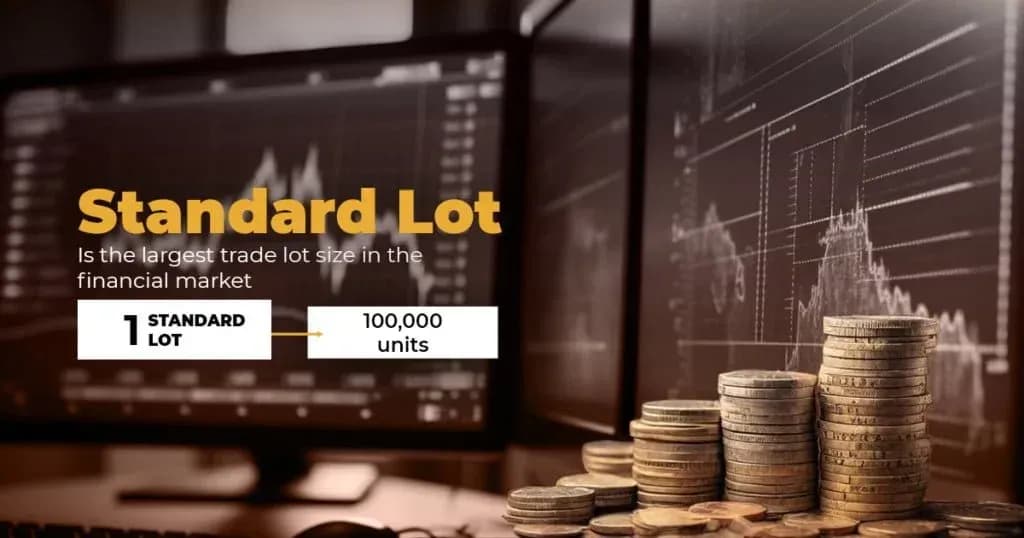
A standard lot is the largest trade lot size in the financial market and equates to 100,000 units of the base currency. For example, if you are trading a GBP/USD pair using one standard lot, it means you are buying 100,000 GBP. Let’s say the current exchange rate for GBP/USD is 1.2500. It means you will need 125,000 of the quote currencies to buy 100,000 of the base currency, which is GBP in this case.
See also 6 best habits to improve your trading performance!
When trading using the standard lot, the value of one pip is $10. So, if the value of GBP/USD increases from 1.2500 to 1.2510 (10 pips), you will make a profit of $100.
2.Mini Lot Size
A mini lot equates to 10,000 units of the base currency. For GBP/USD, it means you are trading 10,000 pounds. If the currency pair moves by one pip, you will be making $1 when using the mini lot. If it moves by 10 pips, you will make a $10 profit or loss. Most traders who want to control their risk normally like to trade using this lot size compared to a standard lot.

3.Micro Lot Size
A micro lot size amounts to 1000 units of the base currency. It trades at a volume of 0.01, and for every pip movement, you will gain or lose $0.10. For example, if the EUR/USD pair moves from 1.2500 to 1.2520 (20 pips), you make a profit of $2.
This lot size is best for Forex beginners who are looking to gain experience and want to minimize their risk exposure as much as possible.
4.Nano Lot Size
This lot size is not very common in most brokerage firms. Specific brokers offer it, and it is suitable for traders who want to practice with real money but with minimal risk. Nano lot equates to 100 units of the base currency. It is a super small lot size and will help you get started on a live account, as it offers extremely low-risk trades.
The value of one pip when using a Nano lot is $0.01. So, if you buy GBP/USD at an exchange rate of 1.3500 and it moves down by 20 pips (1.3480), you will only lose 0.20 cents.
Now that you know what each lot size represents and how they can impact your trade, you may be wondering how you can maximize your profits. Professional traders that make huge profits daily use either the mini lot or the standard lot. But this also means you must have a reasonable capital to avoid blowing your account.
Read More about Why You Should Combine Fundamental and Technical Analysis?
This is where prop trading firms come in handy. If you do not have enough capital to make reasonable profits in the market, getting a funded account could be an ideal solution. With Audacity Capital, you can get funding starting from $15,000 up to $2,000,000. This will allow you to trade with a bigger lot size, which means massive profits on a monthly basis if you know what you are doing.
The good thing about a prop trading firm like Audacity Capital is that they provide you with guidelines, a working risk management plan, and resources to help you become consistently profitable in the long run.

Funded Trader Program
Get Funded NowReal World Examples
Lot size selection significantly affects profits and losses. This is why some traders can blow their accounts overnight while others can make huge profits within a short period. Here are a few scenarios that will help you understand why proper lot size selection is important:
Scenario 1: Trading Eur/usd Using A Standard Lot.
Assuming the EUR/USD current exchange rate is 1.2500 and it moves by 50 pips upwards (1.2550). This means that you would have gained a profit of $500. So, if your trading capital was $1000, then your new balance will be $1,500. But if the trade goes in the opposite direction, you will lose half of your trading capital, leaving you with $500. One more trade, and you will be at $0.
Pip movement x Value of pip = profit/loss
50 pips x $10 = $500
Scenario 2: Trading A Mini Lot.
A mini lot size amounts to 10,000 units, which means that for every pip movement, you will make $1. So, if the EUR/USD moves by 50 pips, you will make a profit or incur a loss of $50. This means if you are trading with an account size of $1000, your new balance will be $1050, and if you lose the trade, you will have $950.
The mini lot size is quite reasonable when you are trading with an account size of $1000. It will help you minimize your risks, ensuring you do not blow your account.
See also What Are Swaps in Forex Trading
Pip movement x value of pip = profit/loss
50 pips x $1 = $50
Scenario 3: Trading A Micro Lot.
With a micro lot, you will be making a profit of $0.10 for every pip movement. If GBP/USD moves by 50 pips, you will make a $5 profit. This lot size may be a bit smaller if you are trading with an account size of $1000. It will give you very low returns, meaning it might take you long to reach your target.
Pip movement x value of pip = profit/loss
50 x $0.01 = $5
Bottom Line
Selecting appropriate lots for your account forms the foundation of successful Forex trading. It directly impacts your potential profits and losses in each trade, making it a crucial factor to consider when coming up with a risk management plan.
Traders can pick any lot size in regard to their trading capital. The right lot size allows you to preserve your capital, ensuring you become profitable in the long run. You can get started today with a funded account at Audacity Capital, where you will receive proper guidance on how to manage your risk. They will help you pick the right lot size, ensuring your account performs well in the long run. To get started, click here.
Learn More About Best Leverage For Forex
FAQ
Yes, lot size determines the volume of your trade and directly affects your profits and losses. With the right lot size, you can effectively manage your risk exposure and reach your financial goals in a span of a few weeks or months.
There are a few things you must consider, like account size, risk management plan, trading strategy, currency pair, and the percentage you want to risk. A position size calculator will also help you ensure you are using the correct lot size.
A lot size refers to the number of currency units you trade in a position. It determines the size of your trade and directly affects how much you gain or lose per pip movement.
There are four common lot sizes:
- Standard Lot – 100,000 units
- Mini Lot – 10,000 units
- Micro Lot – 1,000 units
- Nano Lot – 100 units
Smaller lot sizes allow traders to manage risk more effectively.
Beginners should start with:
Micro lots (0.01)
This allows them to:
- Limit risk
- Learn trade management
- Avoid large losses
Yes. Most brokers allow trading with micro or nano lots, making Forex accessible even with small accounts.
No.
- Lot size = trade size
- Leverage = borrowed capital to increase exposure
Both impact risk but serve different purposes.

Bereit, diszipliniertes Risiko auf Krypto anzuwenden? Entdecken Sie die neuen Krypto-Instrumente von Audacity Capital und bringen Sie Ihre Trading-Strategie mit.
Mehr erfahrenNewsletter
Treten Sie unserem Newsletter bei, um auf dem Laufenden zu bleiben.
Treten Sie unserer sozialen Gemeinschaft bei

Beginnen Sie Ihre Reise heute Mit unserer kostenlosen Testversion
Präsentieren Sie stolz Ihre Fähigkeiten und Leistungen durch Zertifikate und erhalten Sie Anerkennung für Ihre harte Arbeit und Ihr Engagement von potenziellen Investoren und Kollegen.
Kostenlose TestversionVerwandte Artikel
__webp__orig.webp&w=1920&q=75)
From Demo To Live: When Are You Ready To Go Live?


What Is A Black Swan Event in Trading & Finance?
Learn what a black swan event is in trading and finance, with real examples, market impact, and strategies to manage risk during extreme events.
__webp__orig.webp&w=1920&q=75)
The Psychology Behind Funded Trading: Managing Pressure, Risk, And Performance

Are Volumes Useful In Forex Or Not?
Learn how trading volume helps forex traders confirm trends, identify market strength, and improve decision-making with practical insights.