



What Is a Black Swan Event? Meaning, Examples and Impact on Forex Trading


Financial markets are influenced by economic data, central bank decisions, geopolitical developments and investor sentiment. While traders use historical data and market analysis to prepare for different scenarios, some events occur so unexpectedly that they disrupt even well-established trading strategies. These events are known as Black Swan events.
A Black Swan event is an unexpected occurrence with a significant impact, often challenging existing assumptions about how financial markets behave. In forex trading, such events can trigger sudden currency movements, increased volatility, liquidity shortages and unexpected losses.
The concept was popularised by former trader and author Nassim Nicholas Taleb in his 2007 book The Black Swan: The Impact of the Highly Improbable. Understanding this concept can help forex traders recognise the limitations of market predictions and prepare their risk management strategies for unexpected conditions.
What Is a Black Swan Event?
A Black Swan event is an extremely rare and difficult-to-predict occurrence that has a significant impact on financial markets, economies or society.
The term describes events that fall outside normal expectations and are difficult to explain using historical patterns alone. Although these events may appear obvious in hindsight, they are often not anticipated before they happen.
For forex traders, a Black Swan event can cause rapid changes in currency valuations, disrupt market liquidity and create trading conditions that differ significantly from normal market behaviour.
For example, an unexpected political decision, financial crisis or major geopolitical development can trigger sharp movements in currency pairs. These movements may happen within minutes or hours, leaving traders with limited time to adjust their positions.
However, not every unexpected market movement qualifies as a Black Swan event. The concept specifically relates to events that combine unusual unpredictability with substantial consequences.
Origins of the Black Swan Theory
The expression "Black Swan" comes from the historical belief that all swans were white. Europeans widely held this assumption until black swans were discovered in Western Australia in the late 17th century.
The discovery challenged an established belief and demonstrated how assumptions based on limited observations can be overturned by unexpected evidence.
Nassim Nicholas Taleb later popularised the concept in finance through his book The Black Swan. He used it to explain how rare, high-impact events can influence financial markets, businesses and everyday life.
Taleb identified three defining characteristics of a Black Swan event:
- Unpredictability: The event falls outside normal expectations and is difficult to anticipate using conventional forecasting methods.
- Significant impact: Its consequences can be substantial, affecting financial markets, economies, industries or society.
- Retrospective explanation: After the event occurs, people often develop explanations that make it appear more predictable than it was beforehand.
These characteristics help explain why historical market data alone cannot account for every possible risk.
Examples of Black Swan Events in Financial Markets
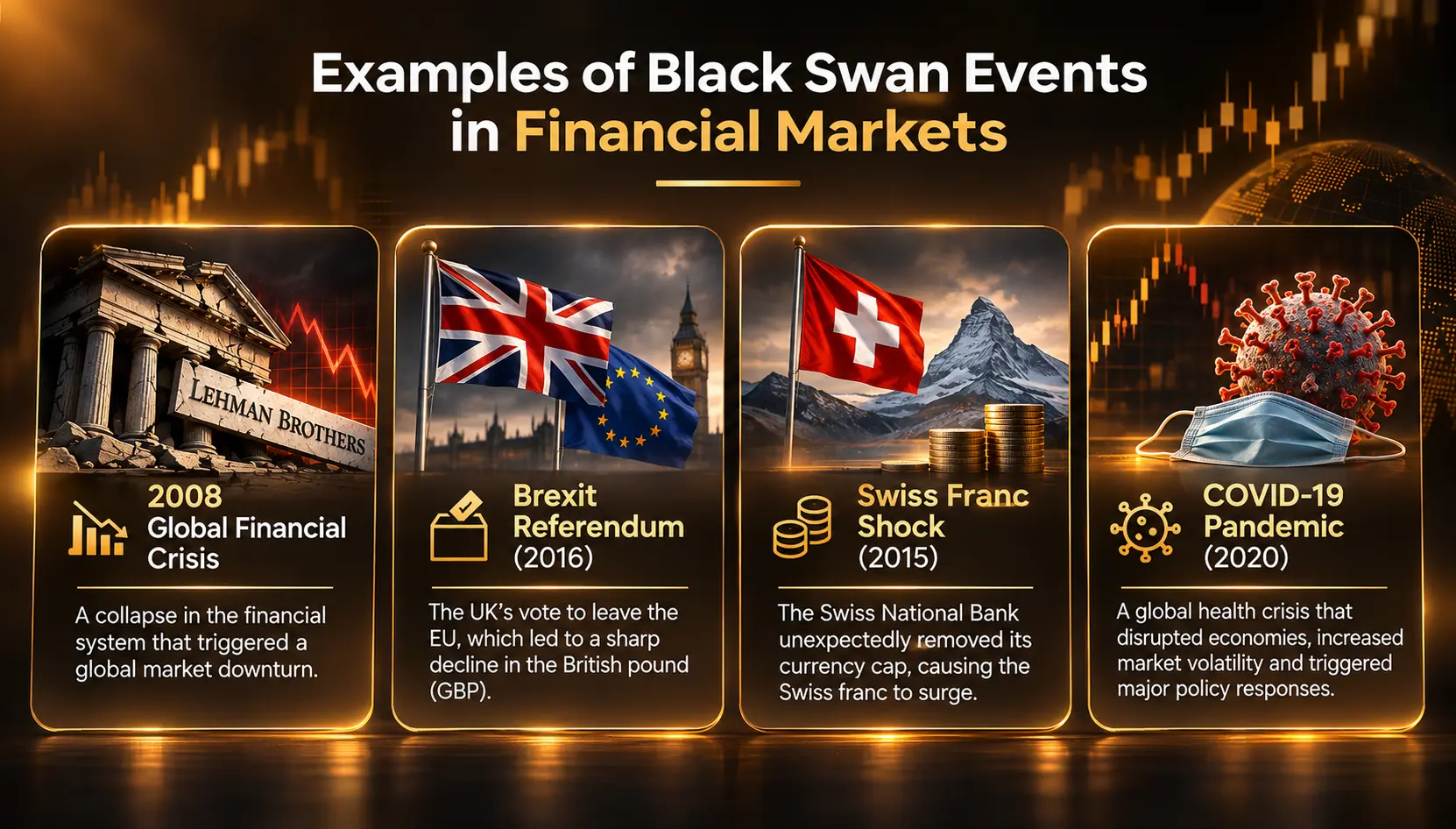
Several major historical events demonstrate how unexpected developments can disrupt financial markets and influence currency movements.
1. The 2008 Global Financial Crisis
The 2008 global financial crisis was one of the most significant financial disruptions in modern history. It was triggered by problems in the US housing market and the collapse of major financial institutions, including Lehman Brothers.
The crisis spread across international financial markets, creating widespread uncertainty and a sharp decline in investor confidence.
In the forex market, traders experienced significant changes in demand for major currencies. The US dollar and Japanese yen, for example, attracted safe-haven demand during different periods of the crisis.
The event demonstrated how problems within one part of the financial system can spread across global markets.
2. The Brexit Referendum in 2016
The UK's referendum on leaving the European Union created considerable uncertainty across financial markets.
When the referendum result became clear in June 2016, the British pound experienced a sharp decline against several major currencies.
GBP/USD fell dramatically as traders reassessed the UK's economic outlook, trade relationships and political stability.
The referendum demonstrated how unexpected political developments can influence currency valuations and create substantial volatility in the forex market.
3. The Swiss Franc Shock in 2015
On 15 January 2015, the Swiss National Bank unexpectedly removed its minimum exchange rate of 1.20 Swiss francs per euro.
The announcement caused the Swiss franc to appreciate sharply against several major currencies within a very short period.
The sudden movement created substantial losses for some traders and brokers, particularly those holding leveraged positions.
This event demonstrated how central bank decisions can produce extreme market movements and why traders should understand the risks associated with leverage, liquidity and unexpected price gaps.
4. The COVID-19 Pandemic
The COVID-19 pandemic caused widespread disruption to global economies and financial markets in 2020.
As governments introduced lockdowns and economic activity slowed, investors reassessed their expectations for growth, interest rates and international trade.
Currency markets experienced significant volatility as investors moved between risk-sensitive currencies and perceived safe-haven assets.
Central banks also introduced emergency monetary policy measures to support their economies.
The pandemic demonstrated how a global health crisis can create far-reaching economic consequences and affect financial markets in ways that are difficult to anticipate.
How Do Black Swan Events Affect the Forex Market?
The forex market operates continuously during the global trading week and responds to economic, political and financial developments around the world.
When an unexpected event occurs, its impact can spread quickly across currency pairs. The resulting market conditions may differ significantly from normal trading environments.
Here are some of the main ways Black Swan events can affect forex trading.
1. Sudden Currency Price Movements
Unexpected events can cause sharp movements in currency valuations.
For example, a sudden political announcement or central bank decision may change expectations about a country's economic outlook. Traders may quickly adjust their positions, resulting in significant price movements.
These movements can create opportunities, but they can also expose traders to substantial losses.
2. Increased Market Volatility
Black Swan events can cause volatility to rise sharply as market participants react to new information.
Currency pairs that normally experience relatively stable price movements may begin fluctuating significantly within short periods.
Higher volatility can make it difficult for traders to identify suitable entry and exit points or maintain their usual risk levels.
3. Reduced Market Liquidity
During periods of extreme uncertainty, some market participants may reduce their trading activity or withdraw liquidity.
This can result in wider bid-ask spreads and greater difficulty executing orders at expected prices.
For traders, reduced liquidity may increase transaction costs and make position management more challenging.
4. Slippage and Unexpected Execution Prices
Slippage occurs when a trade is executed at a different price from the requested price.
During major market disruptions, prices can move rapidly between available quotes. As a result, stop-loss and market orders may be executed at prices different from those expected.
This is particularly important for leveraged forex traders because unexpected execution prices can increase the financial impact of a losing position.
5. Changes in Safe-Haven Demand
During periods of market uncertainty, investors may move their capital towards currencies they perceive as relatively stable or liquid.
The US dollar, Japanese yen and Swiss franc have historically attracted safe-haven demand during certain periods of market stress.
However, these relationships are not guaranteed. Currency movements depend on the nature of the event, market conditions and investor expectations.
How Can Forex Traders Manage Risk During Black Swan Events?
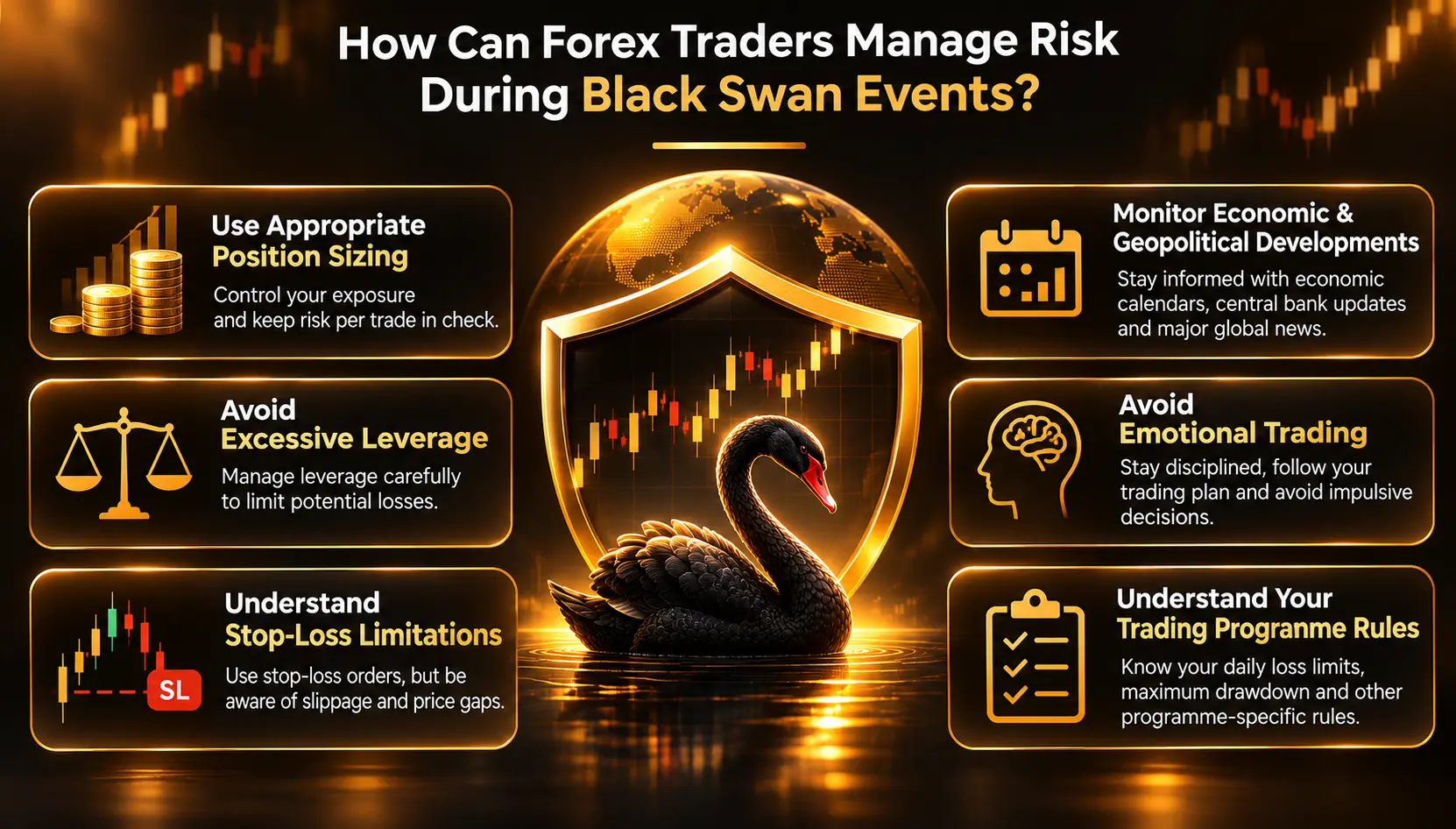
Black Swan events cannot be reliably predicted. However, traders can take practical steps to manage their exposure and avoid relying too heavily on normal market conditions.
The objective is not to predict every unexpected event but to build a trading approach that can withstand uncertainty.
1. Use Appropriate Position Sizing
Position sizing determines how much capital is exposed to an individual trade.
Opening positions that are too large relative to the available account balance can increase the impact of unexpected market movements.
Traders should calculate position sizes based on their risk tolerance, stop-loss distance and account rules rather than focusing only on potential profits.
2. Avoid Excessive Leverage
Leverage allows traders to control larger positions with a smaller amount of capital. However, it also magnifies the financial impact of price movements.
During periods of extreme volatility, highly leveraged positions can experience rapid losses.
Using leverage carefully can help traders maintain better control over their overall market exposure.
3. Understand Stop-Loss Limitations
Stop-loss orders are commonly used to manage trading risk by setting a predefined exit level.
However, they do not guarantee execution at the exact requested price. During market gaps, reduced liquidity or rapid price movements, orders may be filled at less favourable prices.
Traders should understand these limitations when planning their risk management strategies.
4. Monitor Economic and Geopolitical Developments
Although Black Swan events are difficult to predict, traders can stay informed about developments that may influence financial markets.
Economic calendars, central bank announcements, geopolitical news and major financial developments can help traders understand changing market conditions.
Monitoring these developments does not make rare events predictable, but it can improve awareness of potential market risks.
5. Avoid Emotional Trading
Unexpected market movements can create fear, uncertainty and pressure to recover losses quickly.
Making impulsive decisions during these periods may increase exposure and lead to further losses.
Traders should follow their established risk management plans and avoid changing their trading approach purely in response to short-term market panic.
For more information, read our guide on The Fear of Missing Out: How to Deal With It.
6. Understand Your Trading Programme Rules
Traders participating in funded trading programmes should understand the applicable daily loss limits, maximum drawdown rules and other trading restrictions.
These rules may differ between programmes and account types.
Understanding how drawdown is calculated and how positions are affected by market volatility can help traders manage their exposure more effectively.
At Audacity Capital, traders should review the rules applicable to their selected trading programme before placing trades.
Can Traders Prepare for Black Swan Events?
No trader can reliably predict every Black Swan event. However, preparation can help reduce unnecessary exposure and improve decision-making when unexpected market conditions arise.
A practical approach includes:
- Maintaining a consistent risk management strategy.
- Avoiding excessive leverage and oversized positions.
- Understanding the limitations of stop-loss orders.
- Monitoring important economic and geopolitical developments.
- Reviewing exposure across correlated currency pairs.
- Understanding the trading rules and drawdown limits applicable to an account.
The key lesson is that successful risk management should not depend on the assumption that markets will always behave as expected.
Black Swan events remind traders that uncertainty is an unavoidable part of financial markets. Rather than attempting to predict every possible outcome, traders should focus on controlling their exposure and making disciplined decisions under different market conditions.
Frequently Asked Questions About Black Swan Events
A Black Swan event in forex trading is an unexpected occurrence with a significant impact on currency markets. It can trigger sudden price movements, increased volatility, reduced liquidity and unexpected trading losses.
Examples commonly discussed in financial markets include the 2008 global financial crisis, the 2015 Swiss franc shock and the COVID-19 pandemic. The Brexit referendum is also an example of a major political event that caused substantial currency market disruption, although not every major unexpected event necessarily meets all three characteristics of Taleb's Black Swan framework.
Nassim Nicholas Taleb popularised the Black Swan concept in finance through his 2007 book, The Black Swan: The Impact of the Highly Improbable. The underlying expression existed before his work and originated from the historical discovery of black swans in Australia.
Black Swan events are, by definition, extremely difficult to predict using conventional forecasting methods. Traders can monitor economic and geopolitical developments, but they cannot reliably anticipate every rare, high-impact occurrence.
They can trigger sudden changes in currency demand, increased volatility, wider spreads and reduced liquidity. The direction and scale of currency movements depend on the nature of the event and how market participants respond.
Traders can manage their exposure by using appropriate position sizes, avoiding excessive leverage, understanding stop-loss limitations and following consistent risk management practices. However, no strategy can eliminate all risks associated with unexpected market events.

Bereit, diszipliniertes Risiko auf Krypto anzuwenden? Entdecken Sie die neuen Krypto-Instrumente von Audacity Capital und bringen Sie Ihre Trading-Strategie mit.
Mehr erfahrenNewsletter
Treten Sie unserem Newsletter bei, um auf dem Laufenden zu bleiben.
Treten Sie unserer sozialen Gemeinschaft bei

Beginnen Sie Ihre Reise heute Mit unserer kostenlosen Testversion
Präsentieren Sie stolz Ihre Fähigkeiten und Leistungen durch Zertifikate und erhalten Sie Anerkennung für Ihre harte Arbeit und Ihr Engagement von potenziellen Investoren und Kollegen.
Kostenlose TestversionVerwandte Artikel

10 Best Futures Prop Firms for Swing Trading In 2026
Compare the best futures prop firms for swing trading in 2026 with overnight holding, flexible rules, fast payouts, and funded accounts.


How To Choose The Right Prop Firm – A Complete Checklist
Learn how to choose the right prop trading company with our expert guide. Compare fees, rules, profit splits, and platforms to trade confidently.

From Demo To Live: When Are You Ready To Go Live?

Are Volumes Useful In Forex Or Not?
Learn how trading volume helps forex traders confirm trends, identify market strength, and improve decision-making with practical insights.