



What Is a Lot in Forex Trading? Types, Lot Sizes & Examples


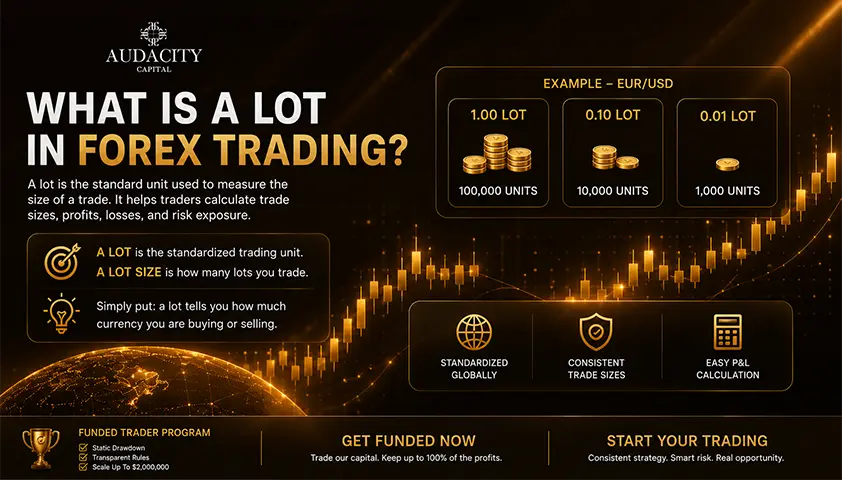
A lot in forex trading is the standard unit used to measure the size of a trade. One standard lot equals 100,000 units of the base currency, while mini, micro, and nano lots represent smaller trade sizes. Lots help traders standardize position sizes, calculate profits and losses, and manage risk more effectively. |
|---|
What Is a Lot in Forex Trading?
A lot in forex trading is the standard unit used to measure the size of a trade. Instead of buying or selling individual currency units, forex traders place orders in standardized lots, making it easier to calculate trade sizes, profits, losses, and risk exposure.
For example, when a trader places an order for 1 standard lot of EUR/USD, they are buying or selling 100,000 units of the base currency (EUR). Likewise, 0.10 lots represents 10,000 units, while 0.01 lots represents 1,000 units.
Standardized lots create consistency across the global forex market, allowing traders, brokers, liquidity providers, and institutions to trade using a common measurement system.
Simply put, a lot tells you how much currency you are buying or selling, while the lot size refers to the quantity of lots used in a particular trade.
Why Does Forex Trading Use Lots?
The foreign exchange market deals with extremely small price movements. Most major currency pairs move by fractions of a cent, with changes measured in pips. If traders bought and sold currencies one unit at a time, even large price movements would generate very little profit or loss.
For example, buying just 1 euro against the US dollar would result in almost no meaningful return if the exchange rate moved by a few pips. To make trading practical, the forex market groups currency units into standardized lots.
Using lots provides several benefits:
- Standardizes trade sizes across global markets.
- Makes position sizing consistent for all traders.
- Simplifies profit and loss calculations.
- Helps traders manage risk more effectively.
- Allows brokers and liquidity providers to process orders efficiently.
Without standardized lots, forex trading would be significantly more complex, and comparing trade sizes across different brokers and trading platforms would be difficult.
Lot vs. Lot Size: What's the Difference?
Many beginners use the terms lot and lot size interchangeably, but they have slightly different meanings.
A lot is the standardized trading unit established by the forex market. A lot size refers to how many lots you decide to trade in a particular position.
For example:
- 1 Standard Lot = 100,000 units
- 0.50 Lot Size = 50,000 units
- 0.10 Lot Size = 10,000 units
- 0.01 Lot Size = 1,000 units
Think of it like buying bottled water:
- The bottle represents the lot.
- The number of bottles you buy represents the lot size.
In other words, the lot defines the trading unit, while the lot size determines your market exposure.
Types of Forex Lots
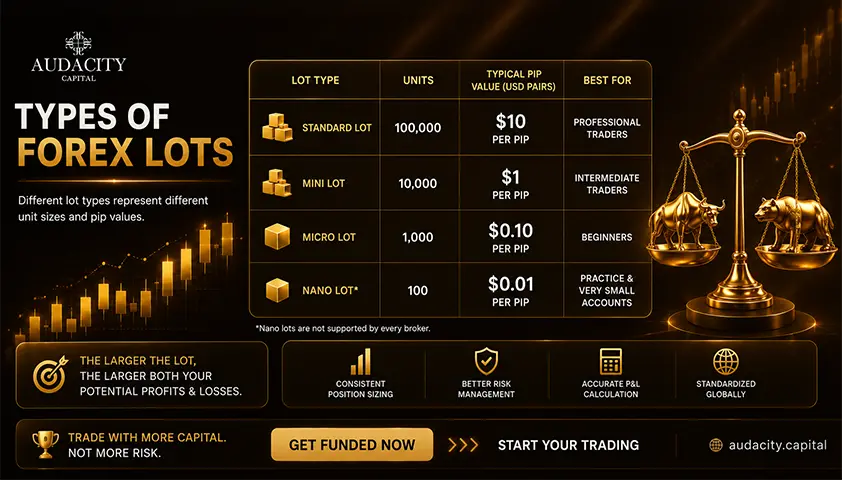
Forex traders can choose from four main lot types: standard, mini, micro, and nano. Each lot represents a different number of currency units and directly affects the value of each pip movement, the amount of capital required, and the level of risk involved.
Choosing the right lot type depends on your account balance, trading experience, risk tolerance, and overall trading strategy. While larger lots can generate higher profits, they also expose traders to greater losses if the market moves against them.
The table below provides a quick comparison.
Lot Type | Units | Typical Pip Value (USD Pairs) | Best For |
|---|---|---|---|
Standard Lot | 100,000 | $10 per pip | Professional traders |
Mini Lot | 10,000 | $1 per pip | Intermediate traders |
Micro Lot | 1,000 | $0.10 per pip | Beginners |
Nano Lot* | 100 | $0.01 per pip | Practice & very small accounts |
*Nano lots are not supported by every broker.
The larger the lot, the larger both your potential profits and losses.
Standard Lot
A standard lot is the largest commonly traded forex lot and represents 100,000 units of the base currency. If you buy one standard lot of EUR/USD, you are buying 100,000 euros against the US dollar.
Because one pip is typically worth approximately $10 on USD-based currency pairs, even small market movements can result in significant profits or losses.
Example
Suppose you buy 1 standard lot of EUR/USD at 1.1200.
If the price rises to 1.1210, the market has moved 10 pips.
- Pip Value: $10
- Profit: 10 × $10 = $100
If the trade moves against you by 50 pips, your loss would be approximately $500.
Best For
A standard lot is suitable for:
- Professional traders
- Experienced forex traders
- Traders with larger account balances
- Traders who can comfortably manage higher risk
Mini Lot
A mini lot represents 10,000 units of the base currency, or one-tenth of a standard lot. The pip value is approximately $1 for most USD-based currency pairs.
Mini lots provide a good balance between profitability and risk, making them one of the most popular choices among retail forex traders.
Example
You open a 1 mini lot position on GBP/USD.
The market moves 25 pips in your favor.
- Pip Value: $1
- Profit: 25 × $1 = $25
If the trade loses 25 pips, your loss would also be $25.
Best For
Mini lots are ideal for:
- Intermediate traders
- Traders with accounts between approximately $2,000 and $10,000
- Swing traders
- Traders looking for controlled risk
Micro Lot
A micro lot equals 1,000 units of the base currency and has a pip value of approximately $0.10 on most USD pairs.
Micro lots allow traders to participate in the forex market while risking only small amounts of capital on each trade. This makes them particularly useful for beginners who are learning position sizing and risk management.
Example
You trade 1 micro lot on EUR/USD.
The price moves 40 pips.
- Pip Value: $0.10
- Profit: 40 × $0.10 = $4
A 40-pip loss would also result in a $4 loss.
Best For
Micro lots are recommended for:
- Beginner forex traders
- Small trading accounts
- Testing new strategies
- Conservative risk management
Nano Lot
A nano lot represents 100 units of the base currency and is the smallest forex lot offered by some brokers. The pip value is approximately $0.01.
Although nano lots are uncommon, they are useful for traders who want to practice live trading with minimal financial risk.
Example
You trade 1 nano lot.
The market moves 50 pips.
- Pip Value: $0.01
- Profit: 50 × $0.01 = $0.50
Best For
Nano lots are suitable for:
- Absolute beginners
- Traders testing live execution
- Very small trading accounts
- Learning without significant financial exposure
Which Forex Lot Should You Choose?
There is no single "best" lot type for every trader. The right choice depends on your trading capital, experience level, and risk management strategy.
As a general guideline:
- Standard Lots – Best for experienced traders with larger accounts and higher risk tolerance.
- Mini Lots – Suitable for intermediate traders seeking a balance between risk and reward.
- Micro Lots – Ideal for beginners, smaller accounts, and disciplined risk management.
- Nano Lots – Best for practice and learning with minimal financial exposure.
Rather than choosing the largest lot available, focus on selecting a lot size that keeps your risk within 1–2% of your account balance per trade. Consistent position sizing is one of the key characteristics of successful forex traders.

Funded Trader Program
Get Funded NowHow Many Units Are in a Forex Lot?
Lot Type | Number of Units | Position Size |
|---|---|---|
Standard Lot | 100,000 | 1.00 |
Mini Lot | 10,000 | 0.10 |
Micro Lot | 1,000 | 0.01 |
Nano Lot | 100 | 0.001* |
*Availability depends on the broker.
Why Lot Size Matters
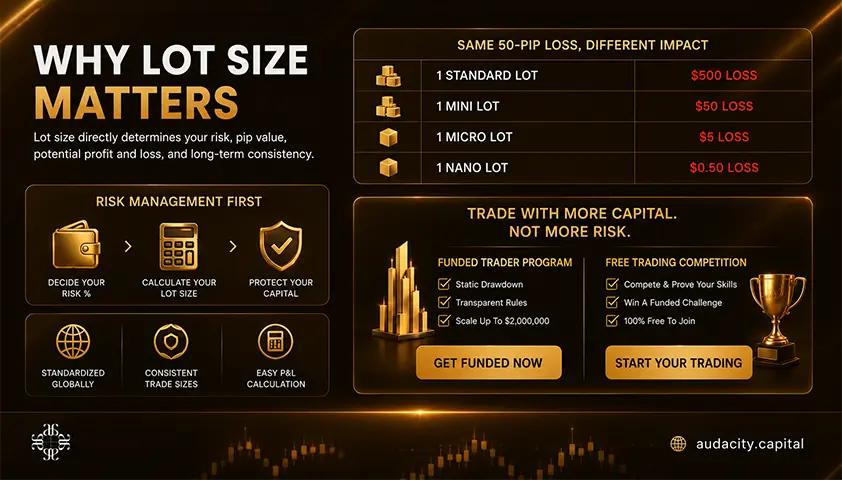
Choosing the correct lot size is one of the most important aspects of forex risk management. Your lot size directly determines:
- How much you risk on every trade.
- The value of each pip movement.
- Your potential profit.
- Your potential loss.
- How quickly your account can grow—or decline.
For example, if two traders both experience a 50-pip loss, their financial outcome depends entirely on the lot size they selected.
- 1 Standard Lot: $500 loss
- 1 Mini Lot: $50 loss
- 1 Micro Lot: $5 loss
Although both traders lost the same number of pips, the monetary impact was completely different because they traded different lot sizes.
This is why experienced traders determine their risk percentage first and calculate their lot size second—not the other way around.
How Lots Affect Risk Management
Professional traders rarely choose a lot size based on how much profit they hope to make. Instead, they calculate it based on their maximum acceptable risk.
A common rule is to risk 1% to 2% of your account on a single trade.
For example:
- Trading Capital: $10,000
- Maximum Risk: 1%
- Maximum Loss Allowed: $100
If your trading strategy requires a 50-pip stop loss, you'll calculate a lot size that limits your maximum loss to $100 if the stop loss is hit.
This disciplined approach protects your capital and allows you to remain in the market over the long term, even during losing streaks.
Which Lot Size Should Beginners Use?
Most beginner forex traders should start with micro lots (0.01) or mini lots (0.10).
These smaller lot sizes help traders:
- Gain real-market experience.
- Learn risk management.
- Reduce emotional pressure.
- Protect trading capital.
- Develop consistency before increasing position size.
Trading standard lots without sufficient capital or experience can expose traders to unnecessarily large losses, making it difficult to maintain a disciplined trading plan.
Conclusion
Understanding what a lot is in forex trading is one of the first steps toward becoming a disciplined trader. Whether you trade standard, mini, micro, or nano lots, your lot size directly affects your risk, potential returns, and long-term consistency. Rather than choosing the largest position possible, successful traders focus on selecting a lot size that aligns with their account balance, trading strategy, and risk management plan.
Once you're comfortable managing position sizes and controlling risk, trading with larger capital can help you unlock greater opportunities without risking more of your own money. Audacity Capital's Funded Trader Program gives skilled traders access to funded accounts with transparent trading rules, static drawdown, and a clear scaling path of up to $2 million, allowing you to apply proper lot sizing with significantly more trading capital.
If you're not ready to start a funded account yet, you can join Audacity Capital's Free Trading Competition for a chance to win a funded challenge account at no cost. It's an excellent way to test your skills, gain experience, and take your first step toward becoming a funded trader.
Related Articles
Read More About The Guide About Forex Lot Size And Leverage
See also 6 best habits to improve your trading performance!
Read More about Why You Should Combine Fundamental and Technical Analysis?
See also What Are Swaps in Forex Trading
Learn More About Best Leverage For Forex
Explore our Funded Trader Program or join the Free Trading Competition today and start building your trading career with confidence.
FAQ
Yes, lot size determines the volume of your trade and directly affects your profits and losses. With the right lot size, you can effectively manage your risk exposure and reach your financial goals in a span of a few weeks or months.
There are a few things you must consider, like account size, risk management plan, trading strategy, currency pair, and the percentage you want to risk. A position size calculator will also help you ensure you are using the correct lot size.
A lot size refers to the number of currency units you trade in a position. It determines the size of your trade and directly affects how much you gain or lose per pip movement.
There are four common lot sizes:
- Standard Lot – 100,000 units
- Mini Lot – 10,000 units
- Micro Lot – 1,000 units
- Nano Lot – 100 units
Smaller lot sizes allow traders to manage risk more effectively.
Beginners should start with:
Micro lots (0.01)
This allows them to:
- Limit risk
- Learn trade management
- Avoid large losses
Yes. Most brokers allow trading with micro or nano lots, making Forex accessible even with small accounts.
No.
- Lot size = trade size
- Leverage = borrowed capital to increase exposure
Both impact risk but serve different purposes.

Prêt à appliquer un risque discipliné aux cryptos ? Explorez les nouveaux instruments crypto d'Audacity Capital et apportez votre stratégie de trading.
En savoir plusNewsletter
Rejoignez notre newsletter pour rester informé.
Rejoignez Notre Communauté Sociale

Commencez Votre Voyage Aujourd'hui Avec Notre Essai Gratuit
Affichez fièrement vos compétences et réalisations grâce à des certificats et obtenez la reconnaissance de votre travail acharné et de votre dévouement auprès d'investisseurs potentiels et de pairs.
Essai GratuitArticles Connexes

10 Best Futures Prop Firms for Swing Trading In 2026
Compare the best futures prop firms for swing trading in 2026 with overnight holding, flexible rules, fast payouts, and funded accounts.


The First 30 Days: What New Traders Should Focus On (And Ignore)

Are Volumes Useful In Forex Or Not?
Learn how trading volume helps forex traders confirm trends, identify market strength, and improve decision-making with practical insights.

How To Choose The Right Prop Firm – A Complete Checklist
Learn how to choose the right prop trading company with our expert guide. Compare fees, rules, profit splits, and platforms to trade confidently.