


What Is Buying Power in Trading? Definition and How It Works


You fund your account with one number, then open your platform and see a different number staring back at you, which is much bigger than what you’ve deposited.
It's this gap that confuses nearly all new traders and it is exactly what will be discussed in this article.
So, what is buying power in trading?
Buying power is simply the total sum you can use for opening new positions right now. It's your actual money, plus the money that your account allows you to trade with using margin or leverage.
By the end of this article, you will learn
- how buying power is calculated,
- how it changes by account type,
- and how to use it without blowing up your account.
What is buying power in trading? (the simple definition)
Buying power helps to answer one practical question: How much can I trade at the moment?
Buying power includes the money you have and extra capital coming from your broker or firm. It is not a constant value and changes with every opening of positions and returns when positions close or cash is deposited.
Let's start with an easy example. Let's say, you have $5,000 of cash in a regular cash account. Then, your buying power is equal to $5,000. No margin, no leverage – simply because there are no borrowed funds. This is where all the calculations mentioned in this article are based on.

Buying power vs. account balance vs. purchasing power
These concepts are always getting confused. Let us make it clear for you.
An account balance means the total sum of money in your trading account. In case you use leverage, your buying power might exceed your balance, or it might become smaller due to open positions or unsettled cash. There is an interconnection between buying power and your balance, but they are not identical.
Purchasing power, however, is a totally separate idea. It is a macroeconomic term about how much a currency can actually buy as inflation climbs or eases. It has nothing to do with how much you can trade. So don’t confuse the two.
While buying power is the ability to trade with available finances, purchasing power is a concept related to macroeconomics and describes the amount of purchases that people can make in accordance with changes in inflation. They should not be mixed up.
The purchasing power, on the other hand, is something completely different. This term is used in macroeconomics to define how much a currency can buy amid growing or dropping inflation rates. That's why you shouldn't mix it with trading terms.
How buying power works: cash accounts vs. margin accounts
There's a big difference here. Once you understand the main principles, everything else becomes easier.
If the account is cash-based, the buying power is equal to the settled cash, which means the funds that have already cleared. No other money can be used for trading until the cash is cleared after the sales process, known as T+ settlement.
In a cash account, buying power is equal to settled cash position. You trade solely with cleared funds. After you sell, the proceeds are usually required to pass a brief settlement period known as the T+ settlement. Until that cash settles, it isn’t part of your buying power.
A margin account works differently. The broker gives you additional buying power based on your equity, often doubling it.
Margin means borrowing from the broker and using your account as collateral. It's important to note here: the money borrowed should be repaid, and overnight balances usually incur interest charges. Margin allows for more room to trade, but it is a loan, not free capital.
The standard ratios: 2:1 and 4:1 (and the PDT rule)
Margin accounts run on multipliers, and two versions show up a lot.
A standard margin account provides roughly 2:1 overnight buying power. So if you’ve got $25,000 in equity, it could hold roughly $50,000 in positions overnight.
For active intraday traders in the US, day trading buying power (4:1) is available to those classed as pattern day traders. The same $25,000 can maintain approximately $100,000 in intraday positions with the ratio of 4:1.
However, there is an important detail here. The PDT rule and minimum requirements for day trading ($25,000) are US-specific and are dictated by FINRA and the SEC. They don’t apply everywhere. Some areas and brokers have different leverage and margin limits. If trading outside the US, be sure to see the rules and terms of your broker.
Another rule to be stated quite simply: the more you can afford, the more risk you take. The same multiplicative effect that works on profits is in force for losses.
How is buying power calculated? (with examples)
In practice, how does one calculate the buying power? The formula is not as complicated as what most traders think. Here they are, with a worked example for each.
Cash account: buying power = settled cash. Example: $25,000 in settled cash gives you $25,000 in buying power.
Standard margin (2:1): buying power = equity x 2. Example: $25,000 equity x 2 = $50,000 in overnight buying power.
Day trading (4:1, US PDT): buying power = maintenance margin excess x 4. Example: $25,000 in margin excess x 4 = $100,000 in intraday buying power.
See for yourself by doing the calculations using your own balance.
Buying power by account type:
Account type | Typical buying power | Example on $25,000 |
Cash account | 1x | $25,000 |
Standard margin (overnight) | About 2x | About $50,000 |
Day trading / PDT (intraday, US) | About 4x | About $100,000 |
Futures / forex | Varies, often higher | Depends on contract and broker |
The exact number will vary depending on your broker, the instrument you trade, and the rules where you live. Treat the table as a guide and NOT a promise.
Buying power in futures and forex (briefly)
Unlike stocks, futures and forex have a much more aggressive scaling of buying power.
Futures are based on contract leverage, meaning a small amount of margin is used to control a larger amount of the contract.
Forex trading involves high leverage ratios, which could be as high as 1:30 or 1:100 or even higher, depending on the region and the regulations in place. The specific boundaries are variable from jurisdiction to jurisdiction.
The takeaway is simple. Beyond stocks, the same deposit can bring about a whole lot more purchasing power, making disciplined risk control even more significant.
Buying power in a prop / funded account (the part most guides skip)
This is the part that almost every other guide would skip and it's important to mention when you are trading a funded account or prop.
When you trade with a prop firm, the firm assigns you an account size, for example, $50,000 or $100,000, along with the buying power that comes with it. You do not post that capital yourself. Rather, you normally pay a small assessment fee, and trade inside the firm's rules and leverage.
This is where a common confusion shows up on trader forums. For a funded or prop account, the buying power is based on the firm's money and leverage, not on money you put in. Your downside is not based on a "margin call" on your capital but according to the firm's drawdown limits.
Contrast this with retail margin. Retail margin involves borrowing from your own capital, repaying what you borrowed with interest on the overnight balances. A funded account, on the other hand, gives the firm more money to split the profits with. It's different, but the result is the same; you exchange more than you could with your own money.
More precisely, respectable companies organize them as simulated skill environments to evaluate and develop trading skills. No income guarantees are given with an evaluation. The focus is making capital available, not making money.

Buying power vs. leverage: what's the difference?
Traders use these two words as if they mean the same thing. They do not.
In the buying power vs leverage comparison, the distinction is clean. Leverage is the ratio that increases your exposure, e.g., 2:1, 4:1, 1:30. Buying power is the amount of dollars that are available for trading.
In other words: leverage equals multipliers, and buying power equals product.
What happens if you exceed your buying power
When you go over your "budget," two things happen.
Any trades placed that are larger than the balance will typically be rejected. But if you are already over the line, for example, a margin position has moved against you, you may receive a margin call. This is a call from your broker to put money in or to close the positions to get your account back on the right track. If you do not meet it, the broker can force-liquidate your positions, often at unfavorable prices.
There is a parallel in funded accounts. When you go over your risk limits in a prop account, it is typically a violation of a drawdown rule, which could lead to losing the account rather than a margin call. Different way, but same lesson: respect your limits before they respect you.
How to use buying power wisely
Don't use buying power as free money. Just because you can trade at 4x does not mean you should.
A few practical principles help here:
- Size positions off your risk per trade, not your maximum buying power. Position sizing should start from how much you are willing to lose, not how much the platform lets you deploy.
- Keep a buffer. Trading at the very edge of your buying power leaves no room for normal market movement.
- Think twice about holding leveraged trades overnight, as risks and interest accumulate during those hours.
- Consider the expense of margin interest before you decide to borrow money.
The above guidelines are purely educational. Leveraged or margin trading involves high risks; therefore, losses can exceed deposits in certain markets. Consult your broker regarding your account regulations.
How to increase your buying power (legitimately)
When you need to give yourself more room to trade, here are some legitimate methods of doing just that:
- Deposit more capital into your account.
- Close or reduce open positions to increase available margin.
- Wait for unsettled cash to clear in a cash account.
- Qualify for a margin or portfolio-margin account from your broker.
- Gain access to accounts from prop-trading firms.
All of these methods have pros and cons. The more buying power you have, the more risk management is involved.
Putting it together
Buying power refers to the amount of capital available for trading, including any leverage or margin available on the account. It varies depending on the account type, broker, and market being traded. Buying power is a risk management tool and should be used responsibly, not treated as a measure of trading success.
Balance represents the funds currently held in an account, while buying power reflects the amount of capital available to open and maintain positions. Understanding the difference is an important part of effective risk management.
For traders looking to access larger account sizes without committing substantial personal capital, funded trading programs offered by prop firms can provide an alternative pathway, subject to meeting the firm's evaluation requirements.
Audacity Capital offers traders the opportunity to access funded trading programs, account scaling opportunities, and educational resources through Trader University, subject to meeting the applicable program requirements.
Depending on the program, traders who successfully meet the evaluation requirements and comply with all trading rules may be eligible to earn up to 90% profit share through Audacity Capital's Funded Trader Program.
Trading involves risk, and past or hypothetical performance is not indicative of future results.
Frequently asked questions
Buying power is the total amount you can use to open new positions right now. It is your usable cash plus any extra funds your account adds through margin or leverage. In a cash account, it equals your settled cash. In a margin account, it is usually higher.
It depends on the account. In a cash account, buying power equals your settled cash. In a standard margin account, it is roughly your equity times two. For US pattern day traders, intraday trading buying power can reach four times your maintenance margin excess.
Leverage is the ratio that multiplies your exposure, such as 2:1 or 1:30. Buying power is the actual dollar amount you can trade as a result. Leverage is the multiplier, and buying power is the product of applying that multiplier to your equity.
In a margin account, the broker extends extra funds against your equity, so buying power can exceed your balance. It can also be lower than your balance when open positions and unsettled cash tie up part of your capital, reducing what is currently available to trade.
A new order beyond your funds is usually rejected. If an existing margin position moves against you, you may get a margin call demanding more funds or closed positions. Unmet, the broker can force-liquidate. In a prop account, exceeding limits usually means breaching a drawdown rule.
In a funded account, buying power comes from the firm's capital and leverage, not cash you deposited. You trade within the firm's rules, and your downside is governed by its drawdown limits rather than a margin call on your own money. These are simulated, evaluation-based skill environments.

¿Listo para aplicar un riesgo disciplinado a las criptomonedas? Explore los nuevos instrumentos de cripto de Audacity Capital y traiga su estrategia de trading.
Aprender másBoletín
Únase a nuestro boletín para mantenerse al día.
Únete a Nuestra Comunidad Social

Comienza Tu Viaje Hoy Con Nuestra Prueba Gratuita
Muestra con orgullo tus habilidades y logros a través de certificados y obtén reconocimiento por tu arduo trabajo y dedicación de posibles inversores y compañeros.
Prueba GratuitaArtículos Relacionados

Margin Account Requirements in 2026
Learn the margin account requirements for 2026, including minimum equity, initial and maintenance margin, margin calls, and new day-trading rules.

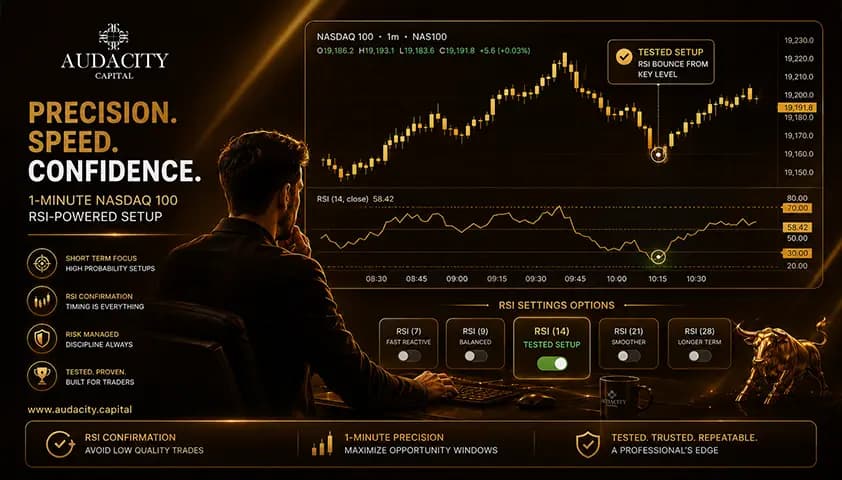
Best RSI Settings for the 1-Minute Nasdaq 100 Chart
No single setting prints money on this fast, noisy index. Here's the best RSI for 1-minute chart Nasdaq 100 scalping, the filters it needs, and the real risks.
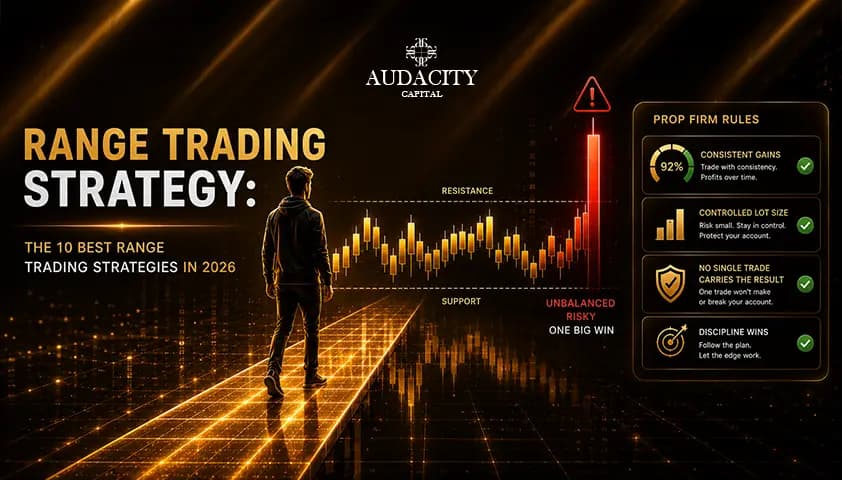
Range Trading Strategy: The 10 Best Range Trading Strategies in 2026
Discover the 10 best range trading strategies for forex, stocks, and indices. Learn how to identify ranging markets, manage risk, and trade support and resistance successfully.
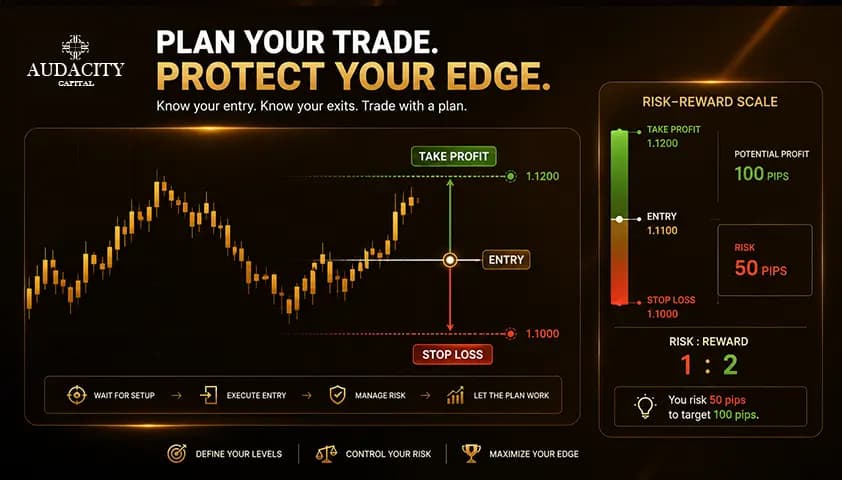
Take Profit vs Stop Loss: How These Two Orders Work Together
Take profit vs stop loss explained for new traders: what each order does, how they differ, how to set them, and why you use both to manage risk on every trade.