



Day Trading Regulations: U.S. Rules, Margin, Short Selling, and Taxes Explained



A trader can open and close positions within the same day in the United States, but the freedom to trade does not remove the rules that govern the account and the market. Margin, short selling, settlement, order execution, trading hours, and tax reporting all have their own requirements.
Understanding the day trading regulations is important in 2026 because the rules governing active margin trading have changed. Effective June 4, 2026, FINRA replaced the former Pattern Day Trader framework and its $25,000 minimum equity requirement with new intraday margin requirements. Syndication Broker-dealers have until 20th October 2027 to complete the transition. Traders should also check how their brokerage currently applies the new framework.
Its Result? Well, a regulatory landscape that looks different from the one described in many older day trading guides. Let’s look into the latest day trading rules and regulations deeply.
What Are Day Trading Regulations?
Day trading regulations are the rules that govern how traders can buy, sell, and finance securities during the trading day. These regulations cover different sections, but the exact requirements depend on the security being traded, the type of account, and the broker handling the transactions.
What counts as day trading?
A day trade happens when a trader buys and sells, or sells and buys back, the same security on the same day. FINRA's definition of day trading applies to securities including stocks and options.
For instance: At 10 am, a trader bought 200 shares of a company, and the position closes at 1:30 pm – the purchase and sale form one day trade. But a trader who starts a position today to carry it overnight before closing it tomorrow is dealing with a different pattern.
In day trading, account type has a crucial role:
- A margin account allows traders to borrow against eligible securities and thus brings margin requirements into the picture.
- A cash account, whereas, does not provide the same borrowing facility, but it still has rules governing the use of cash and the settlement of transactions.
But why are there regulations for day traders?
Regulations for day traders are not meant to restrict frequent trading.
Having margin rules helps manage the financial exposure that is created when traders borrow money from a brokerage firm.
Similarly, the short-selling rules address risks associated with borrowed securities and potentially abusive selling practices.
Market-access rules also require broker-dealers to maintain controls that limit financial exposure and prevent certain erroneous or impermissible orders. SEC Rule 15c3-5, for example, requires appropriate risk controls for firms providing market access.
H3: Regulations vs Broker Rules vs Trading Best Practices
This distinction matters throughout the article. Federal regulations establish one layer, FINRA rules another, and exchanges impose their own operating rules. Brokers can then apply stricter house requirements within the framework that governs their business.
Rule or practice | Typical Example |
Federal regulation | Regulation SHO and Regulation T |
FINRA requirement | Intraday margin requirements |
Exchange rule | Trading sessions and price controls |
Broker house rule | Higher margin requirements |
Trading practice | Stop-loss or position-sizing rules |
The difference between day trading rules and regulations matters because a broker's internal policy should not be presented as federal law.
U.S. Day Trading Rules
For anyone researching day trading regulations US, the first point to understand is that there is no single rule governing every intraday trade. Requirements change based on the account type, security, and amount of leverage involved. A trader using a margin account faces rules around borrowed funds and maintenance equity, while someone using a cash account must pay for purchases in full and manage settlement carefully.
This difference matters because the former Pattern Day Trader rule was only one part of the margin framework. It should not be treated as a synonym for all U.S. day trading rules.
Margin Accounts and Day Trading
With a margin account, a broker can lend money to the trader against eligible assets held in the account. The borrowed amount increases purchasing power, but it also creates an obligation that remains even when the market moves against the position.
The 2026 U.S. Intraday Margin Framework
On June 4, 2026, FINRA's amended margin framework replaced the former day-trading margin provisions with new intraday requirements. The previous system relied on a Pattern Day Trader designation, a $25,000 minimum equity requirement, and a specific day-trading buying-power formula. The new framework instead focuses on the relationship between a trader's equity and the positions held during the day.
The difference can be seen more clearly here:
Before June 4, 2026 | New framework |
PDT status based on qualifying day-trade activity | No PDT designation under the new framework |
$25,000 minimum equity | No fixed $25,000 day-trading requirement |
Day-trading buying power formula | Intraday margin based on account exposure |
Trade count played a central role. | Account equity and position risk take the central role. |
The new framework still has a basic margin-account threshold. The $2,000 is the minimum equity required to use leverage, although a brokerage firm may require more. An account below that amount can still exist as a margin account, but it cannot use borrowed funds. Firms have time up to October 20, 2027, to implement the new requirements. A broker may therefore still operate under the former day-trading requirements until it completes its transition.
What does the change mean for traders?
The change removes the former $25,000 equity floor as the central requirement for frequent margin day trading. That means an account below $25,000 is not automatically subject to the old PDT restriction under the new framework.
However, traders still have to support their positions with enough equity. If an account develops an intraday margin deficit, the firm must require the deficit to be addressed as promptly as possible. Depending on its implementation, a broker may monitor the account continuously and block trades that would create a deficit, or calculate the requirement and issue a margin call.
So, the rule change creates more flexibility, not a free pass to use unlimited leverage.
Cash accounts have different rules
Cash trading follows a different path because the trader is not borrowing money from the broker to purchase the securities. The position must be paid for in full, which makes settlement timing particularly important.
Most U.S. securities transactions now settle on T+1, meaning settlement normally occurs one business day after the trade. If a trader buys a security with unsettled proceeds and sells it before those proceeds have settled, the account can run into a good-faith violation. Buying securities without sufficient settled funds and then using the sale to cover the purchase can also create a free-riding violation under Regulation T.
So, can you day trade without a margin account?
Yes. You can trade intraday in a cash account, but you must use funds available under the cash-account rules and understand how settlement affects what you can trade next.
Margin Requirements for Day Traders

Margin determines how much financial support a trader must provide when using borrowed money. It is one of the most important parts of the modern-day trading regulations framework because it deals directly with the risk created by leveraged positions.
To understand it, simply separate the rules into two questions:
- How much do you need to open a position?
- How much must you keep in the account after opening it?
What is a margin requirement?
A margin requirement is the amount of equity a trader must provide to support a position. The rest may be financed by the broker when the security and account are eligible for margin.
- Initial margin: Equity required when opening a leveraged position.
- Maintenance margin: Equity that must remain available while the position is open.
- Intraday margin: Margin assessed against positions during the trading day.
- Buying power: The amount a trader can use to purchase securities under the applicable margin rules.
- Margin call: A demand to add funds or reduce exposure when an account falls below a required level.
These concepts are related, but they are not interchangeable. A trader may have enough money to open a position but later fall below the maintenance requirement after the security moves against them.
Regulation T and Initial Margin
The Federal Reserve's Regulation T provides the federal baseline for the amount of credit a broker-dealer can extend for many marginable securities. For a standard marginable equity security, the regulation generally sets the initial margin requirement at 50% of the security's current market value, although exceptions and higher requirements can apply.
For example, if a qualifying stock purchase is worth $10,000 and the 50% initial requirement applies, the trader would generally need $5,000 in equity to support the purchase under that baseline.
That does not mean every trader will receive exactly 2:1 leverage. The broker may apply stricter house requirements, and the security itself may be subject to different treatment.
Maintenance Margin
Initial margin answers the question of how much equity is needed when a position is opened. Maintenance margin deals with what must remain in the account afterward.
Under the standard FINRA framework, the maintenance requirement for a long margin security is generally 25% of its current market value. FINRA Rule 4210 also contains different requirements for short positions and particular securities, so the 25% figure should not be treated as a universal requirement for every position.
Now that the two above questions are answered, let’s move forward.
Broker House Requirements
The regulatory minimum is not necessarily the limit your broker will use.
A brokerage firm can impose higher house requirements based on factors such as the security, market conditions, or its own risk controls. FINRA's investor guidance specifically warns traders that firms may require higher minimum equity amounts than the regulatory minimum.
That means two traders with identical account balances can receive different buying power from different brokers.
What happens when you fall below the requirement?
Under the new intraday framework, falling below the required level can create an intraday margin deficit. The broker must require the deficiency to be addressed as promptly as possible. Depending on the firm's chosen system, it may block trades that would worsen the deficit or calculate the deficit and issue a call for additional margin.
A trader may then need to deposit eligible funds or securities or reduce open positions. Repeated failure to deal with intraday deficits can lead to restrictions on margin trading, including a potential 90-day restriction under the applicable rule.
So, margin is not just about how much you can buy, but it also determines how much room your account has to absorb losses while positions remain open.
What Happened to the Pattern Day Trader Rule?
For years, the PDT rule was the rule most retail traders associated with frequent U.S. stock trading. It was designed around the idea that traders making frequent intraday trades on margin needed additional account equity.
Under the former framework, a customer making four or more day trades within five business days was generally classified as a pattern day trader when those trades made up more than 6% of total trades in the account during that period. The designated account then had to maintain at least $25,000 in equity and was subject to a special day-trading buying-power formula.
What the PDT rule used to require?
The legacy system can be reduced to four points:
Former requirement | What it meant |
4+ day trades | Four or more within five business days |
More than 6% | Day trades exceeded 6% of total trades. |
$25,000 equity | Required for a designated PDT account |
Day-trading buying power | Special buying-power calculation applied. |
This was a margin-account rule. It was not a general rule saying that a person needed $25,000 simply to buy and sell stocks during the same day.
Is the PDT rule still in effect in 2026?
No. The former PDT framework was replaced on June 4, 2026. FINRA's new intraday margin requirements removed the old trade-counting approach and the fixed $25,000 day-trading equity requirement. Instead, firms assess whether an account has enough equity to support its positions during the trading day.
Because the former PDT system shaped U.S. day trading for years, references to its $25,000 requirement remain common. That’s why knowing why pattern day trading was never illegal and how the rule changed can give you useful context before looking at the current intraday margin framework.
Why are traders still seeing references to $25,000?
The figure continues to appear because a large amount of older educational material still describes the former system. There is also a transition period during which brokerage firms can move to the new framework at different times. FINRA gives firms until October 20, 2027, to complete the transition, so traders should check the rules and margin policies of their own broker rather than relying on order information.
Short Selling Rules for Day Traders
Short selling lets traders earn a profit from a falling stock price. Without buying shares first, the trader sells borrowed shares and later attempts to buy them back. If the repurchase price is lower, the difference can represent a gain before costs and fees.
However, short selling comes with additional day trading short selling rules that do not apply in the same way to a simple long position.
What is short selling?
The basic process looks like this:
Borrow shares → sell them → buy them back → return the shares
The important point is that the trader needs access to shares that can be borrowed. A broker cannot simply treat every stock as available for short selling.
Locate requirement
Regulation SHO generally requires a broker-dealer to have reasonable grounds to believe that the security can be borrowed and delivered on the settlement date before executing a short sale. The broker must also document compliance with the locate requirement.
This is why a broker may show a stock as unavailable to short even though the stock itself is actively traded.
Rule 201 and the 10% decline trigger
Rule 201 of Regulation SHO introduces another restriction when a covered stock experiences a sharp decline.
If the stock falls 10% or more from the previous day's regular-session closing price, the short-sale price test is triggered.
Once triggered, the restriction generally applies for the remainder of that trading day and the following trading day, subject to applicable exceptions. The rule is designed to prevent short-sale orders from being executed or displayed at or below the current national best bid during the restriction period.
Why Can't You Short Every Stock?
Short availability can change from one stock to another because brokers need access to borrowable shares.
Factors include:
- Share availability: The broker needs a source of shares to borrow.
- Easy-to-borrow status: Stocks with readily available borrow may be easier to short.
- Hard-to-borrow status: Limited supply can make borrowing difficult or expensive.
- Borrow fees: Some stocks carry additional costs for maintaining a short position.
- Broker policies: A firm can restrict short selling beyond the regulatory baseline.
Can day traders short any stock?
No. The stock must be eligible for short selling, the broker must be able to satisfy the applicable locate requirements, and the firm's own policies may limit availability.
U.S. Stock Market Trading Hours

Knowing the rules is only part of day trading. You also need to know is today a regular trading day.
Regular U.S. stock market hours
For the main U.S. equity session, the schedule is straightforward:
Trading session | Time, Eastern Time |
Pre-market | 4:00 a.m. to 9:30 a.m. |
Regular session | 9:30 a.m. to 4:00 p.m. |
After-hours | 4:00 p.m. to 8:00 p.m. |
Nasdaq lists these hours for its regular, pre-market, and after-hours sessions. The NYSE's core trading session also runs from 9:30 a.m. to 4:00 p.m. ET.
Pre-market and after-hours trading
Extended-hours trading gives traders access outside the core session, but the market can behave differently.
During these periods, traders may encounter:
- lower liquidity
- wider bid-ask spreads
- fewer available counterparties
- sharper price movements
- different order restrictions
The exact access and order types depend on the broker and trading venue.
Is today a regular trading day?
This is where checking the calendar matters.
The U.S. market normally operates on weekdays, but exchanges close for scheduled holidays and may shorten the session on certain dates. The NYSE's official 2026 calendar, for example, lists a 1:00 p.m. ET early close on Friday, November 27, 2026, and another on Thursday, December 24, 2026.
So, before assuming the market closes at 4:00 p.m., check the current exchange calendar.
Risk-Management Requirements and Practical Rules
The word "requirements" can be misleading here. Some controls are part of the regulatory framework, while others are simply ways traders manage their own capital. Keeping those categories separate makes day trading regulations US easier to understand.
What regulators control?
Regulators and broker-dealers place limits around areas such as:
- margin and borrowing
- market access
- short selling
- account permissions
- order handling
- financial risk controls
For example, SEC Rule 15c3-5 requires broker-dealers with market access to maintain pre-trade controls that manage financial and regulatory risks. That does not mean the SEC tells every trader where to place a stop or how much capital to risk.
What traders control?
A personal risk plan can cover position size, maximum daily loss, total exposure, and leverage. One useful way to think about position sizing is:
Account size → acceptable loss → stop distance → position size
Suppose a trader is willing to lose $150 on a position and places the stop $3 from the entry. A simple calculation produces a 50-share position before allowing for commissions, slippage, and other trading costs.
The familiar "1% rule" can be used as a personal framework, but it should never be presented as one of the day trading rules imposed by U.S. regulators.
Why leverage deserves attention?
Leverage can make a relatively small price movement produce a large change in account equity. It can therefore magnify losses just as quickly as it magnifies gains.
A practical risk plan might set a maximum loss for each position, a daily drawdown limit and a maximum amount of capital exposed across open trades. The exact figures depend on the trader's strategy and circumstances. They are not part of the statutory day trading account requirements.
Do Day Traders Pay Taxes?
In most cases, taxable trading gains create a tax obligation, but the answer depends on how the IRS classifies the activity, what is being traded, and whether the trader has made a valid tax election.
There is no single day-trader tax rule.
The IRS separates investors from traders in securities. A person seeking to profit from daily market movements may qualify as a trader when the activity is substantial and carried out with continuity and regularity. Simply calling yourself a day trader does not establish that status.
Without a valid Section 475(f) election, a qualifying trader generally reports securities transactions under the capital-gain and loss rules. The wash-sale rules can also apply.
That is why the tax side of Day Trading Regulations should not be reduced to a single percentage or tax bracket.
Other U.S. Rules Day Traders Should Know
The main U.S. day trading rules are only part of the picture. Traders should also understand a few practical rules that can affect how and when they trade:
- T+1 settlement: Most covered U.S. securities transactions settle one business day after execution. The shorter cycle has been in effect since May 28, 2024.
- Broker house rules: A brokerage may set higher margin requirements or restrict short selling, options, deposits, and extended-hours trading beyond the regulatory baseline.
- Market-wide controls: Limit Up-Limit Down can pause or restrict trading when an individual stock moves outside its permitted price bands during periods of unusual volatility.
- Trading records: Keep confirmations, statements, and other transaction records. Clear records make it easier to check your activity and prepare accurate tax reporting.
These rules do not replace the core day trading margin requirements. Instead, they fill in the practical details that traders can encounter when they put those rules into practice.
Conclusion
Day trading is legal in the U.S., but traders must understand the rules that apply to their account and market. The 2026 changes also mean older day trading rules and regulations can no longer be treated as current. Before trading, check your broker's margin requirements, permissions, short-sale availability, market hours, and tax obligations.
Understanding the rules is only the starting point. Audacity Capital helps traders apply their skills in a professional trading environment.
Related Articles
Day Trading Patterns: 12 Chart Patterns Every Trader Should Know
Why Is Pattern Day Trading Illegal?
FAQs
Yes. Day trading regulations allow it, provided traders follow the rules for their account, securities, and broker.
Yes. Day trading regulations us cover margin, short selling, and settlement, while brokers may impose stricter house rules.
No. The former $25,000 PDT requirement was removed when FINRA's new intraday framework took effect in June 2026.
FINRA replaced the former PDT rule with intraday margin requirements based on account equity and exposure.
Yes. Cash accounts do not provide broker leverage, but settled-funds and settlement rules still apply.
Yes, when shares are available to borrow, and the broker and Regulation SHO requirements permit it.
The regular session generally runs from 9:30 a.m. to 4:00 p.m. ET on trading days.

¿Listo para aplicar un riesgo disciplinado a las criptomonedas? Explore los nuevos instrumentos de cripto de Audacity Capital y traiga su estrategia de trading.
Aprender másBoletín
Únase a nuestro boletín para mantenerse al día.
Únete a Nuestra Comunidad Social

Comienza Tu Viaje Hoy Con Nuestra Prueba Gratuita
Muestra con orgullo tus habilidades y logros a través de certificados y obtén reconocimiento por tu arduo trabajo y dedicación de posibles inversores y compañeros.
Prueba GratuitaArtículos Relacionados

RSI Divergence: A Complete Guide to Spotting and Trading Momentum Shifts
Learn what RSI divergence is, explore bullish, bearish and hidden divergence, and discover how to identify, confirm and trade RSI divergence.

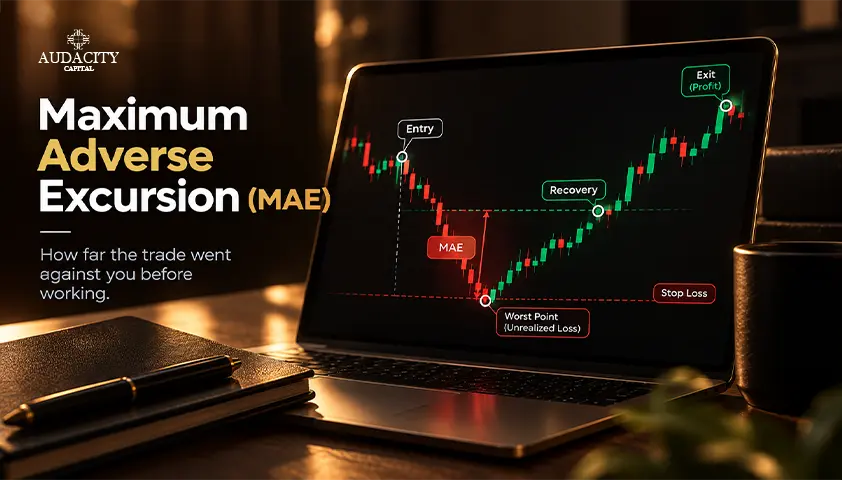
Maximum Adverse Excursion Explained for Traders
Learn how maximum adverse excursion measures a trade's worst open loss, how to calculate MAE, read charts, test stops, and avoid common errors.

Market Profile Trading: How to Read TPO Charts
Learn Market Profile Trading with TPO charts, value area, POC, initial balance, day types, practical examples, and risk controls.
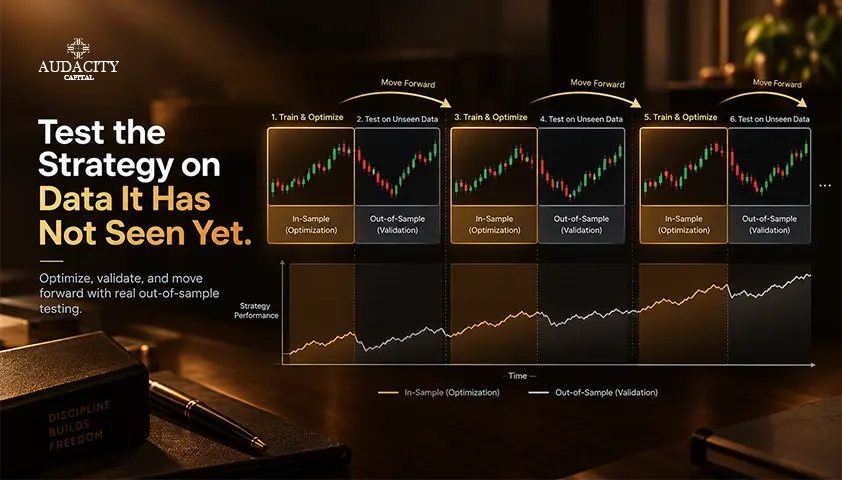
Walk-Forward Analysis in Trading: A Practical Guide
Learn how walk-forward analysis works in trading: in-sample and out-of-sample windows, rolling vs anchored designs, a worked example, and how to read results.