



How to Trade During a Recession: Strategies and Tips for Traders.


Introduction
A recession is a period of declining economic activity. This can have effects on businesses, jobs, consumer activity, and financial markets. A recession can cause lower levels of output within the economy, meaning businesses may lose confidence and there will be less demand from consumers.
Economic downturns can result in greater volatility for traders. This can cause erratic price movements and changes in investor sentiment. Currency values can change based on interest rate decisions. Stocks and commodities can also see significant price changes. Although there could be trading opportunities, it can be an added risk due to the unpredictability of the market.
Trading during a recession can be tricky, but by being adaptable and keeping an eye on market conditions, economic indicators, and risk management, traders can make the most of the situation. You may have to alter your trading strategy, look at position sizing, and avoid making decisions based on fear and speculation. This guide will help you understand how a recession affects financial markets, what trading strategies you can use, what investment opportunities there are, and what mistakes to avoid.
Understanding How a Recession Affects Financial Markets
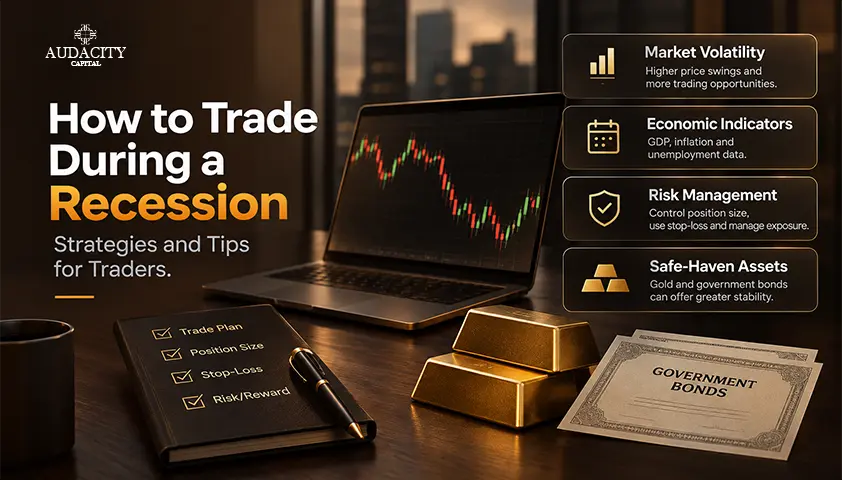
A recession can impact financial markets in several ways. During periods of economic decline, traders should take into account new information, which includes reduced corporate earnings, interest rates, and a decline in consumer confidence. This can lead to large movements in financial markets, causing traders to reassess the value attached to various financial instruments.
If investors understand how a period of economic decline can impact various financial instruments, then it may enable traders to identify possible opportunities.
What Happens to Financial Markets During a Recession?
When a country experiences a recession, and businesses are suffering due to falling sales, profits, and weak demand, stock markets often suffer, and investor concerns may emerge regarding company profits and what it looks like for future economic growth. This often causes increased selling in the markets.
However, sometimes this downturn doesn’t last for long, and prices can begin to recover or increase as investors start to see an improvement in the economy, and central banks can take action by launching policies that benefit the economy.
Investors are often less confident and take on less risk during times of economic uncertainty. During this time, individuals sell off their high risk/high potential assets such as growth stocks and increase the amount of safer defensive assets.
Market volatility may also increase as traders react to economic reports, unemployment figures, inflation data, and central bank announcements. Unexpected developments can trigger rapid price movements and reversals, making it more difficult to predict short-term market direction. Liquidity can also change, particularly in less actively traded markets, where wider bid-ask spreads and reduced trading activity may increase transaction costs.
How Does a Recession Affect Different Asset Classes?
The impact of a recession varies across different asset classes:
Forex markets: Economic downturns can affect currency prices due to changes in interest rates, monetary policy, and sentiment. Currencies from countries suffering badly from the downturn could suffer from selling pressure. However, major currencies such as the US dollar, Japanese Yen and Swiss Franc may benefit from increased demand during periods of uncertainty.
Stock markets: Individual company stocks could fall as companies see lower revenue, profits, and consumer demand. Companies that operate in cyclical industries could be hit badly, such as the travel and manufacturing industries. However, defensive stocks may be more resilient.
Commodities: Gold can be an attractive investment option when investors are looking for a safe-haven asset. The price can also be affected by interest rates and currency fluctuations. Oil could also fall due to lower levels of economic activity, causing less industrial production and transport and energy demand.
Bonds and government: Government bonds, especially those with governments known for being financially stable, can see an increase in demand. Bond prices and yields can, however, fluctuate depending on inflation and interest rate changes, as well as the creditworthiness of the government.
Cryptocurrencies: Digital assets like Bitcoin can be under pressure due to investors pulling out of risky assets. They can vary during times of recession as they are also affected by liquidity, regulation, and industry-specific factors.
Overall, a recession does not affect every financial instrument in the same way. Traders should assess the economic factors influencing each market rather than assume that all assets will follow the same direction.
Is Trading During a Recession a Good Idea?
Trading in a recession can be both beneficial and challenging depending on the conditions of the market you are trading. Whilst an economy is in a downturn, it can create uncertainty but can also create some great opportunities. Interest rates, corporate earnings, and investor sentiment can all change, which can create opportunities in the forex, stocks, commodities, and other financial markets.
The increased volatility can be beneficial to traders who know how to analyze price movements and find potential trends. However, the increased price movements can create more risk of losing money if you are using too much leverage or placing trades with no clear plan. Stop-loss orders can also be affected by sudden market reversals after economic news.
Before you get into any positions, you should know what is happening economically with the markets you are looking at trading. Keeping an eye on inflation data, employment rates, GDP reports, and central bank decisions can often be useful. Using both fundamental and technical analysis can help.
Don’t fall into the trap of buying everything that goes down. Some assets may just keep going down as they have poor fundamentals, less demand, or have been suffering from long-term issues. This can turn into bad investments during a recession, especially if you ignore the risk factors involved.
Ultimately, trading during a recession is not necessarily a good or bad idea. Success depends on preparation, realistic expectations, disciplined execution, and the ability to manage risk in changing market conditions.
How to Trade During a Recession: 7 Strategies for Traders
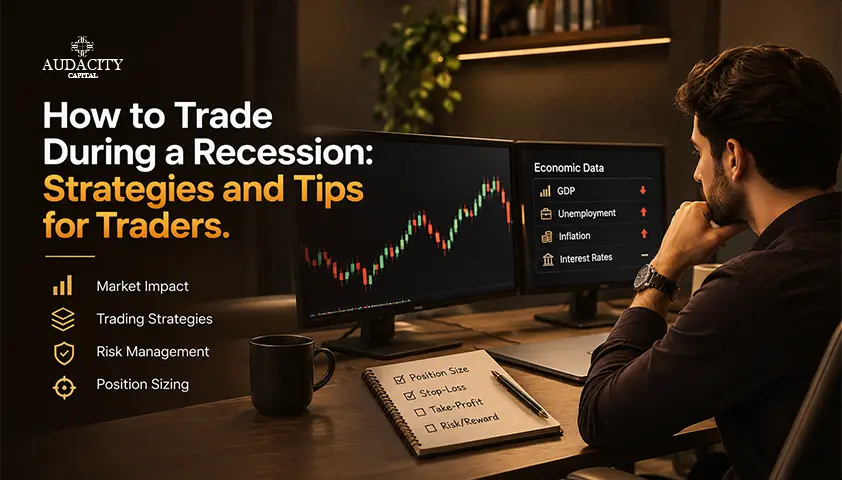
Trading during a recession means that you need to have a plan in place, as the economy can cause market movements, volatility, and investor behavior. Being aware of the changing economic conditions and adjusting your strategy will help protect your capital and identify any opportunities. Below are some strategies you can consider when trading during an economic downturn.
Focus on Risk Management
Risk management is very important to consider when trading in a recession. Uncertainty can cause rapid price swings in the financial markets. By setting limits and having clear risk management rules, traders can protect their trading capital and take trades confidently.
Stop-loss orders can help control any possible losses incurred from a trade going against you. Setting target profit levels will ensure that traders know when to close their positions realistically. However, stop loss orders cannot guarantee they will be filled at the set price due to large gaps within the financial market.
Position sizing is also very important when trading. Traders should decide how much they want to risk within each trade depending on their account balance and how far away their stop-loss order is. Traders should not use too much leverage, as this can increase losses as much as it can double profits. Proven strategies should be used to help protect your capital. You should also avoid attempting to gain from every movement within the market, as you may end up losing more than expected.
Monitor Economic Indicators
Economic indicators are very useful to give insight into how the economy is performing. Traders should keep an eye on Gross Domestic Product (GDP), inflation, unemployment, and interest rates.
This is because if GDP is falling and unemployment is increasing, this can indicate a slowing economy, which could impact share prices and currency. Inflation can also impact interest rates, as central banks decide whether to increase, decrease, or leave them the same. This can influence the demand for currencies, bond yields, and market sentiment.
Central banks such as the US Federal Reserve and the European Central Bank are very important to keep an eye on. When they make announcements about monetary policy, they can cause large market movements. Traders can use economic calendars to keep track of when announcements will be made, what date they will be published, and what the expected figures will be.
By comparing actual figures to what the market was expecting, traders can get an understanding of why prices move after an economic release. However, economic indicators shouldn’t be the only thing you look at. You should combine fundamental information with technical analysis to get a better understanding of potential trading opportunities.
Consider Safe-Haven Assets
In a recession, investors may look to invest in safe-haven assets. These include gold, government bonds, and currencies like the US dollar, Japanese yen, and Swiss Franc. Investors may want to reduce risk, and therefore demand may increase in assets such as gold. Gold is often seen as a safe way to store value during economic uncertainty. Government bonds from countries with strong financials also may appeal to investors.
However, it is important to understand that demand for safe haven assets will vary depending on market sentiment. Factors such as interest rates, inflation, currency strength, and geopolitical factors may affect the price. For example, if interest rates increase, this can put downward pressure on gold prices. There is still some risk involved with safe haven assets, and prices can move quite substantially. Traders should always look at market conditions before entering any positions.
Adjust Your Trading Strategy
During a recession, market volatility can increase as traders react to various economic reports, central bank announcements, and unforeseen events. This can cause increased volatility in prices and sudden changes, meaning traders should consider adapting their strategy.
Traders can consider decreasing their position sizing, adjusting stop losses, or waiting for more confirmation before entering a trade. Technical traders can look at the support and resistance levels, trend and volatility indicators to see where they could enter or exit.
Avoid chasing the market; if there has been a large increase or decrease in price, do not enter into a trade just because the asset is moving quickly. This can cause you to enter trades at poor prices and, in turn, face unexpected reversals. By being patient and having a clear trading plan, you will be able to make more informed decisions during volatile market conditions in a recession.
Explore Forex Trading Opportunities
Whenever you see an economy fall, there will be many opportunities in the forex market to capitalize on. An economy that is declining will have a negative effect on the currency. This can be due to a decline in economic growth, rising unemployment, or less activity within the country. A central bank cutting its interest rates will cause a reduction in demand for that currency, as investors may not want to hold the asset anymore.
You can look at the major currency pairs (EUR/USD, GBP/USD & USD/JPY) and try to figure out where you could gain some profits. Tracking economic data and Central Bank announcements will help give you insight into why the currency is moving. Remember, fundamental analysis might not be enough to give you buy/sell signals, so it is advisable to combine fundamental analysis along with technical analysis (trends, support/resistance, patterns, etc.) to have an idea of how the market could move.
Maintain a Disciplined Trading Approach
When trading in a recession, it is important to stay disciplined. Market volatility can often cause you to make impulsive trades based on emotions. You should have a set trading strategy in place outlining the entry/exit criteria, risk management, position sizing, and profit targets. Having this in place will help you stay in control of your decisions.
Try to avoid making any trades based on fear, greed, or trying to recoup lost money. This can happen if you start increasing trade sizes after a loss. Be patient and only open trades based on your set criteria.
Keeping a trading journal will help with discipline. You can track your trades, market conditions, entry and exit points, and see how you are doing. You will be able to identify where you are going wrong repeatedly and what strategies need changing. This will help you to constantly improve and stay disciplined through the uncertain times of the economy.
Common Mistakes to Avoid When Trading During a Recession
Trading in a downtrend economy can be risky if you're not careful. Knowing what mistakes traders commonly make will help you avoid them and improve your trading performance.
Over Leveraging
Leveraging could increase the potential losses within a market. If prices in the market go against you, this can have a negative effect on your overall profits. During a recession, prices can change unpredictably, and traders could easily suffer massive losses by leveraging heavily on their positions. Leverage should be used very carefully, and you may want to always make sure that you're only ever risking as much as you are comfortable with.
Not Paying Attention to Economic Data
Central banks and economic reports can greatly affect the trading markets during a recession. If you aren't paying attention to your economic data such as GDP figures, inflation data, unemployment, and interest rate decisions, then you could be caught out when prices move suddenly. By following reliable financial news websites and using economic calendars, you will be able to predict key events before the moves happen.
Panic trading
When there are large price movements in the market, traders can get scared and act irrationally. Selling early or buying because prices have fallen will lead to bad trading decisions. Traders should consider the market situation first before opening any trades.
Not adapting your strategy.
During a recession, the market conditions can be very different. If you don’t adjust your strategy, it can cause you to incur unnecessary losses as you are not taking into consideration the changes in volatility, liquidity, and market trends. You should always review and adapt your strategy depending on how the market behaves.
Ignoring Risk Management
Failing to use stop loss, sizing, and risk management can expose you to unexpected losses. Before opening a trade, decide on how much you are willing to risk. Don’t risk too much on any one trade.
Chasing the Market
This is caused by a fear of missing out (FOMO) and can lead to poor trade entries. Traders will often enter trades after large price movements, which can cause them to get bad entries and be exposed to large market reversals. Instead, wait for good entry conditions to meet your trading plan.
Practical Tips for Managing Trades During Economic Uncertainty
As mentioned earlier, uncertainty in the economy can cause markets to become more volatile. Here are some tips to help you trade with care and discipline.
Keep up to date with Economic news. Always follow financial news and economic reports. Take note of what the central bank is doing. Keep an eye on how the economy is performing (GDP, Inflation, Unemployment) and changes in interest rates that may impact the market.
Reduce your position sizes. If the market becomes more volatile, it may be wise to reduce your position sizes. This will limit any potential losses you may have.
Protect Essential Funds: Avoid trading with money reserved for rent, food, bills, debt repayments, or other essential expenses. Only use capital you can afford to lose without compromising your financial responsibilities.
Practice with a Demo Account: Test trading strategies in a simulated environment before applying them in live markets. This allows you to evaluate how your approach performs under different market conditions without risking real money.
Keep Track of Your Trading Performance: Keep a Trading Journal to help you track your performance. This will help you to learn from your mistakes, understand how effective your strategy is and know when to make changes.
Stay Patient & Protect Your Capital: Don’t try to force trades if you are unsure of the market. Try to focus on protecting your capital. Sometimes it’s better to sit on your hands until a better opportunity presents itself.
Conclusion
Trading during a recession can be tricky, but you can prepare and be flexible to trade more effectively. With the economy in decline, financial markets always react to the changes, so it is important that you develop a working strategy, depending on the market conditions present.
Managing risk, analyzing the economy, and being disciplined are all very important. Monitoring key economic indicators, controlling your position size, using appropriate stop-loss levels, and avoiding making any snap decisions will also help you make informed decisions in the Market. You should also diversify your trading and regularly review how you are doing.
However, it is not guaranteed that you will be able to profit from a recession. Volatility increases and traders are exposed to large losses. Therefore, you should always look to protect your trading capital even before thinking of opening any trade.
When trading, you should have a structure in place. It should include your trading goals, risk tolerance, and rules for when you enter and exit trades. Having a trading plan will help you trade more professionally and make better decisions based on the uncertain economy.
Frequently Asked Questions
Yes. Market volatility can create trading opportunities, but unpredictable price movements also increase the risk of losses.
There is no single best asset. Gold, major currency pairs, government bonds, and defensive stocks may attract attention depending on market conditions.
Gold may benefit from increased safe-haven demand, but its price can also decline due to interest rate changes and currency movements.
The US dollar (USD), Japanese yen (JPY), and Swiss franc (CHF) are commonly considered safe-haven currencies.
Yes. Increased volatility, sudden price reversals, and changing interest rate expectations can increase forex trading risks.
Beginners should learn fundamental and technical analysis, practice with a demo account, use appropriate position sizes, and follow a clear risk management plan.

¿Listo para aplicar un riesgo disciplinado a las criptomonedas? Explore los nuevos instrumentos de cripto de Audacity Capital y traiga su estrategia de trading.
Aprender másBoletín
Únase a nuestro boletín para mantenerse al día.
Únete a Nuestra Comunidad Social

Comienza Tu Viaje Hoy Con Nuestra Prueba Gratuita
Muestra con orgullo tus habilidades y logros a través de certificados y obtén reconocimiento por tu arduo trabajo y dedicación de posibles inversores y compañeros.
Prueba GratuitaArtículos Relacionados
Risk Return Trade Off in Financial Management: A Complete Guide
A complete guide to the risk return trade off in financial management: types of risk, sources of return, and how to strike the right balance.

Why Every Trader Sees The Chart Differently ?
Unlock the secrets of trader chart interpretation. Understand why different traders see the same chart differently and how it affects trading.
Stop Loss Orders To Reduce Risk
Earn more profit by using stop loss orders techniques to reduce risk in forex trading. One of the best strategy to keep more profit.

12 Trading Risk Management Tools Every Trader Needs
Explore 12 trading risk management tools for position sizing, trade planning, drawdown control, journaling, and smarter trading decisions.