


India's Options Trading Boom: What's Driving Retail Interest?



India has become one of the world's largest markets for equity derivatives, with options playing a particularly important role in retail trading. But the latest data shows that the story is no longer simply about rapid growth.
In FY2025–26, the number of individual traders in India's equity derivatives market declined from the previous year, while aggregate retail losses also fell. At the same time, options continued to account for most individual-trader activity and losses.
So, is India's options trading boom continuing?
The answer depends on what you measure. Retail participation has cooled, but options remain a major part of India's derivatives market. Regulatory changes introduced by SEBI have also changed how and when traders participate.
This article examines the latest data, the reasons behind India's strong interest in options, the impact of regulatory changes, and what traders should understand before participating in the market.
What Is Driving Options Trading in India?
Several factors have contributed to the popularity of options trading among Indian retail investors.
1. Easy access to online trading
Digital brokerage platforms have made it significantly easier for individuals to open trading accounts and access derivatives.
SEBI and other industry research have previously linked the expansion of retail market participation with digitalisation, easier account opening and greater financial-market access. SEBI-linked research showed individual participation in equity derivatives rising substantially between FY20 and early FY25.
2. Interest in short-term trading
Options can be used for short-term strategies because their prices respond not only to movements in the underlying asset but also to factors such as time to expiry and implied volatility.
This has contributed to strong interest in short-duration index options.
3. Relatively small upfront capital
An options buyer generally pays a premium rather than purchasing the underlying asset outright. This can make options appear accessible to traders with smaller amounts of capital.
However, a smaller initial outlay does not mean lower risk. Options can lose value rapidly, particularly as expiration approaches.
4. Index options dominate retail interest
India's retail derivatives activity is heavily concentrated in options. SEBI's FY25–FY26 studies found that options accounted for the overwhelming majority of individual traders' activity and losses in the equity derivatives segment.
Is Options Trading Actually Booming in India?
The latest data requires some context.
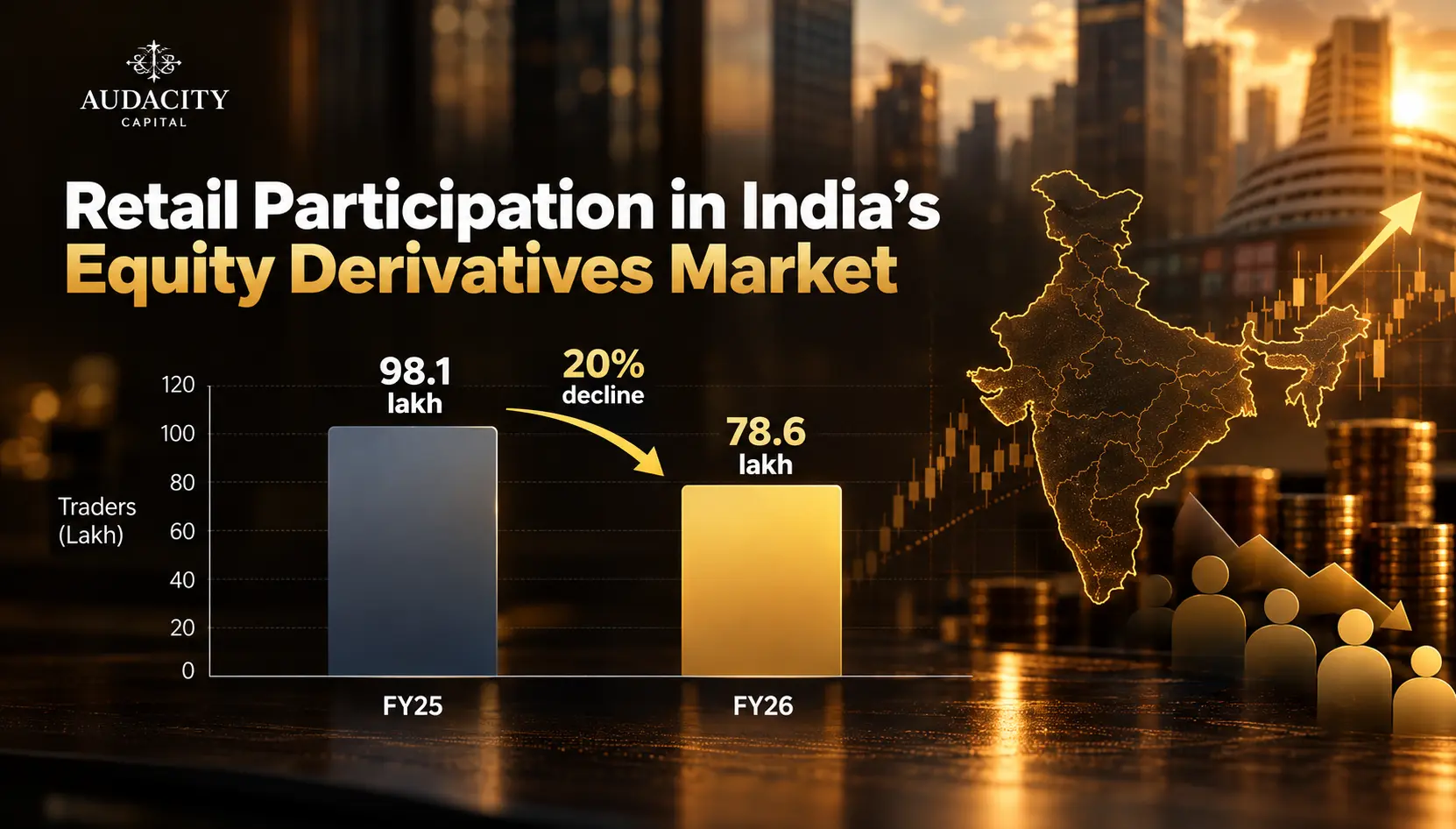
SEBI's FY25–FY26 study found that the number of active individual equity-derivatives traders declined from 98.1 lakh in FY25 to 78.6 lakh in FY26, a decline of about 20%. New entrants also fell during the period.
Aggregate net losses among individual traders also declined, from approximately ₹1.12 lakh crore in FY25 to ₹91,685 crore in FY26.
That means describing the latest period simply as an accelerating retail boom would be misleading.
A better description is that India continues to have a large and highly active options market, while retail participation has moderated following regulatory changes.
India's Retail F&O Market: Key Numbers
Metric | FY25 | FY26 |
|---|---|---|
Individual traders | 98.1 lakh | 78.6 lakh |
Aggregate individual net losses | ₹1.12 lakh crore | ₹91,685 crore |
Individual trader participation | — | Declined |
Options' role in individual losses | — | About 92% |
Source: SEBI's FY25–FY26 studies and government-reported data.
Why Are Options Still So Popular With Indian Traders?

The decline in the number of individual traders doesn't mean options have become irrelevant.
SEBI's latest research shows that options continued to dominate individual participation in equity derivatives. Reporting based on the SEBI study indicates that approximately 99.3% of individual derivatives traders traded options at least once, while around 93.4% traded only options in FY26.
Several characteristics help explain this concentration.
Options provide defined-cost entry for buyers
An options buyer pays a premium to acquire the contract. This differs from buying the underlying asset outright.
Options offer multiple strategies
Traders can use options for:
- Directional trading
- Hedging
- Income strategies
- Volatility strategies
- Spread strategies
However, different strategies have very different risk profiles.
Expiry creates short-term opportunities and risks
Options lose time value as expiration approaches, all else equal. This makes short-dated options particularly sensitive to changes in the underlying market and volatility.
SEBI has specifically examined the concentration of retail index-options activity close to expiry.
How Much Options Trading Happens Near Expiry?
One of the most interesting findings from SEBI's FY25–FY26 trading-behaviour study is how concentrated individual index-options activity remains around expiry.
According to reporting based on the study, around 59% of individual index-options turnover occurred on expiry day in FY26, compared with about 70% in FY25.
Around 75% occurred on expiry day or within one day of expiry, while approximately 97% occurred within seven days of expiry.
Individual Index-Options Turnover by Time to Expiry
Time to expiry | Share of FY26 turnover |
|---|---|
On expiry day | ~59% |
Expiry day + 1 day | ~75% cumulative |
Within 7 days | ~97% cumulative |
More than 7 days | ~3% |
This concentration matters because options become increasingly sensitive to time decay and changes in the underlying asset as expiration approaches.
What Changed in India's Options Market?
SEBI introduced several measures affecting the equity-derivatives market, particularly index derivatives.
These measures included changes relating to:
- Index-derivative contract sizes
- Expiry-day risk measures
- Weekly index derivative products
- Upfront option-premium collection
- Position-limit monitoring
- Other risk-management requirements
SEBI's stated objective has included strengthening the index-derivatives framework and addressing concerns around excessive speculative activity and investor risk.
The effects are visible in market activity.
According to reporting based on SEBI's FY25–26 annual report, options contract volumes declined by about 51% during FY26 after the regulatory changes.
That is an important distinction:
The number of traders and options volumes have fallen, but options remain central to India's retail derivatives market.
Are Indian Retail Options Traders Making Money?
This is one of the most important questions to answer when discussing India's options market.
SEBI's FY25–FY26 profitability study found that 87.7% of individual traders in equity derivatives incurred losses during the financial year. Aggregate net losses were approximately ₹91,685 crore.
The average loss per trader was also reported at roughly ₹1.17 lakh, meaning that a decline in aggregate losses does not necessarily mean that individual traders experienced better outcomes. The number of active traders also declined substantially.
Why this matters
Trading activity and profitability are two different measures.
A market can have:
- High trading volume
- Large numbers of participants
- Frequent transactions
without the average retail participant being profitable.
For anyone researching options trading, this distinction is more useful than simply looking at market turnover.
Read our Guide about How Much Money Do You Need to Start Options Trading?
Why Do So Many Retail Traders Lose Money?
SEBI's data does not establish one single cause for every individual trader's losses. However, the market characteristics highlight several risks traders need to understand.
1. Short holding periods
Very short-term options trading leaves little room for mistakes in entry, timing or execution.
2. Time decay
An option's time value generally declines as expiration approaches, all else equal. This can work against buyers when the underlying asset does not move sufficiently.
3. Volatility
Option premiums can change quickly when implied volatility rises or falls.
4. Overtrading
High-frequency trading can increase transaction costs and make it harder to maintain a consistent strategy.
5. Expiry-day concentration
SEBI's data shows that a large share of individual index-options turnover occurs on or close to expiry.
6. Transaction costs
Trading costs matter, especially when traders make frequent short-term transactions.
SEBI's studies have highlighted transaction costs as a significant factor affecting retail trading outcomes.
Options Trading vs Investing: What's the Difference?
Options trading and long-term investing involve different objectives and risk structures.
Factor | Options Trading | Long-Term Investing |
|---|---|---|
Typical holding period | Short to medium term | Often years |
Expiration | Options have defined expiry dates | Shares generally do not expire |
Time decay | Relevant | Not applicable in the same way |
Leverage | Can be embedded in exposure | Generally lower |
Complexity | Higher | Usually simpler |
Primary focus | Price, volatility and timing | Business/asset value and long-term growth |
Neither approach automatically produces a particular outcome. The appropriate approach depends on the individual's objectives, risk tolerance, knowledge and circumstances.
What Should Traders Check Before Trading Options?
Anyone considering options should understand the contract before placing a trade.
Check the underlying asset
Understand what the option derives its value from.
Check the strike price
Know the relationship between the strike and current market price.
Check the expiry
Short-dated options can behave very differently from longer-dated contracts.
Understand the premium
For an option buyer, the premium represents the upfront cost of the contract.
Understand the maximum possible loss
The risk depends heavily on whether you are buying or writing options and on the strategy being used.
Consider liquidity
Higher liquidity can make it easier to enter and exit positions, although it does not eliminate market risk.
Understand transaction costs
Brokerage, exchange charges, taxes and other costs can affect the final result.
What Does the Future of Options Trading in India Look Like?
The latest evidence points to a market that is changing rather than simply disappearing or continuing its previous growth trajectory.
Retail participation declined in FY26, options contract volumes fell substantially, and aggregate individual losses decreased following regulatory changes. At the same time, options remain deeply embedded in India's equity-derivatives market.
The key question going forward is therefore not simply whether Indians will continue trading options.
It is how trading behaviour changes as regulation, market structure, technology and investor awareness evolve.
SEBI's continued publication of data on participation, trading behaviour and profitability provides an important source for tracking these changes.
Key Takeaways
- India's options market remains one of the most important parts of its retail derivatives ecosystem.
- The latest SEBI data shows that individual participation declined in FY26, rather than continuing its earlier upward trend.
- Active individual traders fell from 98.1 lakh to 78.6 lakh between FY25 and FY26.
- Aggregate individual net losses declined from about ₹1.12 lakh crore to ₹91,685 crore.
- 87.7% of individual equity-derivatives traders recorded losses in FY26.
- Options remained the dominant product among individual derivatives traders.
- A large proportion of individual index-options activity continued to occur close to expiry.
- Regulatory changes have significantly altered trading volumes and market behaviour.
Related Articles
Best Options Prop Trading Firms : An Honest Map of Who Actually Funds Options
FX Options Trading: How It Works in Forex Markets?
Sources & Further Reading
For credibility, I would include a “Sources” section at the bottom of the article, but also link the relevant source directly beside important statistics.
Primary sources
- SEBI — Trading Behaviour of Individual Traders in the Equity Derivatives Segment (FY25–FY26) SEBI study
- SEBI — Profitability of Individual Traders in the Equity Derivatives Segment (FY25–FY26) SEBI profitability study
- SEBI — Key findings on retail participation, trading behaviour and profitability SEBI press release
- SEBI — Index derivatives framework consultation paper SEBI consultation paper
Supporting sources
- Reuters — Retail option trader losses fell after regulatory curbs
- The Economic Times — Options volumes in FY26
- Indian Express — Retail F&O participation and demographics
Frequently Asked Questions
Yes. Options remain a major part of India's equity-derivatives market, particularly among individual traders. However, SEBI's FY25–FY26 data shows that the number of active individual derivatives traders declined from the previous financial year.
SEBI reported 78.6 lakh individual traders in the equity-derivatives segment in FY26, down from 98.1 lakh in FY25. This figure covers individual traders in equity derivatives rather than options traders alone.
SEBI's FY25–FY26 study found that 87.7% of individual equity-derivatives traders incurred losses.
Accessibility through online trading platforms, interest in short-term trading, the relatively small upfront premium required by option buyers, and the availability of index options are among the factors associated with strong retail interest.
Options volumes declined significantly in FY26 following regulatory changes introduced by SEBI. These included measures affecting contract sizes, expiry structures, premium collection and risk management.
Yes. Options can involve substantial risk, particularly when traders use leverage, trade close to expiration, or use complex strategies without fully understanding how premiums, volatility and time decay affect the position.

Prêt à appliquer un risque discipliné aux cryptos ? Explorez les nouveaux instruments crypto d'Audacity Capital et apportez votre stratégie de trading.
En savoir plusNewsletter
Rejoignez notre newsletter pour rester informé.
Rejoignez Notre Communauté Sociale

Commencez Votre Voyage Aujourd'hui Avec Notre Essai Gratuit
Affichez fièrement vos compétences et réalisations grâce à des certificats et obtenez la reconnaissance de votre travail acharné et de votre dévouement auprès d'investisseurs potentiels et de pairs.
Essai Gratuit