


How Much Money Do You Need to Start Options Trading? (Beginner’s Guide 2026)



You can start options trading with as little as $100–$500, but realistically:
$500–$1,000 → learning phase
$1,000–$3,000 → beginner trading
$5,000+ → serious options trading
$0 (via funded trading with Audacity Capital) → trade with larger capital
Options trading is less about starting capital—and more about risk control and strategy.
How Much Money Do You Need to Start Options Trading
Starting options trading requires a clear understanding of capital requirements and risk management. Most traders enter this market with anywhere from $1,000 to $10,000, depending on their strategy.
This guide breaks down the specific costs, margin requirements, and account minimums required for successful trading. Every figure provided is designed to help you determine your ideal starting balance.
Minimum Capital to Start Options Trading
Small Account ($500–$1,000)
Limited strategies (mostly buying options)
Higher risk due to limited diversification
Faster account drawdowns possible
Best for learning, not consistent income
Mid-Level Account ($1,000–$3,000)
Ability to use basic strategies
Better risk management
Some diversification possible
Ideal starting range for most traders
Serious Options Trading ($5,000+)
Access to advanced strategies (spreads, hedging)
Better capital protection
More consistent performance
Required for long-term sustainability
Brokerage and Regulatory Minimums

Determining the starting capital for options trading depends on three pillars: regulatory requirements, broker minimums, and strategy-specific risk.
If using:
Cash Accounts: $0 - $500 minimum
Margin Accounts (Standard): $2,000 minimum
Pattern Day Trader (PDT) Accounts: $25,000 minimum
Comparison Table Showing How Minimum Accounts Affect Your Ability to Use Leverage
Account Type | Minimum Deposit | Ability to Leverage |
|---|---|---|
Standard Cash | $0 - $100 | None |
Standard Margin | $2,000 | 2x - 4x |
Portfolio Margin | $100,000+ | 6x - 10x |
PDT Margin | $25,000 | 4x (Day Trading) |
Standard Account Minimums by Brokerage
Brokers have varying entry barriers for options trading. While some allow $0 balances, most professional platforms require a functional minimum for margin accounts.
Broker Category | Minimum Deposit | Best For |
Discount Brokers (Robinhood/Webull) | $0 - $100 | Beginners |
Professional Brokers (Interactive Brokers) | $2,000 | Active Traders |
Specialized Options Platforms (tastytrade) | $2,000 (for margin) | Complex Strategies |
Full-Service Firms (Charles Schwab) | $0 - $1,000 | Long-term Investors |
If you’re unable to meet the minimums stated above, you can always try your hand at prop trading. Firms like Audacity Capital have made it easier to access funding via Funded Trader Programs.
FINRA Regulation T and Pattern Day Trader (PDT) Rules
Regulatory bodies enforce strict capital rules for frequent options traders. Violating these can lead to account restrictions and frozen assets.
If you execute four or more-day trades within five business days, you are automatically classified as a Pattern Day Trader. This classification triggers a significantly higher capital requirement.
- PDT Minimum Equity: $25,000
- Regulation T Margin: 50% of purchase price
- Maintenance Margin: 25% of market value
- Day Trading Buying Power: 4x maintenance margin excess
Strategy-Specific Capital Requirements
If using:
Long Calls/Puts: $50 - $500 per contract
Vertical Spreads: $200 - $1,000 per spread
Cash-Secured Puts: $5,000 - $50,000+
Iron Condors: $500 - $2,500 per setup
Capital Requirements by Trading Strategy
Strategy | Recommended Starting Capital | Risk Level |
|---|---|---|
Buying Long Calls/Puts | $1,000 - $2,500 | High |
Covered Calls (100 shares) | $5,000 - $50,000+ | Moderate |
Vertical Credit Spreads | $2,000 - $5,000 | Moderate |
Iron Condors | $5,000 - $10,000 | Moderate |
Naked Puts (Cash Secured) | $10,000 - $100,000 | Low to Moderate |
Understanding the Cost Per Contract
Options are leveraged instruments where one contract typically represents 100 shares of the underlying stock. The price you pay is the premium.
For example:
Average Premium for Low Volatility Stocks: $0.50 - $2.00 per share ($50 - $200 per contract)
Average Premium for High Volatility Stocks: $5.00 - $15.00 per share ($500 - $1,500 per contract)
Out-of-the-Money (OTM) Options: $0.05 - $0.50 ($5 - $50 per contract)
Deep In-the-Money (ITM) Options: $20.00+ ($2,000+ per contract)
Commission Structures and Hidden Fees
Transaction costs eat into small accounts quickly. It is essential to calculate your 'break-even' point including these fees.
Some of the fees you must consider in your calculations are:
Standard Commission: $0.00 - $0.65 per contract
Exercise/Assignment Fees: $0.00 - $20.00
Regulatory Fees (SEC/ORF/FINRA): $0.01 - $0.05 per trade
Data Feed Subscriptions: $0.00 - $120.00 per month
The 2% Rule and Capital Allocation
Professional traders never risk their entire balance on a single trade. Adhering to percentage-based sizing ensures longevity in the market.
The following is an example that can help you better understand the 2% rule:
Max Risk Per Trade: 1% to 2% of total account value
For a $5,000 Account: Risk only $50 - $100 per trade
Max Portfolio Heat (Total Open Risk): 10% to 15%
Target Profit/Loss Ratio: 2:1 or 3:1
Traders who succeed in options trading are those who have mastered discipline, consistency, and risk management.
Capital Protection by Strategy Type
Strategy Type | Maximum Risk Potential | Recommended Stop-Loss | Capital Buffer Required |
|---|---|---|---|
Long Calls/Puts | 100% of Premium Paid | 50% of Premium | High (High Volatility) |
Vertical Spreads | Width of the Spread | 50% of Max Profit Target | Moderate |
Iron Condors | Limited to Spread Width | 2x the Credit Received | Moderate |
Naked Puts | Substantial (Stock Price to $0) | 200% of Premium Received | Very High |
Essential Risk Management Numbers
Beyond position sizing, you must also learn to track "The Greeks" to quantify how much money is at risk based on time and price movement.
Delta (Price Sensitivity): Represents the expected change in option price for a $1 move in the stock.
Theta (Time Decay): The dollar amount an option loses every day as it approaches expiration
Vega (Volatility): The impact of a 1% change in implied volatility on the option's price.
Stop-Loss Placement: Professional traders often set technical stops at 20% to 50% of the initial premium to preserve remaining capital.
The Importance of Risk Management for Options Traders
Effective risk management is the difference between long-term profitability and a total account wipeout.
Because options are leveraged instruments, small market moves can result in significant percentage losses if not managed mathematically.
Sample Trade Scenarios and Capital Drawdown
Calculating potential outcomes helps in visualizing how account balances fluctuate. Below are examples based on a $5,000 starting balance.
Trade Type | Contract Price | Quantity | Total Outlay |
AAPL Call (OTM) | $1.50 | 3 Contracts | $450 |
TSLA Spread (5-wide) | $2.00 | 5 Contracts | $1,000 |
SPY Put (ITM) | $8.50 | 1 Contract | $850 |
MSFT Iron Condor | $1.25 | 10 Contracts | $1,250 |
An Options Trader’s Daily Workflow

Following a disciplined daily routine ensures that capital is allocated based on data rather than emotion. And more importantly, having a structured timeline allows you to manage "The Greeks" and adjust positions before volatility spikes.
Pre-Market Preparation (8:00 AM – 9:30 AM EST)
This phase is dedicated to scanning the market and identifying potential trade setups before the opening bell.
- Check Economic Calendar: Identify high-impact events like CPI data or FOMC meetings that could spike volatility.
- Monitor VIX Levels: A VIX above 20 indicates high market fear, suggesting higher premiums for sellers.
- Review Overnight Moves: Track S&P 500 futures to gauge market sentiment and potential gap-ups or gap-downs.
- Update Watchlist: Select 5–10 liquid stocks with high open interest to ensure tight bid-ask spreads.
Market Open and Execution (9:30 AM – 11:00 AM EST)
The first 90 minutes of the trading day see the highest volume and volatility. Professional traders use this window to execute or adjust core positions.
- First 15-Minute Rule: Avoid entering new trades in the first 15 minutes to let the initial morning volatility settle.
- Execute New Trades: Enter positions based on pre-set Delta and Vega targets.
- Adjust Existing Spreads: Roll or close positions that have hit 50% of their maximum profit target.
- Verify Buying Power: Ensure the account balance remains above the $2,000 margin minimum or $25,000 PDT threshold.
Mid-Day Maintenance and Post-Close (11:00 AM – 4:30 PM EST)
Consistency is built through recording data and reviewing performance. The post-market wrap-up helps prepare you for the next session.
- Monitor Theta Decay: Observe how time decay has affected the value of your short contracts throughout the day.
- Check Earnings Calendar: Verify that none of your held stocks have earnings reports after the bell to avoid "IV Crush".
- Log Trades in Journal: Record the entry price, contract type, and the why behind every trade.
- Review Daily P/L: Calculate the daily change in account equity against the total 2% risk limit.
Smarter Approach: Trade With Larger Capital (Without Risking Your Own)
Here’s the reality:
Small options accounts are hard to grow consistently.
That’s why traders consider firms like Audacity Capital:
Access larger capital without personal financial risk
Trade with structured risk models
Scale based on performance and consistency
This allows traders to focus on execution—not capital limitations.
Realistic Expectations
Let’s be honest:
$500 account → learning only
$2,000 account → slow growth
$10,000+ → meaningful returns
Traders who succeed (including those working with Audacity Capital) focus on:
✔ strategy
✔ discipline
✔ consistency
—not just account size.
Common Mistakes to Avoid
Overleveraging options contracts
Ignoring time decay
Trading without a strategy
Risking too much per trade
Most beginners fail due to poor risk management—not lack of capital.
Conclusion
To trade options effectively, a minimum of $2,000 is recommended for margin accounts, while $25,000 is required for unrestricted day trading.
Focus on strategies that match your capital level and prioritize risk management above all else to maintain your trading longevity.
At Audacity Capital, we find that the traders who succeed, and go on to become funded are those who are disciplined and who know how to apply risk management practices.
Related Articles
Read more about our guide How Much Money Do You Need to Start Trading?
Learn more about our latest guide How Much Money Do You Need to Start Forex Trading?
Read more about Our guide How Much Money Do You Need to Start Trading Stocks?
Read more about How Much Money Do You Need to Start Trading Futures?
Learn more about our guide How Much Money Do You Need to Start Swing Trading?
Leran more about our latest guide How Much Money Do You Need to Start Crypto Trading?
Read more about our guide How Much Money Do You Need to Start Day Trading?
Check about Best Options Trading Firms 2026
Frequently Asked Questions
Yes, but it’s mainly for learning and basic strategies.
Yes, it’s a good starting point for beginners.
Yes, through funded trading models like Audacity Capital.
Technically yes on commission-free apps, but your strategy will be limited to very high-risk, out-of-the-money tickets.
FINRA rules generally require at least $2,000 to trade on margin and utilize complex multi-leg spreads.
You must always maintain a minimum equity balance of $25,000 in your brokerage account.
Many platforms offer free software, but professional-grade live data feeds typically cost $15 to $120 per month.
Most pros suggest risking no more than 1% to 2% of your total account value on a single options trade.
Yes. Prop firms like Audacity Capital have numerous Funded Trader programs that will allow you to trade without having to raise the high minimums quoted by brokerage accounts. All you need to do is to pay a small evaluation fee to get started.

Ready to apply disciplined risk to crypto? Explore Audacity Capital's new crypto instruments and bring your trading strategy.
Learn MoreNewsletter
Join our newsletter to stay up to date on features and releases.
Join Our Social & Community

Start Your Journey Today With Our Free Trial
Proudly showcase your skills and accomplishments through certificates and get recognition for your hard work and dedication from potential investors and peers.
Free TrialRelated Articles
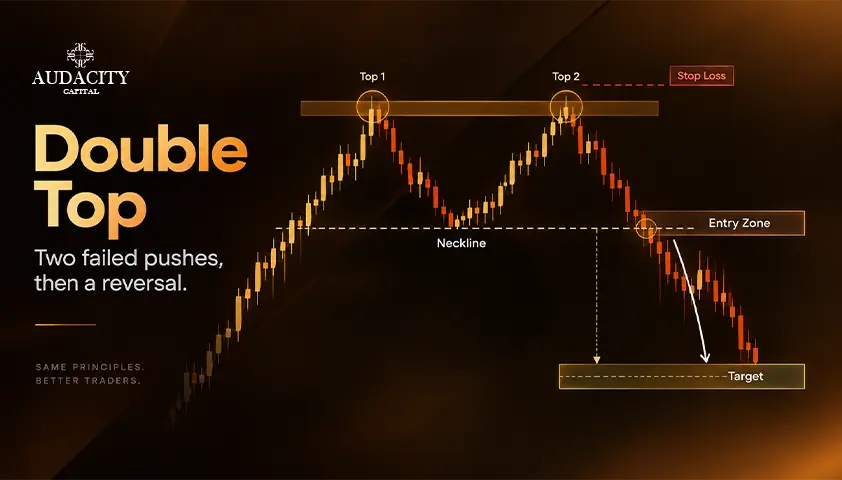
Double Top Pattern: How to Trade It
Learn how to identify, confirm, and trade a valid double top pattern with precise targets and stops.


Averaging Down: Explained
What averaging down does to your breakeven and your exposure, the one question that settles whether to do it, and why leverage changes the answer entirely.

Spread Betting vs CFD Trading
Spread betting vs CFD trading for UK traders: how each is priced, the real tax difference and its conditions, expiry costs, and which suits which trader.

Liquidity Sweeps Explained: How to Identify and Trade Them
Learn what a liquidity sweep is, how to identify bullish and bearish sweeps, spot sweeps vs breakouts, and use price action and market structure for confirmation.