


8 Best Day Trading Simulators for Beginners in 2026



Day trading simulators provide a risk-free environment to practice trading, test strategies, and develop discipline using virtual funds. The best platforms combine realistic market data, advanced charting tools, and detailed analytics to prepare traders for live market conditions.
- Thinkorswim: Best for Advanced traders
- Webull: Best for: Beginners
- Interactive Brokers PaperTrader: Best for: Professional Traders
- TradingView Paper Trading: Best for: Technical traders
- NinjaTrader Simulator: Best for: Futures traders
- TradeStation Simulator: Best for: Algorithmic traders
- Moomoo Paper Trading: Best For: Beginner/Intermediate Traders
- Power E*TRADE: Best for: Options traders
Key Highlights
- Day trading simulators replicate real market conditions using virtual capital
- They help traders develop execution speed, discipline, and risk management
- Most platforms offer between $50,000 and $1,000,000 in demo funds
- The best simulators provide real-time data and realistic order fills
- Beginners should prioritize ease of use; advanced traders should prioritize execution realism
- Consistent journaling and structured practice are critical for improvement
- Simulators significantly reduce the learning curve before live trading
Comparison Table of the Best Day Trading Simulators
Platform | Best For | Asset Classes | Key Strength | Ease of Use |
Thinkorswim | Advanced Traders | Stocks, Options, Futures | Professional tools | Medium |
Webull | Beginners | Stocks, Options | Simplicity | High |
Interactive Brokers | Professionals | Multi-asset | Global access | Low |
TradingView | Technical Traders | Multi-asset | Charting | High |
NinjaTrader | Futures Traders | Futures, Forex | Replay tools | Medium |
TradeStation | Algo Traders | Stocks, Futures | Automation | Medium |
Moomoo | Beginners | Stocks, Options | UI & data | High |
Power E*TRADE | Options Traders | Stocks, Options | Strategy tools | High |
What Is a Day Trading Simulator?

A day trading simulator is a platform that mimics real financial markets while allowing traders to place trades using virtual money. These tools simulate price movement, order execution, and profit/loss tracking in real time or near real time.
Unlike theoretical learning, simulators allow traders to experience actual trade execution: placing orders, managing positions, and reacting to market volatility.
Most simulators include:
- Real-time or delayed market data
- Charting tools and indicators
- Order types (market, limit, stop-loss)
- Trade tracking dashboards
- Performance analytics
- Replay functionality for historical testing
In short, they bridge the gap between learning and real trading.
Why Use a Day Trading Simulator?
The following are the top reasons to use a trading simulator:
1. Learn Platform Mechanics
Many beginner losses come from execution errors—not bad strategies. Simulators help traders master:
- Order entry and exits
- Chart navigation
- Trade management tools
- Platform shortcuts and workflows
Execution speed becomes especially important in fast-moving markets like scalping or news trading.
2. Practice Risk Management
Risk management separates profitable traders from losing ones. Simulators allow traders to practice:
- Position sizing
- Stop-loss discipline
- Risk-to-reward optimization
- Daily loss limits
Building these habits early prevents costly mistakes later.
3. Test Strategies Safely
Before risking real money, traders should validate strategies. With a simulator, you can measure:
- Win rate consistency
- Average risk vs reward
- Maximum drawdown
- Performance across different market conditions
This helps identify weaknesses before they become expensive.
4. Build Consistency and Discipline
Even without real money, patterns emerge. Examples of these include:
- Overtrading
- Emotional exits
- Poor risk control
Recognizing these behaviors early improves long-term performance.
Limitations of Trading Simulators
While powerful, simulators are not perfect. Some of their limitations include:
1.Lack of Emotional Pressure
Trading virtual money does not trigger the same fear and greed as real capital. This can lead to overconfidence.
2.Unrealistic Execution
Some simulators provide perfect fills, while real markets involve:
- Slippage
- Partial fills
- Spread widening
3.Risk of Bad Habits
Resetting accounts or ignoring rules can create undisciplined behavior.
The solution: treat your simulator like a real funded account.
8 Best Day Trading Simulators
Below are the top platforms, based on features, usability, and realism.
1. Thinkorswim – Best for : Advanced traders
thinkorswim offers one of the most advanced simulation environments available. Its paperMoney feature mirrors live trading conditions and provides deep customization.
Key Features:
- Advanced charting and indicators
- Real-time simulation
- Strategy backtesting
- Options analytics tools
Pros:
- Highly realistic
- Professional-grade tools
Cons:
- Steep learning curve
Verdict: Ideal for serious traders who want a near-live trading experience.
2. Webull Paper Trading – Best for : Beginners
Webull is known for its simplicity and accessibility. It allows traders to start practicing quickly without overwhelming complexity.
Key Features:
- Real-time data
- Mobile-friendly interface
- Easy account setup
Pros:
- User-friendly
- Free to use
Cons:
- Limited advanced tools
Verdict: Perfect starting point for new traders.
3. Interactive Brokers PaperTrader – Best for : Professional Traders
Interactive Brokers provides institutional-level tools and global market access, making it suitable for advanced users.
Key Features:
- Multi-asset support
- Advanced order types
- Risk analytics
Pros:
- Highly realistic execution
- Extensive market access
Cons:
- Complex interface
Verdict: Best for experienced traders testing advanced strategies.
4. TradingView Paper Trading – Best for : Technical traders
TradingView combines powerful charting with a simple simulation environment.
Key Features:
- Bar replay
- Custom indicators
- Cloud-based charts
Pros:
- Excellent charting tools
- Easy to learn
Cons:
- Some features require subscription
Verdict: Great for chart-focused traders.
5. NinjaTrader Simulator – Best for : Futures traders
NinjaTrader excels in execution speed and replay functionality.
Key Features:
- Tick-level replay
- Depth of market tools
- Fast execution
Pros:
- Highly realistic
- Strong for scalping
Cons:
- Focused on futures
Verdict: Top choice for futures traders.
6. TradeStation Simulator – Best for : Algorithmic traders
TradeStation is known for automation and systematic trading.
Key Features:
- Backtesting tools
- Automation via EasyLanguage
- Advanced charting
Pros:
- Excellent for strategy testing
Cons:
- Complex setup
Verdict: Ideal for data-driven traders.
7. Moomoo Paper Trading – Best For : Beginner/Intermediate Traders
Moomoo offers a modern interface with strong data tools.
Key Features:
- Level 2 data
- Interactive charts
- Community insights
Pros:
- Clean interface
- Strong learning tools
Cons:
- Limited automation
Verdict: Great balance of usability and features.
8. Power E*TRADE - Best for: Options traders
Power E*TRADE focuses heavily on options strategy simulation.
Key Features:
- Strategy analysis tools
- Options chains
- Risk metrics
Pros:
- Strong options tools
Cons:
- Less advanced than pro platforms
Verdict: Best for options-focused traders.
Comparison Table of the Best Day Trading Simulators
Platform | Best For | Asset Classes | Key Strength | Ease of Use |
thinkorswim | Advanced Traders | Stocks, Options, Futures | Professional tools | Medium |
Webull | Beginners | Stocks, Options | Simplicity | High |
Interactive Brokers | Professionals | Multi-asset | Global access | Low |
TradingView | Technical Traders | Multi-asset | Charting | High |
NinjaTrader | Futures Traders | Futures, Forex | Replay tools | Medium |
TradeStation | Algo Traders | Stocks, Futures | Automation | Medium |
Moomoo | Beginners | Stocks, Options | UI & data | High |
Power E*TRADE | Options Traders | Stocks, Options | Strategy tools | High |
What this comparison means:
- Match the Platform to Your Strategy: Your asset choice dictates your software. If you want to trade futures, look at NinjaTrader or thinkorswim. If you are hyper-focused on options, Power E*TRADE or thinkorswim will offer the specialized strategy tools you need.
- Don't Overpay for Complexity: If you are a beginner, platforms like Webull and Moomoo offer high ease of use with solid UI and data. Starting on a professional-grade platform like Interactive Brokers or TradeStation can create an unnecessarily steep learning curve due to their complex interfaces.
- Technical Traders Need Charts, Not Just Data: If your trading relies heavily on technical analysis, chart patterns, and indicators, TradingView stands out because its core strength is charting, making it highly intuitive for visual traders.
- Practice Speed with Replay Tools: For fast-paced day trading, static charts aren't enough. Simulators with historical market replay tools (like NinjaTrader) allow you to practice trading past market sessions in real-time, speeding up your learning curve significantly.
- Automation Requires Specific Infrastructure: If you plan to scale your trading using algorithms or automated scripts, your options narrow down immediately to specialized platforms like TradeStation, which prioritize automation over basic simplicity.
How to Choose the Best Simulator

When choosing a simulator, consider:
- Accuracy of market data
- Supported assets
- Charting capabilities
- Ease of use
- Backtesting tools
Match the platform to your trading style—not just popularity.
How to Get the Most Out of a Simulator
The following tips will help you get the most out of any trading simulator:
- Treat It Like Real Trading: Use realistic position sizes and avoid resetting accounts unnecessarily.
- Focus on One Strategy: Master one setup before exploring others.
- Keep a Trading Journal: Track every trade and review patterns.
- Practice During Market Hours: Simulate real trading conditions for better adaptation.
- Review and Improve: Analyze performance metrics regularly to refine your edge.
Conclusion
Day trading simulators are essential tools for anyone serious about trading. They provide a risk-free environment to build skills, test strategies, and develop discipline.
The key is consistency. Traders who treat simulation seriously and follow structured processes gain a major advantage when transitioning to live markets.
But when all is said and done, the best simulator is the one that aligns with your trading goals—and the one you use with discipline.
Learn, practice, and apply your trading strategy in Audacity Capital's free monthly trading competition.
FAQs
The primary benefit is learning how to trade without risking real capital.
Webull is considered the best free simulator. It offers a free paper trading account with a user-friendly, mobile-first design, providing essential tools like charting and indicators without requiring a financial commitment.
While a simulator cannot fully replicate the intense pressure of trading real money, it is essential for developing the discipline and consistency required for long-term success.
A traditional simulator uses virtual funds for practice. On the other hand, a funded trading provider like Audacity Capital gives traders access to real capital and a professional environment once they have developed basic skills, allowing them to trade real markets without risking their own personal funds.
Beginners focus on foundational skills like understanding order types and stop-loss placement. Experienced traders use simulators for advanced strategy testing, such as validating a system's performance through historical backtesting and evaluating win/loss ratios before committing capital.

क्या आप क्रिप्टो पर अनुशासित जोखिम लागू करने के लिए तैयार हैं? Audacity Capital के नए क्रिप्टो उपकरणों का पता लगाएं और अपनी ट्रेडिंग रणनीति लाएं।
और जानेंन्यूज़लेटर
हमारे न्यूज़लेटर से जुड़ें।
हमारे सामाजिक समुदाय में शामिल हों

आज ही अपनी यात्रा शुरू करें हमारे नि:शुल्क परीक्षण के साथ
प्रमाणपत्रों के माध्यम से अपने कौशल और उपलब्धियों को गर्व से प्रदर्शित करें और संभावित निवेशकों और साथियों से अपनी कड़ी मेहनत और समर्पण के लिए पहचान प्राप्त करें।
नि:शुल्क परीक्षणसंबंधित लेख
15 Best Day Trading Platforms in 2026
The best day trading platforms in 2026, grouped by what they actually do. Compare brokers, charting layers and funded accounts.

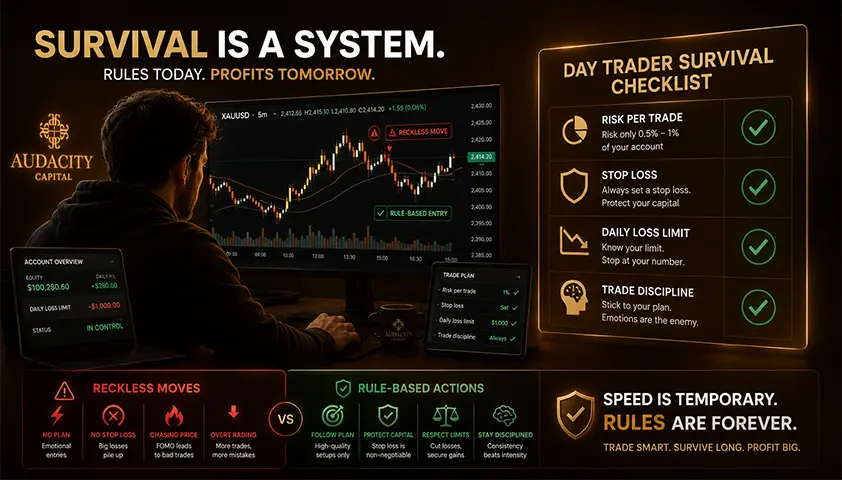
Day Trading Tips: The Rules That Actually Decide Whether You Survive
Practical day trading tips ordered by what actually matters. Risk rules, discipline, execution, and the 2026 pattern day trader change explained honestly.
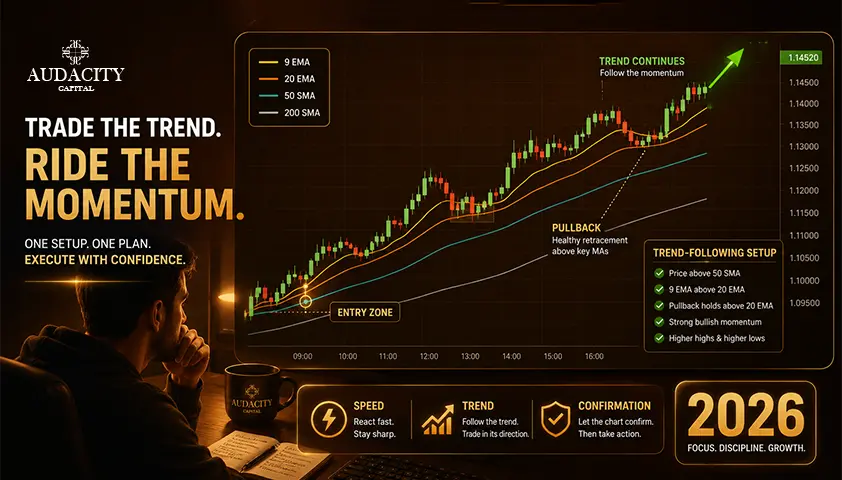
Best Moving Average for Day Trading in 2026
Compare the 9, 20, 50 and 200 moving averages for day trading, when each works best, and how to avoid lag, noise and false signals.

How to Create a Day Trading Risk Management Plan?
Build day trading risk management strategies with daily loss limits, position sizing rules, drawdown controls, and a practical trading checklist.