


What Is a Funded Trading Account and How It Works



Funded trading accounts have become some of the most visible ways of entering into trading with size. The concept itself is quite simple: pass the evaluation and get access to a larger account and retain a percentage of that earnings.
However, the process in-between has been less talked about. First, there is a fee and an evaluation. Then come the rules that carry into the funded stage, followed by a payout process with its own conditions.
All these rules affect each other and their interconnection is important for evaluating the whole arrangement on its own merits.
In this article, we will explain these processes in order, starting with the payment process, followed by the funded trading account and the payouts and elucidates what each rule is testing.
What Is a Funded Trading Account?
A funded trading account is an agreement with a proprietary trading firm whereby the firm provides a trader access to a much bigger account than what has been deposited by the trader. The trader, in turn, follows specific rules and shares a portion of any gains.
Access is normally earned by passing an evaluation the trader pays a fee to attempt.
Splitting the responsibility is easy. The trader brings the strategy and discipline while the firm provides the account, rules, and payout system
The trader's loss is limited to the amount of the fee already paid and this is the true and central part of the whole model. You cannot lose more than you spent to enter.
There are two phrases used somewhat indiscriminately that require distinction. "Funded account" is an environment with attached rules. "Funded trader" is the individual given the opportunity to operate within such an environment.
Therefore, the funded trading account meaning is reduced to an environment combined with a contract. And the rules don't end once you pass the evaluation. They are the permanent terms under which your account will operate.
How It Differs From Your Own Account
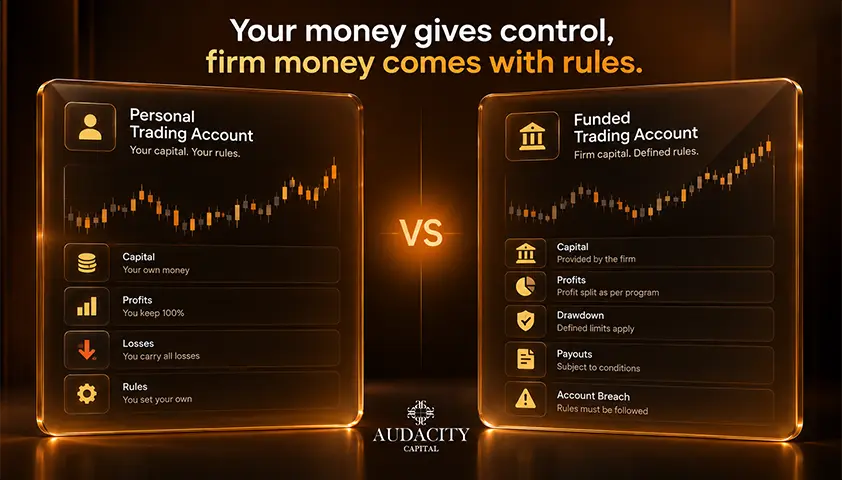
There is no better way to comprehend the concept of a funded account than comparing it with your trading account.
The key distinction lies in the issue of control. In an individual account, you control the money and the risk. In a funded account you have no control over either. All of the data in the table below are based on that inversion.
There is one row which needs some clarification. The financial impact of a loss can be different. A loss on your own savings can seep into non-trading areas. If you lose a funded account, you lose access to your account and the amount you put into it, and that's it.
It looks like a relief in a way, but there is another aspect to consider. No matter the result, the fee is lost. And this happens with most traders.
Your own account | Funded account | |
Who supplies the capital | You do, by depositing | The firm, as account access |
How you get in | Fund it | Pay a fee, then pass an evaluation |
Who sets the risk rules | You do | The firm, and they are enforced automatically |
Who keeps the profit | All of it | A share, on the firm's schedule |
What a bad run costs | Your capital | Account access and the fee already paid |
What protects you | Broker regulation and client money rules | The contract, and nothing else |
Is the Capital Real?
The standard retail system works through simulating the trading environment. The prices, spreads and slippage are more or less the same as the live markets, but your orders are not executed on the market using real funds as your own account's orders would be.
The question of is a funded trading account real money is answered as follows: The amount of money a person can trade with is simulated while the payout is not. If the conditions are met, the firm pays out actual money, based on your simulated performance, from the firm's assets.
There are variations in arrangements: some firms may take some activity to live markets, so check, don't assume. The structure itself gives an explanation as to the question of legitimacy within the question asked.
In this case, the company does not take client funds nor sends client orders to the market. This is what makes this structure different from the structure designed for the regulation of brokers.
The regulatory approach depends on activities of the company and jurisdiction. The reader should verify the legality of the company and regulations that will apply to their area.
This will have two obvious consequences for you. There will be no borrowed capital; hence, there is no possibility to break a losing streak owing any money. And it's why the rules are so strict: the exposure is the firm's payout obligation, not an open market position.
A Prop Firm Is Not a Broker
This distinction can set your expectations of recourse before you spend a single cent, that's why it's important to get it right.
A broker holds the deposited money and sends your orders to actual liquidity. It also has regulations that mandate separating client funds and protecting them.
In the case of failure, the rules will determine what you are owed, and segregated client funds play a major role in that protection.
A proprietary trading firm in this context operates in a very different way. It sells you access to an evaluation process, operates a simulation system and has a contractual obligation to honor its payout terms. It doesn't hold your money, since there is no deposit to hold.
It is more important to think about this reframing rather than about the definitions. The question that your due diligence must address has changed.
It is not how safe your money is, because you have not deposited any. It is how reliable the firm is paying what it owes and that is answered by track record and terms, not by regulation.
How It Works, Stage by Stage

This is the part the advertising leaves out. Here is the sequence in the order you would actually experience it, which is the clearest answer to how do funded trading accounts work.
Stage one, the evaluation.
You choose an account size and pay a fee. You receive credentials for a simulated account with a profit target and loss limits attached. Your job is to reach the target before breaching either limit.
The evaluation fee buys the attempt, not the capital, and it is not returned if you fail. This is the evaluation and challenge phase in practice.
Stage two, verification or additional phases.
Some structures add a second or third phase at a lower target, testing whether your first result repeats. The second phase is not a harder test. It is a repeatability test.
Stage three, the funded account.
Pass, and you are granted access to an account that carries the same or similar rules on a continuing basis. Beginners miss this constantly: the rules do not relax once you are funded.
A breach after funding ends the arrangement exactly as it would have during the evaluation.
Stage four, the payout.
Gains accumulate and are paid on a defined payout cycle and performance reward schedule, as a share, subject to the firm's conditions.
One mechanical fact outweighs the rest. Rules are monitored on the server side and enforced automatically. This can happen tick by tick, around the clock. There is no end-of-day review and no appeal window.
A limit breached at three in the morning closes the account before you wake up. That is one of the most consequential features of the arrangement. It is also why calculating risk before a trade matters so much here.
The Rules and What Each One Is Testing
The rules are the product. It helps to see not just what each one measures, but what the firm is protecting itself against.
First, the daily loss limit ends more attempts than any other rule, because it usually counts floating losses on open positions as well as closed ones. A position you never close at a loss can still trip it.
Second, whether the maximum drawdown is fixed to your starting figure or trails the account upward changes how you must trade the account entirely. A trader who does not know which one applies is sizing blind.
There is also a trap between phases. Rules frequently differ between the evaluation phase and the funded phase at the same firm. You can pass under one set and breach under another without realizing the terms changed underneath you.
Rule | What it is testing | What the firm is protecting against |
Profit target | Whether you can produce a return under constraint | Granting access on no evidence |
Daily loss limit | Whether one session can get away from you | A single bad day ending the arrangement |
Whether losses stay contained over time | A slow bleed the daily limit never catches | |
Minimum trading days | Whether the result came from a process | One lucky trade qualifying |
Consistency requirement | Whether performance repeats | Results driven by a single outsized day |
News and weekend limits | Whether you respect scheduled risk | Gaps the firm cannot manage |
The minimum trading days rule and the consistency rule exist for the same reason: to make sure the result came from a repeatable process rather than a single lucky session.
The Routes In
Most firms offer some version of one-step, two-step, and instant funding. The clearest way to understand them is by what each one trades off, not by their labels.
Single phase.
One target, one assessment. It is faster, and it is usually paired with tighter ongoing rules, because the firm has less evidence to work from before granting access.
Two or more phases.
A first target followed by a lower one that tests repeatability. It is slower, usually the least expensive route, and it gives you the most practice under the rules before anything real is at stake.
Immediate access.
No evaluation to pass. Depending on the firm, you pay a higher fee relative to the account, accept tighter ongoing limits, or start on a lower share.
The genuine use case is narrow: a trader with a demonstrated record who does not need an evaluation to learn whether their method holds.
A beginner choosing it to skip the boring part usually finds that tighter rules punish an undeveloped process faster than an evaluation would have.
Structure | What it offers | What it costs you |
Single phase | A faster route to access | Tighter ongoing rules in exchange |
Two or more phases | The most practice before anything is at stake | A longer path, and more chances to breach |
Immediate access | No evaluation to pass | A higher relative fee and less room once trading |
Getting Paid

This is the part most people care about most, and the part most explanations rush.
The mechanics are straightforward. Gains generated on the funded account are shared, with the trader taking the larger portion under most arrangements.
Payouts usually run on a cycle rather than on demand, and there is typically a waiting period before the first one. Payment methods and processing times vary between firms. The processing clock generally starts when the payout is approved, not when you request it.
Two conditions get missed routinely. A headline profit split that only applies after sustained performance is a very different proposition from one available immediately, so read which one you are being offered.
And payouts are generally discretionary under the terms rather than guaranteed. That is disclosed in the small print of firms across the industry, and it is worth reading before you commit rather than after your first request.
Read the terms and match them to what you were shown in the advertising.
Where the Payout Money Comes From
If the account is simulated, the money reaching a successful trader has to come from somewhere.
It comes from firm revenue. For most firms running this model, the largest single component of that revenue is evaluation fees paid by traders attempting to qualify, most of whom do not.
Some firms also generate revenue by routing a portion of activity to live markets, or by other means.
Here is the implication worth stating plainly. It is a risk-adjusted business, and there is nothing hidden about that. But it means the firm's interests and yours align in some places and not others.
A firm earns when you pay for an attempt, regardless of how the attempt ends. That is not an accusation. It is the structure of the business, it is out in the open, and a reader who understands it can ask sharper questions of any firm, including this one.
Two Very Different Things Are Called Prop Firms
One phrase covers two unrelated businesses, and confusing them causes most of the uncertainty traders feel about whether the whole category is legitimate.
The traditional model comes first. Established proprietary trading firms employ traders. They recruit selectively, pay a salary, allocate genuine firm capital, provide infrastructure, and charge the trader nothing.
The trader is an employee. The barrier to entry is being hired.
The retail model is the one you meet online. Access is bought rather than won, the relationship is contractual rather than employment, the account is generally a simulated account, and revenue is driven substantially by evaluation fees. There is no interview and no salary.
Both are called proprietary trading firms, and the label stretches across two businesses that have almost nothing in common.
This is not a judgment on either. It is a caution against reading the credibility of the first model into marketing produced by the second, which is a common and completely understandable mistake.
What You Actually Own, and What Happens If the Firm Fails
It helps to state your actual position clearly, because it is easy to assume protections that are not there.
What you have is a contractual right of access on the firm's terms, for as long as you meet the rules, plus a claim to a share of gains payable on the firm's schedule and subject to its conditions.
You do not own the capital. You are also not an employee, so you do not have the protections that come with employment. Nor are you a client of a regulated broker with the protections that status may provide.
You also have no guarantee the arrangement continues, since the firm sets and can amend its own terms. If the firm fails, the position is blunt.
There is generally no segregation and no compensation scheme, because no client funds were ever deposited. An unpaid balance in a failed firm is a claim against a company, not a protected holding.
This is one reason to review the firm's operating history and payout record before you commit. It is a due-diligence point, not a reason to avoid the category.
The cleanest way to frame it: a funded account is a performance agreement, not an asset. The capped downside is a real advantage. If you walk in expecting the protections of a brokerage relationship or a job, you will find neither.
Why Most Attempts Do Not Succeed
An honest account of how this works has to include how it usually ends.
The common failure modes are recognizable. Breaching the daily loss limit while trying to claw back a bad session. Increasing size near the end of a phase because the target is close and the clock is short.
Trading a strategy that has never been tested against hard limits, so the rules and the method work against each other. And treating the evaluation as a place to develop an approach rather than to demonstrate one.
None of these is a market problem. Each one is a trader responding to a deadline, and the deadline is the variable your personal account does not have. Most attempts do not succeed, and the rules are not the reason. The pressure of a fixed target inside a fixed window is.
Conclusion
In short, a funded trading account is a contractual arrangement in which a trader buys an attempt at access to a large simulated account and a share of what they can produce on it.
The buying power is simulated, the payout is real, the downside is the fee, and the rules are the product. One concrete step before you pay for any evaluation.
Establish three things from the firm's own terms: whether the account is simulated, exactly how the loss limits are calculated, and whether the rules change between the evaluation phase and the funded phase.
A firm that makes those three answers hard to find has already told you something worth knowing.
Frequently Asked Questions
Payouts are generally treated as income of some description rather than as capital gains in many jurisdictions. Treatment depends heavily on your country and your individual circumstances, and it can change. A local tax professional is the right source for your situation, not an article.
This is usually permitted, since firms operate independently of one another. Running more than one spreads your exposure if a single firm develops payout problems. It also multiplies the number of separate rule sets you have to track, which is exactly how many traders breach a limit by accident.
Policies vary widely between firms. Some close accounts after a defined dormant period, and others do not. This detail sits inside the terms rather than anywhere obvious in the marketing, so check it before you assume an account will wait for you.
The trading environment is technically similar, but that is where the similarity ends. A demo account has no rules, no fee, no assessment, and no payout. A funded account is a demo environment with a contract attached, and the contract is the entire product.
It depends on the structure you choose. Minimum trading day requirements set a floor regardless of how quickly you hit a target, so a fast result still cannot skip that minimum. There is no meaningful average, because most attempts never complete.
A breach generally closes the account immediately rather than triggering a warning. Enforcement is automatic, and it applies during the funded phase, not just the evaluation. Terms vary on whether gains earned before the breach are still paid, so that is worth confirming before you trade rather than after.

क्या आप क्रिप्टो पर अनुशासित जोखिम लागू करने के लिए तैयार हैं? Audacity Capital के नए क्रिप्टो उपकरणों का पता लगाएं और अपनी ट्रेडिंग रणनीति लाएं।
और जानेंन्यूज़लेटर
हमारे न्यूज़लेटर से जुड़ें।
हमारे सामाजिक समुदाय में शामिल हों

आज ही अपनी यात्रा शुरू करें हमारे नि:शुल्क परीक्षण के साथ
प्रमाणपत्रों के माध्यम से अपने कौशल और उपलब्धियों को गर्व से प्रदर्शित करें और संभावित निवेशकों और साथियों से अपनी कड़ी मेहनत और समर्पण के लिए पहचान प्राप्त करें।
नि:शुल्क परीक्षणसंबंधित लेख

Best $50K Funded Accounts in 2026
A $50K funded account compared across firms: what each costs, how the rules differ, and which model suits which trader.


What Happens If You Lose Money On A Funded Account
Learn what happens if you lose money on a funded account, including drawdown rules, account breaches, resets, and how to protect your funded trading account.

What Happens If You Lose Money on a Funded Account?
Your only real loss is the fee you paid. Here's what happens if you lose money on a funded account, what a breach actually costs, and how to avoid one.