


What Happens If You Lose Money on a Funded Account?


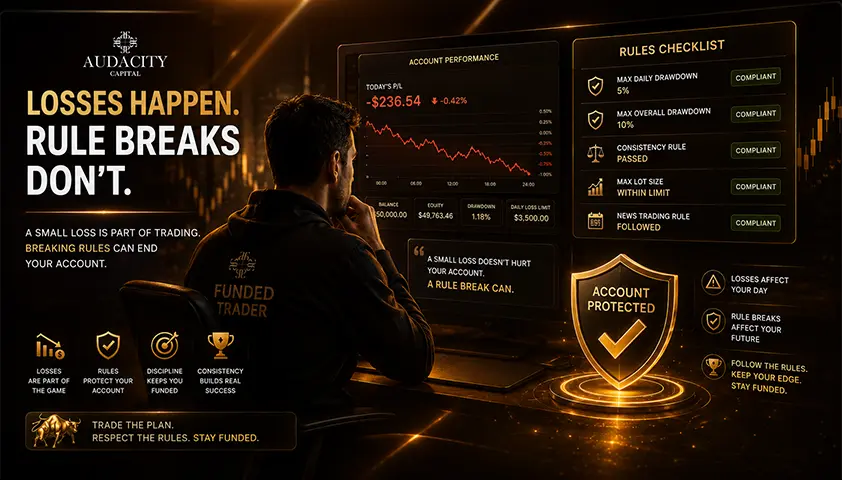
Let’s clear the air first.
No, you do not owe the prop firm money if you lose. You trade the firm's simulated capital, which is a demo balance the firm puts behind your skill, so the firm absorbs the trading loss.
Your only financial loss is the fee you already paid. That is the reassuring part, and it is the truth.
But it is not consequence-free. What happens if you lose money on a funded account comes down to one line: losing too much breaches the rules, and a breach ends the account.
You forfeit any unwithdrawn profit, and you lose your progress and time. So the real fear, owing money or going into debt, is unfounded.
The blog below shows you what losing means, what a breach does, whether you can come back, and how to avoid it.
The honest answer: do you owe money if you lose?
Let's settle the core fear in full. Do you owe money on a funded account when trades go against you?
No. You do not owe the firm for trading losses.
Here is why. You are trading the firm's simulated (demo) capital, not real money you borrowed. When a position loses, the firm absorbs it.
There are no clawbacks, no invoices, and no debt collectors knocking. In practical terms, you are an independent contractor showing your skill, not a debtor who took out a loan.
This is also where negative balance protection comes in. Negative balance protection means the model is built so you cannot lose beyond a preset limit. When your equity hits the firm's threshold, the system closes your access.
The drawdown buffer, which is the cushion the firm allows before that limit, is defined in your agreement as the firm's risk to absorb, not yours.
So make this one fact unmissable: your only financial loss is the fee you already paid, whether that is a challenge, evaluation, or instant-funding fee. That fee is typically non-refundable.
Now the mandatory caveat. This is how the standard, legitimate funded model works, but the exact terms live in your contract.
Read your agreement and confirm it states you owe nothing for trading losses. Models differ across the industry, and the agreement governs your personal liability, so do not treat zero liability as a universal law.
Confirm it in writing for your specific account.
What "losing money" actually means on a funded account

Most traders confuse two very different things, and clearing this up removes a lot of anxiety.
"Losing money" in the everyday sense does not end your account. A red position, a losing trade, or even a losing day is normal. Ordinary drawdown within the rules is just trading. The account continues, and nothing dramatic happens.
The kind of losing that ends an account is a breach. A breach means you crossed a specific risk threshold the firm set. There are usually two:
Limit | What it caps | Example |
Daily loss limit | How much you can lose in a single trading day | 5% of the account in one day |
Maximum drawdown | Your total loss from the starting balance (static) or from your equity peak (trailing) | 10% total loss from the start on a static model |
The daily loss limit is the most you may lose in one day before the account is cut for that session or breached outright.
The maximum drawdown is your total loss floor across the whole account. Cross either, and the account ends.
One important detail to keep in mind - the type of maximum drawdown changes where that breach line sits. A static drawdown is measured from your fixed starting balance, so the line never moves.
A trailing drawdown moves up with your equity peak, which can catch traders out when they give back profit.
So normal losses are fine. Funded account losses only become terminal when they break the core risk boundaries. It is rarely one bad trade. It is crossing the line.
What happens the moment you breach
Let's walk the mechanics so there is no mystery about blowing a funded account.
When your equity crosses the limit, the firm's automated system acts almost instantly. Here is what typically happens:
1. Read-only access.
Your platform switches to read-only. You can still see charts and your trade history, but you cannot open new positions.
2. Open positions are liquidated.
Any live trades are closed at market to stop the loss from exceeding the firm's limit.
3. Unwithdrawn profit is forfeited.
Any profit sitting in the account that you had not yet withdrawn is typically forfeited to the firm. These forfeited profits are gone with the account.
4. Withdrawn payouts are kept.
Any payouts you already withdrew are yours. The breach does not claw them back.
5. The fee is spent.
The fee you paid is non-refundable and is considered used.
On a hard drawdown breach, this is automatic. There is usually no warning and no second chance.
Additionally, it helps to know the difference between a hard breach and a soft breach.
A hard breach is crossing the drawdown limit, which ends the account outright.
Soft breaches are rule flags that depend on the firm's conditions, such as trading during restricted high-impact news, holding over the weekend without authorization, or missing a mandatory stop-loss.
Depending on the firm, soft breaches can flag or close an account too.
The practical takeaway here is, because unwithdrawn profit is forfeited at the moment of breach, taking your payouts on schedule matters.
Profit you have already moved out is safe. Profit still sitting in the account is exposed.
Normal losses vs rule violations: when does losing get you banned?
Traders often fear two things as if they are the same. But they are not.
A normal losing run does not get you banned. Even an account breach from crossing the drawdown limit does not get you banned. It simply ends that account. You can come back and try again. Honest traders always have a door open.
Bans are a completely different category. A ban happens for a rule violation, not a loss. Things like account manipulation, using prohibited strategies, exploiting the platform, or attempting fraud can lead to an account termination that bars you from getting a new account at that firm.
Here is the contrast in plain terms:
Situation | What it means | Can you come back? |
Normal loss or drawdown breach | The account ends, your skill was tested and missed | Yes, start a new evaluation |
Rule violation (manipulation, prohibited strategies, fraud) | Treated as misconduct, not a trading result | Often no, can mean a permanent ban |
So the line is simple. Losing within the rules or breaching the rules is recoverable. Cheating is not. Trading honestly, even after a hard loss, keeps you welcome.
After a breach: your options
A breach is recoverable. Let's be honest about the cost, too.
Most firms let you get back in, and the path usually looks like one of these:
- Free reset after a waiting period. Some firms restart your evaluation for free once a set time passes, for example after 30 days.
- Paid immediate reset. Some firms let you reset or buy a new evaluation right away for a fee.
- Case-by-case discretion. Some firms assess individually. If your overall approach showed potential, a free restart is sometimes granted, but it is never guaranteed.
The reset or retry evaluation options vary by firm, so check your specific terms before assuming any path. You pay the challenge or evaluation fee again, and you lose the progress and time you had already invested.
A retry is recoverable, but it is not free.
The goal is not just to come back. It is to come back better. That is where the next section earns its place.
The psychology of losing
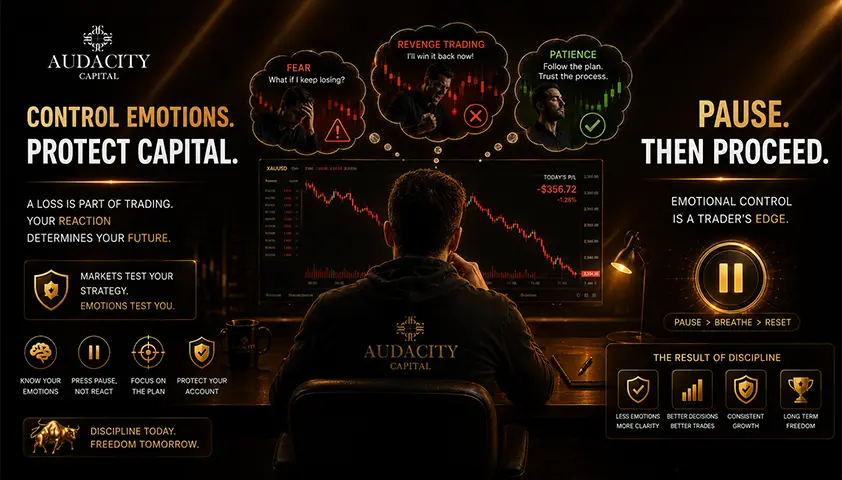
The breach itself is rarely the real problem. What happens in the 48 hours after the breach decides whether you recover or repeat the cycle.
The danger is the panic, the shame, and the urge to immediately buy a new challenge to "win it back." That urge often runs on a quiet, damaging belief: the money belonged to the firm, so the loss is the firm's problem.
That mindset fuels revenge trading, impulsive size increases, and overtrading. Revenge trading, where you size up to recover a loss fast, is one of the fastest ways to blow another account right behind the first.
The constructive fix is calm and structured:
- Take a 24-hour cooling-off period. Do nothing impulsive. No new fee, no fresh challenge, no doubling down.
- Run an honest post-mortem. Was the loss a skills gap or an emotional lapse? Was it slippage, a missed stop, or overtrading? Name it clearly.
- Rebuild before risking another fee. Go back to a demo account with a trading journal. Prove the fix works before you pay again.
Losing is a normal part of every trader's path. It does not define you. How you respond is the actual skill, and it is one you can train.
How to avoid losing the account in the first place
Prevention beats recovery every time. Most avoidable losses come from misunderstanding the rules, not from bad trades. Build these habits:
Habit #1: Read the rules, then re-read them. Most blown accounts start with a misread drawdown model or a missed condition.
Habit #2: Know your drawdown type and how it is measured. Static or trailing changes where your breach line sits, and exactly how it moves.
Habit #3: Use a stop-loss on every single trade. It protects you against spikes and slippage, which is exactly the kind of move that crosses a maximum drawdown line without warning.
Habit #4: Risk small per trade. Many traders keep risk around 0.5 to 1% per position. Surviving the drawdown structure beats chasing big wins.
Habit #5: Favor quality over quantity. A few solid setups beat many rushed ones.
Frame the whole thing this way: a funded account is about surviving the rules, not hitting a home run.
Trade a Funded Account Where the Loss Line Never Moves
If a predictable downside matters to you, Audacity Capital is built for exactly that. We use a static drawdown model, with a fixed 5% daily loss limit and a 10% maximum loss measured from your starting balance, so your breach line never moves.
You always know exactly where it sits, unlike a trailing drawdown that shifts with your equity and catches traders out when they give back gains.
The core reassurance holds here too: you never owe Audacity Capital for trading losses. You trade simulated capital, the firm absorbs the loss, and your only cost is the fee. Any payouts you have already withdrawn are yours to keep.
So if a transparent, capped downside fits how you trade, explore the routes on the funded program page when you are ready.
Funded trading is not risk-free. You can still lose the fee, your progress, and any unwithdrawn profit, and most traders never reach a payout, so always confirm the current rules on the program page before you commit.
FAQ
No. With a legitimate funded account you trade the firm's simulated capital, and there is no negative-balance liability, so you cannot end up in debt to the firm from trading losses. Your only cost is the non-refundable fee. You should still confirm this in your specific agreement.
Not from trading. The capital is the firm's, and losses are absorbed by it. The money you actually risk is the fee you paid to access the account, which you do not get back if you breach or fail.
Any profit you already withdrew is yours and is kept. Profit that was still sitting in the account, unwithdrawn, is typically forfeited when the account is breached. That is exactly why taking your payouts on schedule matters.
No. Normal losing trades, and even a drawdown breach, do not get you banned. They just end that account. Bans are reserved for rule violations like manipulation, prohibited strategies, or fraud, so honest traders can try again.
It varies by firm. Some allow unlimited resets, some offer a free reset after a waiting period or a paid immediate one, and some decide case-by-case. Each retry usually means paying the fee again and starting over.
Generally no. The evaluation, challenge, or instant-funding fee is non-refundable and is considered spent once you breach or fail. Some firms refund or credit it after you pass and meet certain conditions, so check the specific terms.
The daily loss limit caps how much you can lose in a single day. The maximum drawdown caps your total loss from the starting balance or from your equity peak. Breaching either can end the account, and the maximum drawdown can be static or trailing.
Not if you lost or breached honestly. You can simply start a new evaluation. What hurts your chances is an actual rule violation, which can lead to a permanent ban, so trading by the rules keeps the door open even after a loss.

क्या आप क्रिप्टो पर अनुशासित जोखिम लागू करने के लिए तैयार हैं? Audacity Capital के नए क्रिप्टो उपकरणों का पता लगाएं और अपनी ट्रेडिंग रणनीति लाएं।
और जानेंन्यूज़लेटर
हमारे न्यूज़लेटर से जुड़ें।
हमारे सामाजिक समुदाय में शामिल हों

आज ही अपनी यात्रा शुरू करें हमारे नि:शुल्क परीक्षण के साथ
प्रमाणपत्रों के माध्यम से अपने कौशल और उपलब्धियों को गर्व से प्रदर्शित करें और संभावित निवेशकों और साथियों से अपनी कड़ी मेहनत और समर्पण के लिए पहचान प्राप्त करें।
नि:शुल्क परीक्षणसंबंधित लेख

Best $50K Funded Accounts in 2026
A $50K funded account compared across firms: what each costs, how the rules differ, and which model suits which trader.


What Is a Funded Trading Account and How It Works
How a funded trading account works: the evaluation, the rules, the payouts, and whether the capital is actually real.