



Instant Funding vs the Challenge: Which Funded Account Should You Choose?


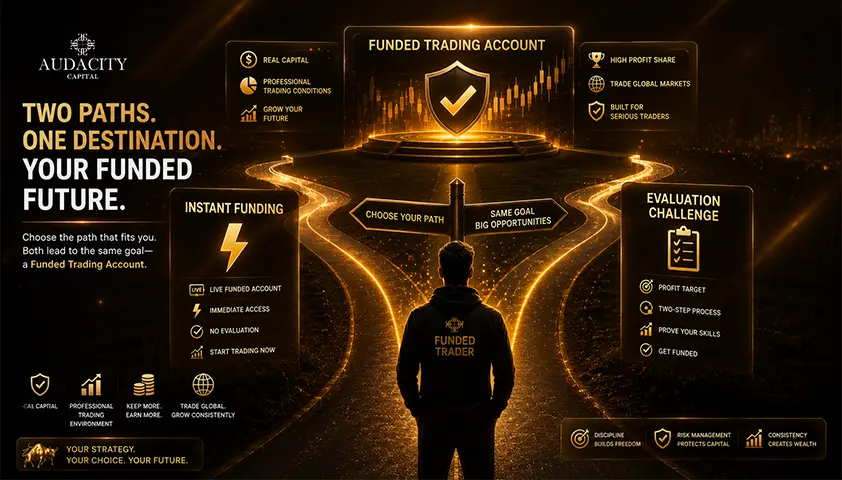
There are two ways to get a funded account.
You can purchase instant funding, and start trading the firm’s capital immediately, or you can choose to take a cheaper evaluation challenge, pass the test, and then be funded.
So which is the "smart" path?
The straightforward answer, first and foremost: Neither option is easy. It's a balance between speed, cost, pressure, drawdown structure, profit sharing and your trading style.
One thing to understand is that "instant" does not mean instant profits or an easier process. You still trade with the same risk guidelines, and most traders don't make it one way or the other.
Today we'll discuss both models, the main differences, for whom they are, the truth behind them, and how to choose wisely.
The two models in brief (and why firms offer both)
First, let's start by briefly defining each.
Instant funding refers to a system in which you pay a fee and receive a funded account immediately, without an evaluation process. Your task is to trade according to the firm’s risk policies and keep your losses within their limits.
The evaluation challenge differs. You still need to make a payment, but a small one, then successfully pass through one or two phases, meeting the profit target and the drawdown limits at the same time.
One-step model requires passing only one phase. The two-step model distributes the profit target between two stages. Once you pass them successfully, you get the funded account.
So why do companies provide both?
The evaluation serves as a screening process. It screens traders, reduces the risk for the company, and is cheaper for both sides involved, which is why it attracts a bigger number of candidates who desire a lower-cost method to prove themselves.
Instant funding is for traders who already have a proven edge and are willing to pay to avoid the waiting period.
Most serious prop firms, such as Audacity Capital, provide both, instead of pushing everyone down one path.
Instant funding vs the challenge: the key differences
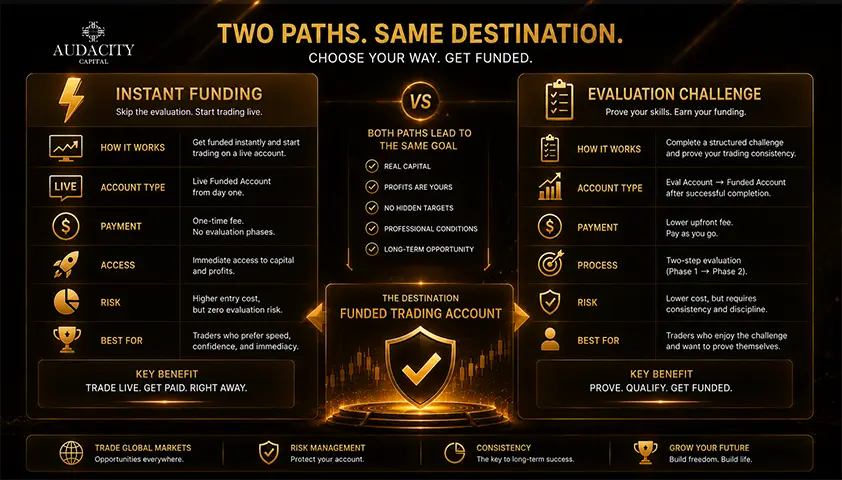
Let's look at both of these approaches. These are all issues that can directly impact your finances and anxiety. All figures are representative and indicative only and any cost, split or account size will vary from company to company and will also be subject to variations based on any discount.
Factor | Instant funding | The challenge (evaluation) |
Upfront cost / fee | Higher for the same account size | Smaller, usually $100 to $300 for single step evaluation (varies) |
Refundability | Fee is usually non-refundable | Fee is often refunded on your first payout (verify per firm) |
Time to funded | Immediate | Time to pass plus minimum trading days |
Evaluation pressure | There’s none, you skip evaluation altogether | To pass you have to hit a goal within the rules. |
Drawdown structure | Often trailing and tighter | Usually static, does not move against you |
Profit split | Often starts lower, for example around 80% | Can be higher, up to around 90% (varies) |
Rules once funded | Often more restrictive | Often more flexible |
Cost of failing | You lose the larger instant fee | You lose the smaller challenge fee |
Some of these warrant a closer look.
1. Cost and refundability.
The challenge is cheaper to participate in, and many companies will refund that amount on the initial payout, so that the upfront cost / fee is reduced again. Instant fees are typically sizable and non-refundable. The access is the service and you're paying for it.
2. Profit split.
The profit split in instant options is typically lower, and is around 80%, while the challenge options can offer 90% profits or more, depending on the firm.
These figures are average, and they change according to the promotions and performance.
3. Drawdown.
This is the row that you need to look out for because it determines how difficult it will be to maintain the account. Usually, challenge uses a static drawdown, which is a fixed loss / daily limit.
On the other hand, the majority of the companies use a trailing drawdown for instant accounts, where your loss limit rises with your equity, and leaves a smaller cushion as you grow.
Instant limits are also often more stringent, since there is no filter in front of the firm and the firm has to take the risk from the start. This difference is more critical than the headline price and highlights the Audacity point later on.
When instant funding makes sense
There are certain traders who indeed benefit from instant funding. This funding is suitable for:
- Experienced traders who have a clear trading edge and want to bypass the process of evaluation and get straight into trading with funded capital.
- Traders who desire quick access and are willing to pay extra to get instant access.
- Traders who are not fond of deadlines. Since there is no evaluation to meet a deadline, you get to trade at your own leisure.
- Part time traders who might not be able to consistently meet a challenge's minimum trading days or profit requirements.
- Day traders who wish to participate in real-time events rather than watching from the sidelines mid-evaluation.
A beginner trader cannot benefit from instant funding. Money from the stricter and trailing drawdown system will quickly punish you for careless trading.
An instantly funded account can be easily blown within a few days without proper risk management and strategy. Instant funding appreciates the discipline you already have but doesn't give you the one you don't have.
When the challenge makes sense
The challenge path is for another set of traders:
- Beginners and intermediate traders who are yet to build consistency in their trading. The evaluation route is a lower-cost proving ground that focuses on the trader's discipline prior to actual money use.
- Cost-conscious traders. The entry cost is cheaper, and is typically returned after the first payout.
- Traders wishing to gain greater profit share and improved scaling.
- Traders who work well with structure, goals and plan.
This actually leads us to a very important point.
The discipline learned during an evaluation is the same discipline that keeps a funded account alive.
Drawdown management, position sizing, and staying away from forced trades are necessary skills no matter if your trading account is evaluated or immediately funded.
Many traders will find that the challenge option is not only more affordable, but training itself. Let's be honest, however, about one thing.
The challenge process is longer, and few of the applications pass it successfully. It rewards patience and a tested edge, not hope.
The honest truth about "instant" funding
"Instant" refers to instant access to capital. It's not a quick way to success and it's not a get rich scheme.
An instant-funded account is real. It comes with a price though. The high price, tight or trailing drawdown, and stringent regulations exist for one reason: balancing the risk that the company assumes by funding you without an assessment.
There is no evaluation, but the company protects itself through other means. You too have to follow the risk discipline like any of the other traders.
In fact, the tighter or trailing drawdown may actually make your “instant” account even more difficult to trade than the evaluated account because you have no chance to practice your game, and the drawdown may become lower.
Most traders are bound to lose with both approaches. Neither approach offers a quick and easy route to making money. And the evaluation is not only a problem to overcome.
It is a filter which shows that you can trade with limitations, and this is precisely the skill that will keep your funded account in business.
And there is one thing that can be concluded after the entire comparison: in prop trading, the ability to survive under the rules is more valuable than any other factor.
Choose the route that will lead you to survival, not the fastest.
How to choose: a quick decision framework
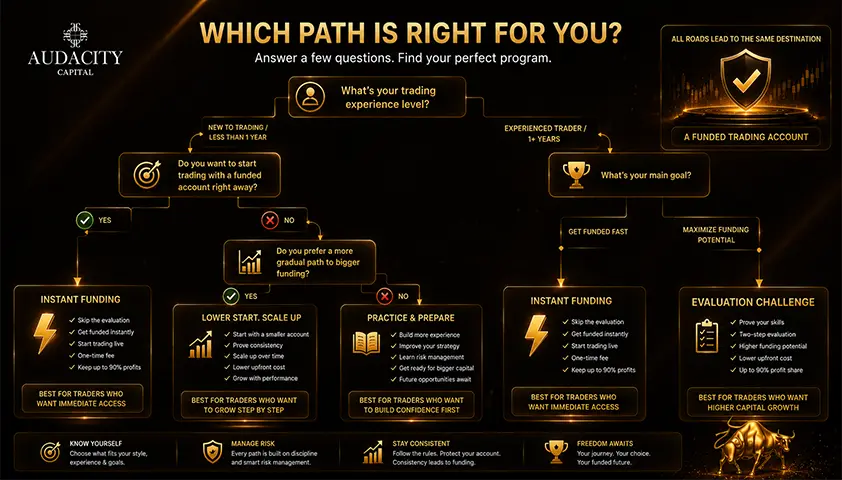
Think about these questions. Each answer will show you the way to go.
Q1: Do you have a consistent and proven profitable edge, or are you still developing one?
Q2: How much budget do you have and is refundability important?
Q3: Are you psychologically ready to deal with real capital right now and a tighter drawdown?
Q4: Do you need to avoid waiting periods and deadlines?
Q5: Do you want the highest profit split and the best scaling? That leans challenge.
In case you are not sure about your edge, the challenge will be an easier place to test its validity.
You can always switch to instant after validation of your edge, or even use both methods together. You don't have to commit to choosing one and stick with that forever.
Where Audacity Capital fits
Audacity Capital has a good standing on this comparison owing to two reasons.
For one, it provides no restrictions on which model to choose. Audacity provides both options.
FTP provides you instant funding with no evaluation, and the Ability Challenge (two-step) and Ability One (one-step) evaluations provide you the cheaper path to the proving ground.
It's also possible to do both at the same time: trade funds in real time through FTP and run a higher split evaluation at the same time. Other companies force you to make a choice. Not Audacity.
Second, the most important negative aspect of instant funding for the whole market is the drawdown which becomes increasingly tighter as your profits increase.
Audacity Capital's instant funding approach is based on static drawdown which is a fixed daily and maximum loss limit that doesn’t increase as you make more money. This takes away the exact downside to the remainder of the market names – the primary cause for caution with instant funding.
The rules are clear on both routes and you're aware of your limits in both trades.
Both of the approaches offer you access to funding and a framework. Neither of the options provides you with any advantages and guarantees payouts because they depend entirely on you as a trader.
Choose the path that suits your edge, budget and temperament then view the details of our funded trader program.
FAQ
Neither is objectively better. The instant funding is available immediately and is more expensive with stricter requirements, whereas the challenge is more affordable and develops discipline, but first you must pass it. The selection depends on one's edge, budget and temperament.
It could be for an experienced trader with a proven history who is looking for quick access and avoids the evaluation stress. For a beginner, it's seldom worth it due to the high price tag and a sharper drawdown that can backfire on non-disciplined traders.
They can, but for most beginners it is advisable to start with a more economical evaluation challenge first. Instant capital puts real capital at risk right away under a tight drawdown, often trailing, that is unforgiving without proven risk control.
No. Trailing drawdown is common on instant accounts across the industry, but it is not universal. Some firms, including Audacity Capital, use static drawdown on the instant route, which keeps your loss limit fixed rather than tightening as you profit.
The challenge route often offers a higher split and better scaling, while instant accounts frequently start lower, for example around 80%. Splits vary by firm and can scale up with performance, so treat any figure as typical rather than fixed.
It can be Instant funded accounts often carry tighter and trailing drawdowns with no practice phase, so the same trade that survives on a static-drawdown account might breach a tightening instant limit.
Often yes. Many firms let you run an instant account and an evaluation account simultaneously, which lets you trade funds now while also working a cheaper, higher-split challenge in parallel.
No, it is a legitimate model, but it is not free money. The higher cost, tighter rules, and trailing drawdown some firms use exist to offset the risk of funding you without an evaluation, so judge any firm by its rules and its payout record.

क्या आप क्रिप्टो पर अनुशासित जोखिम लागू करने के लिए तैयार हैं? Audacity Capital के नए क्रिप्टो उपकरणों का पता लगाएं और अपनी ट्रेडिंग रणनीति लाएं।
और जानेंन्यूज़लेटर
हमारे न्यूज़लेटर से जुड़ें।
हमारे सामाजिक समुदाय में शामिल हों

आज ही अपनी यात्रा शुरू करें हमारे नि:शुल्क परीक्षण के साथ
प्रमाणपत्रों के माध्यम से अपने कौशल और उपलब्धियों को गर्व से प्रदर्शित करें और संभावित निवेशकों और साथियों से अपनी कड़ी मेहनत और समर्पण के लिए पहचान प्राप्त करें।
नि:शुल्क परीक्षणसंबंधित लेख
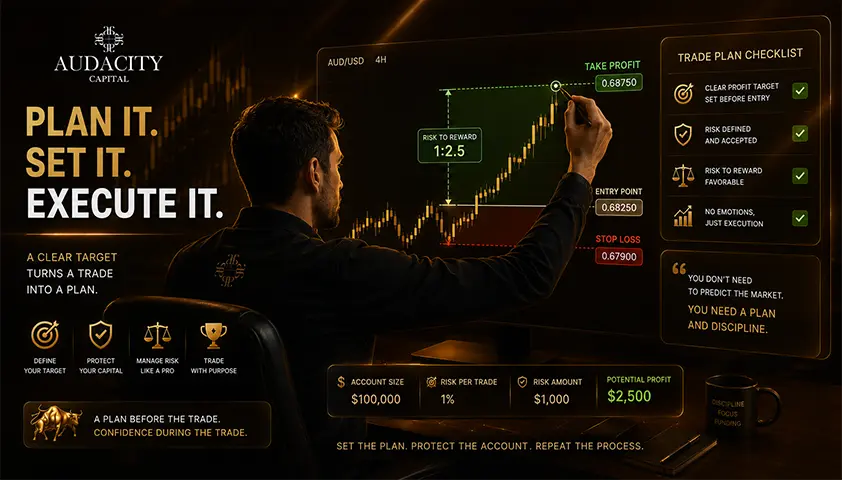
What Is Take Profit in Trading? A Detailed Guide for Traders
Learn what a take profit is, how to set one well using technical levels, risk-reward, and ATR, plus partial profits, trailing stops, and a funded-trader lens.

Can You Hold Trades Overnight or Over the Weekend on a Prop Firm?
Can you hold trades overnight or over the weekend on a prop firm? Learn the rules, risks, gap exposure, and which prop firms allow swing trading.

10 Best Prop Trading Firms in Malaysia in 2026
Compare the 10 best prop trading firms in Malaysia for 2026, ranked on swap-free accounts, payout speed, fees, and payments that work from Malaysia.

How Much Does an Instant Funded Account Cost?(2026 updated)
Sticker price tells only half the story. See what an instant funded account cost really covers, why it runs 2 to 3x a challenge, and if it's worth it.