


10 Best Prop Trading Firms in Singapore in 2026



Singapore traders have more prop firm choices in 2026, but not every program is built for the same trading style.
Evaluation structure, drawdown mechanics, market coverage, platform choice and payout rules vary sharply from one firm to the next. If the fit is wrong, you could pay an evaluation fee before your strategy even gets a chance to work.
In this article we are comparing the 10 best prop firms available to traders based in Singapore.
What Does "Prop Trading Firm in Singapore" Mean?
The purpose must be clarified before the list.
A prop firm is an online evaluation or funded-account provider that accepts traders from Singapore. It doesn't mean a proprietary trading company within an institution that employs local salaried traders.
The list also covers two different product models. Some firms offer forex/CFD or multi-asset tests, while others specialize in exchange-traded futures.
Their platforms, market hours, drawdown systems and funded-stage rules aren't comparable, line by line.
There's a third difference that's relevant throughout the article. "Available in Singapore" does not necessarily mean it is "Singapore-based" or "MAS-regulated." Keep these three ideas separate when you read.
10 Best Prop Trading Firms in Singapore in 2026
The 10 companies listed below were chosen based on their accessibility in Singapore and transparent published rules.
Operating history, verifiable program documentation, platform fit and market coverage were also taken into consideration. Firms had to have adequate first-party data to make a responsible comparison.
Group 1: Established and Multi-Route Prop Firms
1. Audacity Capital
Best for: Traders who prefer to have two-step, one-step and instant funding route options instead of a single evaluation structure.
What Singapore traders get: Singapore is not on Audacity Capital's current restricted-country list.
The Ability Challenge is a two-step assessment with profit targets of 10%, then 5%, and a minimum of four trading days per phase. It's also got relatively large headline drawdowns.
Ability One provides a one-step pathway. FTP offers immediate payment to traders who want to skip the evaluation process entirely.
Important rules: The funded trader program mechanics may vary across the three routes. Drawdown, profit targets and scaling logic depend on which program you buy.
According to the terms of the program, news trading, weekend holding, EAs and copy trading are allowed.
Things to check before purchase: Double check the live account-size menu, maximum allocation, profit-share thresholds, platform availability on MT5 and on the DXTrade, the payout schedule, and the current wording on both the sales page and knowledge center.
2. FTMO
Suitable for: Traders who appreciate long-term structured assessment and a relatively detailed publicly accessible ruleset.
What Singapore traders will gain: Singapore is recognized by FTMO's present worldwide eligibility page since it is not among the restricted countries.
Traders have two options: a one-step or two-step path. MT4, MT5 and cTrader are available in 2026 after DXtrade was discontinued for new selection.
Important rules: Challenge and Verification have fixed profit targets, loss limits and maximum loss limits depending on account size.
Things to check before purchase: Check the current challenge fees, account size, loss limit, profit target and platform availability for Singapore on the exact day of the purchase.
3. The5ers
Ideal for: Forex and CFD traders who prefer clear scaling paths and options for evaluation or funding structures.
What Singapore traders get: Singapore is not part of The5ers' current forbidden territories.
High Stakes is a 2-step MT5 program that has published targets and loss limits. Other programs use different structures. EAs may be used under the prohibited-strategy rules.
Important to note: The scaling of milestones and the frequency of payouts will vary by program family and the profit split will be dependent on progression rather than being fixed at signup.
Things to check before you buy: Check the Singapore checkout programs, current profit split, account size, payout frequency, news-trading rules, and full list of programs available on the platform.
4. FundedNext
Ideal for: Traders seeking a variety of challenge setups in both CFD and futures product families from a single brand.
What Singapore traders get: Singapore is not featured in FundedNext's 2026 restricted-country pages for either CFD or futures programs.
Its main advantage is product breadth. Even though the two models are similar, they are not interchangeable due to their various rules and platforms.
Key rules to know: Choose the market model first. Daily drawdown, maximum drawdown and payout eligibility are set by the individual program, not the brand.
Before purchasing: Check out the actual model that is available at Singapore checkout, challenge price, profit target, drawdown type, payouts condition, platform support and any regional product restrictions.
5. FundingPips
Ideal for: Traders who are comparing one-step, two-step and no-evaluation simulated funding models from the same provider.
What Singapore traders get: FundingPips' current core restricted countries are Iran, Vietnam and the UAE, with additional sanctions-based restrictions. Singapore is therefore supported.
On some models, accounts can go up to $200K and the platform is available in various regions.
Important rules to be aware of: The model you choose will affect the rules, not only the cost. Daily loss, maximum loss, minimum trading days and payout minimums differ across programs.
Things to check before making your purchase: Check Singapore checkout eligibility, daily and maximum loss limits, commission rate, minimum payout, platform choice, and any fee-refund condition.
Group 2: Alternative Models and Futures-Focused Firms
This group widens the comparison without pretending every firm solves the same problem. Fintokei, Alpha Capital and E8 offer different multi-asset or evaluation structures, while Topstep and Apex are futures-focused providers built for a completely different trader.
6. Fintokei
Ideal for: Traders looking for one-step and two-step evaluations on MT5, cTrader and TradingView.
What Singapore traders get: Fintokei's current restricted-country list does not include Singapore. ProTrader and SwiftTrader use different evaluation paths. Compare the program that suits your strategy rather than mixing their rules.
Important to note: Each program has its own set of targets, loss limits and payout structure, plus some accounts may have strategy-specific restrictions.
Things to check before purchasing: Singapore eligibility, program price, targets, loss limits, payout structure, platform availability as well as any particular account limitations for trading.
7. Alpha Capital Group
Best for: Traders who want several platform choices from a global evaluation provider with broad country availability.
What Singapore traders get: Alpha Capital's 2026 checkout supports more than 200 countries and territories, and Singapore appears in its country selection.
Key rules to know: Evaluation structure, drawdown model and performance split depend on the specific plan chosen at checkout. Treat "global" marketing as scope, not a quality signal.
What to verify before buying: Confirm the exact Singapore checkout options, current performance split, account sizes, drawdown rules, payout methods and platform availability before purchase.
8. E8 Markets
Best for: Traders comparing customizable forex or crypto evaluations, or a provider that also offers a separate futures product.
What Singapore traders get: E8's current accepted-country documentation does not restrict Singapore for either forex/crypto or futures. Its 2026 platform page lists TradeLocker, MatchTrader, cTrader and MT5 for eligible forex/crypto users.
Key rules to know: Account customization and program breadth are the real differentiators. Headline profit-share marketing does not describe the drawdown or payout conditions attached.
What to verify before buying: Confirm which program is available at Singapore checkout, your drawdown model, any daily profit cap, news rules, payout conditions and platform-specific restrictions.
9. Topstep
Best for: Singapore traders who specifically want CME futures rather than forex or CFDs.
What Singapore traders get: Singapore is absent from Topstep's current ineligible list and is not restricted to Express Funded Accounts only. The Trading Combine is futures-only and requires intraday position closure.
Key rules to know: Positions must be flat before daily close, and the Maximum Loss Limit works differently from a static CFD drawdown. This program fits a different trader from every CFD firm above.
What to verify before buying: Confirm Singapore's current eligibility status, Trading Combine pricing, Maximum Loss Limit, payout requirements, Live Funded Account access and supported payout methods immediately before purchase.
10. Apex Trader Funding
Best for: Futures traders who want a large account-selection ecosystem and are comfortable with simulated evaluation and performance accounts.
What Singapore traders get: Singapore is not on Apex's current restricted-country list, and Apex's own 2026 payout pages show payouts to traders located in Singapore. This confirms current access rather than guaranteeing future payout approval for any individual trader.
Key rules to know: Apex uses a trailing drawdown model and a subscription-based fee structure. Payout eligibility rules differ between evaluation and performance stages.
What to verify before buying: Confirm account types, evaluation fee or subscription structure, trailing drawdown mechanics, payout eligibility rules, supported trading connections and Singapore access on the live restricted-country page.
What Singapore Traders Should Compare Before Paying for a Challenge?
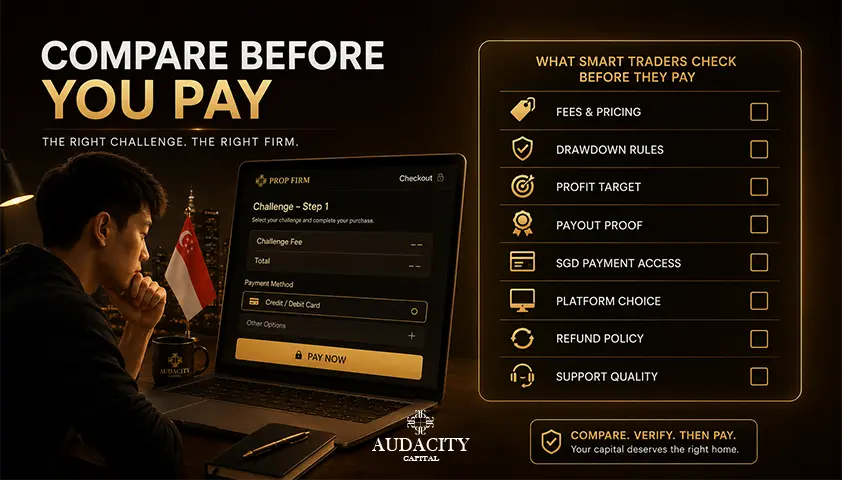
There are six factors to be considered when deciding whether a prop firm challenge Singapore traders are thinking of is worth paying the fee. Work through them in order before checkout.
1. Singapore eligibility and KYC.
Review residency and citizenship requirements. A firm may accept Singapore residents in general, but still refuse to accept a particular trader on nationality grounds, sanctions screening or payment-processor constraints.
2. Market type.
Decide whether you want forex/CFDs, crypto-style products or exchange-traded futures before comparing anything else. Comparing a CME futures combine to a forex challenge as though they are the same product will produce a bad decision.
3. Drawdown math.
Static, end-of-day trailing and intraday trailing limits behave very differently. The largest headline funded trading account Singapore traders can find may be the worst fit if the usable loss buffer is tighter than a smaller account with static rules.
4. Total cost, not advertised discount.
Add initial evaluation fee, monthly fees (if applicable), resets, activation charges, platform/data costs, and SGD conversion fees. The lowest sticker price doesn't necessarily mean the lowest first-time price.
5. Payout rules.
Compare minimum profitable days, withdrawal ceiling, profit share, time taken for the first payout, payment methods available internationally and conditions that change after the first withdrawal.
6. Strategy fit.
Ensure that news trading, weekend trades, EAs, copy trading, consistency conditions, minimum trading days, and position limits are in line with your current trading strategy. If your usual setup is not allowed at a firm, it's not a firm you can pass.
How Singapore Time Changes Which Prop Firm Fits You?
Singapore Standard Time is UTC+8 all year long, whereas market hours in London and US vary with daylight saving time. During part of the year, the same market can be an hour ahead or behind of your local clock, influencing your actual trading time.
The European open and early US sessions are typically the best times for traders in Singapore to find trading opportunities in Forex and CFD markets. However, many traders in the US futures market require to be available at the desk later in the day, or even at night, to deal with the US cash session in liquid conditions.
A very basic example is that the opening of the US equity index at 9:30 EST translates to either 21:30 or 22:30 SGT depending on daylight savings.
This is more than just a minor detail because some futures prop trading programs have intraday closes, while most CFD prop trading programs allow overnight and weekend holds.
Your schedule alone could rule out a prop firm even before considering the costs, profit split or platform.
How to Choose the Right Prop Firm in Singapore
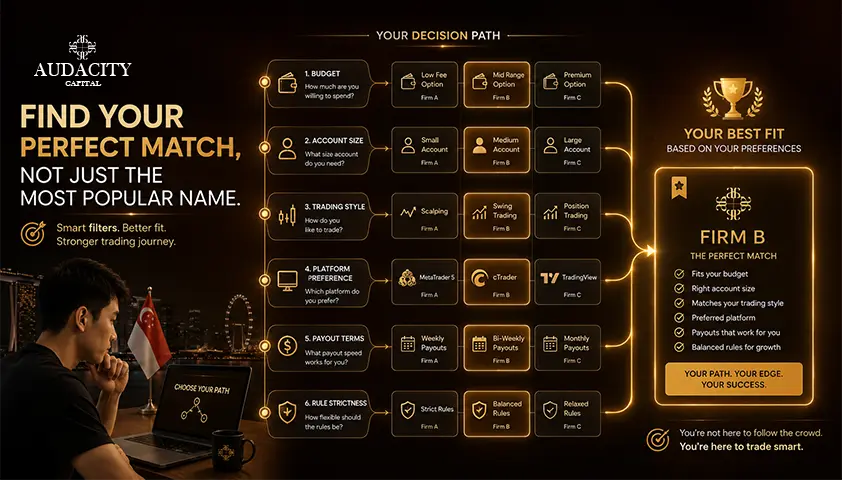
A well-defined selection process results in cost savings. Follow the below process in sequence.
Step 1: Decide the market first: forex/CFD market, crypto-related products or exchange-traded futures. Everything follows from here. Having both forex and futures firms in the shortlist may result in bad comparisons.
Step 2: Select only those firms that explicitly indicate they will accept your residential status-citizenship combination and perform full KYC for you.
Step 3: Compare the loss buffer system and drawdown system before making comparisons based on the size of accounts or profit share. For example, a $200K account with a tight trailing drawdown can be less practical than a $50K account with a static drawdown.
Step 4: Find the actual first-attempt cost in SGD. Add subscriptions, resets, activation and data charges (where possible), and possibly payout charges.
Step 5: Study the rules and list of prohibited strategies in the terms of that particular firm. Save or take a screenshot of the terms that you read prior to purchasing because terms can be updated.
The correct firm is the one who has rules that fit your trading strategy, not the one with the biggest promotional number on their home page.
Conclusion
In 2026, Singapore traders can access both multi-asset evaluation firms and futures-focused programs. There are professional operators for both systems.
What is more important than the size of the account is the match between the rule model and your current trading style.
Three filters should decide your shortlist among prop trading firms Singapore traders can currently join: confirmed Singapore eligibility at checkout, drawdown and payout rules you can live with in real trading conditions, and market hours and platforms that fit your weekly routine.
Get those three right and the rest of the comparison becomes straightforward.
If you want to explore Audacity Capital's Ability Challenge, Ability One or Instant Funding alongside the other options here, start on the program page and read the current rules before you commit.
Frequently Asked Questions
Yes, many international prop firms currently accept Singapore residents. Availability is set by each firm's restricted-country list and payment processor rules, and can change at any time. Always confirm eligibility on the live checkout page and complete KYC before assuming access.
There is no single answer, but the best prop firms in Singapore for forex traders are those combining a rule set that matches your strategy with a platform you can actually run. Compare drawdown model, news-trading rules, minimum trading days and payout conditions before the profit split. If EAs or copy trading are part of your workflow, confirm they are permitted.
Among the Singapore prop firms in this list, Topstep and Apex Trader Funding are the two futures-focused options. Both use rules built around simulated evaluation and performance accounts, and both require intraday risk management that a forex trader may not be used to. Match your session availability in SGT to the contracts you intend to trade.
Many do. MT5 is common across forex and CFD evaluation firms, alongside cTrader, MatchTrader, TradeLocker, DXTrade and TradingView. Futures-focused firms typically use different platforms tied to CME data feeds, so confirm the exact platform list for your selected program.
Payout methods vary by firm and payment processor. Some support bank transfers to Singapore accounts, while others rely on international payment rails, stablecoin or third-party processors. Verify the exact payout rail, currency and any fees before purchasing an evaluation.
Tax treatment depends on your personal circumstances and current IRAS rules. This article does not give tax advice. Check IRAS guidance directly or speak with a qualified Singapore tax professional before assuming how any payout will be treated.
No. A prop firm challenge is a paid evaluation that, when passed, gives access to a funded or simulated funded account with a profit-share arrangement. A proprietary trading job at a Singapore-based institutional firm is salaried employment with internal capital, internal risk oversight and a hiring process. The two attract very different candidates.
Verify Singapore eligibility at checkout, the exact evaluation fee, daily drawdown and maximum drawdown rules, profit target, minimum trading days, prohibited strategies, payout rules and platform availability. Save the terms you relied on before buying. If any detail is unclear on the firm's own site, that itself is a signal to slow down and confirm before paying.

暗号資産に規律あるリスクを適用する準備はできていますか?Audacity Capitalの新しい暗号資産商品を探索し、あなたの取引戦略を持ち込んでください。
詳細を見るニュースレター
ニュースレターに登録して最新情報を入手。
ソーシャルコミュニティに参加

関連記事

Tape Reading in Trading: How to Read Time and Sales
Master tape reading in trading with this practical guide to reading Time and Sales. Learn how to interpret order flow, pace, and size at key levels.


Footprint Charts Explained: How Order Flow Traders Use Them
Discover how order flow traders use footprint charts to analyze volume delta, market absorption, and price action to confirm high-probability setups.
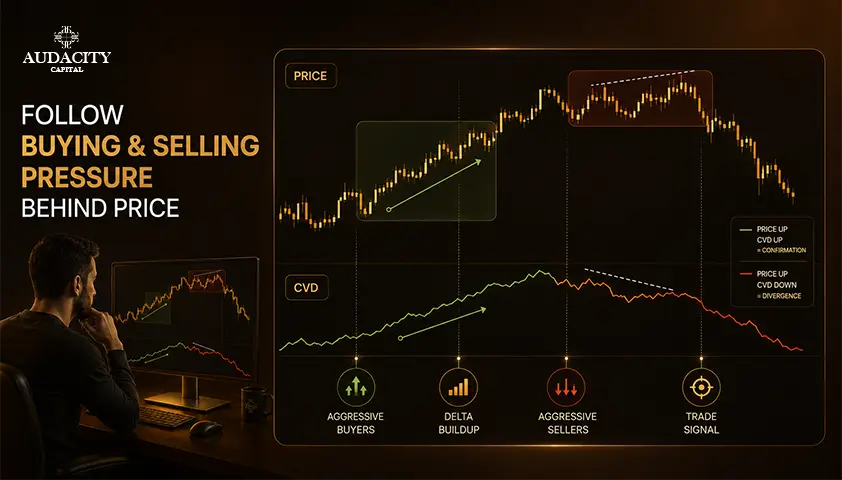
Cumulative Volume Delta (CVD): How to Read and Trade It
Cumulative Volume Delta (CVD) shows real buying vs selling pressure. Learn how CVD works, how to read divergence, and how to trade it across markets.
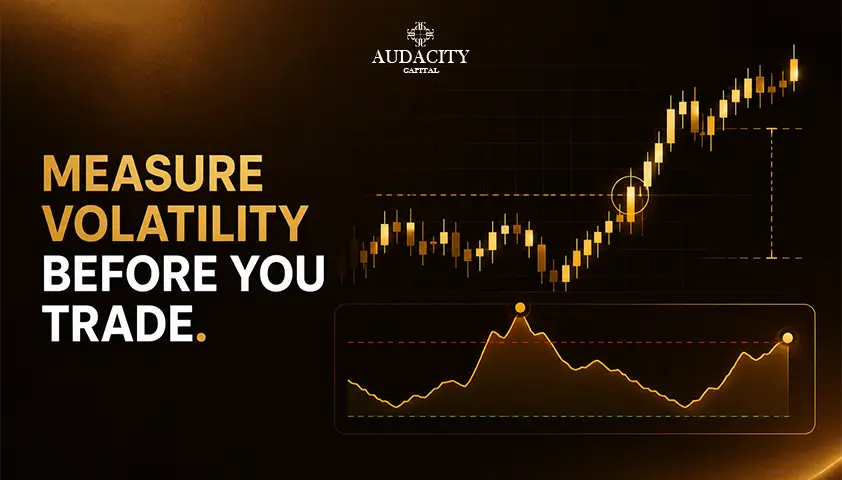
Average True Range: A Complete Guide for Traders
Learn what average true range measures, how to read the ATR indicator, and how to apply ATR% to stops, position sizing and volatility regimes with clarity.