


Best Time to Trade Forex in 2026: The Complete Session-by-Session Guide



Why Timing Matters in Forex Trading
Here is something most articles on forex timing fail to tell you clearly: the forex market is open 24 hours a day, but it is NOT equally tradeable 24 hours a day.
The difference between trading during peak hours and off-peak hours is the difference between:
- Tight spreads vs wide spreads — peak hours can cut your transaction cost by 50–70%
- Reliable price action vs erratic noise — technical setups work far better in liquid markets
- Trend-following opportunities vs choppy, directionless price movement
- Fast, slippage-free execution vs order fills at prices you didn't expect
A perfect technical setup that forms during the London-New York overlap has a fundamentally different probability of success than the same setup forming at 3 AM on a quiet Tuesday in the Tokyo session. Same chart pattern. Completely different environment. Completely different outcome probabilities.
Understanding when to trade is not a minor refinement to your strategy — it is a foundational pillar of consistent forex profitability. This guide gives you that understanding, broken down in more detail than any competitor article, with specific times for every session, every currency pair, every trading style, and every time zone including IST for Indian traders.
Understanding Forex Market Hours
The global forex market runs 24 hours a day, five days a week. It opens on Sunday evening (when the Sydney session begins) and closes on Friday evening (when the New York session ends).
This around-the-clock operation is possible because forex is traded across four major financial centers spread across different time zones. As one market closes, another opens — creating a continuous, rolling global marketplace.
The key concept to understand: Volume, volatility, and liquidity are NOT constant throughout this 24-hour cycle. They surge when major financial centers are open and active, and they dry up during off-peak hours. Your job as a trader is to align your trading activity with the high-volume windows.
The four sessions, in order of when they open each trading day:
- Sydney (Australia / Oceania)
- Tokyo (Asia)
- London (Europe)
- New York (North America)
The Four Major Forex Trading Sessions
The forex day moves through four sessions — Sydney, Tokyo, London, New York — each with its own personality, volume, and best-fit pairs. Here's the quick version of each, with the full breakdown linked below.
🇦🇺 Sydney — The smallest session by volume, opens the trading week, and suits range strategies over trend-following. Best for AUD and NZD pairs.
👉 Best Currency Pairs To Trade In The Sydney Forex Session
🇯🇵 Tokyo (Asia) — Moderate volatility, JPY-driven, and often sets a range that the London open breaks out of. Best for USD/JPY, EUR/JPY, AUD/JPY.
👉 Best Currency Pairs To Trade In The Forex Asia Session
🇬🇧 London — The most important session in forex, driving 35–40% of global daily turnover. The first 60–90 minutes ("London Open") are often the most explosive window of the day.
👉 Best Currency Pairs To Trade In The London Session
🇺🇸 New York — The second-largest session, dominated by USD pairs and major US data releases (NFP, CPI, FOMC). Volume drops noticeably once London closes.
👉 Best Currency Pairs To Trade In The New York Session
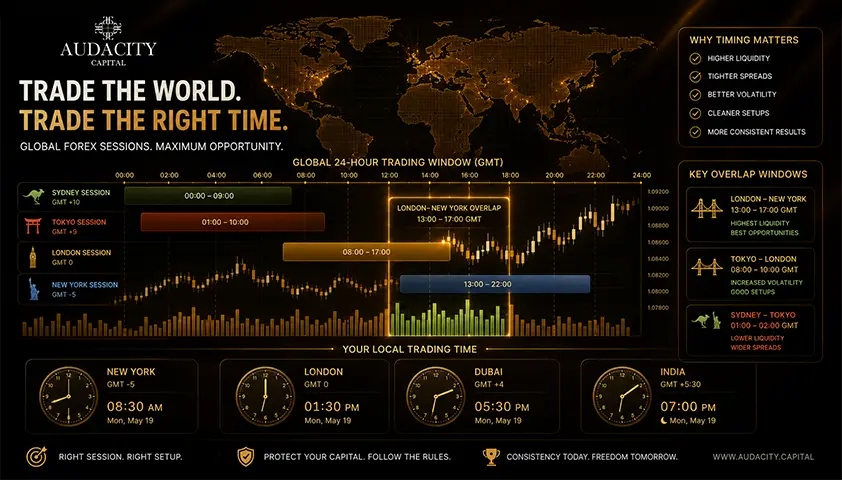
Session Overlaps: Where the Real Money Is Made
Session overlaps are the periods when two major financial centers are simultaneously open. These windows produce the highest trading volume, tightest spreads, and most explosive price movements of the entire trading day. If you only trade during one specific window, make it one of these.
🏆 #1 — London–New York Overlap (The Best Time to Trade Forex)
Time Zone | Start | End |
GMT | 1:00 PM | 5:00 PM |
EST | 8:00 AM | 12:00 PM (Noon) |
IST | 6:30 PM | 10:30 PM |
BST | 2:00 PM | 6:00 PM |
This is unquestionably the single best time to trade forex. Although it represents only about 19% of the 24-hour trading day, it accounts for over 37% of total daily forex volume. Some currency pairs see an even higher concentration of volume during this window.
Why it is the best:
- Two of the world's largest financial centers are simultaneously active
- Combined, London and New York account for over 55% of all global forex transactions
- Spreads are at their daily minimum — your transaction cost is at its lowest
- Price moves are at their largest and most directional
- High-impact US economic data releases hit during this window (8:30 AM EST)
- Institutional order flow from Europe and America creates powerful, sustained trends
- Both technical and fundamental setups have maximum reliability
Best pairs during London–New York overlap: EUR/USD, GBP/USD, USD/JPY, USD/CAD, USD/CHF
Strategy note: The first hour of this overlap (1:00–2:00 PM GMT / 8:00–9:00 AM EST) is often the most explosive as New York traders react to European trends and US data releases. After 3:00 PM GMT / 10:00 AM EST, momentum often continues but new trend initiations become less reliable.
🥈 #2 — Sydney–Tokyo Overlap (Asian Session Power Hour)
Time Zone | Start | End |
GMT | 12:00 AM | 7:00 AM |
EST | 7:00 PM | 2:00 AM |
IST | 5:30 AM | 12:30 PM |
The Sydney-Tokyo overlap is when the Asia-Pacific trading community is most active. This is the premier window for AUD, NZD, and JPY currency pairs.
While significantly less volatile than the London-New York overlap, this window offers genuine, reliable opportunities for traders who focus on Asian currency pairs and range-trading strategies.
Best pairs: AUD/USD, NZD/USD, USD/JPY, AUD/JPY, NZD/JPY
🥉 #3 — Tokyo–London Overlap (The Transition Window)
Time Zone | Start | End |
GMT | 8:00 AM | 9:00 AM |
EST | 3:00 AM | 4:00 AM |
IST | 1:30 PM | 2:30 PM |
This is the shortest overlap of the major sessions — just one hour. Its significance is modest in volume terms, but it often produces sharp moves as European traders respond to the Asian session and start positioning for the full London session.
What to watch: EUR/JPY and GBP/JPY often spike sharply in this window as European institutional desks open and react to Asian-session price action. This brief volatility burst can offer high-risk, high-reward setups for experienced traders — but it's not recommended for beginners.
Best Time to Trade Forex by Currency Pair
Matching your pair to the right session is one of the most underrated edges in forex. Here's the quick-reference version:
Pair | Best Time to Trade | Session Link |
|---|---|---|
EUR/USD | London open + London–NY overlap | |
GBP/USD | Full London session, peaks in overlap | |
USD/JPY | Tokyo session + London–NY overlap | |
AUD/USD | Sydney–Tokyo overlap | |
NZD/USD | Sydney + Tokyo sessions | |
USD/CAD | New York session, esp. overlap | |
USD/CHF | London session + overlap | |
GBP/JPY | London open through overlap | |
EUR/JPY | Tokyo–London overlap + London |
For a full breakdown of every major and minor pair, see our complete guide: The Best Forex Currency Pairs To Trade
Best Days of the Week to Trade Forex
Day-of-week matters as much as time-of-day. Here's the short version:
Day | Verdict | Why |
|---|---|---|
Monday | ⚠️ Avoid mornings | Weekend news digestion, low liquidity, gap risk |
Tuesday | ✅ Good | Positions established, volatility picks up |
Wednesday | ✅✅ Best | Peak volume + FOMC days |
Thursday | ✅✅ Excellent | Momentum carries from Wednesday |
Friday | ⚠️ Morning only | Afternoon liquidity dries up before the weekend |
Sat/Sun | ❌ Don't trade | Market effectively closed |
For the full data and reasoning behind each day, see: Best Days To Trade Forex
Worst Days and Times to Trade Forex
Beyond Monday mornings and Friday afternoons, avoid these windows regardless of the day:
Avoid | Why |
|---|---|
Dead Zone (5–10 PM GMT) | New York winding down, Sydney not yet active — minimal volume, wide spreads |
5–15 min before high-impact news (NFP, CPI, FOMC, ECB) | Spreads blow out, stop-hunting spikes are common |
Major public holidays (US Thanksgiving, Christmas/New Year, July 4th, UK bank holidays, Japanese Golden Week) | Session volume can drop 40–60% |
When you're tired, distracted, or tilted | A non-trading day beats a badly traded one |
Best Months to Trade Forex
Months | Verdict | Why |
|---|---|---|
March–May | ✅ Best | Central bank activity + Q1 data, strong well-defined trends |
Sept–November | ✅ Best | Markets return from summer, Q3 data, year-end positioning |
Jan, Feb, June | ⚠️ Moderate | Decent but builds gradually / slows toward summer |
July–August | ❌ Worst | Institutional summer vacations, thin liquidity, choppy price action |
Late December | ❌ Worst | Holiday season, low volatility, wide spreads |
Best Time to Trade Forex by Trading Style
Style | Best Window | Why |
|---|---|---|
Scalpers | London–NY overlap (1–5 PM GMT) | Tightest spreads, max liquidity |
Day Traders | London open → overlap (8 AM–5 PM GMT) | Full window for intraday trends to develop and sustain |
Swing Traders | London open / NY open / daily close | Entry/exit timing matters more than screen time |
Position Traders | Flexible — daily/weekly closes | High-liquidity windows just reduce slippage on entries |
Best Forex Trading Times for Indian Traders (IST)
IST (UTC+5:30) puts the London–New York overlap conveniently in the Indian evening:
Window | IST Time | Notes |
|---|---|---|
Primary | 6:30–10:30 PM (winter) / 5:30–9:30 PM (summer) | London–NY overlap — best liquidity |
Secondary | 1:30–4:30 PM | London open — good for GBP/USD, EUR/USD |
Avoid | 12:00–5:00 AM | Dead zone + early Sydney session |
This gives Indian traders a natural edge: work or study during the day, trade peak hours in the evening. Note: DST shifts in the UK/US move this window by an hour — always check current GMT offsets.
How Economic News Affects the Best Time to Trade
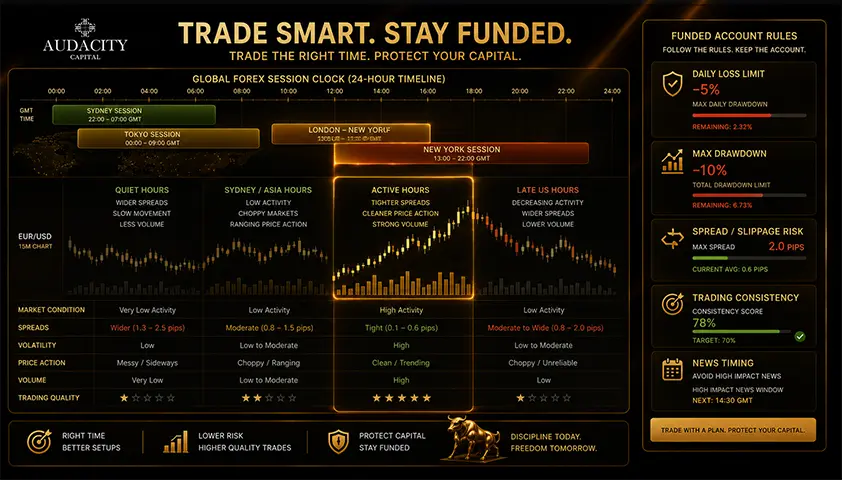
Economic news releases are the single most powerful short-term catalysts in forex. The timing of these releases directly overlaps with specific sessions, which is another reason those sessions are considered "best" for trading.
The Most Market-Moving Forex News Events
Non-Farm Payrolls (NFP) Released on the first Friday of every month at 8:30 AM EST / 1:30 PM GMT. The NFP is arguably the most important regular economic release in all of forex. It measures US employment and can move EUR/USD, GBP/USD, and USD/JPY by 50–150 pips in the first 30 minutes. Falls squarely within the London–New York overlap. Experienced news traders specifically plan for this event.
FOMC Meetings and Fed Statements The US Federal Reserve releases rate decisions at 2:00 PM EST / 7:00 PM GMT, typically on Wednesdays. The accompanying statement and press conference (starting at 2:30 PM EST) can trigger the largest single-session moves of any month. Falls within the New York session (after London closes) — a rare case where the New York afternoon is highly tradeable.
European Central Bank (ECB) Decisions Released during the London session, typically 12:45 PM GMT, followed by a press conference at 1:30 PM GMT. Directly impacts EUR pairs. ECB decisions often initiate or reverse EUR/USD trends that last for days.
Bank of England (BoE) Decisions Released at 12:00 PM GMT during the London session. Primary driver for GBP pairs on announcement day.
US CPI (Consumer Price Index) Released at 8:30 AM EST / 1:30 PM GMT on a mid-month Tuesday or Wednesday. Directly impacts Fed rate expectations and moves all USD pairs.
How to Use the Economic Calendar
Every trader should review a forex economic calendar before each session. The top free resources:
- Forex Factory (forexfactory.com)
- Investing.com economic calendar
- DailyFX economic calendar
Filter for "High Impact" events only. Before a high-impact release, decide in advance whether you will:
- Exit existing positions 15 minutes before the release (to avoid slippage)
- Wait and trade the post-release setup (most common professional approach — let the initial spike settle, then trade the sustained directional move)
- Trade the release directly (high-risk, high-reward — requires specific news-trading strategies and very fast execution)
Never be caught in a position with no plan when high-impact news hits.
How to Build Your Personal Forex Trading Schedule
Most articles tell you when the market is best. Very few tell you how to build a personal trading schedule that aligns your life with those peak windows. Here is a step-by-step framework:
Step 1: Identify Your Available Trading Hours Write down your daily schedule for a typical week. When are you realistically available to sit at a screen, focused, with no major interruptions? Be honest. Two focused hours beats six distracted ones.
Step 2: Map Your Available Hours to Sessions Using the session times in this guide, identify which major session(s) overlap with your available hours. If you're in India, the London–NY overlap is naturally in your evening. If you're in Australia, the Asian session and Sydney–Tokyo overlap align with your morning.
Step 3: Select Your Primary Trading Window Choose ONE 2–4 hour window as your primary trading time. Ideally this is the London–NY overlap. If that's not possible, choose whichever major session aligns with your schedule. Commit to this window rather than trying to trade multiple sessions.
Step 4: Match Your Currency Pairs to Your Session Using the pair-by-session guide above, select 2–3 currency pairs that are most active during your chosen trading window. Do not trade pairs that are inactive during your session — you'll fight the market's natural rhythm.
Step 5: Respect the "Off" Days Deliberately schedule your off days: Sunday (no trading), Monday morning (observe only), Friday afternoon (closed). Trading discipline includes knowing when to close the platform.
Step 6: Build Your Pre-Session Routine Spend 15–20 minutes before each session reviewing: the daily chart for your pairs, the economic calendar for high-impact releases that day, and key levels (support/resistance) to watch. Enter your session with a plan, not a blank slate.
Step 7: Evaluate After 30 Days After a month of following your schedule, review your trading journal. Are your best trades clustering in a specific time window? Are your worst trades happening during certain periods? Adjust your schedule based on evidence, not assumption.
Common Timing Mistakes Forex Traders Make
Mistake 1: Trading Around the Clock
The forex market is open 24 hours — but your brain is not. Trading at 3 AM on a thin Asian session when you're a London-session-focused GBP/USD trader is not opportunity — it's noise-chasing. Quality over quantity always wins in forex.
Mistake 2: Ignoring Daylight Saving Time Shifts
Multiple times per year, the US and UK shift to/from daylight saving time on different dates, temporarily changing the overlap times by one hour. Many traders are caught out by this and miss the peak window or trade during the wrong hours for a few weeks. Always check current UTC offsets for your specific broker and session.
Mistake 3: Trading Every High-Impact News Release
News releases create volatility — but not always tradeable, directional volatility. The NFP's initial 60-second spike is often reversed within 5 minutes. Trading the release itself requires specific skills and infrastructure. Most traders profit more from the post-news setup 15–30 minutes later, when the direction is clearer and the spreads have normalized.
Mistake 4: Treating All Currency Pairs the Same
Trading EUR/USD during the Tokyo session or AUD/USD during the London session makes much less sense than trading each pair during its native session. Match your pair to its most active window.
Mistake 5: Trading the Asian Session with a European Pairs Strategy
EUR/USD and GBP/USD during the Asian session move 20–40 pips in slow, choppy fashion. Attempting to apply breakout or trend-following strategies designed for the London session to the Asian session's range-bound conditions is one of the most common and consistent losing behaviors of retail forex traders.
Mistake 6: Holding Positions Over the Weekend Without Adjustment
Weekends introduce gap risk. Central banks can announce emergency rate decisions. Geopolitical events can shift entire markets in hours when no forex trading is possible. If you must hold positions over the weekend, size them down, ensure stops are in place, and never hold leveraged positions at your maximum risk exposure over a Saturday–Sunday closure.
Forex Trading Hours Quick Reference Table
Session / Overlap | GMT | EST | IST | Best Pairs | Volatility |
Sydney Session | 10 PM – 7 AM | 5 PM – 2 AM | 3:30 AM – 12:30 PM | AUD/USD, NZD/USD | Low |
Tokyo Session | 12 AM – 9 AM | 7 PM – 4 AM | 5:30 AM – 2:30 PM | USD/JPY, AUD/JPY | Low–Moderate |
Sydney–Tokyo Overlap | 12 AM – 7 AM | 7 PM – 2 AM | 5:30 AM – 12:30 PM | AUD/USD, NZD/JPY | Moderate |
Tokyo–London Overlap | 8 AM – 9 AM | 3 AM – 4 AM | 1:30 PM – 2:30 PM | EUR/JPY, GBP/JPY | Moderate spike |
London Session | 8 AM – 5 PM | 3 AM – 12 PM | 1:30 PM – 10:30 PM | EUR/USD, GBP/USD | High |
London–NY Overlap | 1 PM – 5 PM | 8 AM – 12 PM | 6:30 PM – 10:30 PM | EUR/USD, GBP/USD, USD/JPY | Highest |
New York Session | 1 PM – 10 PM | 8 AM – 5 PM | 6:30 PM – 3:30 AM | USD/CAD, USD/JPY | High |
NY Afternoon | 5 PM – 10 PM | 12 PM – 5 PM | 10:30 PM – 3:30 AM | All USD pairs (reduced) | Low–Moderate |
Dead Zone | 10 PM – 12 AM | 5 PM – 7 PM | 3:30 AM – 5:30 AM | Avoid all trading | Very Low |
Best Days: Tuesday, Wednesday, Thursday Worst Days: Monday morning, Friday afternoon, weekends Best Months: March–May, September–November Worst Months: July–August, late December
FAQs
What is the best time to trade forex? The London–New York overlap is the best time to trade forex. It runs from 1:00 PM to 5:00 PM GMT (8:00 AM to 12:00 PM EST / 6:30 PM to 10:30 PM IST). During this four-hour window, over 37% of daily forex volume occurs, spreads are at their tightest, and price movements are at their most directional and reliable.
What is the best session to trade forex? The London session (8:00 AM–5:00 PM GMT) is the best single trading session. It accounts for approximately 35–40% of global daily forex turnover — more than any other individual session. EUR/USD, GBP/USD, and European currency crosses are most active during this time.
What is the worst time to trade forex? The dead zone between approximately 5:00 PM and 10:00 PM GMT — when New York is winding down and Sydney hasn't yet created meaningful volume. Also avoid Monday mornings (Asian session), Friday afternoons (after 12:00 PM EST), and major public holidays.
What is the best time to trade forex for beginners? Beginners should focus exclusively on the London–New York overlap (1:00–5:00 PM GMT) trading EUR/USD or GBP/USD. These hours provide the most reliable, liquid, and technically-sound price action, which is essential while learning. Avoid the Asian session and the dead zone entirely until you have consistent experience.
Can I trade forex at night? Yes, but it depends on which currency pairs you target. The Asian session (midnight–9:00 AM GMT) offers genuine opportunities in JPY, AUD, and NZD pairs. However, European and US pairs (EUR/USD, GBP/USD) are generally poor choices at night due to low volatility and wider spreads.
What is the best time to trade EUR/USD? The best time to trade EUR/USD is during the London–New York overlap (1:00 PM–5:00 PM GMT / 8:00 AM–12:00 PM EST). This is when EUR/USD volume is highest, spreads are tightest, and intraday moves are most sustained.
What is the best time to trade forex in India? For Indian traders (IST), the best time is 6:30 PM to 10:30 PM IST (winter) or 5:30 PM to 9:30 PM IST (summer). This corresponds to the London–New York overlap. The secondary option is 1:30 PM to 5:00 PM IST (London session open).
What are the best days to trade forex? Tuesday, Wednesday, and Thursday are the best trading days. Wednesday is statistically the most volatile day of the week. Monday mornings and Friday afternoons are the least favorable.
Is forex trading profitable in August? August is one of the most challenging months to trade forex due to institutional traders taking summer vacations, reduced liquidity, and choppy, less directional price action. Profitability is possible but requires reduced position sizes and more conservative strategies.
Does the best time to trade forex change with Daylight Saving Time? Yes. When the US or UK shifts to/from DST (which happens on different dates each spring and autumn), session overlap times shift by one hour. For Indian traders, the London–NY overlap moves one hour earlier during European/US summer time. Always check current GMT offsets before your trading session.
Final Verdict: The Best Time to Trade Forex
Here is the definitive summary:
The absolute best time to trade forex is the London–New York overlap: 1:00 PM to 5:00 PM GMT (8:00 AM–12:00 PM EST / 6:30 PM–10:30 PM IST).
This four-hour window accounts for the largest share of daily forex volume, offers the tightest spreads, produces the most reliable technical setups, and is when the most significant economic data releases land. For scalpers, day traders, and active traders of all experience levels, this is the priority window.
If you trade European currency pairs (EUR/USD, GBP/USD): Focus on the London session open (8:00–10:00 AM GMT) and the London–New York overlap.
If you trade Asian currency pairs (USD/JPY, AUD/USD): The Tokyo session and Sydney–Tokyo overlap are your secondary windows, with the London–NY overlap as your primary execution window.
Best days: Trade Tuesday through Thursday. Use Monday to observe and plan. Protect yourself from Friday afternoon's erratic conditions.
Best months: March–May and September–November. Trade defensively in July–August and late December.
The traders who consistently profit from forex are not the ones who trade the most hours — they are the ones who trade the right hours with discipline, patience, and a structured plan. Time your trading correctly, and you give every setup a fundamentally better chance of success.

暗号資産に規律あるリスクを適用する準備はできていますか?Audacity Capitalの新しい暗号資産商品を探索し、あなたの取引戦略を持ち込んでください。
詳細を見るニュースレター
ニュースレターに登録して最新情報を入手。
ソーシャルコミュニティに参加

関連記事

Spinning Top Candlestick Pattern: Meaning, Formation & How to Trade
Learn what the spinning top candlestick pattern means, how it forms, bullish and bearish setups, confirmation signals, trading strategies, examples, and risks.


Prop Firms That Allow Weekend Holding in 2026 (Compare Firms)
Compare prop firms that allow weekend holding. Explore weekend and overnight rules, news trading, drawdown, markets, profit splits and key restrictions.

Micro Futures Contracts Explained
What micro futures contracts are, why a smaller size does not mean lower risk, the margin trap that catches small accounts, and what they actually cost.
Double Top Pattern: How to Trade It
Learn how to identify, confirm, and trade a valid double top pattern with precise targets and stops.