


NQ in Trading – What is NQ in Trading?


Simply put, it's the CME Globex ticker for the E-mini Nasdaq-100 futures contract, a cash-settled way to trade the Nasdaq's largest non-financial companies as one position. Any trader chasing tech momentum or working the market's sharpest intraday swings needs a working grasp of NQ in trading, because this contract often moves before the underlying stocks even open.
Key Takeaways
What Is NQ in Trading? Five essentials before the specs.
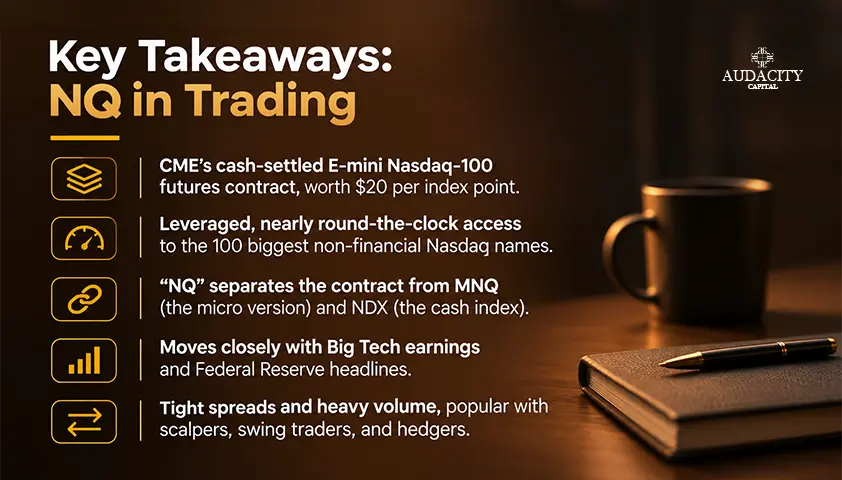
- It is CME's cash-settled E-mini Nasdaq-100 futures contract, worth $20 per index point.
- In practical terms, the nq meaning in trading is leveraged, nearly round-the-clock access to the 100 biggest non-financial Nasdaq names.
- The name "NQ" exists mainly to separate the contract from MNQ, its micro sibling, and NDX, the cash index underneath it.
- Price action follows Big Tech earnings and Federal Reserve headlines more closely than most other markets.
- Tight spreads and heavy volume keep it a fixture for scalpers, swing traders, and hedgers.
What is NQ in Trading?
The Chicago Mercantile Exchange lists NQ as the E-mini Nasdaq-100, an electronically traded futures contract built around the 100 largest non-financial companies on the Nasdaq. Quoted and matched on CME Globex, NQ in Trading works as a single, tradable proxy for the entire index, letting a trader take one position instead of buying a hundred separate stocks. The contract multiplies each index point by $20 and settles for cash when it expires, so no shares change hands.
Depth of market sets NQ apart from most other index products. Anyone researching what is nq in trading runs into the volume numbers fast: several hundred thousand contracts trade most sessions, carrying notional value in the hundreds of billions, far more than the Nasdaq-100 ETF sees on its busiest day. That kind of liquidity holds spreads tight even when headlines hit.
What Does NQ Stand For?
Ask what does nq mean in trading, and most traders will just shrug and say it's shorthand, because it is.
CME never attached an official letter-by-letter meaning to the code when it listed the E-mini Nasdaq-100 in 1999. The exchange simply needed a two-letter Globex symbol, and NQ stuck, distinct from ND, the older full-size Nasdaq-100 contract, and from ES, its counterpart on the S&P 500.
The shorthand survived because desks needed something quick to say out loud. Mention nq in trading on any floor or in any chat, and nobody confuses it with MNQ, the micro-sized version, or NDX, the cash index sitting underneath it. Add a quarterly month code, like NQU6 for September or NQZ6 for December, and the symbol alone tells a broker exactly which contract to route.
How Does NQ Trading Work?
Trading NQ starts with a simple call: buy the contract to profit if the Nasdaq-100 rises, or sell it short to profit if the index falls. Both directions work the same way on CME Globex, since futures carry no uptick rule and no borrow fee for shorting, unlike selling individual stocks short. Closing a position just means entering the opposite trade before expiry, and the exchange settles the difference in cash.
Margin Requirements and Intraday Leverage
Futures run on margin, not full contract value. CME sets the exchange-level initial and maintenance margin, and that figure moves with volatility, recently sitting somewhere in the $16,000 to $40,000 range per contract. Most retail brokers layer a much smaller day-trading margin on top for active session hours, typically $500 to $1,000 per contract. Grasping the NQ meaning in trading starts here: putting up $1,000 to control a position worth several hundred thousand dollars is real leverage, and a 50-point move can swing an account by $1,000 either way.
Order Types and Execution on CME Globex
Execution comes down to three main order types:
- Limit orders lock in a specific price or better, useful for entries that don't chase the market.
- Market orders fill immediately at the best available price, built for speed during breakouts.
- Stop-limit orders trigger a limit order once price hits a set level, useful for protecting capital on a fast reversal.
Deep order-book liquidity fills quickly even around major data releases, one reason NQ in Trading appeals to traders who need to get in and out fast.
What is NQ Futures?
Futures work differently from owning stock outright. As an equity index derivative, NQ in Trading gives a trader synthetic exposure to the Nasdaq-100's price movement, long or short, without buying a single share of Apple, Microsoft, or Nvidia. That distinction shapes capital efficiency, tax treatment, and how a position eventually closes.
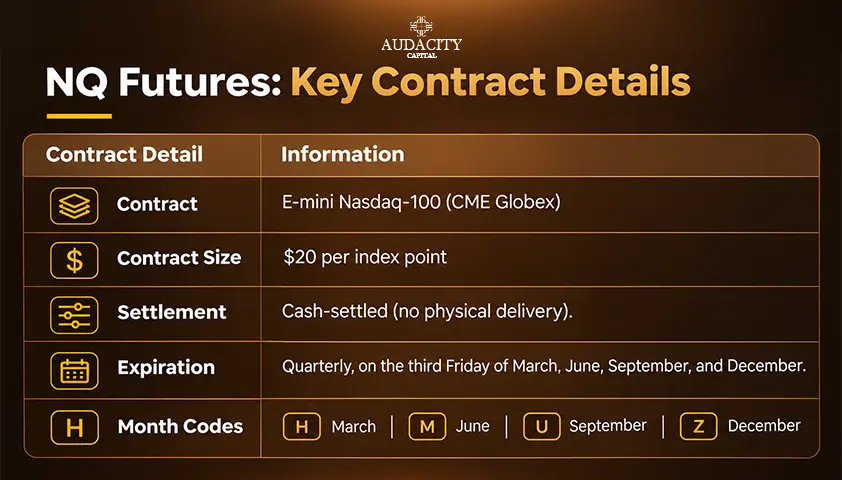
Cash Settlement vs. Physical Delivery
NQ never delivers stock. Unlike a crude oil or wheat contract, which can end with a tanker or a truck showing up, NQ settles entirely in cash. On expiry, the final settlement price is based on the Special Opening Quotation of the Nasdaq-100 Index, calculated from the actual opening prices of each component stock, and the exchange simply credits or debits the difference to each account. Nobody ends up holding 100 individual tech stocks by accident.
Quarterly Expiration Cycles and Ticker Symbol Codes (H, M, U, Z)
NQ expires on a quarterly cycle, settling on the third Friday of the contract month. Each month carries its own Globex code:
March → H
June → M
September → U
December → Z
For example:
NQU6 → September 2026
NQZ6 → December 2026
The code breaks down into the product letters, the month, and the year. Since most active traders switch to the next contract roughly a week before expiration, they generally avoid holding through final settlement.
NQ vs. Nasdaq-100 Index
Knowing what is nq in trading starts with separating it from its own benchmark. NDX is the non-tradable Nasdaq-100 spot index, while NQ is the tradable futures contract built on top of it.
NDX (Spot Index) | NQ (Futures) | |
Tradable | No, index only | Yes, on CME Globex |
Pricing | Live constituent prices | Constituent price plus fair value |
Settlement | Not applicable | Cash, quarterly SOQ |
Typical use | Benchmark, index tracking | Speculation, hedging, leverage |
Spot Index Tracking vs. Derivative Pricing Dynamics
The two rarely trade at an identical price. NQ typically holds a premium or discount to NDX based on fair value, a calculation built from the risk-free interest rate and expected dividends between now and expiry. When that gap stretches too far, arbitrage desks buy the cheaper side and sell the pricier one until the spread closes back up. Because of that constant correction, NQ in trading often moves first, and the spot index catches up, especially outside regular stock market hours.
The Specification of NQ Contract
Behind every NQ in Trading position sits a small set of fixed numbers set by the exchange, and none of them change no matter who is trading or how big the account is.
Spec | NQ (E-mini) | MNQ (Micro) |
Contract multiplier | $20 per index point | $2 per index point |
Minimum tick | 0.25 index points | 0.25 index points |
Value per tick | $5.00 | $0.50 |
Settlement type | Cash | Cash |
Expiration cycle | Quarterly (H, M, U, Z) | Quarterly (H, M, U, Z) |
Contract Multiplier ($20/point), Tick Size (0.25), and Value ($5/tick)
That $20 multiplier is the whole reason NQ trades bigger than it looks. One full point of index movement equals $20 per contract, and because the tick size is 0.25 points, every tick is worth $5.00. Run that forward, and a 50-point range, a routine day for NQ, turns into $1,000 of movement per contract.
New traders usually learn the real weight of NQ meaning in trading the hard way: the first time a quick 20-point spike turns into a $400 account swing before they have finished reading the chart.
CME Globex Trading Hours and Daily Maintenance Breaks
NQ doesn't stop trading when the U.S. stock market closes. On CME Globex, it trades nearly 23 hours a day from Sunday evening through Friday, with just a one-hour maintenance break each day from 5:00 to 6:00 p.m. ET. That means traders can see NQ move on overnight news, European and Asian market activity, or company earnings released after the regular session.
What Moves NQ Futures Prices?
Price action in NQ comes down to two forces working together:
- How is the index itself built?
- What's happening across the broader economy at any given moment?
Both matter, and ignoring either one leaves a trader guessing at every sharp move.
Why Do Big Tech Stocks Have Such a Big Impact on NQ?
The Nasdaq-100 uses a modified market-cap weighting system, which gives its largest companies an outsized influence on the index. NVIDIA, Apple, Microsoft, Amazon, Alphabet, and Meta together make up a significant portion of the index, so a major move in any of these stocks can quickly show up in NQ futures.
This matters even more during earnings season. A strong earnings report or weak guidance from one of the major tech companies can move NQ by dozens of points within minutes, as the reaction spreads through a large part of the underlying index.
Which Economic Reports Move NQ Futures the Most?
NQ is particularly sensitive to interest-rate expectations because growth and technology stocks react strongly to changes in borrowing costs. Three reports and events are especially important:
- FOMC decisions: Rate decisions and comments about the future path of rates can quickly change expectations across the market.
- CPI: A hotter-than-expected inflation reading can push rate expectations higher and trigger sharp selling in tech stocks.
- Nonfarm payrolls (NFP): Jobs data can change expectations about whether the Fed is likely to cut, hold, or raise rates.
These events don't always move NQ on their own. When major economic data lands around the same time as Big Tech earnings, the combination can create some of the largest and fastest moves of the quarter.
Best Times to Trade NQ
NQ trades nearly around the clock, but liquidity isn't spread evenly throughout the day. Some hours have significantly more volume and tighter spreads than others, which can make a big difference when planning a trading session.
When Is NQ Most Active During Regular Trading Hours?
Most NQ volume comes in during Regular Trading Hours (RTH), from 9:30 AM to 4:00 PM ET, when the Nasdaq-100's underlying stocks are also trading.
The busiest part is usually the first 90 minutes:
- 9:30–11:00 AM ET: Heavy volume, deeper liquidity, and frequent momentum moves.
- 11:00 AM–4:00 PM ET: Volume generally slows, although important news can still create sharp moves.
What Happens During NQ's Extended Trading Hours?
Extended Trading Hours (ETH) cover the overnight sessions, including activity from Asian and European markets. Liquidity is generally lighter than during the U.S. session, but these hours can still establish important price levels.
The European-U.S. overlap, roughly 8:00–11:30 AM ET, often brings another increase in activity as both markets are open.
For traders using tight stops, the quieter hours can be more challenging because thinner liquidity can lead to choppier price action and less predictable moves.
NQ Trading Strategies BULLET POINTS
Consistent NQ trading comes down to picking one of a few proven frameworks and sticking with it, rather than reacting to every tick. Here are three that active traders lean on most.
Intraday Scalping & Order Flow Trading (DOM / VWAP)
Scalpers live in the order book, targeting quick 10-30 point swings instead of holding for a full trend. Working NQ in Trading through an order flow lens usually involves tracking:
- Depth of Market imbalance, where resting buy or sell size stacks up unevenly.
- Pullbacks to VWAP, buying dips to the volume-weighted average during an uptrend.
- Cumulative delta divergence, where price direction and aggressive order flow start to disagree.
The best entries tend to show up where size gets absorbed right at VWAP, or where a sharp rejection appears at a heavily traded price node.
How Does Breakout Trading Work With NQ?
High beta makes NQ a natural fit for trading breakouts off key levels. The setup follows a short sequence:
- Note the high and low set during the overnight Asian and London sessions.
- Watch volume build into the 9:30 AM ET equity open.
- Look for price to clear one of those overnight levels cleanly, often the spark for a fast momentum move as trapped stops get triggered.
Traders running this play typically size down on entry, since a false breakout can reverse just as quickly as a real one gets going.
Can NQ Futures Be Used to Hedge a Stock Portfolio?
Speculation isn't the only use case. Institutional managers and individual investors both lean on NQ to offset downside risk sitting in a stock portfolio. Looking at what does nq mean in trading from a hedging angle, the appeal is capital efficiency: shorting NQ against a long equity book softens losses during a downturn without selling the underlying shares, which also avoids the tax bill a sale would create. A fund holding heavy tech exposure into a busy earnings week, for example, can lean on a short NQ position and unwind it once the event risk clears.
NQ Risk Management
How well a trader survives NQ's volatility usually has less to do with picking direction and more to do with how the risk gets sized before the trade goes on.
Managing NQ Volatility: ATR-Based Stop-Losses and Sizing
NQ can range hundreds of points in a single session, which makes a flat, one-size stop unreliable from one day to the next. Average True Range gives traders a way to size stops against current volatility instead of a static number left over from a calmer week. Put into practice on NQ in Trading, a 20-point stop equals $400 of risk per contract, since each full point moves the account $20. From there, position size gets calculated backward from a fixed dollar-risk cap, so no single trade can put a meaningful dent in the account.
How Can You Reduce Slippage During Fast NQ Markets?
A market order fired off during a major release can fill well outside the intended price once the book thins out. Handling NQ in trading safely through those windows usually means favoring stop-limit orders over market orders, or simply staying flat through high-impact events like FOMC announcements and CPI prints instead of forcing an entry. Very little edge exists in the first minute after a headline drops, mostly just faster ways to get run over.
NQ vs. Other Nasdaq Futures Contracts
Picking the right contract size and comparison point matters as much as picking direction. Two comparisons come up constantly.
Contract | Multiplier | Typical Volatility vs. ES |
ES (E-mini S&P 500) | $50 per point | Baseline |
NQ (E-mini Nasdaq-100) | $20 per point | Roughly 1.3–2x ES |
MNQ (Micro E-mini Nasdaq-100) | $2 per point | Same % moves as NQ, 1/10th the size |
NQ (E-mini) vs. MNQ (Micro E-mini): Risk & Notional Scaling
Understanding what is nq in trading relative to its smaller sibling comes down to notional scale. Standard NQ carries a $20 multiplier per index point, while MNQ runs at $2 per point, exactly one-tenth the size. That 10:1 ratio lets newer traders build experience and account size gradually on MNQ before stepping up to full-size NQ, without the jump in risk that skipping straight to NQ would create. A trader who blows through a $500 MNQ stop learns the same lesson a $5,000 NQ stop would teach, just at a scale that doesn't end the account.
NQ vs. ES (E-mini S&P 500): Comparing Volatility & Beta
Looking at what does nq mean in trading next to the E-mini S&P 500 highlights a real volatility gap. NQ's concentrated exposure to mega-cap technology means it typically moves somewhere around 1.3 to 2 times as much as ES in percentage terms on a given session, depending on market conditions. That translates into bigger point swings per contract, which appeals to traders chasing intraday range. However, it also means position sizing needs closer attention than it would on the comparatively steadier ES.
Trading NQ Futures with Funded Accounts & Prop Firms
Skilled traders without six-figure accounts of their own often turn to proprietary trading firms, which fund a live account once a trader clears a structured evaluation. NQ comes up often in those challenges, and looking at NQ in Trading through the lens of typical evaluation metrics shows why: enough liquidity to fill cleanly, and enough volatility to reach a profit target without waiting weeks for the market to move.
Why NQ Liquidity & Volatility Suit Funded Trading Challenges?
Deep order-book depth paired with real intraday range makes NQ a natural match for most funded-account structures. A challenge in the mold of Audacity Capital's Ability Challenge typically sets a profit target around 10%, alongside a daily loss limit and an overall drawdown cap, both usually fixed rather than trailing.
Considering What Is NQ in Trading for this kind of strategy, that fixed structure is the part worth noting. Because the daily limit resets from the prior balance instead of trailing the account's intraday high, locking in a good session doesn't quietly tighten the leash for the next one. Exact terms vary by firm and change over time, so confirming the current rulebook before starting a challenge is worth the five minutes it takes.
Check Audacity Caital's Free funded account challenge
Common Mistakes When Trading NQ
Three mistakes account for most of the damage new NQ traders do to their own accounts.
- Over-leveraging tops the list. Oversized positions relative to account capitalization can turn a normal volatile session into a margin call, and it remains the single biggest risk in nq in trading for anyone trading beyond what their account can absorb.
- Ignoring index concentration comes next. Holding an unhedged position into a mega-cap earnings report or a CPI release means betting on a single headline, a very different risk than most traders think they're taking. Understanding true NQ meaning in trading means recognizing these news-event risks ahead of time and keeping stop-loss discipline in place.
- The third mistake is trying to trade through the low-volume CME maintenance break, from 5:00 PM to 6:00 PM ET. Orders placed right around that window often face routing rejections or sloppy fills once the market reopens, for very little upside.
Conclusion
Learning the expertise of NQ requires sizing risk so the moves that go wrong never end the account. Paired with real discipline, NQ in trading becomes a strategy traders can lean on session after session. Ready to trade it with someone else's capital on the line instead of your own? Audacity Capital's funded trader programs open that door for traders who can prove they've got the discipline to match the contract's speed.
Read More
Best RSI Settings for the 1-Minute Nasdaq 100 Chart
FAQs
For beginners, NQ is the symbol for CME's E-mini Nasdaq-100 futures contract, a cash-settled derivative that tracks the 100 largest non-financial Nasdaq companies as a single, tradable position.
Breaking down what does nq mean in trading by participant type reveals two different playbooks. Retail traders generally use it for intraday speculation and leveraged directional bets, while institutions use it more often to hedge large stock portfolios and arbitrage the gap between futures and the cash index.
NQ meaning in trading describes a cash-settled futures contract giving traders long or short exposure to the Nasdaq-100 Index, tradable nearly 23 hours a day on CME Globex without ever taking delivery of stock.
For funded account evaluations, What Is NQ in Trading usually centers on one thing: the contract moves enough in a session to give a trader a realistic path to a profit target, without needing the account to sit through weeks of flat, directionless price action.

暗号資産に規律あるリスクを適用する準備はできていますか?Audacity Capitalの新しい暗号資産商品を探索し、あなたの取引戦略を持ち込んでください。
詳細を見るニュースレター
ニュースレターに登録して最新情報を入手。
ソーシャルコミュニティに参加

関連記事
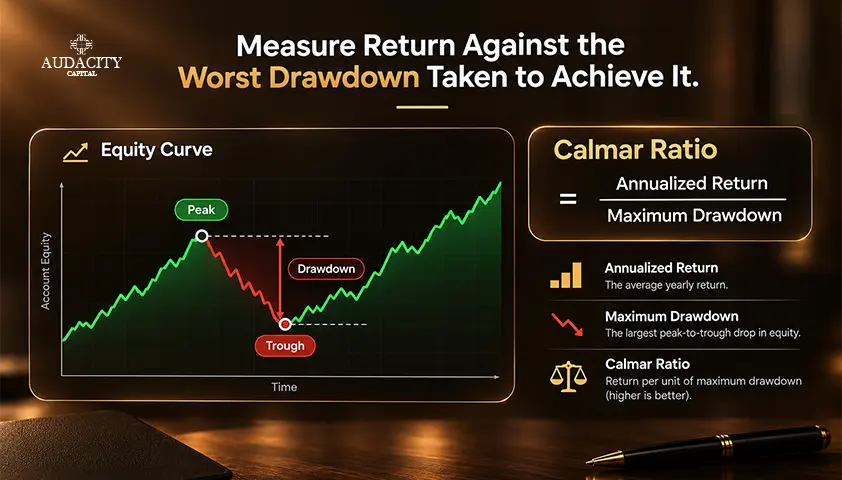
Calmar Ratio: Meaning, Formula and Examples
Learn what the Calmar Ratio means, how to calculate it, interpret results, and compare it with Sharpe and Sortino ratios.

Stochastic Oscillator
Learn how to use the stochastic oscillator in trading, interpret overbought and oversold levels, spot crossovers, and adjust settings.
Bearish RSI Divergence: How to Spot It, Confirm It and Trade It
Learn how to identify bearish RSI divergence, confirm reversal signals, plan entries and exits, and manage risk with practical forex trading examples.
Sortino Ratio in Trading: How It Measures Downside Risk
Learn what the Sortino Ratio means, how to calculate it using downside deviation, and how traders use it to compare risk-adjusted performance.