


Crypto Day Trading: A Complete Guide for Beginners



Crypto day trading means buying and selling digital assets within the same day to profit from short-term price swings rather than long-term appreciation. Bitcoin, Ethereum, and dozens of altcoins move enough in a single session for traders to find real entries and exits.
It's caught on because crypto markets never close (free from any opening bell or lunch break), just continuous price action across every time zone. That constant movement appeals to new traders who want faster feedback than a typical stock portfolio gives.
This Crypto day trading for beginners fits those who've watched a few trading videos or skimmed forum threads but haven't placed an actual trade yet. By the end, you'll know how to day trade crypto responsibly, which indicators matter, and where new traders tend to lose money fastest.
What Is Crypto day trading?
Cryptocurrency day trading is the practice of opening and closing positions within a single trading day, sometimes within minutes, to capture short-term price movements instead of holding through market cycles. Unlike stocks, crypto markets trade 24/7, so "day" refers to the trader's own session length rather than a fixed market schedule, one of the details most crypto trading for beginners guides don't explain well.
Crypto day trading can be done either by buying cryptocurrencies directly on an exchange or by trading Cryptocurrency CFDs through a professional trading platform. While spot traders own the underlying asset, CFD traders speculate on price movements without taking ownership of the cryptocurrency, making CFDs a popular choice for active traders.
Here's what defines the approach:
- A day trade opens and closes within hours (sometimes minutes), with no position carried past the session.
How does it work?

Traders watch price charts for a setup, a breakout, a support bounce, a volume spike, then enter and exit based on that signal, not a long-term thesis about the coin.
- Intraday trading: Nothing is held overnight as every position is flat by the time the trader logs off.
- Volatility: Crypto can move 5–10% in a few hours, which is exactly the kind of swing day traders need to profit from short windows.
- Liquidity: Coins like Bitcoin, Ethereum, and Solana trade enough volume that orders fill fast at fair prices. Thinly traded altcoins often can't say the same.
A trader buys Bitcoin at $61,200 after it breaks above resistance, then sells at $61,900 two hours later, earning a small, repeatable gain rather than a long-term bet.
How Does Crypto day trading Work?
A crypto day trade follows a simple three-part cycle, even though the analysis behind it can get fairly involved. The trader opens a position once a chart setup lines up with their strategy, watches the market closely while the trade is live, and closes it before the session ends — win, loss, or breakeven. Nothing carries forward into tomorrow's price action.
- Opening a position usually follows a specific trigger: a breakout past resistance, a bounce off a moving average, or a sudden volume spike signaling fresh interest.
- Monitoring the market means tracking price and volume in real time, adjusting stop-loss levels as the trade develops, and watching for a reversal that would invalidate the setup.
- Closing the position happens when a profit target is hit, a stop-loss triggers, or the setup simply no longer holds, all within the same day.
The direction and structure of a trade can also vary:
- Long: Buying first, expecting the price to rise, then selling later at a higher price.
- Short: Selling first, expecting the price to fall, then buying back later at a lower price.
- Spot: The actual asset changes hands at the current market price, with no expiry or contract involved.
- Futures: A contract that tracks the asset's price, often with leverage, letting traders go long or short without holding the coin itself.
How to Start Crypto day trading?
Once the mechanics are clear, the next question is how to actually get started. Anyone researching how to start day trading cryptocurrency should treat it as a skill built in stages, not something to jump into with real money on day one.
Start with Choosing an Exchange
Look for a platform with deep order books, low fees, and a clean charting interface, since slippage and clunky execution can quietly erode profits that looked fine on paper.
Now Choose Coins
Stick to a small handful of liquid, well-known coins at first rather than chasing every trending low-cap token, since unfamiliar charts and thin order books make price action harder to read.
Next Step Involves Creating a Trading Plan
Write down entry and exit rules, position size limits, and the specific setups worth acting on before the market opens, so decisions follow a plan instead of a gut feeling.
Consider Risk Management
Decide how much of the account can be risked per trade and per day before placing a single order, and treat that number as fixed rather than negotiable mid-session.
Start Practicing
Run the plan on a demo account or very small position sizes until it feels repeatable, since most early losses come from execution mistakes rather than bad ideas.
Review Performance
Keep a record of every trade and the reasoning behind it, and revisit that log weekly to spot what's actually working versus what only felt like it was.
Best Cryptocurrencies for Day Trading
Not every coin suits an intraday strategy. The ones that do tend to combine deep liquidity, tight spreads, and enough daily movement to create tradable setups without excessive noise.
Cryptocurrency | Why Traders Choose It |
Bitcoin | Deepest liquidity in the market, tight spreads, and a chart that often sets the tone for crypto broadly |
Ethereum | High volume with price action that reacts to network upgrades, DeFi activity, and risk sentiment |
Solana | Sharp, fast intraday moves from an active ecosystem, suiting shorter timeframes and scalping |
XRP | Volatility spikes tied to regulatory news and legal developments, creating distinct event-driven setups |
BNB | Liquidity tied to a major exchange ecosystem, with moves that track broader exchange-token sentiment |
Dogecoin | Retail-driven volatility and social sentiment that can produce sharp intraday swings |
Liquidity determines how easily a position can be entered and exited without moving the price against the trader, which is why the coins above tend to top most lists. Spreads matter just as much: a wider spread eats into profit on every trade, so a coin that looks volatile on paper can still be a poor choice if it costs too much to get in and out. Volatility creates the opportunity in the first place, but without liquidity and reasonable spreads alongside it, volatility on a thinly traded coin usually just means unpredictable slippage.
Best Crypto day trading Strategies
There's more than one way to approach the market, and most cryptocurrency day trading strategies for beginners fall into one of the categories below. Each one has its own dedicated breakdown on our Crypto day trading strategies guide — this section is just a quick overview.
Scalping
It involves taking many small trades across a session, aiming for tiny price movements that add up over dozens of entries.
Momentum Trading
Riding a coin's existing directional move for as long as buying or selling pressure keeps pushing it that way.
Breakout Trading
Entering right as price clears a key support or resistance level, betting the move continues in that direction.
Range Trading
Buying near the bottom and selling near the top of a price band the coin has been stuck inside.
Trend Following
Trading in the direction of a longer intraday trend rather than against it, using pullbacks as entry points.
News Trading
Positioning around scheduled announcements or breaking headlines that tend to move price sharply within minutes.
Mean Reversion
Betting that a price which has moved too far, too fast will snap back toward its recent average.
Best Technical Indicators for Crypto day trading
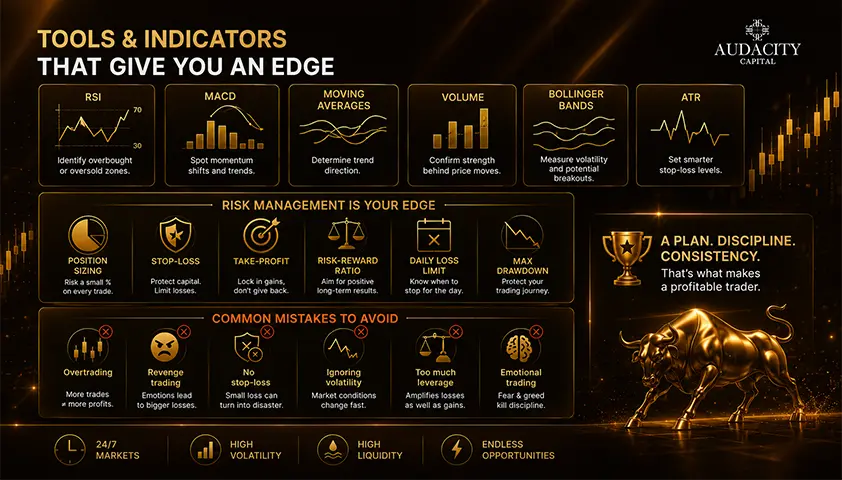
Whichever strategy a trader leans toward, execution still comes down to reading the right signals. Most crypto trading signals for beginners get built around a small set of core indicators rather than dozens of overlapping tools.
- RSI: It measures how overbought or oversold a coin is on a 0–100 scale. Good for spotting reversals in a ranging market and simple to read, but it can stay at an extreme through a strong trend, flagging reversals too early.
- MACD: It tracks the relationship between two moving averages to highlight momentum shifts. Useful for confirming a trend change alongside price action, though it tends to lag in fast, choppy conditions.
- Moving Averages: It smooths out the price to reveal the underlying direction. Helpful for reading trend direction and dynamic support or resistance, but it reacts after a move has started, so entries based on it alone arrive late.
- VWAP: It shows the average price a coin has traded at over the session, weighted by volume. Useful for gauging whether the price is expensive or cheap relative to the day's activity, though it resets each session with little multi-day context.
- Bollinger Bands: It plots bands above and below a moving average based on recent volatility. Good for spotting unusually low or high volatility before a move, though bands can widen sharply during a breakout and trigger exits too early.
- Volume: It shows how much of a coin has changed hands over a given period. Confirms whether a price move has real participation behind it, but says nothing about direction on its own. It needs to be read alongside the price.
- ATR: It measures how much a coin typically moves within a given period. ATR is best for setting stop-loss distances that match current volatility rather than a fixed number, though it says nothing about direction, only the size of expected movement.
Risk Management in Crypto day trading
Every serious set of Crypto day trading rules and risk management practices starts with the same idea: protecting the account matters more than any single trade.
Strategy decides how often a trader wins; risk management decides whether they're still trading a year from now.
- Position sizing: Deciding what percentage of the account to risk on a single trade, usually a small fraction, so no single loss does lasting damage.
- Stop-loss: A predetermined exit point that closes a losing trade automatically, removing the temptation to wait it out once a setup fails.
- Take-profit: A predetermined exit on the winning side, locking in gains instead of letting greed turn a good trade into a break-even one.
- Risk-reward ratio: Comparing potential loss to potential gain before entering, so even a modest win rate can stay profitable over time.
- Daily loss limit: A fixed point at which a trader stops for the day entirely, preventing one bad session from spiraling into a worse one.
- Maximum drawdown: The largest peak-to-trough decline an account can absorb before trading pauses and the strategy gets reassessed.
How Audacity Capital Supports Crypto CFD Trading?
Audacity Capital offers crypto trading in the form of Digital Assets and Cryptocurrency CFDs rather than as a cryptocurrency exchange, meaning traders speculate on price movement through the firm's supported trading platforms instead of buying and holding the underlying coins directly. That distinction matters for day trading specifically, since it removes the need to manage wallet security or exchange withdrawals while still allowing exposure to the same price action that spot traders are watching.
These Digital Asset CFDs sit alongside Forex, Indices, and Metals & Commodities within Audacity Capital's full range of trading instruments, giving funded traders the option to diversify across asset classes rather than trading crypto in isolation. Traders who qualify for a funded account also get access to competitive profit splits, a structure that lets skilled traders scale their Crypto day trading without risking personal capital beyond the evaluation stage. More detail on the firm's full offering, evaluation process, and funded account terms is available at audacity.capital.
Common Crypto day trading Mistakes
- Overtrading: Taking far more trades than the strategy calls for, often out of boredom, which quietly increases fees without adding any edge.
- Revenge trading: Jumping back into the market after a loss to win it back, usually with a bigger position and far less discipline than the plan called for.
- Trading without a stop-loss: Leaving a losing position open, hoping it turns around, which can turn a small, manageable loss into one that wipes out days of gains.
- Ignoring volatility: Using the same position size regardless of how sharply a coin is moving, instead of scaling down when conditions get choppy.
- Too much leverage: Amplifying position size beyond what the account can absorb, so a normal price swing becomes a margin call instead of a manageable drawdown.
- Emotional trading: Letting fear or excitement override the plan, whether that means exiting a winner too early or holding a loser far too long.
Crypto day trading vs Swing Trading
Aspects | Day Trading | Swing Trading |
Holding period | Minutes to hours, closed same day | Days to several weeks |
Chart timeframe | 1-minute to 15-minute charts | 4-hour to daily charts |
Time commitment | Requires active monitoring during the session | Checked periodically, less screen time overall |
Pace | Fast decisions, frequent trades | Slower decisions, fewer trades |
Overnight exposure | None, flat by the end of the day | Positions held through overnight and weekend moves |
Once the common pitfalls are clear, it helps to see how day trading compares to other styles. When it comes to day trading cryptocurrency vs swing trading, the real difference is time horizon. Day trading demands constant attention and fast decisions, while swing trading requires patience, since positions stay open long enough to absorb overnight volatility that a day trader avoids by design.
Crypto day trading vs Forex Trading
Aspect | Crypto day trading | Forex Day Trading |
Market hours | 24/7, including weekends | Weekdays only, closed on weekends |
Typical volatility | Higher, with sharp intraday swings | Generally steadier, with occasional event-driven spikes |
Tradable assets | Thousands of coins, though only a handful are liquid enough for day trading | A smaller, well-established set of major and minor currency pairs |
Regulation | Still developing in many regions | Long-established regulatory frameworks |
Both markets reward the same core skills: reading price action, managing risk, and sticking to a plan. However, crypto's round-the-clock schedule and sharper volatility mean setups can appear and disappear far faster than they typically do on a currency pair.
Is Crypto day trading Profitable?
It can be, but the honest answer sits between the highlight reels on social media and the warnings on every risk disclaimer. Publicly available data on retail day traders across crypto, forex, and equities alike consistently shows that a majority struggle to stay profitable long-term, largely because consistency is harder to maintain than any single strategy is to learn.
The traders who do stay profitable share a few habits rather than a secret indicator: a written plan instead of impulse trades, risk capped before it caps them, and losing trades treated as a cost of doing business rather than something to chase back immediately. Discipline compounds in a way a single good week never does which is what separates a trader with three months of experience from one with three years.
Advantages of Crypto day trading
- 24/7 markets: There's no waiting for an opening bell, which means opportunities can appear at any hour and trading fits around a schedule rather than the other way around.
- High volatility: Sharp price swings create more frequent setups than slower-moving markets typically offer within a single session.
- Liquidity: Major coins trade in high enough volume that positions can usually be entered and exited without major slippage.
- Many opportunities: With thousands of coins listed across exchanges, there's rarely a shortage of charts worth watching on any given day.
Risks of Crypto day trading
- Volatility: The same sharp moves that create opportunity can just as easily turn against a position faster than a trader can react.
- Leverage: Borrowed capital magnifies both gains and losses, and a small adverse move can erase a far larger share of the account than expected.
- Emotions: Fast markets tend to amplify fear and greed, and decisions made under that pressure rarely match the discipline of a calm, pre-written plan.
- Market manipulation: Thinly traded coins are more susceptible to sudden, coordinated price moves that don't reflect any genuine shift in supply or demand.
Essential Tools for Crypto Day Traders
Managing those risks in practice comes down to having the right tools in place, not just the right mindset.
- TradingView: A widely used charting platform offering some of the best crypto charts for day trading, with customizable indicators and drawing tools for spotting setups in real time.
- CoinMarketCap: Useful for tracking market capitalization, trading volume, and price trends across thousands of coins in one place.
- Glassnode: Provides on-chain data that can reveal shifts in holder behavior and network activity that price charts alone don't show.
- Trading journals: A simple log of every trade, including the reasoning behind it, that turns scattered experience into a reviewable record of what's actually working.
- Economic calendar: Tracks scheduled events and data releases that tend to move markets, helping traders anticipate volatility instead of getting caught off guard by it.
Crypto day trading Checklist
- Before the market: Check overnight price action, note any scheduled news or data releases, and confirm the day's risk limit before placing a single trade.
- During the trade: Stick to the entry and exit rules set in advance, adjust stop-loss levels only in the direction of reducing risk, and avoid adding to a losing position.
- After the trade: Log the outcome and the reasoning behind it, note anything that deviated from the plan, and close out the platform rather than watching charts out of habit.
Tips to Become a Better Crypto Day Trader
- Trade fewer coins, but know their charts well enough to recognize unusual behavior at a glance.
- Set a daily loss limit before the session starts, and treat it as non-negotiable once it's hit.
- Review losing trades as closely as winning ones, as they usually contain more useful information.
- Avoid adding size to a position just because a small loss feels uncomfortable to sit with.
- Keep a trading journal and read back through it weekly, not only after a bad week.
- Step away from the screen after a loss instead of immediately looking for the next trade.
How to Day Trade Crypto with a Prop Firm?
A prop firm lets traders access larger amounts of trading capital than they might have on their own, usually after passing an evaluation that tests risk management and consistency rather than raw profit alone. Once funded, the trader operates within defined risk rules, such as a maximum daily loss and drawdown limit, and keeps a share of the profits generated on the firm's capital.
This structure suits Crypto day trading well, since traders can speculate on price movement without holding large amounts of capital in an exchange wallet themselves. It also adds a layer of external discipline: the firm's risk limits mirror the rules a careful trader would ideally set alone, making the evaluation as much a test of habits as of strategy.
Related Articles
How to Make Money Day Trading Crypto
Frequently Asked Questions
Cryptocurrency trading itself is legal in most jurisdictions, though rules around exchanges, taxation, and derivatives like CFDs vary by country. It's worth checking local regulations before trading actively.
There's no fixed minimum, but an amount that can absorb a string of small losses without pressure to make it back matters more than the exact figure. Many traders build skills on a demo account first.
Most day traders work across 1-minute to 15-minute charts. Though the right timeframe depends on strategy, scalpers lean towards shorter intervals, while breakout or momentum traders often work slightly longer intervals.
Yes. Trading Digital Asset CFDs, rather than buying coins on an exchange, lets traders speculate on price movement without holding the coin itself. A structure firms like Audacity Capital offer alongside Forex, Indices, Metals & Commodities.
Fewer than most expect. A small number of well-planned trades, each following a clear setup, usually outperforms a high volume of impulsive ones.
In most jurisdictions, yes, though treatment depends on local tax law and whether trades involve direct ownership or derivatives like CFDs. This isn't tax advice, and a local tax professional can confirm the exact obligations.

暗号資産に規律あるリスクを適用する準備はできていますか?Audacity Capitalの新しい暗号資産商品を探索し、あなたの取引戦略を持ち込んでください。
詳細を見るニュースレター
ニュースレターに登録して最新情報を入手。
ソーシャルコミュニティに参加