



Forex Trading Without Leverage



You can trade forex without leverage by keeping your market exposure at 1:1 with your available capital. That means using your own money to fund a position instead of borrowing extra buying power to make it bigger.
The trade-off of trading without leverage runs both ways:
- Less exposure to leveraged losses and margin calls.
- But a larger capital requirement and smaller cash gains for the same percentage move.
This guide covers how forex trading without leverage works, what capital it takes, real profit and loss examples, its advantages and limits, how to set it up, and which trading styles it actually suits.
Can You Trade Forex Without Leverage?
Can you trade forex without leverage is the most asked question, and yes, you can trade this way. A trade held at genuine 1:1 exposure is fully funded by the trader's own capital, with no borrowed buying power enlarging the position. Whether a broker offers a literal 1:1 setting depends entirely on that broker and account type, so it's never a given.
Not every broker builds in a dedicated "no leverage" option. Where that setting doesn't exist, a trader can still reach the same effective outcome through position sizing alone, opening a position sized to match available capital exactly, even on an account whose maximum leverage is set much higher. The leverage cap a broker advertises is a ceiling, not a requirement to use it.
But none of this removes risk from the trade. Currency prices still move, and a 1:1 position can still lose money on an adverse move. What changes is how that risk shows up, not whether it exists.
What Does 1:1 Leverage Mean in Forex?
Before getting into anything further, let’s understand what 1:1 leverage in trading means.
1:1 leverage means roughly one dollar of market exposure for every dollar of capital committed to that position.
For Example: $1,000 in capital funds a $1,000 position. $10,000 in capital funds a $10,000 position.
No extra buying power layers on top to make the position bigger than the capital behind it.
Leverage, Margin and Position Size Are Different
- Traders use these three terms interchangeably; they have very different jobs.
- Leverage sets the ceiling on how much exposure a trader can control relative to their capital.
- Margin is the deposit a broker actually requires to open and hold a leveraged position.
Whereas position size, or notional exposure, is what determines how much a given market move actually affects profit and loss.
The maximum leverage a broker offers isn't automatically the leverage a trader is using. A simple formula makes the actual figure clear:
Effective leverage = Total position value ÷ Account equity
A trader with $2,000 in account equity who opens a $2,000 position is running effective leverage of 1:1, even if the broker's account technically allows up to 1:50. The account's ceiling and the trade's actual exposure are two separate numbers, and only one of them decides the real risk.
How Does Forex Trading Without Leverage Work?
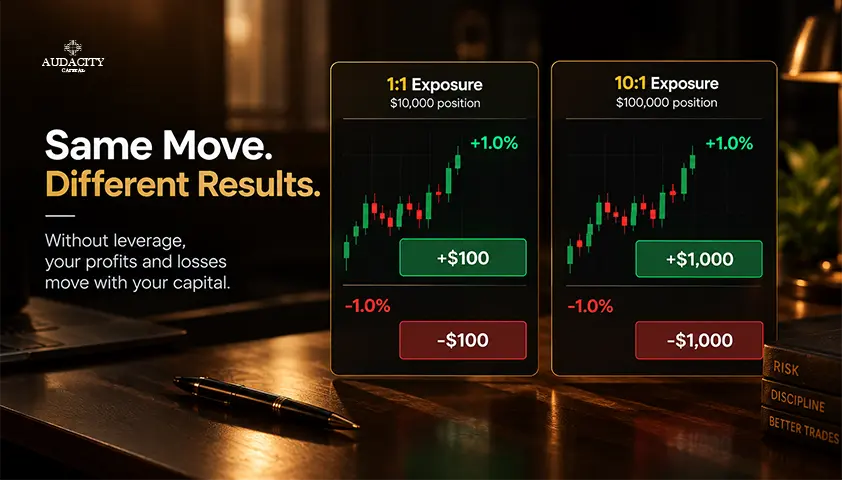
Spot currency exchange rates adjust continually based on global financial flows, central bank interest rate decisions, and broad macroeconomic developments. When executing trades without financial leverage, the monetary result of these price shifts correlates directly with the full cash valuation of the open contract.
Let’s understand it with an example:
A trader with $20,000 in equity who opens a 1:1 unleveraged position worth $20,000 will experience a $200 balance increase from a 1.0% favorable exchange rate movement before accounting for transaction costs. An equivalent 1.0% adverse movement reduces equity by $200. Raising position exposure to $200,000 on that same $20,000 equity base creates an effective leverage ratio of 10:1, amplifying the financial impact of a 1.0% price move to $2,000 in either direction.
The foreign exchange market fluctuates identically for all participants regardless of personal platform settings. The account capital grows or shrinks at different rates purely because total market exposure changes.
Account Capital | Position Exposure | Market Move | Approx. P&L |
$20,000 | $20,000 | +1.0% | +$200 |
$20,000 | $20,000 | -1.0% | -$200 |
$20,000 | $200,000 | +1.0% | +$2,000 |
$20,000 | $200,000 | -1.0% | -$2,000 |
Note: Actual realized P&L depends on the specific instrument, quote currency, contract lot size, currency conversion rates, bid-ask spreads, commissions, and other trading costs.
Calculating potential performance requires evaluating total transaction value alongside account equity. Controlling trade size serves as the primary mechanism for managing equity variance, keeping capital fluctuations fully aligned with organic market movements.
Trading Without Leverage vs Low Leverage
Equating platform leverage limits with active market risk represents a frequent analytical oversight. A clear operational boundary exists between literal 1:1 exposure, low maximum broker leverage settings, and high available leverage managed through deliberate position control.
A $15,000 account with access to 1:100 maximum leverage maintains an effective exposure of 1:1 when opening a position valued at exactly $15,000. Conversely, an account capped at a low 1:30 leverage limit can be driven to full capacity to control $450,000 in market value, generating severe account sensitivity to market swings.
Maximum broker limits do not define trading risks on their own. The effective risk depends entirely on total position value relative to account capital.
Factor | 1:1 Exposure | Low/Moderate Leverage | High Available Leverage |
Own capital used | High | Moderate | Lower relative to exposure |
Potential exposure | Limited (100% of equity) | Higher (2x to 10x equity) | Much higher (up to cap) |
Margin usage | Highest | Lower | Lowest relative to exposure |
Sensitivity to price movement | Lower | Depends on position size | Can become very high |
Similarly, the leverage setting alone does not tell the whole risk story, making position sizing a critical factor in managing market exposure.
How Much Capital Do You Need to Trade Forex Without Leverage?
No universal minimum capital requirement exists for executing foreign exchange trades without financial leverage. Operational funding demands depend on multiple trading parameters, including broker volume thresholds, currency pair valuation, target position sizing, account base currency, contract specifications, portfolio diversification needs, and individual risk allocation rules. Because currency exchange rates fluctuate continuously, the cash required to cover an unleveraged position adjusts in tandem with real-time market valuations.
Contract structures in retail foreign exchange markets operate through standardized lot definitions.
· Standard lot: 100,000 units of the underlying base currency.
- Mini lot: 10,000 units of the underlying base currency.
- Micro lot: 1,000 units of the underlying base currency.
This will be simplified through an example:
Initiating an unleveraged trade of one micro lot in EUR/USD at an exchange rate of 1.0850 requires $1,085 in unencumbered balance. On platforms supporting nano lots of 100 units, the initial cash outlay drops to approximately $108.50. Exact cash commitments shift constantly based on currency pair exchange rates and account settlement currencies.
Useful Info. to Remember: You can trade a small position with a small account, but meaningful dollar returns require either greater capital or greater market exposure.
Asserting that traders require fixed universal balances like $10,000 or $50,000 overlooks modern contract sizing options that permit flexible allocation regardless of total account size.
How Do Profits and Losses Change Without Leverage?
Many new market participants often ask if they can make money operating at a strict one-to-one ratio. The practical answer comes down to basic market mathematics. Your percentage return always derives directly from how far the underlying exchange rate moves. The absolute monetary result depends entirely on the size of your active position in the market.
For instance: Allocating a $5,000 position that experiences a 1% favorable market move yields approximately $50 in gross profit before execution costs. This same mathematical principle applies to losing trades. If that identical $5,000 position faces a 1% adverse market movement, the resulting monetary loss equals approximately $50.
Operating with smaller market exposure fundamentally alters how quickly an account experiences financial drawdowns. A trader holding a $10,000 position who sees a 2% price drop will face a $200 equity decline. If that trader applied a higher multiplier to hold a $100,000 position, that same 2% adverse move would generate a severe $2,000 loss. Restricting position sizes clearly slows down the velocity of negative account swings.
Market participants must remember that simply avoiding borrowed funds does not magically produce a profitable trading edge. The underlying methodology still requires the trader to identify viable entry points, establish logical exits, and enforce strict risk parameters. Consistent success relies entirely on sound market analysis and execution discipline.
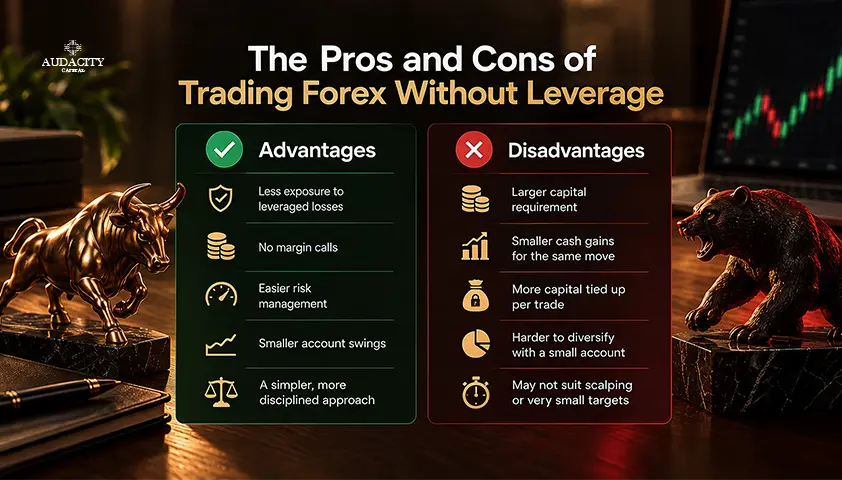
What Are the Advantages of Forex Trading Without Leverage?
You get several distinct operational benefits by engaging the global currency markets with a strict one-to-one ratio. These practical advantages primarily center around capital preservation and structural simplicity. But it is worth knowing that achieving lower risk fundamentally means keeping your total position exposure closely aligned with your actual cash balance.
Advantage | What It Means in Practice |
Lower exposure | The position size stays closer to available capital. |
No leverage-driven margin pressure | There’s less dependence on borrowed buying power. |
Easier exposure calculation | The capital and position value have a direct relationship. |
Smaller account swings | Assuming position sizes are smaller |
Psychological simplicity | Some traders find smaller exposure easier to manage. |
Greater tolerance for normal price movements | More account equity remains uncommitted. |
These structural benefits create a very different daily routine for the active retail trader. Removing borrowed buying power eliminates margin-call anxiety during periods of standard intraday volatility. Because the open position value perfectly matches the cash in the account, calculating potential financial impacts becomes an incredibly straightforward process. A simple percentage fluctuation in the currency asset translates to the same percentage fluctuation in the committed capital.
Keeping a large portion of account equity uncommitted provides a robust buffer against unexpected weekend price gaps and sudden macroeconomic news events. Market participants often report feeling significantly less psychological pressure when their daily account swings remain small and manageable. Maintaining a calm mindset generally leads to better analytical decisions, stricter adherence to trading plans, and greatly improved execution discipline over the long run.
What Are the Disadvantages of Trading Forex Without Leverage?
When a trader moves away from multiplied buying power, it introduces several practical limitations for retail market participants.
A significantly higher capital requirement to open standard position sizes is the most obvious drawback. This dynamic leads to much lower capital efficiency overall. A trader utilizing a strict one-to-one ratio will see much smaller dollar gains on small accounts, even when catching excellent market trends.
Because 100% of the trade value requires actual cash, significantly more capital gets tied up in active positions. This restriction leaves fewer funds available, resulting in potentially fewer simultaneous positions. Consequently, achieving proper portfolio diversification becomes far more difficult for individuals operating with smaller account balances.
Furthermore, this approach may be entirely impractical for specific strategies targeting very small intraday price moves. Scalping tiny fluctuations requires large position sizing to generate meaningful financial returns. Finally, traders must understand that a lower exposure setting does not automatically make a poor strategy profitable. A flawed entry methodology will still slowly drain an account over time, regardless of the position size.
How to Trade Forex Without Leverage?
To trade forex without leverage, it is important to establish a strict one-to-one framework through a structured approach to order execution. The following practical workflow outlines exactly how to trade forex without leverage effectively.
Step 1: Check the broker's account structure
Confirm whether the financial provider explicitly allows a 1:1 account setting. Alternatively, check if the platform supports sufficiently small position sizing to manually control your market footprint.
Step 2: Calculate your effective exposure
Always monitor your real-time risk by using a simple mathematical formula. Effective leverage equals the total active position value divided by the current account equity.
Step 3: Keep position exposure within your chosen limit
If your primary goal involves maintaining a strict 1:1 ratio, your total open market exposure should never exceed your available cash equity.
Step 4: Choose an appropriate position size
Utilize micro lots and other smaller trade sizes to perfectly align your market commitment with your actual account balance.
Step 5: Account for trading costs
Factor all execution expenses into your profitability calculations. These important variables include the bid-ask spread, broker commission, currency conversion rates, and overnight financing charges where applicable.
Step 6: Use a stop-loss and predefined risk limit
The absolute absence of multiplied exposure does not make stop-losses unnecessary. Every single order requires a firm exit plan to protect capital from unexpected macroeconomic shocks.
Step 7: Test the setup on a demo account
Practicing in a simulated environment proves particularly useful for checking exactly how the broker calculates margin requirements, position sizing constraints, and dynamic profit figures.
An important operating principle that traders should remember is that a broker can offer tremendous buying power without forcing you to use the full amount.
Can You Day Trade or Swing Trade Without Leverage?
Here is the classification of both:
Day Trading Without Leverage
Operating on short intraday timeframes presents unique mathematical challenges. Smaller intraday price movements typically produce relatively small cash gains at a strict 1:1 ratio. Because the percentage fluctuations remain tight, you may need more capital for meaningful monetary results. When targeting minor price fluctuations, execution costs become extremely important. The bid-ask spread and commission fees can easily consume a large portion of a tiny gross profit. Despite these hurdles, precise position sizing still controls overall account risk.
Swing Trading Without Leverage
Holding positions over longer durations aligns much better with an unamplified strategy. Larger price movements unfolding over days or weeks can make 1:1 exposure highly practical for some methodologies. The wider profit targets easily absorb standard transaction costs. However, traders must remember that overnight news and macroeconomic events still matter significantly. Holding an asset longer certainly does not remove inherent market risk. Market participants must continually manage their open exposure. Ultimately, neither approach is universally superior. The best choice depends entirely on individual goals and available funding.


Free Prop Firm Trading Competition
Start CompetingIs Trading Without Leverage Safer?
Trading without leverage can effectively reduce the risk created by oversized market exposure, but it definitely does not eliminate inherent forex risk.
Market participants must thoroughly understand the clear distinction between the hazards they can actively control and the hazards built directly into the financial system. This conservative approach successfully minimizes several specific operational dangers. It drastically cuts down excessive market exposure and entirely eliminates the wild leverage-driven account swings that often trigger negative emotional reactions. It also removes some margin-related risks, including the constant threat of sudden broker liquidations during temporary intraday price spikes.
However, numerous operational and systemic risks remain fully active. Traders still face unpredictable currency price movements driven by global macroeconomic forces. Poor trade selection will naturally continue to drain account balances over time. Holding concentrated exposure or taking highly correlated positions across multiple currency pairs can still create massive portfolio drawdowns.
Furthermore, standard operational hurdles like spread and commission costs, overnight financing events, weekend price gaps, and execution differences during fast markets remain constant financial threats. Finally, no platform account setting can ever protect a trader from making impulsive emotional decisions.
The central guiding principle remains explicitly clear. Choosing no leverage simply reduces one specific layer of risk. It absolutely does not remove the daily need for comprehensive risk management, careful trend analysis, and strict execution discipline.
How Should You Manage Risk When Trading Without Leverage?
Protecting capital in the financial markets requires a comprehensive daily strategy that extends far beyond simply adjusting a broker account setting. Effective financial protection demands rigorous attention to precise position sizing and establishing a firm maximum loss per trade. Every single order requires careful stop-loss placement to cap downside potential immediately. Traders must continually monitor their total account exposure and actively watch for correlated currency pairs that could accidentally double their directional market risk. Setting strict portfolio drawdown limits, maintaining a highly detailed trading journal, and maintaining constant economic-calendar awareness help build a truly resilient methodology. Above all, traders must focus on avoiding oversized single positions.
Consider a highly practical numerical example. A $10,000 account risking exactly 1% has a planned maximum loss of approximately $100 before execution effects and costs, subject entirely to how the specific trade is structured.
Forex Trading Without Leverage – Common Mistakes to Avoid
- Thinking "I do not need a stop-loss because I use no leverage."
- Holding excessively large fully funded positions in one single asset.
- Treating a 1:1 setup as guaranteed protection against major market losses.
- Ignoring highly correlated trades that silently multiply portfolio risk.
- Measuring success only by percentage return while ignoring actual dollar figures.
Active defense mechanisms always remain completely indispensable.
Can You Trade Forex Without Leverage in the UK?
UK retail traders frequently encounter rolling spot FX nested deeply within the FCA's broader CFD regulatory framework. The regulatory body maintains strict rules that explicitly restrict leverage for retail CFDs and CFD-like products, with these maximum limits varying significantly by the specific underlying asset. The FCA's official policy statement specifies a mandatory range stretching from 30:1 down to 2:1, while its comprehensive Handbook explicitly includes leveraged rolling spot forex in the applicable risk-warning framework.
Importantly, a regulatory maximum is definitely not a required trading level. A conservative trader may intentionally choose to use far less exposure. However, securing exact broker and account availability of literal 1:1 trading remains highly provider-specific across the industry.
Before depositing any funds, UK readers should always check whether their chosen firm is properly authorised and has the exact permission for the relevant service. The FCA's official Firm Checker was updated on September 22, 2026, offering traders a vital tool for immediate background verification.
Audacity Trading Platform
Trade NowWho Might Prefer Forex Trading Without Leverage?
A market participant wondering whether they can I trade forex without leverage should review several distinct trader profiles. It is a conservative setup that naturally attracts traders with sufficient capital who specifically want lower market exposure. It works beautifully for individuals prioritizing capital preservation over aggressive growth. Longer-term currency traders also benefit, as holding unamplified positions reduces overnight stress.
Additionally, traders learning execution and position sizing find this environment highly forgiving. It appeals to people who prefer a simple, direct mathematical relationship between their capital and their market exposure. Finally, it suits traders who simply do not need the additional buying power available through margin.
Conversely, this framework may feel highly restrictive for very small-account traders looking for significant monetary gains. Strategies requiring larger exposure to capture very small intraday market movements will struggle to function. Furthermore, traders wanting to diversify across many simultaneous positions will find their capital tied up too quickly.
The final choice depends entirely on capital, timeframe, position size, risk tolerance, strategy, and broker structure.
Forex Trading Strategies In Depth
- Best Forex Trading Strategies
- Fundamental Analysis Strategies in Forex
- Forex Leverage Trading Strategies
- Forex Swing Trading Strategies
- Forex Crossover Moving Average Strategies
- Hedging Forex Trading Strategies
- Forex Scalping Trading Strategies
FAQs
Yes, you can participate in the currency markets without borrowing funds. You simply keep your position size equal to or less than your total account balance, maintaining a strict one-to-one ratio with your deposited equity.
Yes, using micro lots allows small accounts to participate safely. However, because your monetary profit relies entirely on your position size, trading with smaller capital generally produces much smaller monetary returns.
It successfully reduces the extreme dangers of oversized positions and margin calls. However, it absolutely does not eliminate standard market risk, currency price fluctuations, or the possibility of losing money.
There is no universal minimum amount required. Your actual capital requirement depends entirely on the specific currency pair, your chosen position size, your broker's minimum limits, and your account currency.
Yes, but profitability depends entirely on your strategy and favorable market movement. Operating without multiplied buying power does not magically create a trading edge or guarantee any financial success.
The underlying market analysis can remain the same. However, your position sizing, daily capital allocation, and overall return expectations will definitely need significant adjustment to match the lower exposure.

暗号資産に規律あるリスクを適用する準備はできていますか?Audacity Capitalの新しい暗号資産商品を探索し、あなたの取引戦略を持ち込んでください。
詳細を見るニュースレター
ニュースレターに登録して最新情報を入手。
ソーシャルコミュニティに参加

関連記事

Why Ex Military Are Good Traders?
Discover the new career opportunity for ex-military: trading. Banks and trading firms are hiring veterans for the trading floor.


Is Crypto Less Risky?
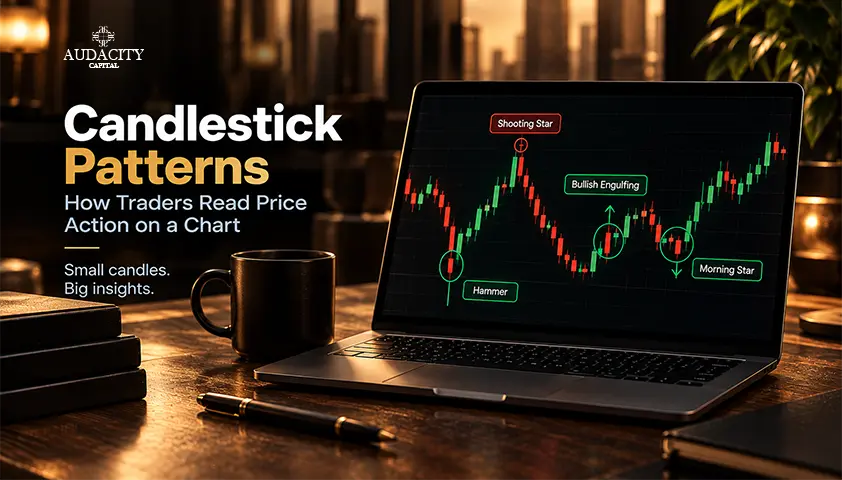
Candlestick Patterns: How Traders Read Price Action on a Chart
Learn to read price action with proven candlestick strategies and improve trading consistency now with Audacity

Weekly Economic Calendar: How Smart Traders Turn Volatility Into Opportunity
Learn how to use the weekly economic calendar to trade market volatility. Discover strategies to manage risk and capitalize on high-impact news events.