


What Is a Trading Edge (and How to Find Yours)



A trading edge is a repeatable advantage that gives your overall trading process positive expected value over many trades. It is an advantage in probability, payoff, or execution, not a prediction about the next trade.
Any single trade can lose, and that outcome tells you very little about whether the edge is real.
This guide separates a setup from a strategy from an edge, walks through the simple math that defines one, and gives you a practical research process to find and test your own.
You will finish with a way to write one testable edge statement and know what evidence would disprove it.
What Is a Trading Edge?
An edge is a small but repeatable advantage that produces positive expectancy after losses and trading costs. Those costs include commissions, spreads, and slippage.
The word "small" matters. Real edges are usually thin, and thin edges only survive when execution and costs are respected.
An edge is also conditional. It may exist only in one market, one session, a defined volatility range, a specific time horizon, or a particular execution environment. Move it outside those conditions and the advantage often disappears.
A real edge does not require a high win rate, a flat equity curve, or a profitable month. A strategy can lose more often than it wins and still have an edge if the winners are large enough.
A strategy can win most trades and still lose money if the average loss is too big. Frequency and payoff are separate levers, and only the combination matters.
A Strategy, Setup and Trading Edge Are Different
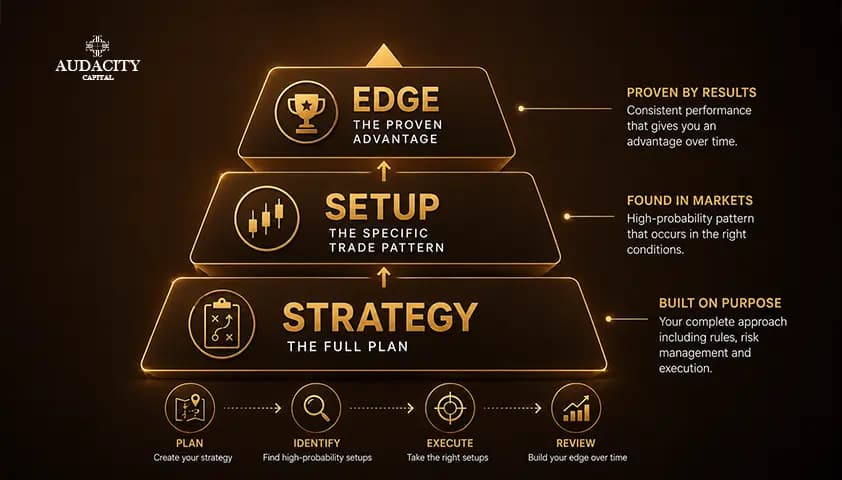
A setup is a pattern or condition on a chart. A strategy adds entry, exit, sizing, and risk rules to that pattern. An edge is the evidence that the complete strategy performs better than chance or a relevant baseline after realistic costs.
Execution sits on top of all three. Two traders can use the same setup and produce different results because one enters late, moves stops, or skips valid trades. This is not a problem with the strategy, but rather a problem with execution, and mixing the two hides where the real issue lives.
An example for you:
The breakout above the previous day's high is the setup. Adding the trend filter, stop below the breakout candle, target at 2R and a flat risk of 0.5% turns this into a strategy. The proven net expectancy of this whole system is the edge.
The Math Behind a Trading Edge
Expectancy is the expected value of the profit or loss per trade for a specific trading strategy in a large sample size. It is simply an estimation based on your data and does not guarantee profit for your future trades.
The formula, where loss is considered a positive number for easier understanding:
Expectancy = (Win rate × Average win) − (Loss rate × Average loss)
As shown in an example: Let us consider that there are 42% winners on average 1.8R and 58% losers on average 1R. Gross expectancy (0.42 × 1.8) − (0.58 × 1) = 0.756 − 0.58 = 0.176R per trade. Then subtract the average costs per trade in R (including commissions, spread, and slippage). Suppose your average cost per trade is 0.05R. Then the net expectancy is 0.126R.
The expectancy is quite sensitive in a small sample. Just one or two large wins can give a high average win, and one missed loss can distort the loss rate. The value that you calculate is only an estimation, and the smaller the sample size, the greater the possible variability.
Where a Trading Edge Can Come From?
Most retail traders believe that the trading edge lies within the indicator. It generally doesn’t. Here are five broader sources of edge that are worth considering.
1. Structural edge.
Rules, limitations, or repeated flows in a market create patterns. Examples include index rebalancing, opening of a session, and settlement process.
2. Behavioral edge.
Traders behave in predictable ways due to fear, urgency, and crowding. An example may be fading late-cycle entries or waiting for panic selling to exhaust itself.
3. Information edge.
Processing of publicly available information better and faster than average participants. This does not mean having access to material non-public information, which is illegal and outside the scope.
4. Execution edge.
Improved entries, order type selection, and cost control. In case of a thin strategy, this alone can determine whether net expectancy remains positive.
5. Risk and process edge.
Position sizing, selection of trades, and consistency that will allow the small signal to survive through drawdowns without being thrown out.
Most retail traders find it far easier to create a process edge, an execution edge, or even a behavioral edge rather than an informational edge. This is just an honest assessment, not a limitation.
How to Find Your Trading Edge?
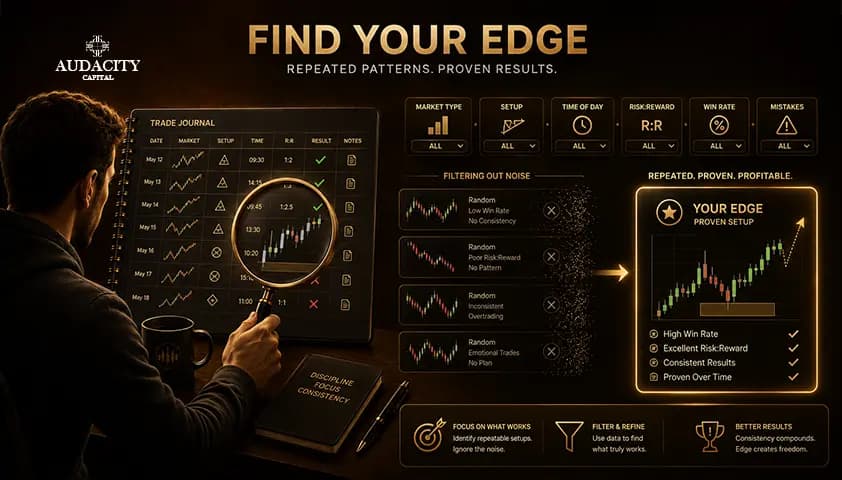
If you are wondering how to find a trading edge, the answer lies within a research cycle, not just a breakthrough idea. Six steps that should be used either on your own trades or historical data.
- Choose one market, one setup, one timeframe. You cannot test everything at once. The narrow scope allows you to interpret results properly.
- Come up with a falsifiable hypothesis. Define the conditions, the expected behavior, and criteria to reject the hypothesis.
- Define your entry, exit, position sizing, and no-trade rules before backtesting. Rules developed after you see results are not rules; they are fitted parameters.
- Choose a good sample. Consider all costs, slippage, and missed trades. Do not eliminate inconvenient data.
- Calculate net expectancy and drawdown. Observe profit factor, average win and average loss, biggest losing streak, and performance under different conditions.
- Apply the same rules to unseen data or in forward simulation. This is out-of-sample testing, and this is where most interesting backtests fall apart.
A proper edge statement is specific and contains a disproof condition. For instance: “If condition A and filter B appear in this market in this time period, then this rule has positive net expectancy after costs.
If the result of an out-of-sample test is below this level or real costs wipe out the edge, I will reject it.”
This is the real form of edge in trading. You make an advance commitment and give data a chance to prove your concept wrong, not right.
How to Test an Edge Without Fooling Yourself?
Research in retail trading ends with a profitable backtest. It is not enough. Several criteria of failure must be met to verify the outcome.
- Transaction costs and slippages must be considered in relation to the assets and lot sizes used.
- Do not modify the rules in response to each test result. Every such adjustment improves the final version in comparison.
- Protect your unseen data. Divide it before testing and keep the validation set away from your eyes until the rules are finalized.
- Test your strategy in various market regimes: trend, chop, high volatility, low volatility.
- Check if performance was based on one particular instrument, year or a few trades.
- Note each change of parameters that you considered. The number counts.
That is exactly what backtest overfitting is all about. As you test more variations of your trading strategy, it becomes easier to find a model that fits historical noise rather than a genuine pattern.
The SEC has time and again mentioned the fact that backtest results are nothing but hypothetical and do not reflect actual trading.
According to Bailey et al., the probability of backtest overfitting is the probability of the process that overestimates the expected performance when choosing the trading strategy.
Avoid having a trade-count benchmark. Instead, what you should have is layered evidence: the initial research sample, the untainted validation sample, and then the forward or small live sample with unchanged rules.
Each stage that survives is evidence, not proof.
What a Real Edge Looks Like in a Trading Journal?
A discretionary trader can quantify an edge if he maintains a trading journal. Each trade should have the tag of its setup, market condition, session, risk level, rule observation, and trade execution grade.
Evaluate your expectancy, profit factor, win/loss average, maximum adverse excursion, drawdown and performance of setups in relation to various market conditions.
Make a distinction between strategy loss and your execution mistake.
Losses generated by the system which are in line with your rules are the information about your strategy, whereas losses incurred from the movement of stops belong to the trader himself.
An optimal trading journal will give you not only the areas where your edge can be found, but also those where it cannot.
Your edge may generate positive results in general, however, there may be some sessions, instruments or market conditions where your specific setup does not work anymore.
Signs You Do Not Have a Proven Edge Yet
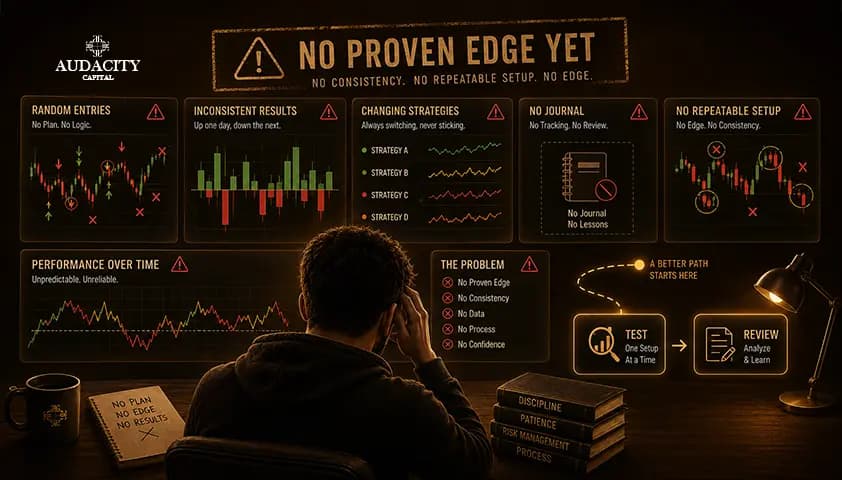
Six indicators your trading system’s edge has not yet been proven:
- The rules can't be stated clearly enough so another trader could understand them.
- The claim is based on a few images rather than a sample.
- The performance is reported gross of costs (thus excluding spread, commissions and slippage).
- The parameter choices were made after the results became visible.
- Performance vanishes when tested on out-of-sample data.
- The execution varies depending on whether losses occur.
An essential point here is that "not proven" does not mean "proven false". The appropriate action will be to gather better data, keep a better trading journal and perform more stringent tests, not to give up immediately.
Actually, many trading concepts are abandoned too quickly or kept too long, both because of neglecting the evidence stage.
Why Do Trading Edges Stop Working?
Edges fade away. Regimes change, competition emerges, costs rise, execution changes, markets change and the trader unconsciously drifts away from the rules they have discovered and proven to work. The strategy that decays is a reality and no verified result lasts forever.
Decay needs to be differentiated from normal variation. A losing streak doesn't necessarily mean that the edge has vanished.
Compare current results with possible variance of initial sample; verify changes in underlying conditions of the strategy.
If there are no changes in conditions, and drawdown is within the range of historical variations, it is probably not decay, but rather variance.
If the conditions have changed, and the results are out of the expected range, then decay is more likely.
The following is a basic maintenance routine:
- Monthly rule-compliance review from your journal.
- Periodic rolling analysis of expectancy and drawdown over recent windows.
- A defined "pause threshold" that was agreed on before the drawdown, not during.
- Periodic out-of-sample retesting on the latest data.
When evidence is weak, shift to simulation testing as you investigate. Continuing to risk capital in the hope that an edge returns is not a research plan.
Conclusion
A trading edge is a positive expectancy from an entire, repeatable process, under specified conditions, after realistic cost. It isn't a single indicator, and it's not a high win rate or a good-looking backtest.
When it comes to explaining what a trading edge is, it is important to be honest and admit that the standard is evidence across a meaningful sample, checked outside the data you used to design the rules.
Your next action is concrete:
- Write one falsifiable hypothesis.
- Freeze the entry, exit, size, and no-trade rules.
- Test on clean data with realistic costs.
- Preserve an unseen sample for validation.
Once operational, ensure that execution is tracked independently of the strategy to avoid confusion between them. Past validation does not assure future success due to changes in markets, costs, and execution.
Frequently Asked Questions
Yes, if the trader journals with enough structure to reconstruct decisions. Tag setup, condition, session, planned risk, and rule compliance on every trade so expectancy and profit factor can be calculated per category rather than only in total.
No. Win rate on its own says nothing about payoff or costs. A 70% win rate with average losers twice the size of average winners can still produce negative expectancy after fees and slippage.
There is no single universal number. Required sample size depends on trade frequency, variance of outcomes, and how thin the edge is. Use staged evidence instead: a research sample, an untouched validation sample, and forward observation with unchanged rules.
Sometimes, indirectly. Position sizing and consistency will not turn a negative-expectancy strategy positive, but they can preserve a genuine small edge that would otherwise be destroyed by oversized losses or abandoned mid-drawdown.
No. Backtested results are hypothetical, and the more parameter variations you tried before landing on the final version, the more likely the result reflects fitted noise. Out-of-sample validation and forward observation are the checks that matter.
Yes, but only if execution, market selection, and process discipline make it a complete trading strategy with positive expectancy within certain parameters. Being popular does not equal being lacking in trading edge even though crowded strategies have a tendency to decay faster.
Compare current results with the range of outcomes expected from the original sample, and check whether the conditions the edge depended on still hold. If results fall outside that range and the environment has clearly changed, treat it as decay and move testing to simulation while you investigate.

Pronto para aplicar risco disciplinado em cripto? Explore os novos instrumentos de cripto da Audacity Capital e traga sua estratégia de trading.
Saiba MaisNewsletter
Junte-se ao nosso boletim para ficar atualizado.
Junte-se à Nossa Comunidade Social

Comece Sua Jornada Hoje Com Nosso Teste Gratuito
Mostre com orgulho suas habilidades e conquistas através de certificados e obtenha reconhecimento pelo seu trabalho árduo e dedicação de potenciais investidores e colegas.
Teste GratuitoArtigos Relacionados
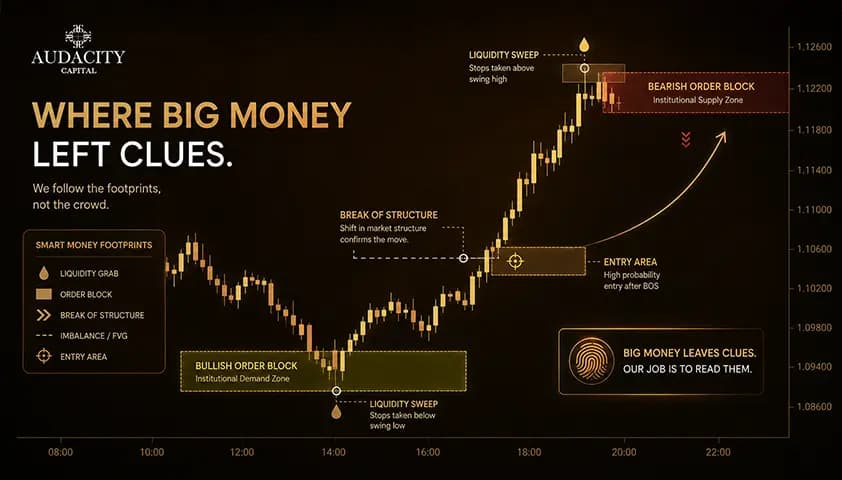
Order Blocks in Trading: A Complete Guide
Learn what an order block is, how to spot bullish and bearish order blocks, the six validation filters, and a practical order block trading strategy with honest, probability-based rules.


9 Best Trading Journal Apps in 2026: Pick the One Fits You.
The best trading journal apps reveal which setups make money and which just feel good. Compare 9 tools honestly, free vs. paid, with real weaknesses included.
Average True Range: A Complete Guide for Traders
Learn what average true range measures, how to read the ATR indicator, and how to apply ATR% to stops, position sizing and volatility regimes with clarity.
What Is Overtrading (and How to Stop It)
Overtrading means taking trades your plan doesn't justify. Spot the 7 signs, measure what it costs from your journal, and install rules that stop it for good.