


Best MQL5 Strategies for Prop Firms: What Survives the Rules


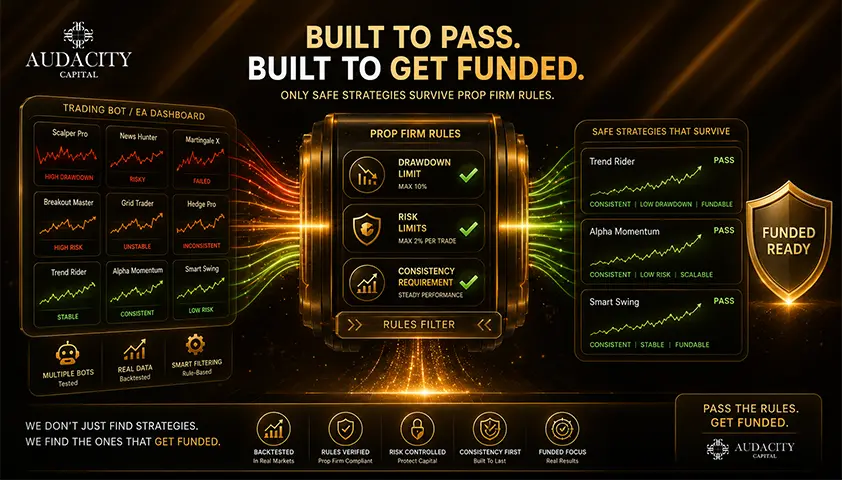
This is the honest answer many bot listicles will not give you: there is no miracle MQL5 strategy that passes prop firm challenges.
Your success depends not on strategy type but on whether your Expert Advisor can withstand the firm's risk rules. Automated trading usually does not fail because the strategy can't make profits, but rather because it breaches a rule or was over-optimized on past data.
If you have an EA that has proven successful on backtests, but repeatedly fails on the drawdown or prohibited strategies rule, you came to the right place.
We will talk about which best MQL5 strategies for prop firms can be considered reasonable, how to create an EA that follows the rules, test it, use the rule checklist, and where Audacity stands in all this.
MQL5 and Prop Trading, Briefly
MQL5 (MetaQuotes Language 5) is the native C++ style programming language of MetaTrader 5 (MT5). Traders use it to create Expert Advisors (EAs), custom indicators, and scripts.
The MQL5 Market is its marketplace for products and signals, while the MT5 Strategy Tester provides multi-threaded historical price tests.
Noteworthy: MT4 EAs don't work with MT5 since they're written in different programming languages, so your old MT4 robot won't work straight away on the MT5 platform.
Why is MQL5 perfect for prop trading? Automation enforces discipline.
It helps eliminate the emotional mistakes when facing the test of trading, such as revenge trading and chasing a move because of fear of missing out (FOMO). Additionally, MT5's tooling has been made easier to backtest a system, then align it to the same set of rules, before risking anything.
This is the real limitation that defines everything in this guide: EA can be helpful only when it matches both the firm's rule book and the broker's execution policy. This is where most algorithmic traders struggle.
The understanding of the technical limitations leads to the following question: What is the factor determining the success of prop evaluation?
The Honest Truth: Behaviour Beats Strategy
Surviving a prop test through an EA comes down to behavioural issues rather than strategy. Prop firms like steady profits over quick wins. The majority of automated systems fail not because they can't make money, but because they can't remain within the rules.
There are two real killers.
The first is rule violations: drawdown violation, banned strategy, or consistency violation for firms that demand it.
The second is over-optimization, which is a curve-fitted backtest that seems to be all sunshine in history and then nosediver when the market turns.
What does a good prop trading EA look like then? Not the program with the highest return from backtests. It is the one which manages capital and drawdown, as well as allows a small edge to work inside the parameters.
The real benefit of automation is that it brings the discipline that humans break in stressful conditions. If you can only remember one thing in this article, remember that one.
The Best MQL5 Strategies for Prop Firms (and the Ones That Get You Banned)
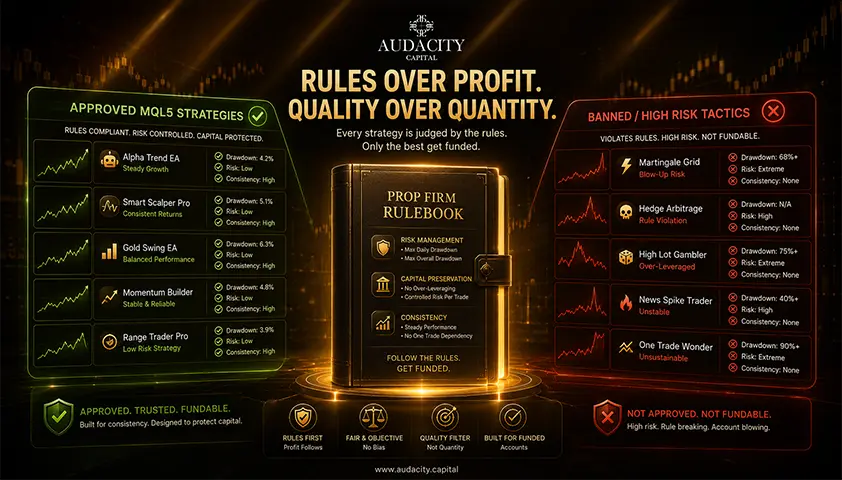
There is no magic formula for passing a strategy type. But some can be risk-controlled to fit prop rules, some are account-killers, and some are outright prohibited. In all scenarios, the risk control that surrounds the strategy is more important than the strategy itself.
Use this table as a quick map, then read the detail below.
Strategy type | How it works | Prop suitability | Main risk |
Trend following | Rides established moves with a defined stop | Can work with strict risk control | Whipsaws occur in choppy markets |
Breakout | Enters on a confirmed level break, stop beyond it | Can work with strict risk control | False breakouts |
Mean reversion / range | Fades extremes inside a range with a hard stop | Workable, conservative only | Trend breakouts blow through the stop |
Grid | Layers orders at set intervals | High-risk account-killer | A losing streak causes high drawdowns |
Martingale | Increases size after losses | High-risk account-killer | Exponential exposure, sudden blowups |
Latency / arbitrage | Exploits price or execution gaps | Prohibited at nearly all firms | Account termination |
HFT / tick-scalping | Exploits off-market quotes | Prohibited at nearly all firms | Account termination |
Signal copying | Mirrors third-party signal services | Prohibited at most firms | Account termination |
1. Workable With Strict Risk Control
These types can realistically be made prop-compliant because their risk is definable per trade.
Trend following follows a proven trend and ends when a stop is set at a logical level. Breakout trading is based on the confirmation of a key level breakout, and the stop is placed just outside that breakout. Conservative mean reversion or range trading fades extremes within a defined range, also with a hard stop.
The common factor here? All of these only prove to be effective when you use strict stops and position sizing. And the edge cannot be assumed, it must be real and proven. These are strategies to test with care not guaranteed strategies.
2. High-Risk Account-Killers: Grid and Martingale
Let me be blunt about grid and martingale. A grid layers puts orders in at regular intervals. Martingale is a strategy that increases position size after every loss.
Both can yield smooth and beautiful equity curves for a considerable period of time. If the EA fails at one point in the series, the challenge is over, no matter how good the EA was before that because drawdown will hit through the roof instantly.
This is the classic path of blowing up EA accounts. Quite a few companies do not allow their usage at all. Consider these risky and unsuitable for prop accounts.
3. Prohibited and Cheating: Arbitrage, HFT, Signal-Copying
These are banned at nearly all firms, and using them gets the account terminated:
- Latency arbitrage, reverse arbitrage, and hedge arbitrage based on price and execution discrepancies.
- High-frequency trading and tick-scalping based on off-market or incorrect quotes.
- Trade copying from signals provided by third parties.
- Group trading (coordinating trades between multiple accounts)
These are not edges to chase. They are violations. Even if the robot is advertised as a clever trick to pass an evaluation, any use of those prohibited strategies results in a ban.
Strategy type is the upper bound. If it passes, it depends on your risk control mechanisms built into the EA, and that will be discussed in the next section.
Building an MQL5 EA That Respects Prop-Firm Rules
This is the section that will tell you whether your EA will be compliant or breaching on day three. Its aim is to have the EA enforce the rules and not break them.
Here are the controls to be built in.
- A hard stop loss on each and every trade. No exceptions. An EA that lacks a stop on every trade is a liability on a prop account.
- Set a reasonable limit on the percentage of the account to risk on any single trade, and use the stop distance to determine position size, not estimating lot size. Our piece on the [Risk-to-Reward Ratio] explains why the per-trade cap is the foundation of survival.
- Implement max-loss and daily-loss limit in code. If the calculated stop would be in violation of the rule, the EA will not trade. Full stop.
- Track equity continuously. Compare current equity to relevant reference and auto-halt trades prior to reaching daily loss or max drawdown levels.
- Apply ATR (a volatility indicator) for dynamic stops, targets and trailing, as this allows the EA to adjust to varying market conditions rather than relying on static values based on pips that only work in one market cycle and not another.
- Implement auto-stop after a certain number of consecutive losses or after reaching a particular daily drawdown to halt the loss train before becoming a breach.
And now the pitfall that even careful programmers fall into. The EA needs to calculate drawdown from the right balance point, and determine if the firm is using a static or trailing drawdown.
Static Drawdown is constant at a fixed level. Trailing drawdown moves up with your equity.
A compliant-looking EA breaks by measuring from the wrong base. If you get this one wrong, there is no good risk management code that will save you.
Risk control checklist call out: hard stop on each trade, fixed stop per-trade, coded daily and max-loss limits, continuous equity tracking, ATR based dynamic stops, consecutive-loss circuit breaker.
Build survival first. The entry signal comes second.
Backtest and Forward-Test Before You Risk a Fee
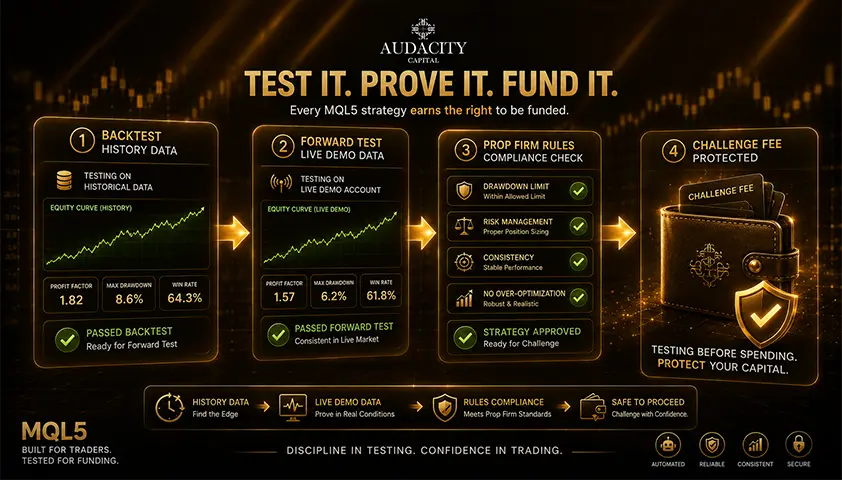
Testing is the place where most Algo traders delude themselves. Here is how it’s done and the trap.
Use the MT5 Strategy Tester with quality tick data to backtest your EA. This is an easy step. However, there is the threat of over-optimizing your EA, also known as curve-fitting.
A strategy that is optimized for profitability on historical data often fails once live trading conditions are slightly altered. So you should always go for consistency and safety over profitability on a particular run of your backtest.
A backtest is a "description" of the past and NOT a "prediction" of the future.
Then forward-test. Run your EA in a demo or simulation account under the current market environment prior to risking a challenge fee. Check the live results against the backtest so that you will be able to tell any performance degradation.
Remember the limitations too. An EA will never cope well with black swan events, price gaps, and slippage beyond the coding of your stop orders.
There is no amount of backtesting that will eliminate live risk. The numbers found on the MQL5 Market and MQL5 Signals may just be cherry-picked or curve-fitted. Treat them with a healthy dose of skepticism and research on your own before you believe a number. That is the homework that distinguishes the professional algorithmic trader from the screenshot hunter.
The Prop-Rule Checklist Your EA Must Pass
The EA must abide by all the rules before approaching any real challenge. Here is the gate.
Rule | What the EA must do | How to verify |
Drawdown type | Be able to recognise static or trailing and measure from the appropriate base | Read the firm's rulebook and verify the reference balance |
Daily loss limit | Auto-halt before the daily cap is hit | Use a demo account to test the halt logic. |
Maximum drawdown | Stop trading before the overall limit | Stress-test against a losing sequence |
Consistency rule | Avoid oversized single trades where a firm enforces one | Check if the firm has a consistency rule at all |
Minimum trading days | Trade across enough sessions to satisfy the rule | Confirm the required number of days |
Prohibited strategies | Avoid arbitrage, HFT, and signal-copying entirely | Cross-check your method against the banned list |
News-trading restrictions | Respect any blackout windows | Confirm the firm's news policy |
One-account / no-group | Run on a single account, no coordinated trading | Read the account-usage terms |
As far as consistency rules go, they are not the same for all firms, and some penalize a single trade that goes too large. Consider this point as a general industry point and review the terms of each firm.
Now the part that you can't outsource.
The EA is your responsibility. The rule violation will end the account and the firm will not excuse it on the grounds that it was your robot's violation.
Rules also vary over time; read the current rulebook of each firm and set the EA to their rules before paying them a fee. This is the last gate.
Run a Compliant EA on a Fixed Drawdown
If you have built a rule-respecting EA, Audacity Capital gives it a clear place to work. Compliant Expert Advisors are allowed on the standard funded program on MetaTrader 5, with no high-frequency trading and no third-party signal copying.
Note that EAs are not supported on DXTrade, and the free competition is manual-only, so automation cannot be used there.
For algo traders, the real advantage is the drawdown. Audacity uses a static drawdown, so your daily and maximum loss limits stay fixed regardless of your equity.
A fixed line is far easier for an EA to measure and honor than a trailing one, which removes one of the most common causes of accidental breaches.
No robot guarantees a pass, and most EAs built for unrestricted accounts fail the evaluation. But a disciplined, well-tested EA on a clear ruleset gets a fair shot here.
If yours is ready, take a look at the funded program page.
Related Guides
MT5 Synthetic Indices Account: How to Trade Synthetic Indices
Mt4 Vs Mt5: What Is the Difference Between Mt4 and Mt5 ?
Best MQL5 Strategies for Prop Firms: What Survives the Rules
FAQ
Many firms allow EAs on MetaTrader 5, but with restrictions. Common bans include latency arbitrage, grid and martingale used without stops, high-frequency exploitation, and third-party signal copying. Always check each firm's rulebook before running one, because the responsibility for any breach sits with you.
None is guaranteed. That said, trend-following, breakout, and conservative mean-reversion are the types most realistically made prop-compliant, because their risk can be capped per trade. The risk control you build into the EA matters more than the strategy type you choose.
They are often restricted or banned, and even where they are allowed, they are high-risk. One bad sequence can spike drawdown straight through the limit and end the challenge, regardless of how well the EA performed beforehand. Treat them as account-killers rather than viable prop strategies.
No, and any seller promising a guaranteed pass is a red flag. An EA can enforce discipline and risk control, which improves your odds of staying inside the rules, but it cannot guarantee a result. Most EAs built for unrestricted accounts fail prop evaluations.
Code a hard daily-loss cap with continuous equity tracking that auto-halts trading before the limit is reached. Make sure the EA measures drawdown from the firm's correct balance reference, and confirm whether the limit is static or trailing, because measuring from the wrong base is a common cause of breaches.
Most MT5-friendly firms do not ban automation itself. They ban specific abusive practices: latency and other arbitrage, off-market tick exploitation, and signal copying. The EA remains the trader's responsibility, so any breach terminates the account.
Audacity allows compliant EAs on its standard funded program on MetaTrader 5, with no high-frequency trading and no third-party signals. Its free competition is manual-only, so EAs are not permitted there. Always confirm the current policy before you run one.
You can, but treat the performance figures skeptically, because they are often curve-fitted or cherry-picked. Verify results independently, forward-test on a demo account before risking a fee, and remember that no bot guarantees a pass.

Готовы применить дисциплинированный риск к криптовалютам? Изучите новые криптоинструменты Audacity Capital и примените свою торговую стратегию.
Узнать большеРассылка
Подпишитесь на нашу рассылку.
Присоединяйтесь к нашему сообществу

Начните свое путешествие сегодня с нашей бесплатной пробной версией
С гордостью демонстрируйте свои навыки и достижения с помощью сертификатов и получайте признание за свой тяжелый труд и преданность делу от потенциальных инвесторов и коллег.
Бесплатная пробная версияПохожие статьи
MT4 vs MT5: The Key Differences That Actually Matter
One platform is still being developed. The other is not. Here is the real difference between MT4 and MT5, and which one you should be trading on.


Best Simulated Trading Platforms in 2026 (Compared)
Compare the best simulated trading platforms in 2026 for stocks, futures, forex, and options trading. Discover the top paper trading platforms for beginners, technical analysis, strategy testing, and risk-free practice.

What is MT5 ?
Learn what MT5 (MetaTrader 5) is, how it works, and why traders use it for Forex, stocks, and CFDs. Complete beginner’s guide by Audacity Capital.
10 Prop Firms That Use MT5 in 2026 (Compared)
Compare MT5 prop firms by platform access, EA rules, drawdown, regional limits and availability from evaluation through funded trading.