


Is Day Trading Gambling? Understanding the Difference Between Trading and Gambling


Day trading is sometimes compared to gambling because both involve financial risk and uncertain outcomes. However, day trading and gambling are not automatically the same thing.
Day trading involves buying and selling financial instruments within the same trading day, usually with the goal of profiting from short-term price movements. Traders may use technical analysis, market structure, economic data, risk management, and predefined trading strategies to make decisions.
Gambling, by contrast, generally involves risking money on an uncertain outcome where the result is primarily determined by chance or the rules of the game.
The distinction becomes less clear when a trader makes decisions based primarily on luck, emotion, impulsive behavior, or the expectation of quick profits. In those circumstances, trading can take on gambling-like characteristics.
The U.S. Securities and Exchange Commission (SEC) warns that day trading is highly risky and that traders should not assume it offers easy or guaranteed profits.
Is Day Trading Gambling?
Day trading itself is not necessarily gambling, but the way someone approaches day trading can resemble gambling.
A trader who follows a defined strategy, understands the market they are trading, manages position size, sets risk limits, and evaluates their results is approaching trading differently from someone who repeatedly enters trades based on a hunch or the hope of making quick money.
The SEC describes day trading as highly risky and emphasizes that traders may suffer substantial losses. It also warns against claims that suggest day trading provides easy or guaranteed profits.
Therefore, the more useful question is not simply whether day trading is gambling. Instead, ask:
Is the trader making decisions based on a repeatable process and controlled risk, or primarily relying on chance?
That distinction helps explain why some forms of trading can look very different from gambling even though both involve uncertainty.
What Is Day Trading?
Day trading is a trading approach where positions are opened and closed within the same trading day rather than being held overnight.
Depending on the market and strategy, day traders may analyze:
- Price action
- Market structure
- Support and resistance
- Supply and demand zones
- Technical indicators
- Trading volume
- Economic data
- Market volatility
- News and scheduled events
A day trader may establish specific conditions for entering a trade, define where the trade will be invalidated, and determine the amount they are willing to risk before entering.
However, having a strategy does not eliminate risk. The SEC specifically notes that day trading can result in substantial financial losses and that traders should only risk money they can afford to lose.
Why Do People Compare Day Trading to Gambling?
There are several reasons day trading is sometimes described as gambling.
Both Involve Uncertain Outcomes
A trader cannot know with certainty whether an individual trade will be profitable.
Even a well-researched setup can fail because markets are affected by many variables, including unexpected news, volatility, liquidity, and changes in market conditions.
This uncertainty is one reason trading requires risk management rather than relying on predictions alone.
Both Can Involve Financial Risk
In both activities, money can be lost.
The difference is that a trader can establish rules around how much capital is exposed to a particular trade, while gambling outcomes are generally determined by the rules and probabilities of the particular game.
Emotional Behavior Can Make Trading Gambling-Like
Trading can become gambling-like when someone:
- Enters trades without a defined setup
- Increases position size after losing
- Trades to recover previous losses
- Chases price movements
- Continues trading after reaching a predetermined loss limit
- Uses money needed for essential expenses
- Makes decisions primarily based on emotion
- Believes a winning trade is "due"
The Financial Conduct Authority (FCA) has also highlighted concerns about trading-app features that can encourage more frequent trading and greater risk-taking. Its research found that certain digital engagement practices, including push notifications, leaderboards, and prize-related features, can increase trading frequency and investment risk.
When Does Day Trading Become Gambling?
Day trading can take on gambling-like characteristics when the trader's decision-making becomes primarily driven by chance, impulse, or emotional reactions rather than a defined trading process.
Consider two hypothetical approaches.
Trader A: Structured Approach
Trader A:
- Defines a trading strategy.
- Identifies specific entry conditions.
- Determines the maximum acceptable loss before entering.
- Uses an appropriate position size.
- Sets an invalidation point.
- Records each trade.
- Reviews performance over a meaningful sample of trades.
- Stops trading when predefined risk limits are reached.
This approach does not guarantee profitability, but it is based on a structured process.
Trader B: Chance-Based Approach
Trader B:
- Enters trades because a price "looks like it will go up."
- Does not define a maximum loss.
- Increases the position after losing.
- Chases trades after large price movements.
- Trades to recover previous losses.
- Continues trading after losing their daily limit.
- Treats each trade as an opportunity to make quick money.
This behavior has much stronger similarities to gambling.
The difference is therefore not simply short-term trading versus gambling. It is also about how decisions are made and how risk is controlled.
Day Trading vs Gambling: Key Differences
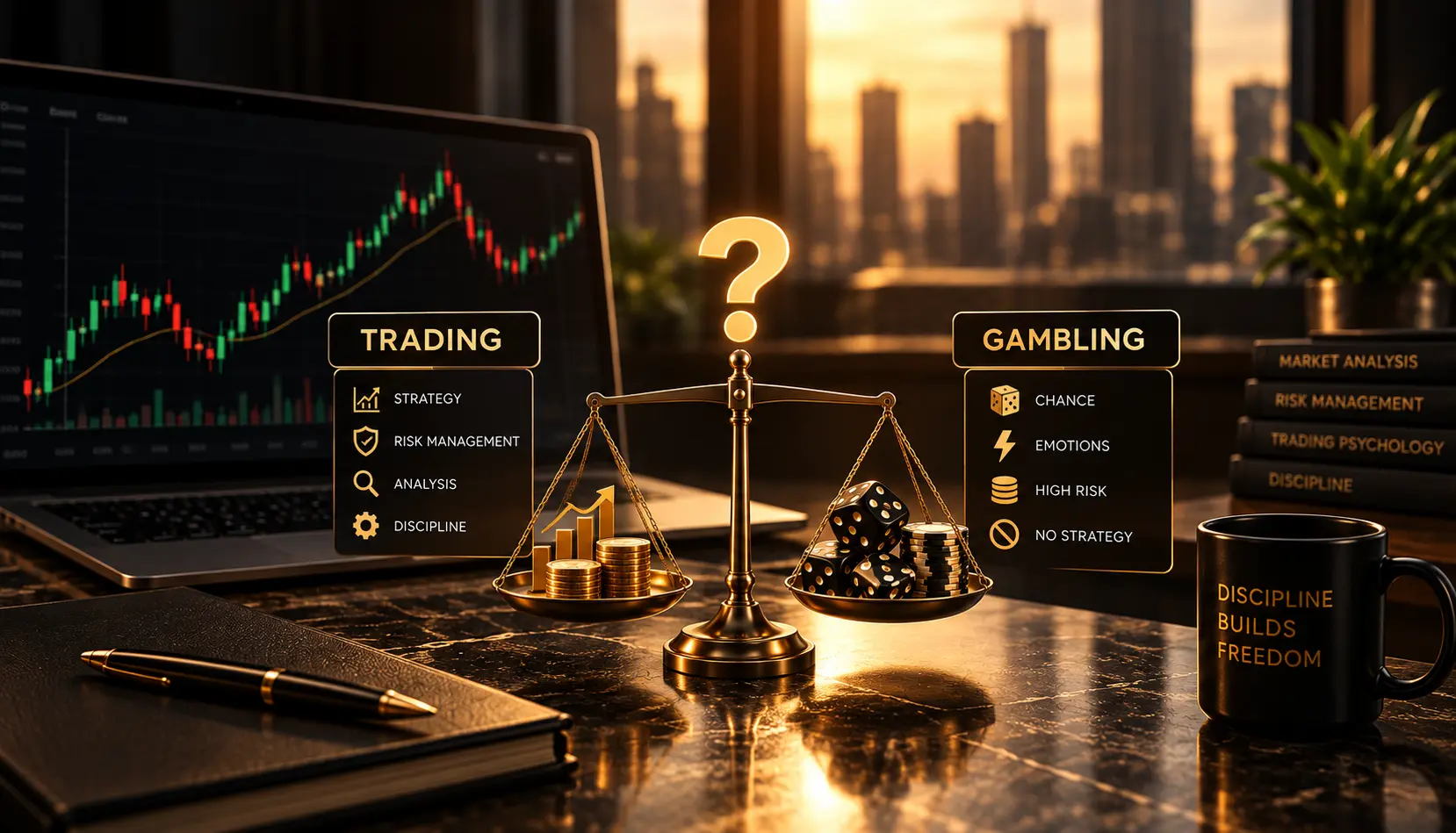
Factor | Day Trading | Gambling |
|---|---|---|
Decision-making | Can be based on market analysis and a defined strategy | Usually based on game rules, probability, or chance |
Risk management | Traders can define position size and loss limits | Depends on the specific gambling activity |
Outcome | Influenced by market movements and execution | Primarily determined by the rules and probabilities of the activity |
Strategy | Can involve technical, fundamental, or quantitative methods | Strategies vary by game but cannot remove inherent house/game odds |
Learning | Traders can study markets and evaluate historical performance | Players can learn game mechanics and probabilities |
Uncertainty | Individual trade outcomes remain uncertain | Individual outcomes remain uncertain |
Loss control | Can be incorporated into a trading plan | Depends on the activity and participant's behavior |
This comparison does not mean that having a trading strategy makes trading safe or guarantees a positive outcome.
Does Having a Trading Strategy Mean Day Trading Isn't Gambling?
Not necessarily.
A strategy can provide a framework for making trading decisions, but a strategy does not guarantee that a trader will make money.
A strategy should ideally be tested, evaluated, and used consistently. Traders also need to understand that historical performance does not guarantee future results.
For example, a strategy may perform well under one market condition and perform poorly under another.
The SEC warns investors to be cautious about claims of large or easy profits from day trading.
The important distinction is therefore between having a process and assuming that the process guarantees an outcome.
Can Day Trading Be Profitable?
Day trading can produce both gains and losses, but profitability is not guaranteed.
The short-term nature of day trading means traders may face frequent trading decisions, transaction costs, market volatility, execution issues, and the possibility of rapid losses.
The SEC states that day trading can be extremely risky and warns that many day traders suffer significant losses.
A trader considering day trading should therefore evaluate:
- Whether they understand the market
- Whether they have a clearly defined strategy
- How much capital they can afford to risk
- Their maximum acceptable loss
- Their trading costs
- Their ability to follow predetermined rules
- Whether their strategy has been appropriately tested
Why Risk Management Matters in Day Trading
Risk management is one of the biggest differences between a structured trading approach and impulsive speculation.
A day trader can establish rules before entering a position, such as:
Position Size
Position size determines how much exposure a trader takes on in a particular trade.
Larger positions can increase both potential gains and potential losses.
Stop-Loss
A stop-loss can be used to define a point at which a trade is closed if the market moves against the trader.
However, stop-loss orders do not guarantee a specific execution price in all market conditions.
Risk Per Trade
Some traders establish a maximum percentage or monetary amount they are willing to risk on an individual trade.
The appropriate amount depends on the trader's circumstances and risk tolerance.
Daily Loss Limit
A trader may also establish a maximum daily loss beyond which they stop trading.
This can help prevent a losing session from turning into a series of increasingly emotional trades.
Does Leverage Make Day Trading More Like Gambling?
Leverage does not automatically make day trading gambling, but it can magnify the financial consequences of trading decisions.
Leverage allows a trader to control a larger position with less capital or margin.
That can increase exposure to market movements.
For example, if a trader uses additional leverage to take a much larger position than their risk plan supports, a relatively small market movement can produce a substantial loss relative to their account.
The SEC warns that day trading on margin can lead to significant losses and, in certain securities-market contexts, losses beyond the initial amount deposited.
The important point is:
Leverage is a tool. How a trader uses that tool determines the level of exposure and risk.
Is Forex Day Trading Gambling?
Forex day trading is not automatically gambling simply because it involves short-term trades.
A forex day trader may use:
- Technical analysis
- Economic calendars
- Market structure
- Price action
- Support and resistance
- Supply and demand
- Risk management
- Position sizing
However, forex trading can become gambling-like when a trader takes positions without a defined process, repeatedly increases exposure after losses, or relies primarily on luck.
Forex and other leveraged products can also carry substantial risk. Traders should understand the specific product, leverage, margin requirements, fees, and applicable rules before trading.
Is Prop Firm Trading Gambling?
Trading through a proprietary trading firm does not automatically make an activity gambling either.
A trader participating in a prop firm's program may operate under specific rules relating to:
- Maximum drawdown
- Daily loss limits
- Position size
- Leverage
- Trading instruments
- News trading
- Holding positions
- Profit targets
The specific rules vary between firms and programs.
A trader should understand the applicable terms and trading conditions before participating.
For any prop-firm trading program, the fact that a trader has access to a defined set of rules does not guarantee profitability.
How to Avoid Gambling-Like Trading Behavior
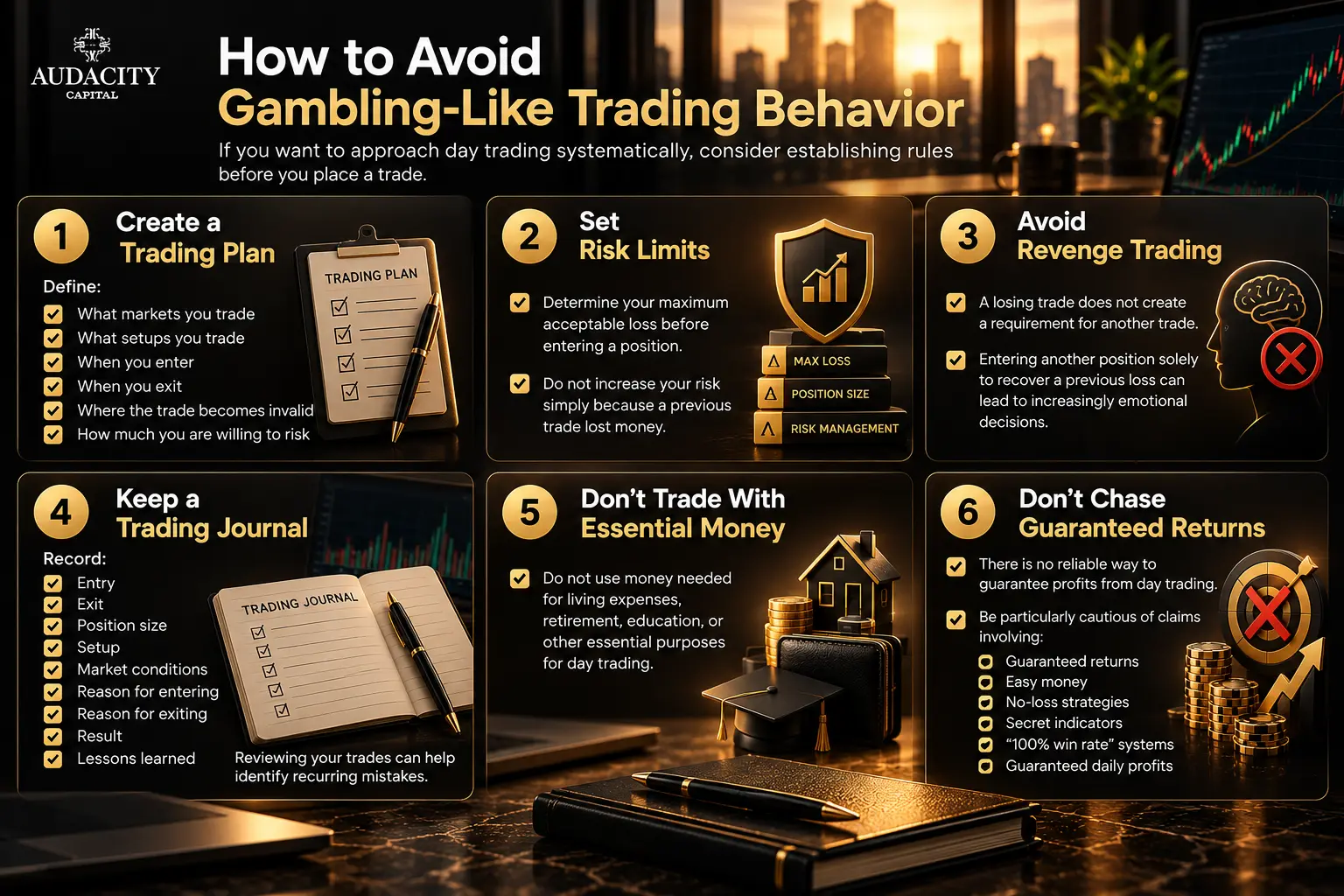
If you want to approach day trading systematically, consider establishing rules before you place a trade.
1. Create a Trading Plan
Define:
- What markets you trade
- What setups you trade
- When you enter
- When you exit
- Where the trade becomes invalid
- How much you are willing to risk
2. Set Risk Limits
Determine your maximum acceptable loss before entering a position.
Do not increase your risk simply because a previous trade lost money.
3. Avoid Revenge Trading
A losing trade does not create a requirement for another trade.
Entering another position solely to recover a previous loss can lead to increasingly emotional decisions.
4. Keep a Trading Journal
Record:
- Entry
- Exit
- Position size
- Setup
- Market conditions
- Reason for entering
- Reason for exiting
- Result
- Lessons learned
Reviewing your trades can help identify recurring mistakes.
5. Don't Trade With Essential Money
The SEC specifically advises day traders not to use money needed for living expenses, retirement, education, or other essential purposes for day trading.
6. Don't Chase Guaranteed Returns
There is no reliable way to guarantee profits from day trading.
Be particularly cautious of claims involving:
- Guaranteed returns
- Easy money
- No-loss strategies
- Secret indicators
- "100% win rate" systems
- Guaranteed daily profits
The SEC specifically warns against claims of easy or guaranteed profits from day trading.
Day Trading vs Gambling: What Is the Bottom Line?
Is day trading gambling? Not necessarily.
Day trading is a form of short-term trading that involves significant financial risk. It can be approached using market analysis, predefined strategies, position sizing, and risk-management rules.
However, day trading can become gambling-like behavior when decisions are driven primarily by chance, emotional reactions, loss chasing, excessive risk, or the expectation of quick and easy profits.
The most important distinction is therefore not simply the amount of time a position is held.
It is the process behind the decision and the way risk is managed.
A disciplined trading process does not guarantee profitable results. Markets remain uncertain, and losses are always possible.
Final Thoughts
Day trading involves uncertainty, financial risk, and the possibility of losing money. That does not automatically make it gambling.
The difference lies partly in how the activity is approached. A structured approach can involve market analysis, predefined entry and exit conditions, position sizing, risk limits, and ongoing performance review. A chance-driven approach can involve impulsive decisions, loss chasing, and excessive risk.
No strategy can eliminate market risk or guarantee profits.
Before day trading, make sure you understand the market, the product you are trading, the costs involved, leverage and margin requirements where applicable, and the amount you can afford to lose.
Frequently Asked Questions
Day trading is not automatically gambling. It involves short-term buying and selling of financial instruments and can be based on a defined trading strategy and risk-management process. However, trading based primarily on chance or emotional behavior can resemble gambling.
Day trading involves financial risk and uncertain outcomes, but it is not inherently gambling. The distinction depends partly on how the trader makes decisions and manages risk.
Forex day trading is not inherently gambling. Traders can use market analysis, predefined strategies, position sizing, and risk-management techniques. However, impulsive or chance-based trading can become gambling-like.
Frequent trading and emotional reactions to wins and losses can contribute to unhealthy trading behavior. The FCA has found that certain trading-app features can increase trading frequency and risk-taking among consumers.
Yes. Day trading can involve substantial financial risk, particularly when leverage or margin is used. The SEC and FINRA both emphasize the significant risks associated with day trading.
In some markets and account structures, traders can trade without borrowed funds or leverage, although the amount of capital required and the available trading products vary. Trading without leverage does not eliminate the possibility of losses.
Day trading and gambling are different activities, so they should not be treated as interchangeable. Day trading involves financial markets and can incorporate analysis and risk-management techniques, while gambling involves games or activities whose outcomes are governed by their specific rules and probabilities.
Warning signs can include repeatedly increasing risk after losses, trading without a plan, chasing losses, making impulsive trades, or using money needed for essential expenses. Establishing clear risk limits and following a written trading plan can help create more disciplined trading behavior.

Готовы применить дисциплинированный риск к криптовалютам? Изучите новые криптоинструменты Audacity Capital и примените свою торговую стратегию.
Узнать большеРассылка
Подпишитесь на нашу рассылку.
Присоединяйтесь к нашему сообществу

Начните свое путешествие сегодня с нашей бесплатной пробной версией
С гордостью демонстрируйте свои навыки и достижения с помощью сертификатов и получайте признание за свой тяжелый труд и преданность делу от потенциальных инвесторов и коллег.
Бесплатная пробная версияПохожие статьи
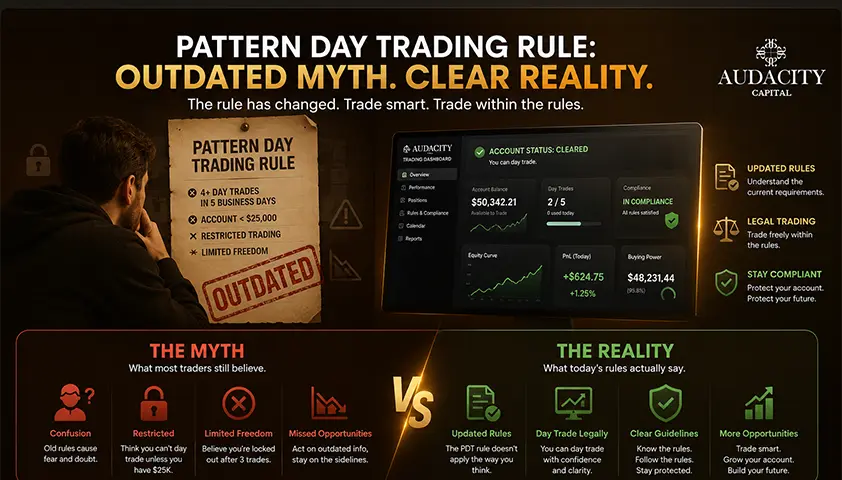
Why Is Pattern Day Trading Illegal? (It Is Not, and the Rule Is Gone)
Why is pattern day trading illegal? It never was. Learn what the old PDT rule required, what changed in 2026, and what traders need to know now.


Day Trading Crypto vs Stocks: Which Is Better?
Compare crypto and stock day trading by hours, volatility, fees, liquidity, rules and risk to find which market fits your trading style.
How to Create a Day Trading Risk Management Plan?
Build day trading risk management strategies with daily loss limits, position sizing rules, drawdown controls, and a practical trading checklist.
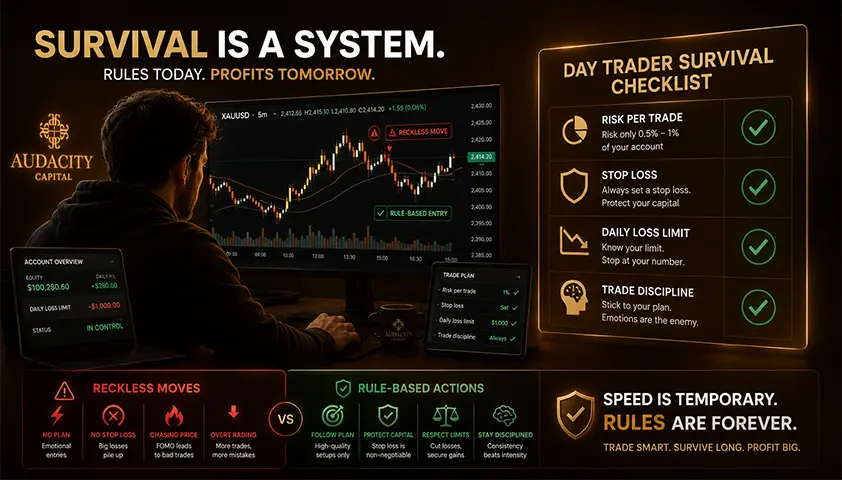
Day Trading Tips: The Rules That Actually Decide Whether You Survive
Practical day trading tips ordered by what actually matters. Risk rules, discipline, execution, and the 2026 pattern day trader change explained honestly.