


Micro Futures Contracts Explained



A micro futures contract can often be opened with a margin deposit somewhere in the low hundreds of dollars. That low margin figure is what makes micros look accessible, which is why so many explanations present them as beginner-friendly. But there is more to it than that.
The actual figure which determines if you can trade the contract or not is the notional value of the position it opens, which can be several times the size of a small account.
This article is for educational purposes and should not be used for any investment or taxation advice. Futures are leveraged instruments, and losses can be greater than your investment.
What a Micro Futures Contract Is
A micro futures contract is a small version of the large futures contract, typically to offer the trader a finer control over the size of a futures position. It follows the same underlying market, but the contract multiplier or contract unit is smaller.
The trading hours and expiry dates will vary with each product; refer to the current contract specifications and do not assume they are the same.
The following table explains the principle very well.
For example, the E-mini S&P 500 has the contract multiplier of $50 per index point, whereas the Micro E-mini S&P 500 has the contract value of $5 per point.
Therefore, a quarter-point move would cause the contract value to vary by $12.50 for the full contract and $1.25 for the micro contract. The tick value scales down with the contract size.
Micro-sized contracts are available in equity indices, metals, energy, FX, rates, and crypto. The exact size varies by product, so the table below uses selected CME contracts as examples.
Market | Full-size contract | Micro contract | Relative size |
S&P 500 | E-mini, $50 per index point | Micro E-mini, $5 per index point | One tenth |
Nasdaq-100 | E-mini, $20 per index point | Micro E-mini, $2 per index point | One tenth |
Gold | 100 troy ounces | Micro Gold, 10 troy ounces | One tenth |
WTI crude oil | 1,000 barrels | Micro WTI, 100 barrels | One tenth |
Bitcoin | 5 BTC | Micro Bitcoin, 0.1 BTC | One fiftieth |
The key is that “micro” doesn't always translate to one-tenth of the standard contract. A prime example is Bitcoin: Micro Bitcoin is 0.1 BTC while the standard Bitcoin futures contract is 5 BTC.
What the Word Micro Does Not Mean
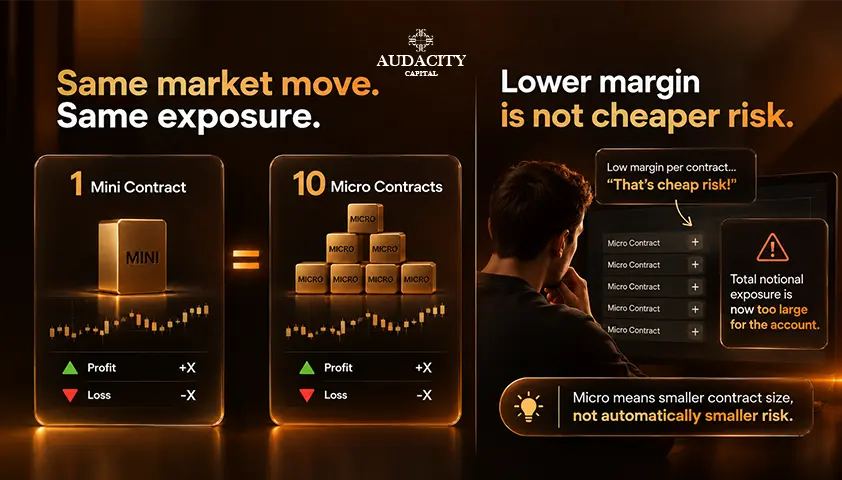
This is the point this entire article hangs its hat on. A reduced contract size decreases the smallest position that you can hold. However, it does not automatically make the position small relative to your account.
There is at least one website ranking for this term that states reduced risk exposure is an advantage of micro contracts and that's the worst possible interpretation.
Leverage is the ratio of notional value to the margin that is posted, and this ratio is similar across a micro and its full-size sibling.
A trader holding ten micro is in the same position as a trader with one mini. Same profit and loss, same exposure to the same move. The underlying asset got smaller. The mathematics did not.
The trap works as follows. A trader reads a low margin figure as the cost of the trade. That number seems reasonable, so a few contracts still seem reasonable, and they open a few.
What they have actually created is a notional position which may be many multiples of their account and a relatively small adverse move in the market can wipe out a substantial portion of this account.
Margin is the requirement set by the broker to facilitate the trade. It is not an indication of how much of your account to use. Confusing the two is how you turn a simple product into a quick one.
The Real Advantage Is Granularity
After that correction in wording, there is a true advantage that is never explained correctly. This isn't about the cost being lower. It is all about sizing granularity.
With a standard sized contract, your choice of size is either one or two contracts, and one contract may be too big for some accounts. This isn't much sizing flexibility. With micros, you have the exact same exposure but in smaller sizes.
This means that the position size can be determined by the risk level of the trade, not necessarily the size of the contract. You can also scale in or out in smaller pieces instead of committing the entire position at once.
Don't think of this as a cost saving; think of it as a risk-management benefit. The advantage is that the position could be nearer to what size your account can actually handle.
Day Margin Is Not the Real Margin
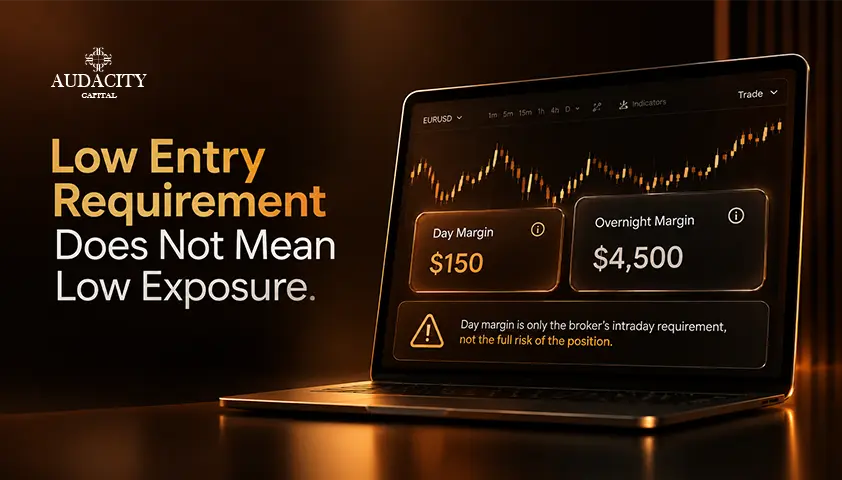
This is probably the most practical part of the page, and the part least likely to be the first thing a broker will point to. There are two margin numbers, and the smaller one is not from the exchange.
Exchange initial margin is the sum necessary to open a futures contract in the exchange and clearing system. Day-trading margin is an intraday margin provided by some brokers for positions held during certain hours.
The critical point about it is as follows: day margin is a broker intraday margin, not the total value of the position or a recommendation of what portion of your margin you should allocate to this trade.
There are three traps in it.
First, brokers increase day margins whenever volatility increases, even without much warning, and that requirement upon which you’ve planned might change right from underneath you.
Second, every broker establishes a cut-off point before the close whereby the open position either becomes flat or gets re-evaluated based on full overnight margin, and someone who has not considered this is forced out or lacks margin.
Third, whenever equity drops below maintenance, brokers automatically liquidate, and the forced closure favours getting flat over getting a good price.
There are no specific figures here, since both the numbers depend on broker, product and market conditions. The correct guidance would be to read your broker’s margin schedule and cut-off points before you start trading, and to be aware of the initial and maintenance margin for whatever you have in your account.
Day trading margin | Exchange initial margin | |
Who sets it | Your broker, at its discretion | The exchange |
When it applies | Intraday only, before the cutoff | Any position held past the cutoff |
How stable it is | Can be raised when volatility rises | Revised by the exchange periodically |
What it is sized for | A bounded intraday move | A substantial move over about two days |
What it is not | A guide to how much to risk | A guide to how much to risk |
What Micros Cost You
The cost follows directly from the granularity benefit.
Commissions and exchange fees are charged per contract. So ten micros cost roughly ten times the round turn commission of one full-size contract carrying the same exposure.
The profit and loss is identical. The transaction cost is not. And because each micro tick is worth a tenth as much, those costs eat a proportionally larger share of every move.
That matters most to the highest-frequency traders and least to those holding for longer.
On liquidity, be fair. The headline micro index contracts trade with tight spreads, frequently a single tick, so liquidity is not a concern there.
It is worth checking on the less heavily traded micro products, where the spread in ticks can be proportionally wider and slippage becomes a real cost rather than a theoretical one.
Before you trade a product, price a round turn on that specific contract and compare it against the value of a single tick. That ratio tells you how hard the market has to move before you are ahead.
Two US-Specific Points, One of Which Has Just Changed
This section applies to US-based traders. If you are elsewhere, skip to the conclusion. There are two reasons US traders reach for micros, and one of them is being described inaccurately across most pages ranking for this term.
Tax treatment. US futures fall under Section 1256, which applies a fixed split between long-term and short-term treatment to gains and losses regardless of how long the position was actually held, including intraday trades.
That differs from stock trading, where treatment follows the real holding period. This depends on your individual circumstances and can change, so state it once, take no rates from anyone, and speak to a qualified tax adviser.
The day-trading rule. Older explanations often say that traders prefer futures because stock day trading was subject to FINRA's pattern day trader rule and its $25,000 minimum equity requirement. That comparison is now outdated.
FINRA's new intraday margin standards took effect on June 8, 2026. The new framework eliminated the pattern-day-trader designation and the associated $25,000 minimum equity requirement for accounts covered by the rule.
That does not make stocks and futures interchangeable. Futures have their own margin requirements, contract specifications and risks, while securities remain subject to their own regulatory and broker requirements.
The useful comparison is therefore not “futures have no day-trading minimum,” but that the old $25,000 PDT argument is no longer an accurate reason to choose futures over stocks.
Conclusion
A micro contract is a unit of measurement, not a category of product. It solves a sizing problem that full-size contracts genuinely create, and it solves nothing else.
The traders who suffer from these markets are not those who have chosen an incorrect contract size. They are people who interpret a margin amount as a price of the contract.
That is why you should always perform some calculations prior to opening any trade. Work out the notional value of the position, not the margin required.
You should be aware of a current day margin, the overnight margin requirement, and the cutoff time of the broker. These four numbers are describing your trade, but the margin figure on its own does not.
Frequently Asked Questions
Not in one continuous position. Futures contracts expire on a set schedule, so a longer-term view requires contract rollover into the next expiry as the current one approaches its end.
That roll is a transaction with a cost attached. Most active traders roll before the final days, because liquidity in the expiring contract tends to thin out and spreads widen.
The major index micros are cash settled, so an unclosed position is settled in cash at the final settlement price rather than resulting in physical delivery. That is not universal across every product, though.
Some micros settle differently, so check the specification for anything you hold before assuming cash settlement applies.
Yes, in many cases. These are CME products, reachable through brokers that offer US futures, but availability depends on the broker and on your jurisdiction.
Some countries impose additional requirements on trading overseas derivatives. The practical answer is to check with a broker licensed in your own country.
Nano is a smaller step again, available on a small number of products rather than across the board. A bitcoin contract at one-hundredth of a coin is the common example. The nano lineup is narrow, so treat it as a niche extension rather than a full parallel range of contracts.
Some firms run futures-focused evaluation programmes, and participants often trade micro contracts precisely because the granularity fits a fixed loss limit well. Rules, sizing limits and payout terms vary widely between programmes.
Compare the programme rules carefully rather than choosing on headline claims, and understand exactly how loss limits and drawdown are measured before you start.

Готовы применить дисциплинированный риск к криптовалютам? Изучите новые криптоинструменты Audacity Capital и примените свою торговую стратегию.
Узнать большеРассылка
Подпишитесь на нашу рассылку.
Присоединяйтесь к нашему сообществу

Начните свое путешествие сегодня с нашей бесплатной пробной версией
С гордостью демонстрируйте свои навыки и достижения с помощью сертификатов и получайте признание за свой тяжелый труд и преданность делу от потенциальных инвесторов и коллег.
Бесплатная пробная версияПохожие статьи

What Is a Breaker Block in Trading? A Complete Guide for 2026
Learn what a breaker block is in trading, how bullish and bearish breaker blocks form, how to identify them, and how traders use them in SMC and ICT.


What Is BOS in Trading? A Complete Guide to Break of Structure (2026)
Learn what BOS in trading means, how Break of Structure works, how to identify bullish and bearish BOS, and how traders use it in market analysis.

Prop Firms With No Consistency Rule in 2026
Compare prop firms with no consistency rule. Find firms offering flexible profit requirements, trading conditions, and payout policies for traders.

Trailing Stop Loss: How to Use It
How a trailing stop loss works, three ways to set the distance, the MetaTrader setting most traders get wrong, and what the trail costs you in return.