



Aditya's Trading Journey
How Risk Management & Psychology Helped a Trader Achieve Consistent Withdrawals
Trader Snapshot
Trading Style | Intraday Trading |
Preferred Assets | US30 and Gold |
Risk per Trade | 1% – 2% |
Trades per Day | Max 1–2 setups |
Risk-to-Reward Ratio | 1:3 |
Average Win Rate | 35% – 40% |
Trading Session | New York session |
Aditya's Trading Journey
Introduction
- The conversation begins with greetings between the interviewer and Aditya.
- Aditya has just made his first withdrawal on the Ability Challenge account, which is highlighted as a significant achievement.
- Aditya shares his trading journey:
- He moved to Pune three years ago.
- His roommate traded in the Indian market, which sparked his curiosity about trading.
- He started with forex trading, moving from observation to active trading.
- Currently, he trades full-time, which is a milestone given his three-year experience.
Key Insight:
Aditya transitioned from curiosity to full-time trader within three years.
Early Trading Experience and Learning
- Aditya started trading on a demo account initially and then moved to real funds.
- During the first year, he lost most of his savings in live trading.
- He then discovered prop trading platforms, where he unfortunately blew 20-30 accounts over 2-3 years a difficult but formative phase.
- The interviewer notes that with the current prop firm (Ability Challenge), Aditya was fortunate to withdraw profits immediately, unlike previous platforms.
Key Insight:
Aditya’s early career involved significant losses, highlighting the steep learning curve and risks in live trading before developing his current approach.
Trading Strategy and Risk Management
- Aditya follows a disciplined risk management plan:
- Risks 1-2% of the account per trade.
- Trades a maximum of two setups per day.
- If the first trade is profitable (hits take profit), he does not take the second trade, preserving gains.
- If the first trade is a loss, the second trade serves as a backup opportunity.
- He focuses exclusively on intraday trading within the New York session:
- Entry based on market structure, primarily using longer time frame direction combined with short time frame execution.
- He incorporates supply and demand zones as part of his decision-making.
- Currently, he does not use any technical indicators routinely but is experimenting with three new indicators specifically for silver.
Key Insight:
Aditya’s strategy centers on strict risk control, selective trading (max 2 trades/day), and price action analysis using market structure and supply-demand concepts.
Asset Specialization and Account Management
- Aditya trades different assets on separate accounts to manage risk:
- US30 (Dow Jones Index) on one account.
- Gold on another.
- This compartmentalization avoids blowing multiple accounts simultaneously during a losing streak affecting more than one asset.
- He recognizes that each asset behaves differently and adapts his setup accordingly rather than using a one-size-fits-all strategy.
Asset - Account Management
Asset | Account Type | Rationale for Separation |
US30 | Separate Prop Account | Limits risk and isolates drawdowns |
Gold | Separate Prop Account | Avoids simultaneous losses across assets |
Silver | Studying (plan to trade) | Developing tailored approach before live trading |
Key Insight:
Segmenting assets by account helps in targeted risk management and psychological control over trading losses.
Psychology, Trade Frequency, and Discipline
- Psychology is identified as the hardest lesson for Aditya.
- Earlier, he traded very frequently (20-40 trades per day), leading to overtrading and account blow-ups.
- He shifted to a disciplined approach of only 1-2 trades per day per account, drastically improving his performance and mental state.
- He enforces strict rules: if the first trade is profitable, stop trading for the day. If the first trade loses, a second trade is allowed as a backup.
- This discipline helps manage fear of missing out (FOMO) and impulsive trading.
Key Insight:
Strict trade frequency limits and rule enforcement are critical in improving psychology and reducing losses.
Areas for Improvement and Current Focus
- Aditya acknowledges that his trading psychology is still a work in progress.
- Although improved compared to previous years, he sees room for growth in managing emotions during trades.
- He is currently studying silver, backtesting a three-indicator setup over the past 3 months with plans to extend testing for another 3-4 months before trading live.
Key Insight:
Continuous learning and iterative testing (especially on new assets like silver) are essential for evolving strategy and confidence.
Back testing Metrics and Risk-to-Reward Ratios
- Aditya focuses mainly on two key performance metrics during backtesting:
- Risk-to-Reward (R:R) ratio
- Winning rate (win percentage)
- He strictly targets a risk-to-reward ratio of: 1:3
Meaning he only takes trades that offer a potential reward at least three times the risk.
- His average win rate is around 35-40%, which is considered acceptable given his R:R ratio.
- He notes performance variance month to month, ranging between 30-60% win rate, emphasizing the importance of a flexible range rather than fixed numbers.
Trading Metrics
Metric | Value/Range | Notes |
Risk-to-Reward Ratio | 1:3 | Minimum acceptable trade setup |
Win Rate | 35-40% (average) | Varies monthly between 30%-60% |
Key Insight:
Maintaining a high R:R ratio compensates for a moderate win rate, supporting profitable trade outcomes over time.
Advice to Aspiring Full-Time Traders
- Aditya advises traders starting full-time careers to:
- Stick to constant risk on every trade rather than fluctuating risk sizes.
- Avoid the common pitfall of increasing risk after losses or decreasing risk inconsistently, which stagnates progress.
- He emphasizes discipline and consistency in risk management as key to long-term success.
Key Insight:
Consistency in risk percentage per trade is crucial to maintaining steady growth and avoiding psychological pitfalls.
Experience with Prop Firm and Final Thoughts
- Aditya shares that his experience with the current prop firm (Ability Challenge) is highly positive.
- He contrasts this with a previous larger prop firm where he had a 1k.
- Aditya discovered Ability Challenge through an Instagram influencer, highlighting the role of social proof in prop firm selection.
- The interviewer and Aditya plan to reconnect in about six months, particularly when Aditya begins live trading silver.
Key Insight:
Choosing a trustworthy prop firm with transparent payout policies is vital. Positive support from the firm boost’s trader confidence and success.
Overall Summary
Aditya’s trading journey exemplifies the progression from curiosity-driven beginnings and heavy initial losses to disciplined, consistent trading at a professional level. Over three years, he developed a well-defined risk management and trading strategy focusing on intraday setups within the New York session, employing market structure and supply-demand concepts without reliance on heavy indicators. His disciplined approach limits trade frequency to enhance psychological control, reduces risk exposure to 1-2% per trade, and prefers a strict 1:3 risk-to-reward ratio to manage lower win rates profitably. Asset segregation by account helps in effectively managing losing streaks. Aditya continues to learn and adapt, currently studying silver with methodical backtesting before expanding into trading the asset. His insights stress the importance of psychology, consistent risk management, and choosing reputable prop firms to support long-term, sustainable trading success.
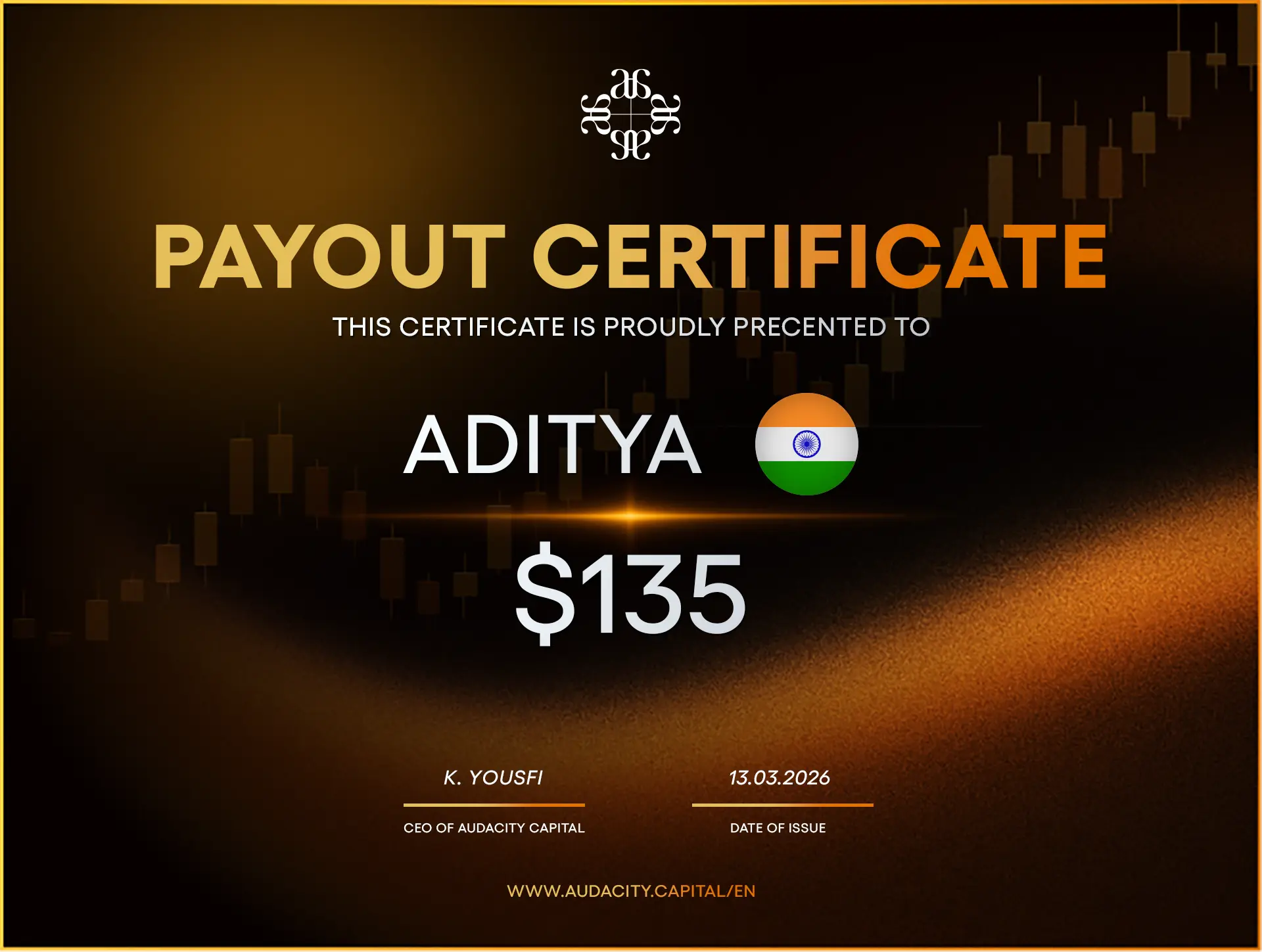
Certification
Choose Your Funded Account



Challenge
Related Success Stories

12 Years of Experience, Discipline & Progression with Audacity Capital
I had to do it the right way, and that meant focusing on consistency and controlling my emotions.


Brian’s Journey From Emotional Trading to Funded Success
Focus on one asset, master it, then diversify.

How Florida Turned 15 Years of Experience Into Scalable Results
Discipline and patience are the key to becoming a successful trader.