



What Is Forex Fundamental Analysis and How Can Traders Use It?


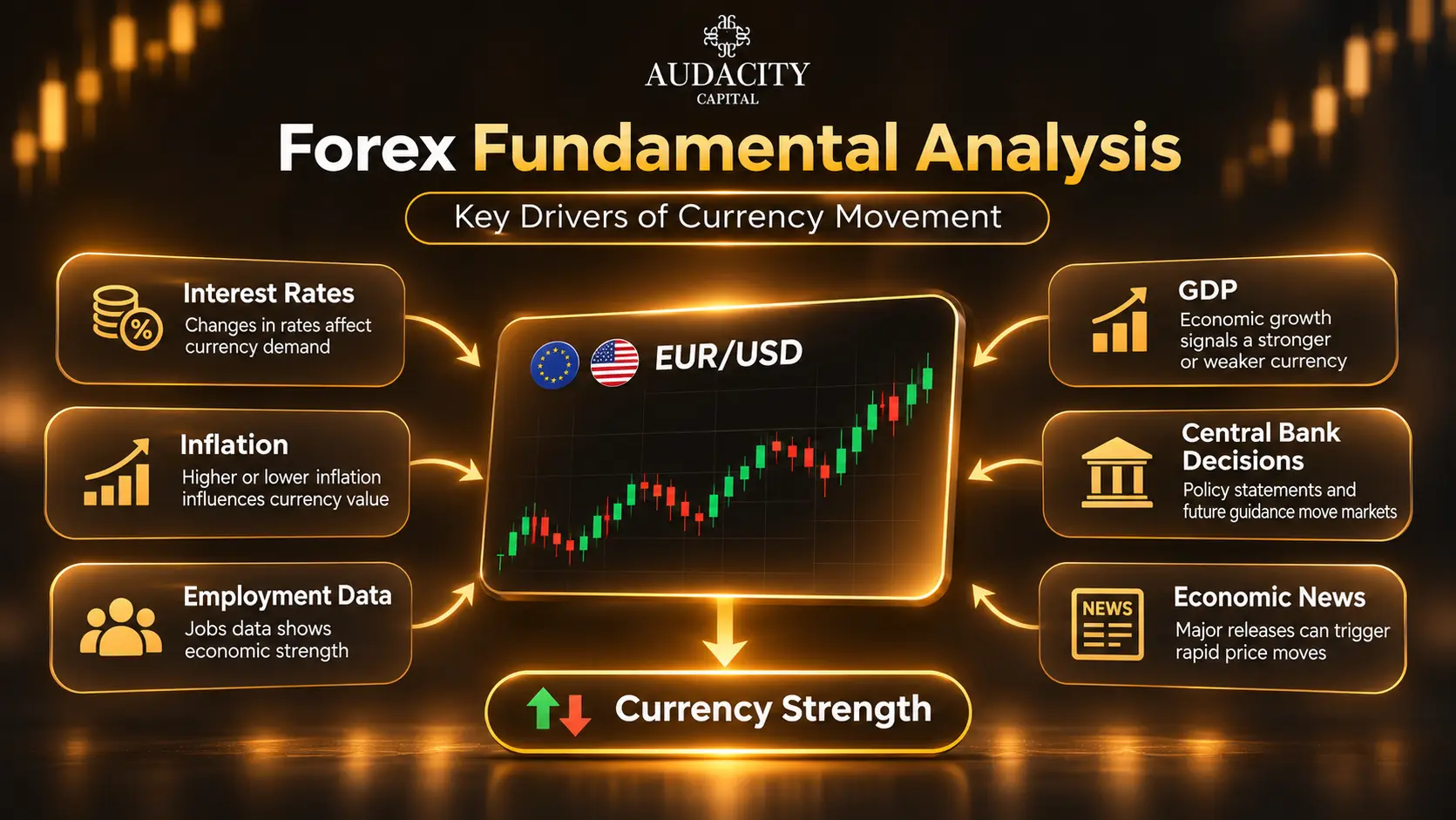
Forex fundamental analysis allows traders to find out why a currency can appreciate or depreciate when compared to another currency. It includes an analysis of economic factors, interest rates, inflation, employment, and central banking policies for evaluating the currency’s value.
A currency pair has two sides, so look at both economies, not just one. That’s the way to figure out which currency may gain or lose strength.
This guide covers the key economic factors that influence currency values and explains how traders use economic data and central bank decisions to assess market conditions and develop a viable market perspective.
What Is Fundamental Analysis in Forex and Why Is It Important?
Fundamental analysis in forex involves studying economic, monetary, political, and market factors which could affect the value of one currency in relation to another currency.
As opposed to beginning with a chart (like in technical analysis), fundamental analysis begins with the drivers of the chart. These drivers include the rate of growth in the economy, the pace of inflation, what the central bank will do next, and what the market expects at that point.
The main forex fundamentals fall into a few groups: economic growth, inflation, jobs, interest rates and central bank policy, fiscal and political events, and market expectations.
Why fundamental analysis matters
With fundamental analysis, you can get an idea of the economic factors behind the fluctuations of currencies.
The economic situation of a particular country may affect its assets' attractiveness to foreign investors. That is, when there is a prospect of improved growth rates or returns on investments, investors tend to purchase stocks, bonds, or any other assets in that particular country.
In order to purchase those securities, they will have to pay for them using the country's currency. As a result, the demand for the currency increases.
Fundamental analysis gives you three things:
- A reason behind the move. You can see the reason why one currency is appreciating against another, rather than simply following the price action.
- A way to compare economies. You can compare two economies and see what changes may occur in terms of expectations of central banks.
- Context for every release. You understand what is a market reaction to the news and what is a change in the fundamental picture.
The key concept that applies here: It's all relative
If you ask: “Is the US economy strong?”, then you only have half the answer. What you should actually be asking is: “Is the US economic outlook stronger or weaker compared to the other economy in this pair?”
Take EUR/USD. Strong US data on its own doesn’t tell you much. Strong US data, weak Eurozone data, and a Fed that’s more hawkish than the ECB? That tells you a lot.
So how do you build a relative view in practice? Start by choosing an approach.
Types of Fundamental Analysis
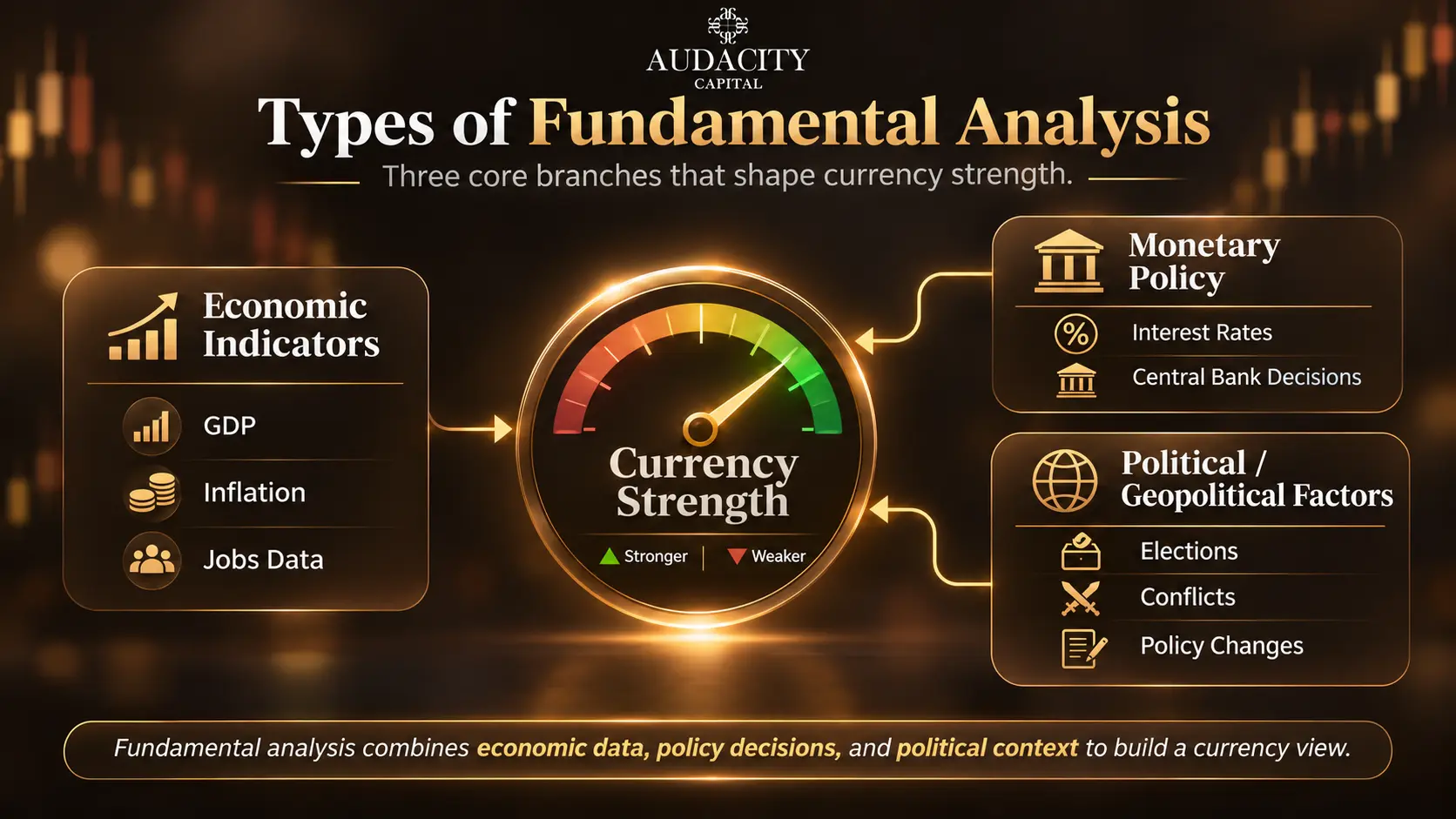
Two methods can be used to create a fundamental perspective, namely top-down and bottom-up. Neither one is superior to the other; they simply start from different points.
Top-Down Analysis
In this approach, you start with the broader picture and work your way down to one specific trade.
The first step is to examine the global context, such as economic growth, inflation, monetary policy and risk appetite. Next, you determine which currencies are strong and which are weak. Once you've done that, you can select the currency pairs.
For instance, you might realize that market participants are expecting the Fed to remain tighter for longer than the ECB. This implies that the US dollar may have an advantage over the euro, so you analyze EUR/USD as one way to act on that view.
Bottom-Up Analysis
You start with the pair you are going to trade and expand out from there.
First, choose the pair, then analyze the factors behind each currency, like interest rates, inflation, growth, and employment in each of them. The point of view is based on the specifics of the two economies, not on any global trend.
Example: You are trading EUR/USD, so you compare the Fed and ECB, then the US and Eurozone inflation, growth, and employment, and decide whose position looks better.
Which One Should You Use?
Most of the time, traders use both approaches. The first one shows you what is going on in the world, and the second one shows you what it means for your pair. If you are new to this, the bottom-up approach will be easier to grasp, since you have to deal with two economies only.
Key Fundamental Factors That Affect Forex

Before you compare two different economies, you need to understand how it should be done. The following is the list of most important factors for traders. Their weight differs depending on the market situation, but typically, interest rates and inflation have the priority.
Interest Rates and Central Banks
Interest rates are the price of borrowing funds, which are regulated by the Fed and ECB, among others. It is the biggest factor influencing currency values.
Higher interest rates in one country compared to another will lead to higher returns for investors from this country and their bonds denominated in this currency. To purchase them, investors should first buy this currency, hence, driving up demand.
But markets don’t just react to today’s rate. They react to where rates are expected to go. A central bank that sounds hawkish (leaning toward tighter policy) can lift its currency before it changes anything. One that sounds dovish (leaning toward easier policy) can weaken it.
What to watch: Rate decisions, minutes of meetings, speeches, and forward guidance. Also watch government bonds yields, as higher yields tend to attract foreign investors.
However, a rate increase does not necessarily lead to a stronger currency. If it was expected by the market participants, the reaction may be minimal.
Rates do not move on their own. The main driver of central banks' decisions is inflation, thus it is the next factor.
Inflation
Inflation shows the pace of price growth. The main indicator of inflation is the Consumer Price Index (CPI), which measures the costs of households.
There is also the Producer Price Index (PPI), which measures the cost producers receive and can indicate the possible change in consumer prices.
It is important for the currencies because it affects the central banks' decisions. The sequence is as follows: inflation → expected rate changes → currency.
If inflation stays high, a central bank may keep rates up or raise them, which can support the currency. If inflation cools, rate cuts become more likely.
What to watch: Is the inflation growing or declining? Is it above or below the target set by the central bank? Then compare both economies in your pair.
GDP and Economic Growth
The gross domestic product (GDP) refers to the total value of all goods and services that an economy generates. This statistic gives a picture of economic wellbeing.
The greater the growth of GDP, the larger the amount of foreign investments it receives, and hence the increased demand for the currency. The negative or low growth will have the reverse impact.
What to watch:The trend over several releases, not just one reading. GDP is published less frequently and is revised; thus it is used to put everything else in perspective, not as a trigger.
Employment Data
The employment reports give information about the job creation, levels of unemployment and wages growth. This set of indicators shows us the strength of the labor market.
The logic runs like this: more jobs and higher wages mean more spending, which can push inflation up, which affects what the central bank does. A tight labor market with rising wages can make rate cuts less likely and support the currency.
What to watch: Jobs creation, unemployment levels and especially wage growth, since wages feed directly into inflation.
PMI and Retail Sales
Purchasing Managers' Index (PMI) is a survey measure for business activities. On the other hand, retail sales measure consumer expenditures.
PMI and retail sales are published more frequently than the GDP, meaning they can serve as a gauge of economic activity earlier than the GDP. PMI is seen as an early indicator of business activities, while the retail sales measure reflects consumer demand.
What to watch: Whether the readings beat or miss forecasts, and whether the direction is improving or worsening over several months. For PMI, a reading above 50 generally signals expansion and below 50 signals contraction.
Trade Balance
The trade balance is the difference between what a country exports and what it imports.
A surplus suggests strong foreign demand for the country’s goods, and that often means demand for its currency too. A deficit can point the other way.
What to watch: Persistent trends rather than one month’s data. Treat it as a clue about currency demand, not a trigger on its own.
Politics and Risk Sentiment
Economic data isn’t the only thing that moves currencies. Elections, policy changes, and global tensions can shift expectations quickly, and they change how willing investors are to take risk.
When markets feel nervous, investors often move money into “safe haven” currencies like the US dollar, the Japanese yen, and the Swiss franc. When confidence returns, money tends to flow back toward riskier assets and currencies.
What to watch: Election outcomes, tax and budget decisions, geopolitical events, and overall market mood. Natural disasters can matter too, because they can damage infrastructure and slow an economy.
Commodities and Currencies
Some currencies are closely tied to what their countries sell to the world. The Canadian dollar (CAD) and the Norwegian krone (NOK) are the classic examples, because both countries rely heavily on oil exports.
When oil prices rise, these economies earn more, and their currencies often strengthen. When oil prices fall, the opposite can happen.
What to watch: Oil prices if you trade CAD or NOK pairs, and the relevant commodity if you trade another commodity-linked currency.
How to Use Fundamental Analysis in Forex
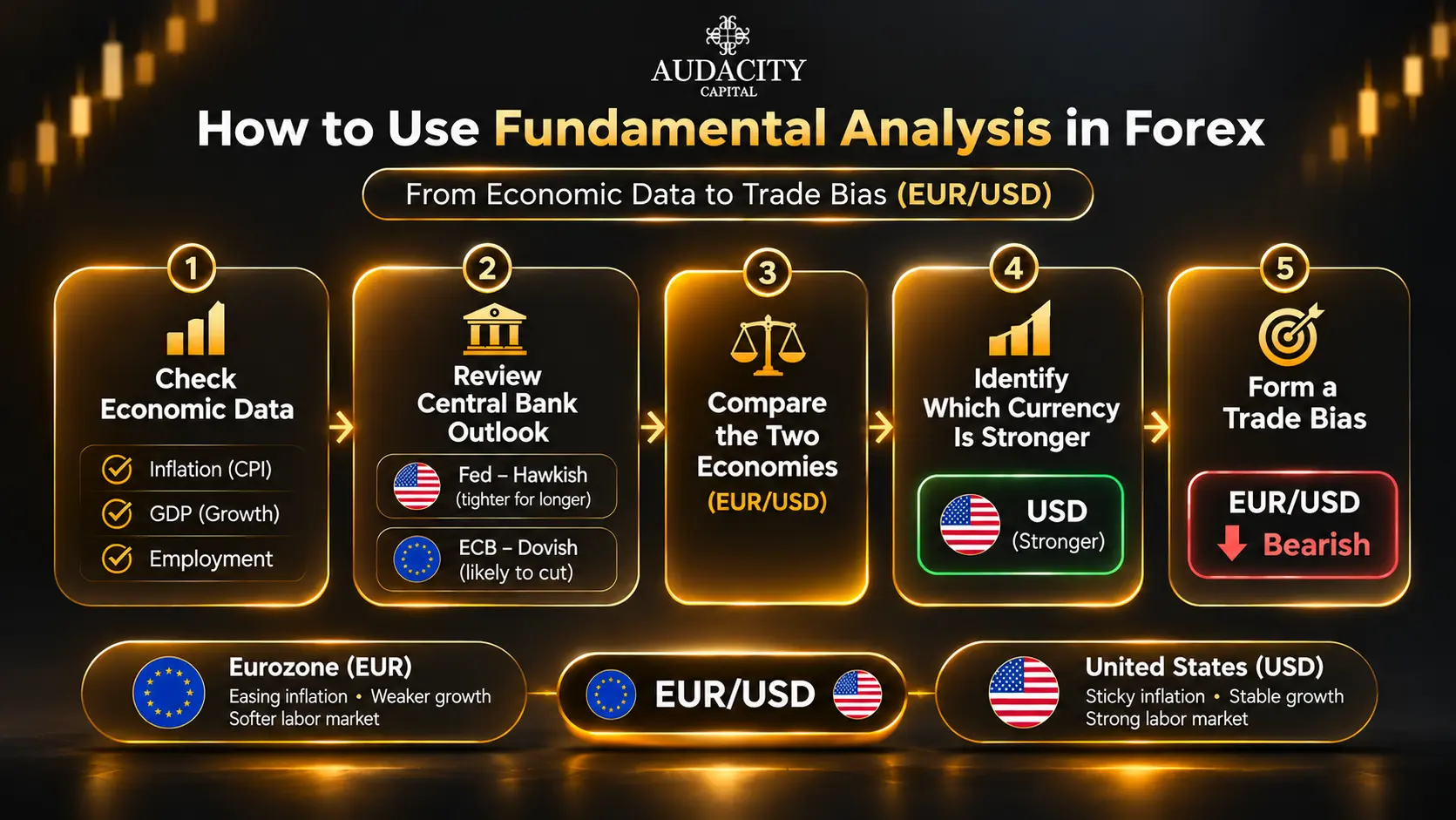
Now that you know what moves currencies, the next question is how to put those factors together. Here’s a simple routine you can use on any pair, from EUR/USD to USD/JPY.
The goal of forex trading fundamental analysis isn’t to predict the next move. It’s to build a clear, relative view: which economy looks stronger, which central bank looks tighter, and what the market already expects. Work through the steps in order, and you’ll end up with a view you can explain in a few sentences.
1. Pick your pair and name both economies
Every pair has two sides. For EUR/USD, you’re looking at the Eurozone and the US, not just one of them.
2. Compare the two central banks
Analyze the current interest rate, expected future rate, recent statements and whether the central bank is hawkish (leaning toward tighter policy) or dovish (leaning toward easier policy). Expected policy is often more important than the current one.
3. Compare inflation
Is inflation rising or falling in each economy? Is it above or below the central bank’s target? Then ask what that means for future rate decisions.
4. Compare growth and employment
Look at GDP, employment levels, unemployment figures, PMI and, if applicable, retail sales. These are among the key economic indicators that affect forex trading.
5. Check the economic calendar
Consult the economic calendar to spot the important news releases: CPI, employment statistics, GDP, PMI and central bank meetings. These are the moments most likely to change the story.
6. Compare actual, forecast and previous.
After each figure's release, there are usually three numbers. The previous one is the last official release; forecast is the number the economists were expecting, while actual is a number that appeared.
It is the difference between the actual and forecast numbers which drives the market and not just the numbers themselves.
Consider whether the surprising part has been factored in already. The markets tend to move ahead of the event – a widely expected interest rate hike is just ignored.
7. Form your view, and decide what would change it
Make up your mind: which economy is healthier, and which central bank is tighter? This is your relative opinion.
Before you proceed, jot down what will prove you wrong. It could be a hotter or cooler inflation number, or simply a shift in the tone of the central bank. Fundamental analysis is not something that you conduct only once and forget. You revisit it as new information arrives.
Let’s see how these seven steps look in practice.
Forex Fundamental Analysis Example
Let's take an example of EUR/USD.
Note: This example is a hypothetical case, and it is not based on any real-time analysis.
- Differences in FED and ECB policies. In this scenario, the expectation is that the Fed will have tighter policy for longer, whereas the ECB will ease earlier.
- US vs Eurozone inflation. Inflation in the US economy is sticky, while in the Eurozone, it is easing.
- Growth. The US economy is stable, whereas Eurozone growth remains unchanged.
- Employment. The US labor market remains strong, while hiring in the Eurozone is weak.
- Upcoming releases.There is US CPI and the next ECB meeting both coming out this month, which could alter the expectations.
- Difference between actual data and forecasts. The current US payroll numbers show positive surprises compared to forecasts.
- Relative view. If US data shows strength, the Eurozone economic fundamentals are weak, and the expectations for the Federal Reserve policy are hawkish compared to ECB, then such a situation would favor the USD to EUR.
How can we know what would change it? In case the US CPI numbers are lower than anticipated, there might be a move towards pricing in Fed rate cuts, which means dollar strength will be in question.
In case the ECB sounds more hawkish than was anticipated in the matter of rate cuts, the euro will improve.
This is one way to put it all together. This is a framework of developing an outlook not a forecast of events.

Audacity Capital's Instant Trading Program
Funded Trader ProgramFundamental Analysis vs Technical Analysis in Forex
Once you have a view, there’s one more question: when to act on it. That’s where technical analysis comes in. Fundamental analysis explains why the currency may increase or decrease. Technical analysis explains how price moves and where it might be going.
Fundamental | Technical | |
Looks at | Rates, inflation, growth, jobs | Price charts, trends, support and resistance |
Best for | Understanding direction | Timing entries and exits |
Driven by | Central banks, data, expectations | Price behavior |
You do not have to choose between the two. Traders can combine fundamental analysis and technical analysis to decide which way they lean, then use charts to time their entries and exits.
Common Mistakes When Using Fundamental Analysis
Even when you have mastered the indicators, there are several things that might make your analysis go awry.
1. Thinking good economic data will always push up the currency
Good numbers matter only if they exceed market expectations. For example, US non-farm payroll comes out at 150,000, which looks good. But if the analysts expected 200,000, the dollar could drop.
2. Ignoring the other side of the pair
A currency pair has two sides. For example, strong US data may not lift EUR/USD if Eurozone data is also improving, or if the ECB turns more hawkish. Always compare both economies before drawing a conclusion.
3. Reacting to just one indicator
One indicator doesn't give you the full picture. For example, weak retail sales do not necessarily signal that the economy is slowing down. See if the other data, such as job creation and PMI, confirm your conclusion.
4. Turning your opinion into a forecast
Fundamental analysis provides an informed opinion. For example, all the indicators may suggest that the dollar should strengthen against the euro, but something unexpected could still happen and make the pair move the other way. Always be prepared to be wrong and manage your risk.
Forex Fundamental Analysis Checklist
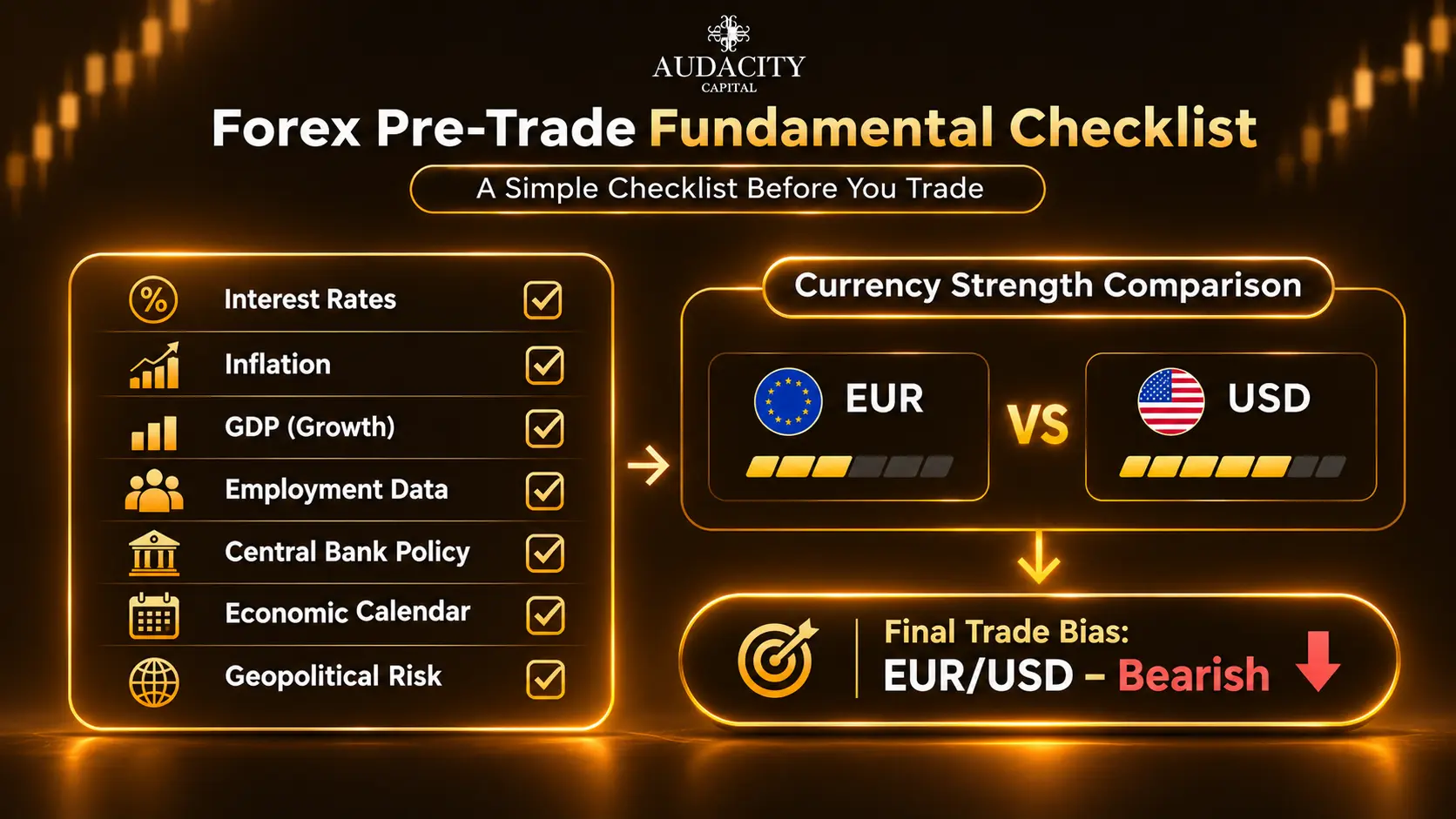
Before you come to any conclusions, ask yourself these questions:
- What two economies am I comparing? Name both sides of the pair, not just one.
- Where are both central banks headed? Look at the stance of each economy (hawkish or dovish) and where the interest rates are likely to go, not just where they are now.
- Is inflation increasing or decreasing in each economy? Find out if the inflation is above or below the target of the central bank.
- Which economy is more resilient in terms of GDP and job numbers? Consider GDP, unemployment, and PMI numbers.
- What’s going to happen in the coming days? Expectations about CPI numbers, job numbers, GDP numbers, and central bank meetings are important.
- How does the recent data stack up against expectations? The difference between expectation and reality is more important than the actual number.
- Are there any political or fiscal events happening? Changes in the policy, elections, and global sentiment may influence the demand for safe haven currencies.
- What would make me change my view? Decide in advance what surprise such as hotter inflation print or a shift in central bank tone will affect your opinion on the market?
Audacity Capital Empowering Traders Since 2012
Trade with Audacity CapitalConclusion
Forex fundamental analysis is helpful for traders to comprehend the underlying factors driving movements in foreign exchange.
By comparing interest rates, inflation, jobs data, and central bank decisions, you can work out which currency in a pair looks relatively stronger. Don’t judge a currency from one release, though. Look at the bigger picture of both economies.
However, no matter how good an analysis is, nothing can give a sure prediction about movements in the exchange rates, so for that a proper forex risk management is always crucial.
Forex Trading Strategies In Depth
- Best Forex strategy for consistent profits
- Trading Forex Without Leverage
- Forex Leverage Trading Strategies
- Forex Swing Trading Strategies
- Forex Crossover Moving Average Strategies
- Hedging Forex Trading Strategies
- Forex Scalping Trading Strategies
Frequently Asked Questions
What is fundamental analysis in forex?
It is the analysis of economic and monetary factors like interest rates, inflation, growth, and employment that will tell you why one currency becomes stronger and why another loses ground.
What is the difference between fundamental and technical analysis in forex?
Fundamental analysis examines economic and monetary issues whereas technical analysis focuses on price movement, charts, and market dynamics.
What are the types of fundamental analysis?
There are two main approaches: top-down, where you start with the global picture and narrow down to a pair, and bottom-up, where you start with the pair and study both economies. Many traders use both.
How do you use fundamental analysis in forex?
Compare both economies in your pair. Look at what each central bank is likely to do, how inflation and growth are trending, and what the job market looks like. Then check upcoming releases, compare actual results with forecasts, and ask what the market has already priced in. Finally, form a view and decide what would change it.
What are the most important forex fundamentals?
The list includes interest rates, inflation, economic growth, employment, policies of central banks, and market expectations.
Which economic indicators matter most in forex?
These include the CPI, GDP, employment figures, PMI, retail sales and trade balance. These factors vary in importance according to the currency and market circumstances.
Can fundamental analysis predict forex prices?
No. It helps you understand the economic forces behind currencies and form a view, but it cannot guarantee future price movements.

Ready to apply disciplined risk to crypto? Explore Audacity Capital's new crypto instruments and bring your trading strategy.
Learn MoreNewsletter
Join our newsletter to stay up to date on features and releases.
Join Our Social & Community

Start Your Journey Today With Our Free Trial
Proudly showcase your skills and accomplishments through certificates and get recognition for your hard work and dedication from potential investors and peers.
Free TrialRelated Articles
How To Use Technical Indicators To Trade Forex?
Learn how to use technical indicators to trade forex step-by-step. Discover how to combine RSI, MACD, moving averages, and Bollinger Bands to identify trends, entry points, and improve your trading strategy.


Is Crypto Less Risky?
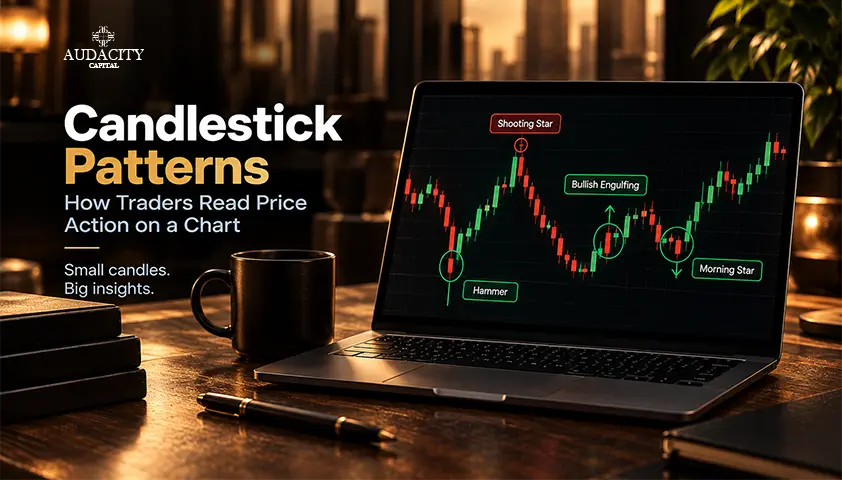
Candlestick Patterns: How Traders Read Price Action on a Chart
Learn to read price action with proven candlestick strategies and improve trading consistency now with Audacity

Best Forex Technical Analysis Books
Find the perfect book for technical analysis in currency trading. Learn from experts and gain a competitive edge in the forex market.